Beyond Terrestrial Limits: What New Satellite Constellations and Semiconductor Giants are Forging for the Space-Based Data Center Market
As terrestrial data centers face severe energy constraints, escalating grid bottlenecks, and multi-year utility wait times, the digital economy is looking upward. What was once considered science fiction has rapidly become a strategic infrastructure imperative: the space-based data center. Driven by explosive demand for AI training and edge processing, a new frontier is unfolding where orbital computing meets next-generation launch capabilities.
According to MarketsandMarkets™, the space-based data center market is estimated to grow from USD 0.11 billion in 2026 to USD 28.16 billion by 2040, expanding at a robust CAGR of 18.3% during the forecast period. This meteoric trajectory is underpinned by an unprecedented shift in satellite constellation scaling projected to surge from 56 deployed nodes in 2026 to over 14,332 satellites by 2040 alongside breakthroughs in space-hardened silicon.
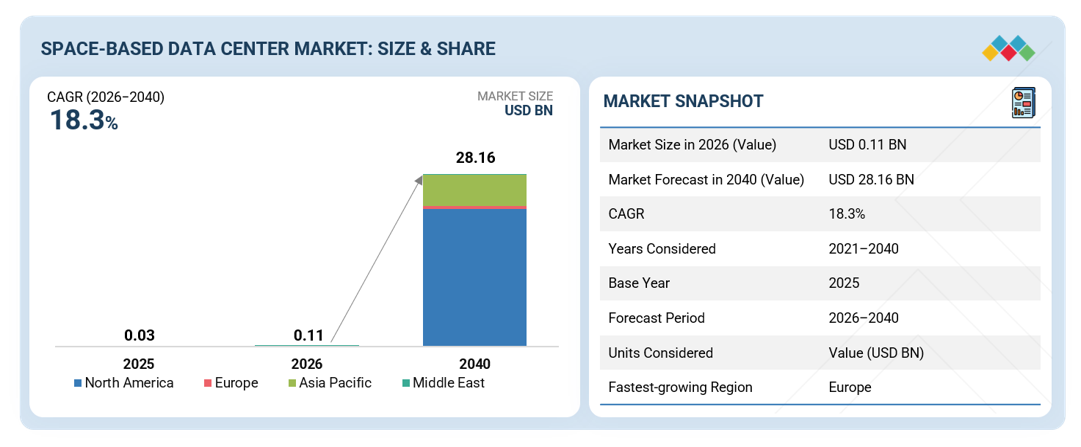
Constellation Expansion: Powering the Orbital Cloud
The architecture of the space-based data center ecosystem is anchored by ambitious new satellite constellations designed to bypass terrestrial bottlenecks. Traditional ground infrastructures are buckling under power demands, with major hyperscalers projected to pump hundreds of billions into data center CAPEX. In response, commercial pioneers are building scalable, high-capacity orbital networks.
- Starcloud’s Massive Fleet Architecture: Formerly known as Lumen Orbit, Starcloud has positioned itself at the forefront of the movement. Following explosive venture funding rounds and rapid scaling, the company has targeted massive constellation deployments (including plans scaled toward a massive fleet of tens of thousands of satellites) to establish the world’s first public cloud in space.
- SpaceX’s Vertical Integration: SpaceX has cemented its role as a titan in this domain. Alongside heavy-lift capabilities provided by Starship, SpaceX’s regulatory filings have outlined frameworks for monumental orbital data center constellations operating at altitudes between 500 and 2,000 kilometers. By integrating its satellite design with launch and network infrastructure, SpaceX is driving toward multi-gigawatt AI compute capacities directly in orbit.
- Advanced Mesh and Optical Interconnects: Beyond raw compute platforms, companies like Kepler Communications are deploying dedicated optical relay constellations (such as its LEO optical mesh networks launched in early 2026) that utilize multi-GPU modules and high-speed laser links. These networks enable dynamic, terabyte-scale data routing directly in space without requiring immediate, high-latency downlinks to Earth.
Key Structural Metrics of the Orbital Data Center Market
|
Market Dimension / Variable |
Projected Scope or Strategic Driver |
Status / Outlook |
|---|---|---|
|
Market Valuation (2026–2040) |
Expands from USD 0.11 billion (2026) to USD 28.16 billion (2040) |
18.3% CAGR trajectory |
|
Constellation Scaling |
Grows from 56 nodes (2026) to over 14,332 satellites (2040) |
Infrastructure ramp-up phase |
|
Primary Application Segment |
Data processing & analytics (highest current share); storage registering 18.3% CAGR |
Core commercial demand driver |
|
Power Capacity Segment |
High-power modules (≥1" MW") growing at 32.6% CAGR |
Transition to multi-megawatt nodes |
These metrics demonstrate why tracking orbital deployment timelines requires distinguishing between experimental single-satellite demonstrations, multi-node commercial networks, and full-scale industrial data computing clusters.
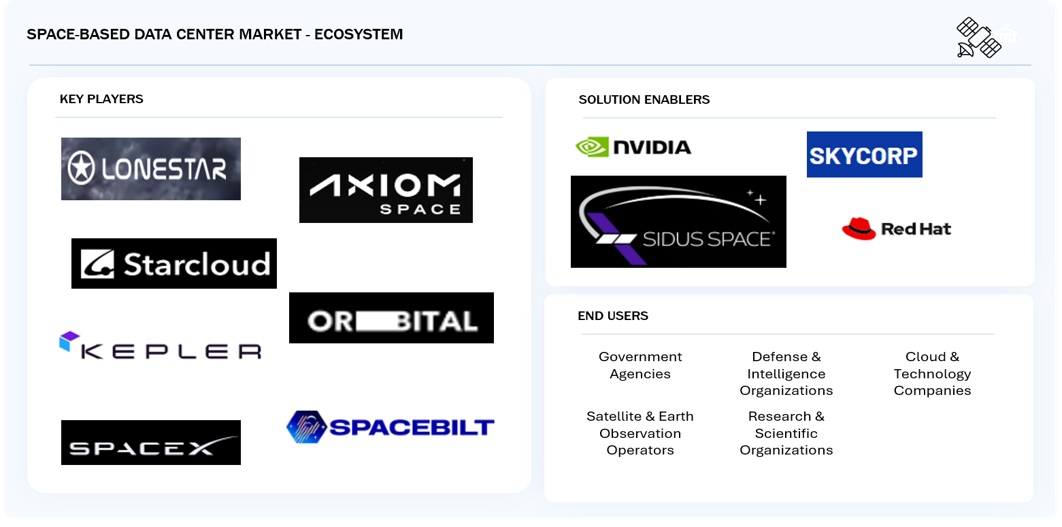
The Semiconductor Shift: Bringing High-Performance Compute to Orbit
For years, the primary barrier to orbital data centers was hardware compatibility, specifically, the extreme challenge of operating power-hungry, high-performance graphics processing units (GPUs) and accelerators in a high-radiation space environment. The latest developments have shattered this barrier, shifting the paradigm from exotic, hyper-expensive radiation-hardened silicon to shielded commercial hardware.
- NVIDIA’s Breakthrough Integration: NVIDIA has emerged as the definitive hardware backbone for the space compute revolution. In a historic milestone, Starcloud successfully placed an NVIDIA H100 GPU into orbit aboard its Starcloud-1 satellite, achieving the first-ever training of an AI model in space (running NanoGPT and querying models like Google’s Gemma).
- Commercial-Off-The-Shelf (COTS) Hardening: Major chipmakers are actively engineering solutions designed specifically for orbital workloads. NVIDIA’s rollouts, including dedicated space computing modules built on commercial TSMC nodes with architectural hardening (such as Error Correction Code and triple modular redundancy), have proven that standard commercial chips can survive LEO radiation profiles when properly shielded. This reduces the cost multiple drastically compared to legacy custom space silicon.
- Real-Time Edge Analytics: These semiconductor advancements allow satellites to process high-value data streams instantly. For instance, in-orbit GPUs are actively running high-powered inference on Synthetic Aperture Radar (SAR) imagery from providers like Capella Space, generating critical maritime and wildfire insights in real time rather than waiting for ground-station transmission.
Market Dynamics & The Path Forward
The structural shift toward space-based data centers is governed by clear market dynamics highlighted in market analysis:
- Payload and Application Growth: By application, the data processing & analytics segment commands the largest market share, driven by defense, Earth observation, and autonomous systems that require sub-second reaction times. Meanwhile, the data storage unit segment is projected to register the highest growth rate as orbit-based retention needs multiply.
- The Power Capacity Shift: High-power modules (≥1" MW") are anticipated to capture an explosive CAGR of 32.6% as operators transition from small demonstration cubesats to multi-megawatt industrial computing clusters.
- The Launch Cost Equation: The viability of this multi-billion-dollar market ultimately hinges on heavy-lift economics. As reusable vehicle systems like SpaceX’s Starship work to drive down per-kilogram launch costs, the economic tipping point for orbital infrastructure draws closer.
Conclusion
The convergence of overflowing terrestrial power grids, revolutionary advancements in space-hardened commercial semiconductors (led by NVIDIA), and massive satellite constellation blueprints (anchored by pioneers like SpaceX and Starcloud) has transformed space-based data centers from a theoretical concept into a high-stakes commercial reality. As the space-based data center market races toward its projected $28.16 billion valuation by 2040, the sky is no longer just a medium for communication it is the next great computing frontier.

This FREE sample includes market data points, ranging from trend analyses to market estimates & forecasts. See for yourself.
SEND ME A FREE SAMPLE