Suicide Drone Market: The Regional Procurement Signals Behind Global Expansion
A geographic assessment of contracts, frameworks and testing activity
The phrase suicide drone is prevalent in public reporting on disposable attack aircraft, but the operational and commercial categories underlying it are more specific. The clearest market signals are not headlines about battlefield use alone; they are signed orders, formal frameworks, military evaluations and domestic industrial arrangements. Comparing these signals country by country helps explain how emerging demand translates—or has not yet translated—into contracted procurement.
Market outlook at a glance
MarketsandMarkets estimates that the global loitering munitions market will expand from USD 5.36 billion in 2025 to USD 13.26 billion by 2030, representing a 19.9% compound annual growth rate. The published forecast covers multiple system types, ranges, endurance categories, warheads, navigation sensors, launch modes, end users, and regions. This total should not be presented as an independent revenue forecast for any single informal search term.
The vocabulary surrounding the sector requires care. “Kamikaze drone,” “suicide drone,” and “one-way attack drone” are frequently used as overlapping descriptions, but they do not create three additive markets. A loitering munition is usually defined by its ability to remain in flight while awaiting or developing an engagement opportunity; an ordinary one-way drone may follow a preplanned course without a comparable loitering capability. Recoverability is a separate design attribute. Market comparisons are meaningful only after these boundaries are held constant.
United States: from evaluation to repeat procurement
AeroVironment disclosed a USD 186 million delivery order for upgraded Switchblade systems in February 2026 under an existing Army contract vehicle. Separately, the U.S. Army reported in July 2026 that four vendors were undergoing risk-reduction tests at Yuma Proving Ground under the Low Altitude Stalking and Striking Ordnance initiative. An evaluation is not an order. The two examples nevertheless show distinct stages of a military acquisition pathway: established procurement alongside assessment of future systems.
Poland: a long-term quantity framework
In May 2025, WB Group announced that Poland’s Armament Agency signed a framework agreement associated with nearly 10,000 WARMATE munitions and almost 1,000 sets, with the overall arrangement extending toward 2035. This is a notable published quantity signal. However, framework scope cannot be treated as proof that all munitions have been ordered through implementing contracts, manufactured, or delivered. The announcement is most meaningful as evidence of intended program scale and procurement structure.
Germany: a market-development arrangement
Elbit Systems and Diehl Defence signed an agreement in June 2026 to jointly offer SkyStriker to the German armed forces and to support potential local industrial arrangements. The conditional wording matters: partnership and offer do not imply that the Bundeswehr has placed an order. Such developments help describe a competitive pipeline rather than a booked value. A country-based tracker benefits from separating these different status categories.
Verified purchases and recent developments
|
Market |
Date |
Disclosed scope |
Status |
Evidence |
|
United States |
Feb 2026 |
USD 186m order |
Firm delivery order |
US Switchblade order |
|
Poland |
May 2025 |
~10,000 munitions |
Framework, implementation pending |
Poland WARMATE framework |
|
Germany |
Jun 2026 |
Value not disclosed |
Conditional industrial partnership |
Elbit–Diehl partnership |
|
United States |
Jul 2026 |
Four vendors |
Testing, not purchase |
US Army LASSO tests |
Note: Contract ceilings, frameworks, R&D budgets, partnerships and tests are not counted as firm delivery orders.
Asia Pacific and other regional considerations
National priorities vary across Asia Pacific. India, for example, is covered by a dedicated MarketsandMarkets geographic market analysis, while other countries may concentrate on indigenous development, imports or defense industrial partnerships. Cross-border comparison requires consistent treatment of program stage, local content requirements, end-user organization, and the number of systems genuinely covered by a signed order. Broad regional statements cannot substitute for validated country data.
Why geography alone is not enough
Procurement opportunity is affected by the integration environment and by the class of equipment involved. A portable loitering weapon evaluated for an infantry formation should not be directly compared with a much larger long-range strike aircraft. Launch method, expected endurance, payload class, navigation design and sustainment concepts shape how acquisition programs are structured. The defense budget headline may also include launch vehicles, training, support or unrelated unmanned technologies.
Interpreting country-level demand
The term “suicide drone” is often encountered in national security reporting, but market data should distinguish self-destructing strike systems from reusable intelligence aircraft and from general-purpose unmanned platforms. The same procurement record can describe an air vehicle, a full launch package or a broader set of unmanned capabilities. Regional comparisons become defensible only when those differences are retained. The U.S. and Polish examples illustrate funded repeat orders and planned framework quantities, respectively; neither should be translated automatically into national market share.
The role of reporting consistency in regional forecasts
Published estimates often use a wide vocabulary, including one-way attack systems, kamikaze drones and suicide drones, even when national procurement documents use narrower official designations. This creates risks for regional comparisons. An order for a complete launcher-and-munition package should not be measured on the same unit basis as a disclosure covering individual rounds. Similarly, announced multiyear quantities may be distributed unevenly across their implementation period. Comparisons of Europe, North America and Asia Pacific must control for procurement accounting, import content, domestic program spending and reporting lag. Local industrial partnerships may also alter the geography of revenue without changing the final military user. These practical limitations help explain why a national contract database and a global forecast do not always show identical totals. Transparent scope boundaries are particularly important as more countries experiment with multiple types of unmanned strike capability.
Visual market indicators
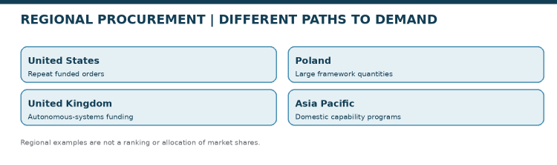
Infographic 1. Published procurement and market interpretation
.
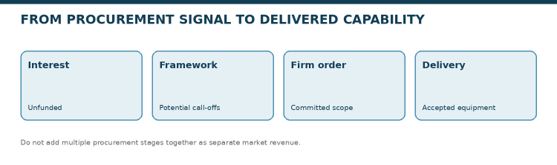
Infographic 2. Qualitative comparison of system or contract characteristics.
The 2030 geographic outlook
The global market is projected to grow substantially through 2030, but the pace of procurement will differ. The strongest evidence is a combination of purchase orders and deliveries, followed by frameworks with clear implementing mechanisms. Trials and partnerships indicate potential future demand but remain less mature signals. This hierarchy reduces the likelihood of overstating regional spending or assuming every announced program will reach production.
Conclusion
The growth of the global loitering munitions market reflects a progression from technical demonstrations to funded programs and increasingly differentiated product families. The category described by this article should be interpreted as part of the wider loitering munitions market, not an additional market layered on top of it. Transparent contract classifications, consistent equipment definitions, and a common approach to regional and technical segmentation remain essential for interpreting developments through 2030.

This FREE sample includes market data points, ranging from trend analyses to market estimates & forecasts. See for yourself.
SEND ME A FREE SAMPLE