Sustainable Aviation Fuel (SAF) Outlook 2035
- HOME
- Aerospace and Defence
- Sustainable Aviation Fuel Market 2035: How AI, Advanced Refining, and Carbon Capture Are Accelerating Growth
Sustainable Aviation Fuel Market 2035: How AI, Advanced Refining, and Carbon Capture Are Accelerating Growth
The Sustainable Aviation Fuel (SAF) market is entering a period of unprecedented expansion as the aviation industry intensifies efforts to reduce carbon emissions and achieve long-term sustainability goals. With governments implementing stricter environmental regulations and airlines committing to net-zero targets, demand for low-carbon aviation fuels is growing rapidly. While policy support and airline investments remain key drivers, technological innovation is becoming equally important in determining the pace and scale of SAF adoption.
Artificial intelligence (AI), advanced refining technologies, and carbon capture systems are emerging as critical enablers of the next generation of sustainable aviation fuel production. Together, these innovations are improving production efficiency, lowering costs, enhancing feedstock utilization, and creating new pathways for scalable low-carbon fuel manufacturing. As the industry moves toward 2035, these technologies are expected to play a central role in accelerating SAF market growth and supporting the broader decarbonization of global aviation.
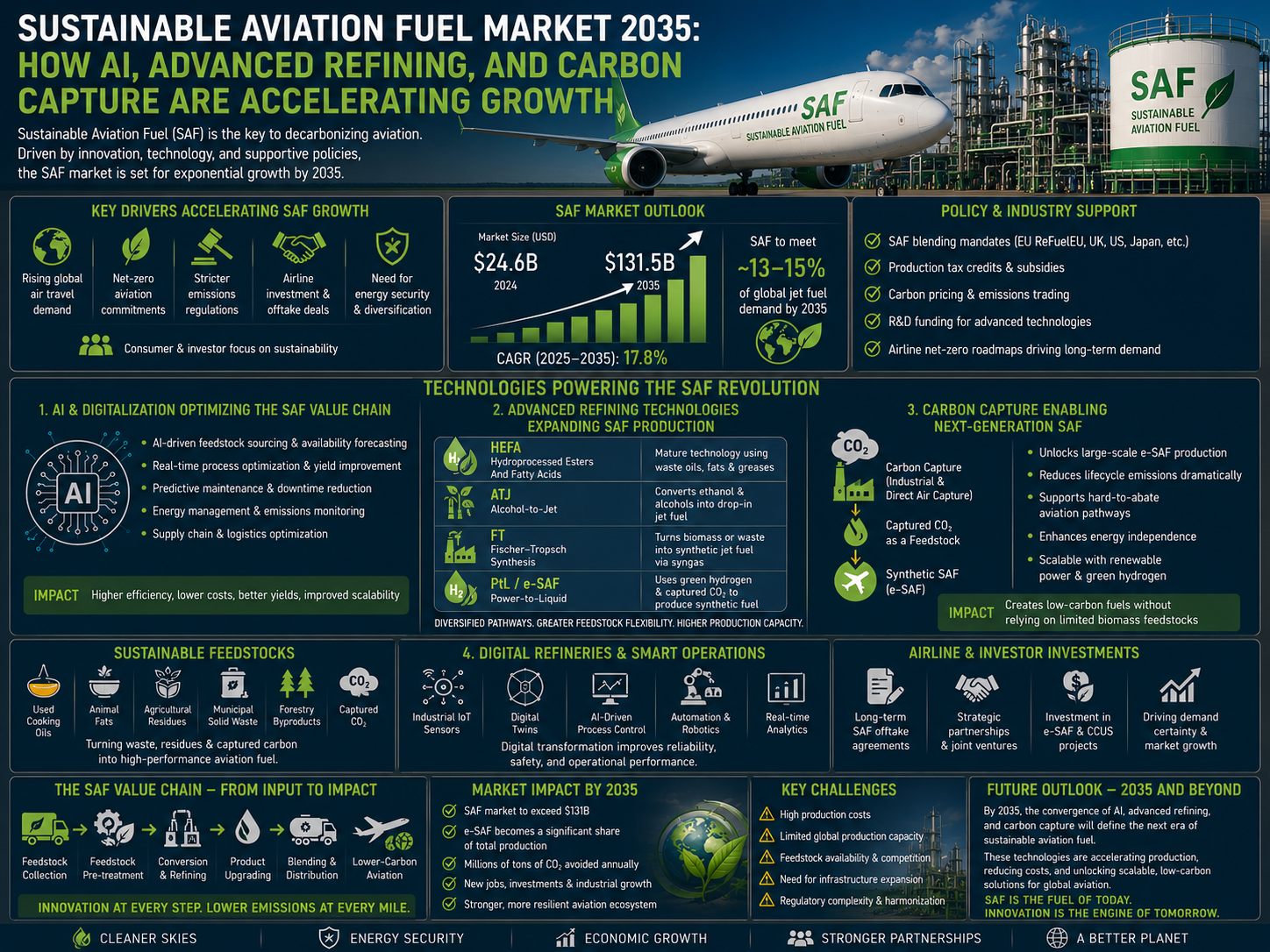
Growing Aviation Emissions Driving Demand for Sustainable Fuels
The aviation sector faces increasing pressure to reduce greenhouse gas emissions while continuing to support global economic growth and passenger mobility.
Key industry challenges include:
- Rising global air travel demand
- Increasing carbon reduction requirements
- Net-zero aviation commitments
- Fuel supply diversification needs
- Regulatory compliance obligations
- Growing investor focus on sustainability
Because conventional jet fuel remains a major source of aviation emissions, sustainable aviation fuels are becoming a critical component of industry decarbonization strategies.
Unlike future aircraft technologies that may require decades to achieve widespread deployment, SAF offers a near-term solution that can be integrated into existing aircraft fleets and fueling infrastructure.
Artificial Intelligence Transforming SAF Production
Artificial intelligence is rapidly becoming a valuable tool across the sustainable fuel value chain.
AI-powered systems help optimize:
- Feedstock sourcing
- Refinery operations
- Production scheduling
- Energy management
- Supply chain logistics
- Quality control processes
Machine learning algorithms can analyze large volumes of operational data to identify efficiencies, predict equipment performance, and improve production yields.
AI enables producers to:
- Reduce waste
- Lower operating costs
- Improve fuel conversion efficiency
- Optimize resource utilization
- Enhance production scalability
As SAF facilities become increasingly digitalized, AI-driven optimization is expected to play a major role in improving commercial competitiveness.
Predictive Analytics Enhancing Feedstock Management
Feedstock availability remains one of the most important factors influencing SAF production economics.
Sustainable aviation fuels can be produced from various feedstocks, including:
- Used cooking oils
- Animal fats
- Agricultural residues
- Municipal solid waste
- Forestry byproducts
- Captured carbon dioxide
AI-enabled predictive analytics helps producers forecast feedstock availability, evaluate sourcing risks, and optimize procurement strategies.
By improving visibility across supply chains, predictive systems support more efficient production planning and reduce disruptions caused by feedstock shortages.
This capability is becoming increasingly important as global SAF demand continues to grow.
Advanced Refining Technologies Expanding Production Capacity
Refining innovation is significantly improving the efficiency and scalability of sustainable aviation fuel production.
Several advanced pathways are gaining momentum:
Hydroprocessed Esters and Fatty Acids (HEFA)
Currently the most commercially mature SAF production pathway, converting waste oils and fats into aviation fuel.
Alcohol-to-Jet (ATJ)
Transforms ethanol and other alcohols into drop-in aviation fuels suitable for commercial aircraft.
Fischer-Tropsch Synthesis
Converts biomass and waste-derived syngas into synthetic jet fuel.
Power-to-Liquid (PtL)
Produces synthetic aviation fuel using renewable electricity, green hydrogen, and captured carbon dioxide.
These advanced refining technologies are helping diversify feedstock sources while supporting larger production volumes.
As technological maturity improves, production costs are expected to decline, accelerating market adoption.
Carbon Capture Unlocking Next-Generation SAF Pathways
Carbon capture technology is becoming increasingly important for the future of sustainable aviation fuel.
Captured carbon dioxide can be utilized as a feedstock for synthetic fuel production, creating new opportunities for low-carbon aviation fuels.
Key carbon capture approaches include:
- Industrial point-source capture
- Direct air capture (DAC)
- Carbon utilization systems
- Integrated carbon management solutions
When combined with renewable energy and green hydrogen, captured carbon can be converted into synthetic aviation fuels through Power-to-Liquid processes.
This approach offers several advantages:
- Reduced lifecycle emissions
- Greater feedstock flexibility
- Improved scalability
- Reduced dependence on biomass resources
Carbon capture is expected to become a major growth driver for e-SAF production through 2035.
e-SAF Emerging as a High-Growth Segment
Electro-Sustainable Aviation Fuel (e-SAF) is increasingly viewed as one of the most promising long-term solutions for aviation decarbonization.
e-SAF production relies on:
- Renewable electricity
- Green hydrogen
- Captured carbon dioxide
- Advanced synthetic fuel synthesis technologies
Unlike conventional bio-based SAF, e-SAF offers the potential for large-scale production without relying heavily on agricultural or waste feedstocks.
As renewable energy costs continue to decline and carbon capture technologies mature, e-SAF is expected to become an increasingly important component of global aviation fuel supply.
Many industry analysts view e-SAF as a critical technology for achieving deep aviation emissions reductions beyond 2030.
Digitalization Improving Refinery Efficiency
The integration of digital technologies is transforming SAF production facilities.
Modern digital refinery solutions include:
- Industrial IoT sensors
- Digital twins
- AI-driven process controls
- Automated maintenance systems
- Real-time performance monitoring
These technologies allow producers to continuously optimize operations and maximize fuel output while minimizing energy consumption.
Digitalization also supports predictive maintenance, helping reduce downtime and improve asset utilization across refining operations.
As SAF production scales globally, digital infrastructure will become increasingly important for maintaining operational efficiency.
Government Policies Supporting Technology Deployment
Public policy remains a major catalyst for SAF market growth.
Governments worldwide are supporting the deployment of advanced fuel technologies through:
- SAF blending mandates
- Production tax credits
- Carbon reduction incentives
- Research and development funding
- Renewable energy investments
- Infrastructure development programs
These initiatives help reduce financial risk while encouraging investment in innovative SAF production pathways.
Policy support is expected to remain essential for accelerating commercialization of AI-enabled refining systems and carbon capture-integrated fuel production.
Expanding Airline Investments Creating Market Momentum
Airlines are increasingly investing in SAF supply chains through long-term procurement agreements and strategic partnerships.
Investment priorities include:
- SAF production facilities
- e-SAF projects
- Carbon capture initiatives
- Green hydrogen infrastructure
- Sustainable fuel research programs
These commitments provide demand certainty that supports continued technological innovation and production expansion.
As sustainability becomes a core business objective, airline investments are helping drive market growth throughout the aviation ecosystem.
Challenges Facing the SAF Industry
Despite strong growth prospects, several challenges remain.
High Production Costs
SAF continues to cost more than conventional jet fuel.
Limited Production Capacity
Global supply remains significantly below projected future demand.
Feedstock Availability
Certain production pathways face long-term feedstock constraints.
Infrastructure Requirements
Scaling advanced production technologies requires substantial investment.
Regulatory Complexity
Global policy harmonization remains an ongoing challenge.
Addressing these issues will be essential for achieving large-scale SAF deployment by 2035.
Future Outlook
The Sustainable Aviation Fuel (SAF) Market is expected to experience substantial growth through 2035 as technological innovation continues to improve production efficiency and scalability. AI-driven optimization, advanced refining processes, and carbon capture integration are creating new opportunities to reduce costs, expand supply, and accelerate aviation decarbonization.
Several trends are expected to shape the next phase of market development:
- AI-powered fuel production optimization
- Expansion of e-SAF manufacturing
- Large-scale carbon capture deployment
- Growth in Power-to-Liquid fuel technologies
- Digital refinery transformation
- Increased green hydrogen integration
- Advanced feedstock diversification strategies
As aviation stakeholders continue investing in cleaner energy solutions, the combination of artificial intelligence, advanced refining technologies, and carbon capture systems will play a decisive role in shaping the future of the Sustainable Aviation Fuel market. These innovations are not only accelerating industry growth but also laying the foundation for a more resilient, efficient, and low-carbon aviation ecosystem through 2035 and beyond.

This FREE sample includes market data points, ranging from trend analyses to market estimates & forecasts. See for yourself.
SEND ME A FREE SAMPLE






