Sustainable Aviation Fuel (Biofuel) Market Size, Share & Trends

Why Airlines Are Signing Billion-Dollar Sustainable Aviation Fuel Agreements Ahead of Global Mandates

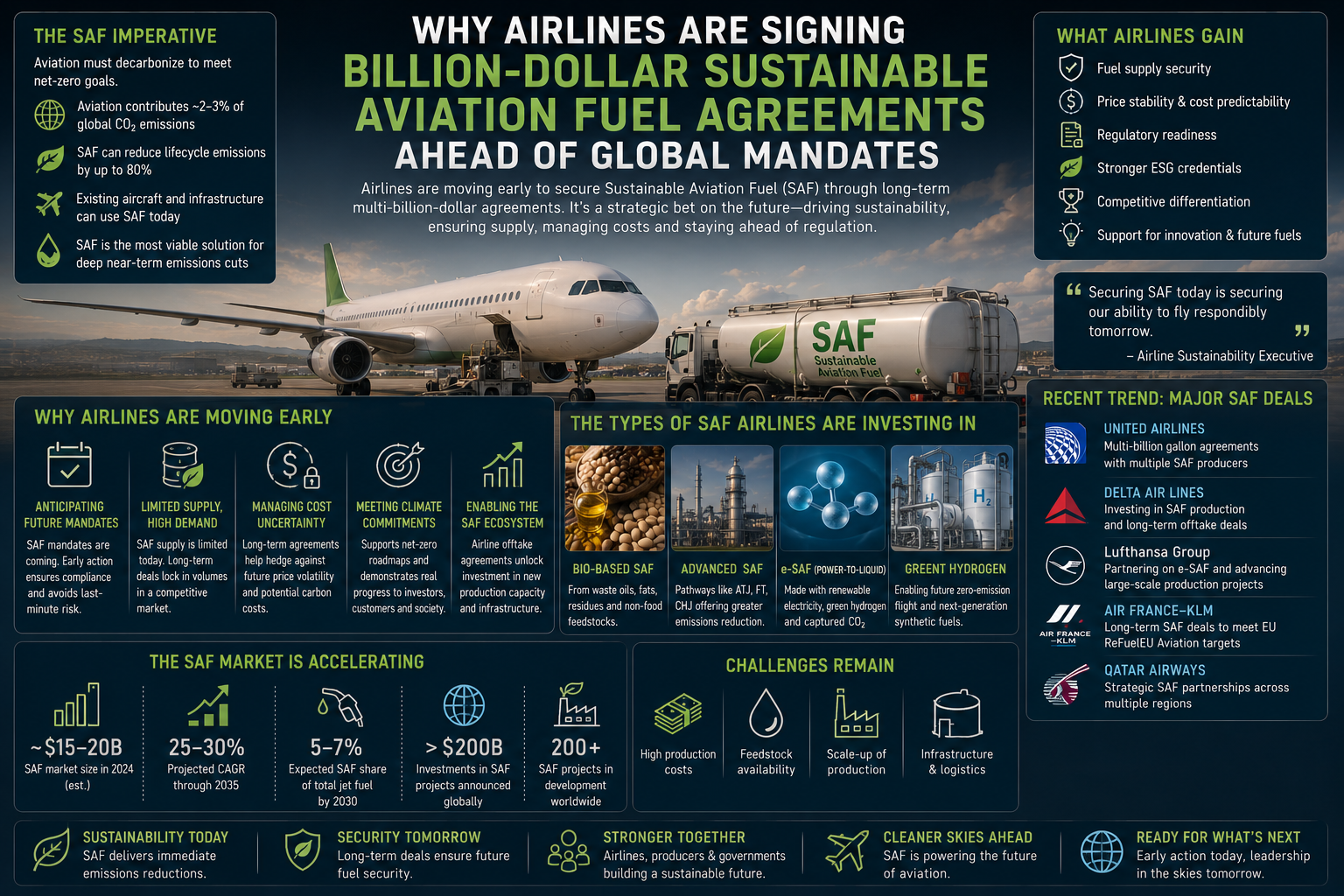
The aviation industry is witnessing an unprecedented surge in long-term Sustainable Aviation Fuel (SAF) procurement agreements as airlines race to secure future fuel supplies ahead of increasingly stringent environmental regulations. Across North America, Europe, Asia-Pacific, and the Middle East, major carriers are committing billions of dollars through multi-year SAF offtake agreements, production partnerships, and strategic investments designed to support decarbonization goals and ensure compliance with upcoming sustainability mandates.

These agreements represent far more than environmental commitments. They reflect a fundamental shift in aviation fuel procurement strategies as airlines seek to secure limited SAF supplies, manage future regulatory risks, and position themselves competitively in an increasingly carbon-conscious market. As governments implement blending mandates and emissions reduction targets, SAF is rapidly becoming a strategic asset within the global aviation ecosystem. The global sustainable aviation fuel (biofuel) market size was valued at USD 4.86 billion in 2026 and is projected to reach USD 31.45 billion by 2031 growing at a CAGR of 45.3% from 2026 to 2031.

Sustainable Aviation Fuel (Biofuel)

Global Aviation Decarbonization Driving SAF Demand

The aviation sector contributes approximately 2–3% of global carbon dioxide emissions and faces mounting pressure to reduce its environmental impact. While advancements in aircraft efficiency continue to improve fuel consumption, Sustainable Aviation Fuel remains the most viable near-term solution for reducing lifecycle emissions from existing aircraft fleets.

Several factors are accelerating SAF demand worldwide:

  • Net-zero aviation commitments
  • Carbon reduction regulations
  • SAF blending mandates
  • Investor ESG requirements
  • Corporate sustainability goals
  • Consumer demand for greener travel

As a result, airlines are increasingly treating SAF procurement as a long-term strategic priority rather than a voluntary sustainability initiative.

Download Brochure Analyst-Verified Insights @ https://www.marketsandmarkets.com/pdfdownloadNew.asp?id=70301163

Anticipating Future Regulatory Mandates

One of the primary reasons airlines are signing billion-dollar SAF agreements is the growing certainty of future regulatory requirements.

Governments and regulatory bodies are implementing policies that require increasing levels of sustainable fuel usage over the coming decades.

Emerging regulations include:

  • Mandatory SAF blending requirements
  • Carbon pricing mechanisms
  • Emissions trading systems
  • Net-zero aviation targets
  • Sustainable transport directives

These policies are expected to significantly increase future demand for SAF while placing pressure on airlines that fail to secure adequate fuel supplies early.

Long-term agreements allow carriers to prepare for regulatory compliance well before mandates reach peak implementation levels.

Limited SAF Supply Creating Early-Mover Advantages

Despite growing demand, SAF production remains relatively limited compared to conventional jet fuel consumption.

Current challenges include:

  • Insufficient production capacity
  • Feedstock availability constraints
  • Infrastructure limitations
  • High production costs
  • Lengthy project development timelines

Industry analysts anticipate that SAF demand could exceed available supply for much of the next decade.

By securing long-term contracts today, airlines gain preferential access to future production volumes while reducing exposure to supply shortages and price volatility.

This first-mover advantage is becoming a key competitive differentiator in the aviation industry.

Protecting Against Future Fuel Price Volatility

Fuel expenses typically represent one of the largest operating costs for airlines.

As SAF demand grows and regulatory mandates expand, significant price fluctuations could occur due to supply-demand imbalances.

Long-term procurement agreements provide several benefits:

  • Greater pricing predictability
  • Improved budget planning
  • Reduced market uncertainty
  • Enhanced fuel supply security
  • Better long-term financial forecasting

Many airlines view these agreements as a hedge against future fuel market disruptions and carbon-related cost increases.

Strengthening Corporate Sustainability Commitments

Sustainability has become a major strategic focus across the aviation sector.

Airlines are facing growing expectations from:

  • Investors
  • Corporate customers
  • Governments
  • Consumers
  • Environmental organizations

Large-scale SAF agreements demonstrate tangible progress toward sustainability objectives and support broader Environmental, Social, and Governance (ESG) initiatives.

For many carriers, these agreements have become central components of long-term corporate responsibility strategies.

Supporting Net-Zero Emissions Roadmaps

Most major airlines have established ambitious carbon reduction targets extending through 2050.

SAF is expected to account for the majority of aviation's emissions reductions during this period.

Industry roadmaps increasingly rely on SAF to deliver:

  • Lifecycle carbon reductions
  • Compliance with climate targets
  • Sustainable fleet operations
  • Reduced dependence on fossil fuels

Securing long-term fuel supplies today enables airlines to align future operations with increasingly ambitious sustainability commitments.

Encouraging Investment in SAF Production Capacity

Airline commitments play a critical role in expanding global SAF production infrastructure.

Fuel producers require long-term demand certainty before investing billions of dollars in new production facilities.

Multi-year airline agreements provide:

  • Revenue visibility
  • Project financing support
  • Reduced investment risk
  • Faster commercialization timelines

These agreements are helping accelerate the development of:

  • HEFA production plants
  • Alcohol-to-Jet facilities
  • Fischer-Tropsch fuel projects
  • e-SAF manufacturing facilities
  • Green hydrogen production systems

As a result, airlines are actively shaping the future SAF supply ecosystem.

e-SAF and Synthetic Fuels Attracting Growing Interest

Beyond conventional bio-based SAF, airlines are increasingly investing in future fuel technologies.

Electro-Sustainable Aviation Fuel (e-SAF) is attracting attention because it uses:

  • Renewable electricity
  • Green hydrogen
  • Captured carbon dioxide
  • Synthetic fuel production technologies

Unlike traditional biofuels, e-SAF offers long-term scalability without depending heavily on biological feedstocks.

Many airlines view e-SAF agreements as strategic investments in the future of aviation decarbonization.

As production technologies mature, synthetic fuels are expected to become an increasingly important component of airline fuel portfolios.

Green Hydrogen Creating New Aviation Opportunities

Green hydrogen is also influencing airline fuel strategies.

Produced using renewable energy, green hydrogen can support:

  • Hydrogen-powered aircraft
  • Fuel-cell propulsion systems
  • Synthetic aviation fuel production
  • Airport energy infrastructure

Although widespread hydrogen aviation deployment remains a long-term objective, airlines are beginning to establish partnerships that position them for future adoption.

These investments reflect growing confidence that hydrogen will play a significant role in aviation's long-term sustainability transition.

Competitive Differentiation in Sustainable Air Travel

Sustainability is becoming a competitive advantage within the airline industry.

Business travelers, multinational corporations, and environmentally conscious consumers increasingly consider sustainability performance when selecting travel providers.

Airlines with strong SAF programs can offer:

  • Lower-carbon travel options
  • Sustainable corporate travel partnerships
  • Enhanced ESG reporting
  • Stronger environmental branding

As sustainability becomes a larger factor in purchasing decisions, SAF investments may provide measurable commercial benefits beyond regulatory compliance.

Challenges Facing SAF Adoption

Despite growing momentum, several obstacles remain.

High Fuel Costs

SAF remains substantially more expensive than conventional jet fuel.

Limited Production Capacity

Current output remains insufficient to meet projected demand.

Feedstock Constraints

Bio-based production pathways face long-term resource limitations.

Infrastructure Requirements

Fuel production, transportation, and storage infrastructure require significant expansion.

Regulatory Uncertainty

Long-term investment decisions depend on stable policy environments and consistent government support.

Addressing these challenges will be critical for sustaining SAF market growth through 2035.

Discover Growth Opportunities & Trends @ https://www.marketsandmarkets.com/Market-Reports/sustainable-aviation-fuel-market-70301163.html

Future Outlook

The growing wave of billion-dollar Sustainable Aviation Fuel agreements highlights how airlines are proactively preparing for the next phase of aviation decarbonization. Rather than waiting for regulatory mandates to take full effect, carriers are securing future fuel supplies, supporting production expansion, and positioning themselves for a lower-carbon aviation future.

Several trends are expected to shape the market over the coming decade:

  • Expansion of long-term SAF offtake agreements
  • Large-scale e-SAF commercialization
  • Increased green hydrogen integration
  • Growth in synthetic aviation fuel production
  • Rising SAF blending mandates
  • Expanded public-private partnerships
  • Greater investment in aviation decarbonization infrastructure

As global sustainability requirements become more stringent and aviation emissions reduction targets intensify, Sustainable Aviation Fuel will remain at the center of industry transformation. Airlines that secure supply early, invest in emerging fuel technologies, and build strategic partnerships across the value chain will be best positioned to navigate the transition toward a cleaner, more resilient, and low-carbon aviation ecosystem.


Sustainable Aviation Fuel Market Size,  Share & Growth Report
Report Code
AS 7756
RI Published ON
6/16/2026
Choose License Type
BUY NOW
ADJACENT MARKETS
REQUEST BUNDLE REPORTS
X
GET A FREE SAMPLE

This FREE sample includes market data points, ranging from trend analyses to market estimates & forecasts. See for yourself.

SEND ME A FREE SAMPLE

  • Call Us
  • +1-888-600-6441 (Corporate office hours)
  • +1-888-600-6441 (US/Can toll free)
  • +44-800-368-9399 (UK office hours)
CONNECT WITH US
ABOUT TRUST ONLINE
©2026 MarketsandMarkets Research Private Ltd. All rights reserved
DMCA.com Protection Status
Get Free Sample Pages

Get Free Sample Pages of the Report

Request Now



