Global Space Industry is Undergoing a Transformation That Would Have Seemed Unimaginable
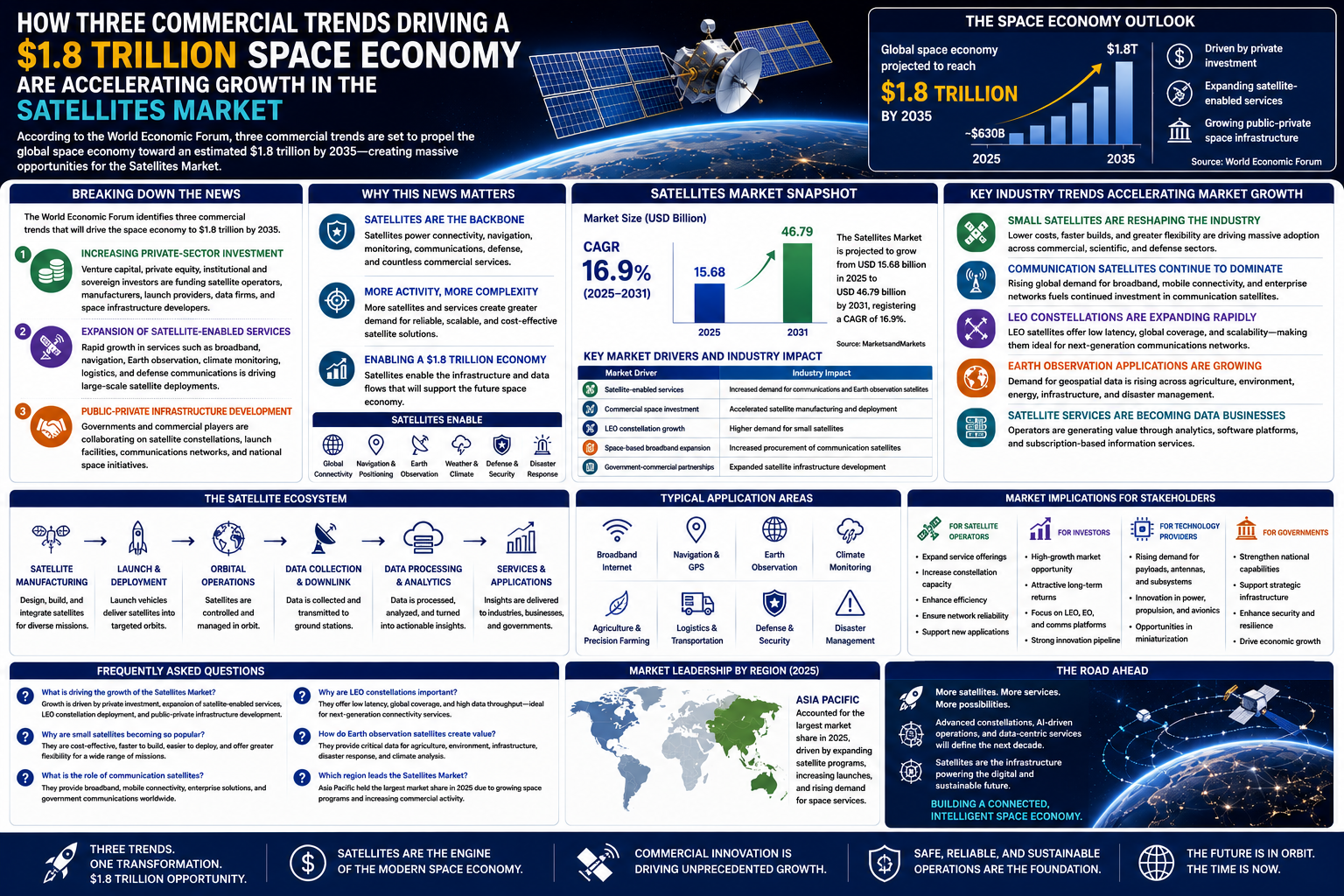
The Global Space Industry is undergoing a transformation that would have seemed unimaginable just a decade ago. What was once dominated by government agencies and a handful of major aerospace contractors has evolved into a dynamic commercial ecosystem attracting billions of dollars in private investment. According to a recent World Economic Forum (WEF) report, three powerful commercial trends are propelling the global space economy toward a projected value of $1.8 trillion by 2035: increased private-sector investment, rapid expansion of satellite-enabled services, and growing collaboration between public and private stakeholders in building space infrastructure.
These developments are reshaping the economics of space. Satellite operators, launch providers, data analytics companies, telecommunications firms, and emerging space startups are driving a new era of innovation that extends far beyond traditional aerospace applications. Space-based services now support critical sectors including telecommunications, agriculture, logistics, transportation, defense, environmental monitoring, and financial services.
At the center of this transformation lies the satellite industry. Satellites have become the foundational infrastructure powering much of the modern space economy. Whether enabling broadband connectivity, supporting navigation systems, monitoring environmental conditions, or providing Earth observation data, satellites are increasingly indispensable to both economic activity and national security.
As the commercial space ecosystem continues to expand, the trends highlighted by the World Economic Forum are creating powerful growth opportunities across the global Satellites Market, making satellites one of the most strategically important segments of the evolving space economy.
Breaking Down the News
The World Economic Forum recently outlined three commercial trends that are expected to drive the global space economy toward an estimated value of $1.8 trillion by 2035.
Trend 1: Increasing Private-Sector Investment
Private capital has become one of the primary engines of growth within the space sector.
Investments are flowing into:
- Satellite manufacturers
- Launch service providers
- Earth observation companies
- Communications operators
- Space infrastructure developers
- Data analytics firms
Venture capital, private equity, institutional investors, and sovereign wealth funds are collectively accelerating innovation and commercialization across the industry.
Trend 2: Expansion of Satellite-Enabled Services
The second trend is the rapid growth of services powered by satellite infrastructure.
These include:
- Satellite internet services
- Earth observation applications
- Navigation and positioning solutions
- Remote sensing technologies
- Climate monitoring platforms
- Logistics optimization tools
Demand for these services is expanding rapidly across both developed and emerging markets.
Trend 3: Public-Private Infrastructure Development
Governments and commercial companies are increasingly working together to develop space infrastructure.
Examples include:
- Satellite constellations
- Launch facilities
- Communications networks
- Space-based data platforms
- National space initiatives
This collaboration is creating new opportunities while accelerating the pace of technological advancement.
Why This News Matters Beyond the Headlines
The World Economic Forum’s analysis highlights a fundamental reality about the future of space: satellites are becoming the backbone of the commercial space economy.
Virtually every major trend driving industry growth depends on satellites.
Satellite systems enable:
- Global connectivity
- Navigation services
- Weather forecasting
- Environmental monitoring
- Disaster response
- Defense communications
- Financial transactions
- Supply chain visibility
As commercial demand for these capabilities increases, so too does demand for satellite manufacturing, deployment, and operation.
The significance extends beyond aerospace.
Satellite technologies now influence sectors ranging from agriculture and transportation to telecommunications and energy management. The continued commercialization of space therefore has implications far beyond the space industry itself.
The trends identified by the World Economic Forum validate many of the underlying drivers supporting long-term growth in the Satellites Market.
What This Means for the Satellites Market
The expansion of the commercial space economy is creating substantial opportunities throughout the global Satellites Market.
According to MarketsandMarkets, the Satellites Market is projected to grow from USD 15.68 billion in 2025 to USD 46.79 billion by 2031, registering a CAGR of 16.9%.
This growth is being fueled by increasing satellite deployments, growing demand for communications infrastructure, and the rapid expansion of commercial space services.
| Market Driver | Industry Impact |
|---|---|
| Satellite-enabled services | Increased demand for communications and Earth observation satellites |
| Commercial space investment | Accelerated satellite manufacturing and deployment |
| LEO constellation growth | Higher demand for small satellites |
| Space-based broadband expansion | Increased procurement of communication satellites |
| Government-commercial partnerships | Expanded satellite infrastructure development |
The World Economic Forum’s projected $1.8 trillion space economy suggests that these growth drivers are likely to remain strong throughout the next decade.
Organizations seeking deeper insights into industry developments can explore broader trends within the Satellites Market and assess how commercial innovation is transforming the global space ecosystem.
Related Resource: Read about the Satellites Market: https://www.marketsandmarkets.com/Market-Reports/satellites-market-189500332.html
Key Industry Trends Accelerating Market Growth
Small Satellites Are Reshaping the Industry
One of the most significant developments within the industry is the rapid growth of small satellite deployments.
The Small Satellite Market is expected to experience the highest growth rate during the forecast period due to several advantages:
- Lower manufacturing costs
- Faster deployment cycles
- Greater operational flexibility
- Improved scalability
- Reduced launch expenses
Small satellites are increasingly being used in communications, Earth observation, scientific research, and defense applications.
Communication Satellites Continue to Dominate Demand
Communication satellites remain the largest application segment within the market.
Growing demand for:
- Space-based broadband
- Satellite internet services
- Mobile connectivity
- Enterprise communications
- Government networks
is driving continued investment in next-generation communications infrastructure.
As connectivity requirements expand globally, communication satellites are expected to remain a major growth engine.
LEO Satellite Constellations Are Expanding Rapidly
Low Earth Orbit satellites have become a central focus of commercial space development.
LEO constellations offer advantages including:
- Lower latency
- Improved coverage
- Greater network scalability
- Enhanced data transmission capabilities
Major operators continue investing heavily in constellation deployments to support broadband services and global communications networks.
Earth Observation Applications Are Growing
Earth observation satellites are becoming increasingly valuable across multiple industries.
Applications include:
- Precision agriculture
- Environmental monitoring
- Resource management
- Infrastructure planning
- Disaster response
- Climate analysis
Growing demand for actionable geospatial intelligence is driving investments in advanced Earth observation technologies.
Satellite Services Are Becoming Data Businesses
Historically, satellites were viewed primarily as hardware assets.
Today, many operators generate value through:
- Data analytics
- Information services
- Software platforms
- Intelligence products
- Subscription-based services
This shift toward service-based business models is creating new revenue opportunities throughout the satellite ecosystem.
Market Implications for Stakeholders
For Satellite Operators
The growth of the commercial space economy creates significant opportunities for satellite operators.
Key priorities include:
- Expanding service offerings
- Increasing constellation capacity
- Enhancing operational efficiency
- Improving network resilience
- Supporting emerging applications
Operators that can scale effectively may benefit from growing demand across multiple industries.
For Investors
The World Economic Forum’s projection of a $1.8 trillion space economy reinforces the attractiveness of space-related investments.
Key themes attracting investor attention include:
- Satellite manufacturing
- LEO constellations
- Earth observation platforms
- Communications infrastructure
- Space-based data services
The Satellites Market represents one of the largest and most visible beneficiaries of these trends.
For Technology Providers
Suppliers supporting satellite programs are experiencing increasing demand for:
- Satellite payload systems
- Satellite antennas
- Propulsion technologies
- Power systems
- Communications hardware
Continuous innovation will remain essential as operators seek improved performance, lower costs, and greater operational flexibility.
For Governments
Governments continue to view satellite infrastructure as strategically important for:
- National security
- Economic development
- Telecommunications resilience
- Environmental monitoring
- Scientific research
Public-sector investments are therefore expected to remain a major contributor to industry growth.
Frequently Asked Questions
What is driving growth in the Satellites Market?
Growth is being driven by increasing commercial investment, expansion of satellite-enabled services, rising demand for communications infrastructure, deployment of LEO constellations, and growing public-private collaboration in space infrastructure development.
Why are small satellites growing so rapidly?
Small satellites offer lower costs, faster deployment timelines, and greater flexibility compared to traditional spacecraft. These advantages make them attractive for commercial, scientific, and defense applications.
What role do communication satellites play in the space economy?
Communication satellites support broadband internet, mobile connectivity, enterprise networks, and government communications. They form a critical part of global digital infrastructure.
Why are LEO satellites becoming increasingly important?
Low Earth Orbit satellites provide lower latency, enhanced coverage, and improved network performance, making them well suited for communications and data-intensive applications.
How do Earth observation satellites support commercial industries?
Earth observation satellites provide data used in agriculture, environmental monitoring, logistics, urban planning, disaster management, and resource management.
What is the significance of the projected $1.8 trillion space economy?
The projection highlights the growing economic importance of commercial space activities and the increasing role of private-sector innovation in driving industry growth.
Which region currently leads the Satellites Market?
Asia Pacific accounted for the largest market share in 2025, supported by expanding space programs, increasing satellite deployments, and growing commercial activity.
Where can organizations find deeper insights into satellite industry trends?
Industry participants often rely on specialized market intelligence to evaluate technology developments, investment opportunities, competitive dynamics, satellite deployment strategies, and future growth prospects.
Looking Beyond Today's Headlines
The World Economic Forum’s projection of a $1.8 trillion space economy reflects a profound shift in the role satellites play within the global economy.
As commercial activity expands, satellites are evolving from specialized aerospace assets into essential infrastructure supporting modern society. Communications, navigation, Earth observation, and data services increasingly depend on satellite networks operating seamlessly across multiple orbital environments.
Future growth is expected to be driven by:
- Expanding satellite constellations
- Space-based broadband services
- Advanced Earth observation capabilities
- AI-enabled satellite operations
- Integrated space infrastructure ecosystems
Commercial innovation is likely to remain the primary force driving these developments.
The next phase of space economy growth will depend heavily on the ability of satellite operators, manufacturers, and technology providers to deliver scalable, reliable, and cost-effective solutions that meet growing global demand.
Future Outlook
The World Economic Forum’s identification of three major commercial trends driving the global space economy toward $1.8 trillion by 2035 underscores the remarkable momentum behind the commercialization of space. Increased private investment, expanding satellite-enabled services, and stronger public-private collaboration are reshaping the future of the industry.
These same forces are creating significant opportunities across the Satellites Market. As demand for communications, navigation, Earth observation, and data-driven services continues to rise, satellite deployments and infrastructure investments are expected to accelerate substantially.
For satellite operators, investors, technology providers, and policymakers, understanding these trends will be essential for navigating the next phase of industry growth. Satellites are no longer simply tools supporting space missions—they are becoming critical infrastructure powering the modern digital economy.
For readers seeking deeper insights into market forecasts, technology developments, competitive dynamics, and growth opportunities, MarketsandMarkets provides comprehensive research on the global Satellites Market and the factors shaping its future expansion.
Download Sample Report: https://www.marketsandmarkets.com/requestsampleNew.asp?id=189500332
Explore the Satellites Market: https://www.marketsandmarkets.com/Market-Reports/satellites-market-189500332.html

This FREE sample includes market data points, ranging from trend analyses to market estimates & forecasts. See for yourself.
SEND ME A FREE SAMPLE






