100 Drone Battery Companies: Innovations, Industry Leaders and Emerging Players
Drone batteries are becoming increasingly important as unmanned aerial vehicles expand across commercial, industrial, government, and defense applications. Drones are used for surveillance, inspection, mapping, agriculture, delivery, and reconnaissance. These applications require reliable power systems that can support flight endurance, provide consistent power output, and meet the operating requirements of different unmanned aircraft.
According to MarketsandMarkets, the Global Drone (UAV) Battery Market is projected to grow from USD 1.65 billion in 2026 to USD 2.45 billion by 2031, registering a compound annual growth rate (CAGR) of 8.2% during the forecast period. Growing drone adoption, investment in domestic UAV production, and demand for longer flight endurance are supporting the need for high performance battery systems.
The competitive landscape includes battery manufacturers, customized battery pack suppliers, drone manufacturers with integrated battery systems, and developers of alternative power technologies. These companies serve different requirements, ranging from lightweight batteries for consumer drones to specialized power systems for commercial and military UAVs.
Battery performance is a major consideration in drone design because battery weight, energy capacity, power output, and operating reliability influence aircraft performance. Manufacturers are working to improve energy density and develop lightweight designs while addressing thermal management, safety, and battery degradation. Customized battery packs and intelligent battery management systems are also becoming important for UAV manufacturers seeking power solutions tailored to specific aircraft.
The industry is not limited to conventional rechargeable batteries. MarketsandMarkets identifies lithium based batteries, nickel based batteries, fuel cells, and sodium ion batteries within its market segmentation. The report also highlights solid state batteries, fast charging, and alternative power technologies as areas influencing the development of longer endurance drones.
Among the key companies identified in the report are DJI, Shenzhen Grepow Battery Co., Ltd., EaglePicher Technologies, RRC Power Solutions GmbH, and Epsilor Electric Fuel Ltd. The report also identifies Denchi Group and Amprius Technologies as progressive companies, reflecting the role of innovation in battery development.
This article examines the drone battery market, its growth drivers, leading companies, technology trends, market segments, regional outlook, and competitive opportunities using the supplied MarketsandMarkets report page and the market information provided.
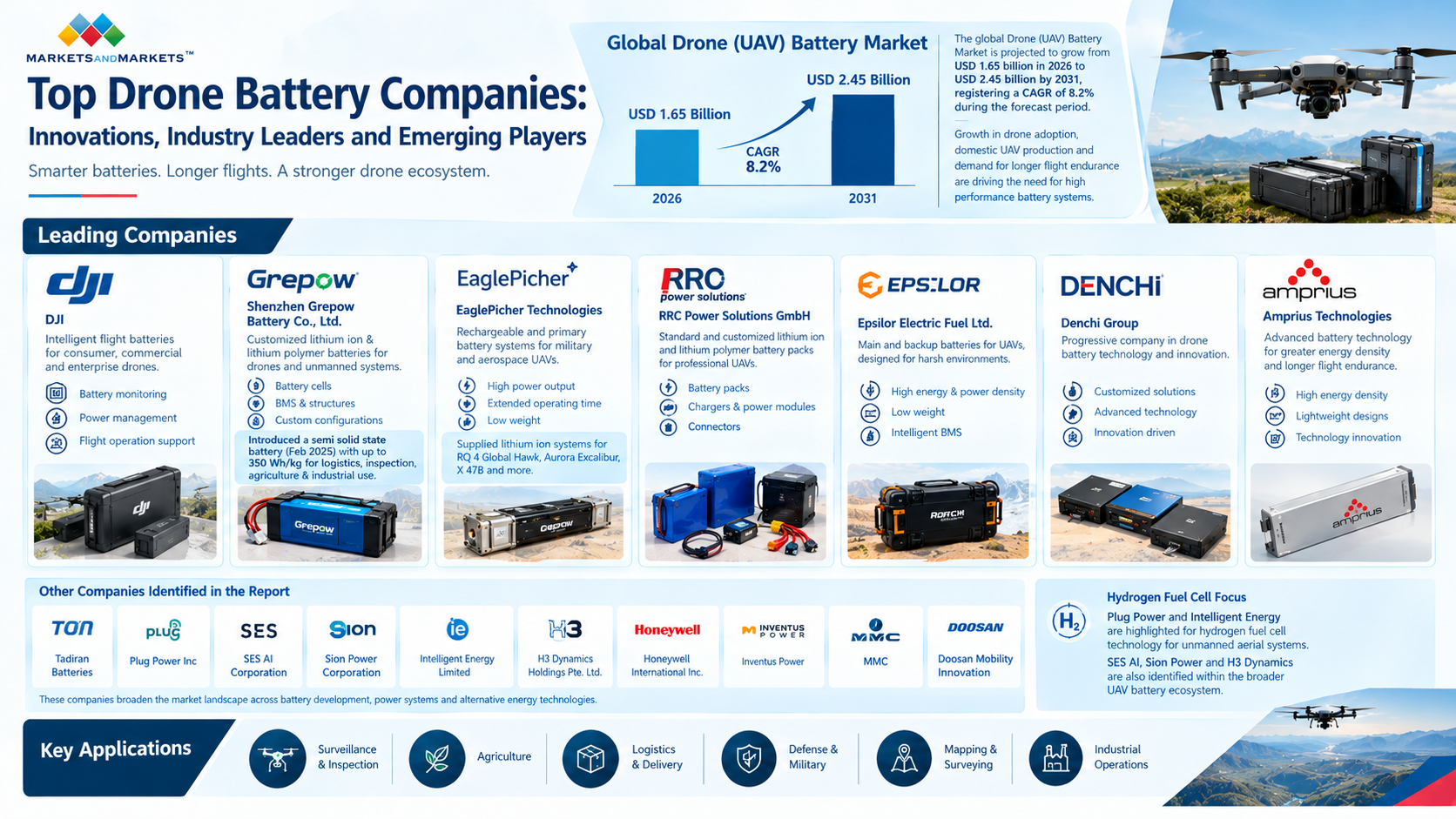
Market Size and Forecast
The global Drone Battery Market is projected to grow as drone manufacturers and operators require dependable power systems for a broader range of missions. The forecast reflects increasing use of UAVs, investment in drone production, and demand for batteries that can support longer flight times.
|
Market Metric |
Value |
|---|---|
|
Market size in 2026 |
USD 1.65 billion |
|
Projected market size in 2031 |
USD 2.45 billion |
|
CAGR from 2026 to 2031 |
8.2% |
|
North American market share in 2025 |
42.2% |
|
Commercial platform CAGR, 2026 to 2031 |
11.9% |
|
Aftermarket CAGR, 2026 to 2031 |
8.5% |
|
Leading capacity segment |
5 to 20 Ah |
|
Leading technology segment |
Lithium based batteries |
|
Leading component segment |
Battery cells |
|
Leading point of sale segment |
Original equipment manufacturer |
Source: MarketsandMarkets Drone (UAV) Battery Market report.
The commercial platform segment is projected to register the highest CAGR of 11.9% from 2026 to 2031. The aftermarket segment is projected to grow at a CAGR of 8.5% over the same period. North America accounted for 42.2% of the market in 2025, while Asia Pacific is expected to be the fastest growing region during the forecast period.
These market indicators point to opportunities across original equipment manufacturing, replacement batteries, customized battery packs, and battery management systems. The market also includes alternative power technologies that may be suitable for particular UAV applications where endurance requirements extend beyond the capabilities of conventional battery configurations.
Top 10 Key Takeaways
- The global Drone Battery Market is projected to grow from USD 1.65 billion in 2026 to USD 2.45 billion by 2031.
- The market is forecast to register a CAGR of 8.2% from 2026 to 2031.
- DJI, Shenzhen Grepow Battery Co., Ltd., EaglePicher Technologies, RRC Power Solutions GmbH, and Epsilor Electric Fuel Ltd. are identified as key players.
- Commercial drone batteries are projected to record the highest platform segment CAGR at 11.9% through 2031.
- The aftermarket segment is projected to grow at a CAGR of 8.5% from 2026 to 2031.
- North America accounted for 42.2% of the global market in 2025.
- Asia Pacific is expected to be the fastest growing regional market.
- Lithium based batteries dominate the technology segment, while battery cells account for the largest component segment.
- The 5 to 20 Ah capacity segment leads the market, according to the report.
- Higher energy density, intelligent battery management, fast charging, lightweight designs, and alternative power technologies are important areas of development.
Key Growth Drivers in the Drone Battery Market
Rising Adoption of Drones Across Commercial and Defense Applications
The growing use of drones across commercial, industrial, and defense applications is increasing demand for reliable battery systems. UAVs are being deployed for surveillance, inspection, mapping, agriculture, delivery, and reconnaissance. Each application places specific demands on battery capacity, power output, weight, and endurance.
Commercial operators need batteries that can support repeated missions and predictable operating schedules. Defense users may require battery systems suited to demanding mission conditions. Industrial applications need dependable power for aircraft carrying sensors or other equipment.
As drone fleets expand, battery manufacturers have opportunities to supply original equipment manufacturers and operators requiring replacement packs. The increasing diversity of UAV applications also supports demand for customized batteries designed around particular aircraft and mission requirements.
Growing Demand for Longer Flight Endurance and Higher Energy Efficiency
Flight endurance is a key consideration in UAV development. A battery must provide sufficient energy while remaining light enough to preserve payload capacity and aircraft performance. As operators seek to cover larger areas or complete longer missions, demand is increasing for batteries with improved energy density and efficient power delivery.
Battery manufacturers are focusing on lightweight designs, higher energy density, and improved battery performance. These developments are intended to support longer flight times without adding excessive weight to the aircraft.
Energy efficiency also depends on the relationship between the battery and the drone's overall design. Battery selection, aircraft power requirements, and the intended mission must be considered together when choosing a suitable power system.
Expansion of Domestic Drone Manufacturing
Growing domestic drone production is creating demand for battery cells, battery packs, and related components. As UAV manufacturers expand their fleets and production capacity, they need dependable supplies of batteries compatible with their aircraft.
Battery requirements can differ significantly between drone platforms. Manufacturers may need customized dimensions, power output, battery management functions, and electrical interfaces. Suppliers that provide integrated solutions can help UAV manufacturers match battery performance with aircraft requirements.
MarketsandMarkets identifies the expansion of domestic drone manufacturing and regional battery supply chains as important market growth drivers.
Development of High Energy Density Batteries
Higher energy density is an important development priority because it can allow a battery to store more energy relative to its weight. This is especially relevant for drones, where battery mass influences flight performance and available payload.
MarketsandMarkets highlights high energy density batteries and alternative power technologies as sources of opportunity in the market. The report also identifies solid state batteries, fuel cells, and other advanced power technologies as areas supporting the development of longer endurance UAVs.
The commercial value of these technologies depends on their ability to meet practical requirements for power output, safety, reliability, and operating conditions. Battery developers must evaluate performance as part of a complete UAV power system rather than focusing on energy density alone.
Increasing Demand for Customized Battery Packs and Intelligent Battery Management
Drone manufacturers require battery packs that fit their aircraft's dimensions, weight limits, and power requirements. Customized battery systems can combine cells, battery management systems, enclosures, and connectors in a configuration designed for a particular UAV.
Intelligent battery management systems can support battery monitoring, balancing, and safety functions. They can also provide information about battery status during operation, helping operators manage charging and battery condition.
MarketsandMarkets identifies customized battery packs and intelligent battery management systems as important growth drivers. This creates opportunities for suppliers that can combine battery design with electronic monitoring and integration support.
Top Drone Battery Companies and Their Competitive Positioning
The MarketsandMarkets report identifies five key drone battery market players: DJI, EaglePicher Technologies, RRC Power Solutions GmbH, Shenzhen Grepow Battery Co., Ltd., and Epsilor Electric Fuel Ltd. It also identifies Denchi Group and Amprius Technologies as progressive companies in its competitive evaluation.
The profiles below are based on the company names and product information provided on the specified report page. They are not a ranking by revenue or market share.
DJI
DJI is identified as a leading player in the drone battery market. According to the report, DJI develops intelligent flight batteries for consumer, commercial, and enterprise drones. Its battery systems are designed to support different UAV platforms with varying capacity, voltage, and flight requirements.
The report highlights battery monitoring, power management, and flight operation support as features of DJI's battery solutions. These functions are relevant to drone users who need visibility into battery status and dependable operation.
DJI's position illustrates the role of integrated battery solutions in the UAV market. When battery functions are designed around a specific drone platform, the manufacturer can align the power system with the aircraft's operating requirements.
Shenzhen Grepow Battery Co., Ltd.
Shenzhen Grepow Battery Co., Ltd. is identified as a key player in the drone battery market. The report describes the company's customized lithium ion and lithium polymer batteries for drones and other unmanned systems.
Its solutions cover battery cells, battery management systems, and battery structures. These components can be combined to match the size and power requirements of different UAV platforms.
The report also notes that Shenzhen Grepow introduced a semi solid state battery for commercial drones in February 2025, with a stated energy density of up to 350 Wh/kg. The battery was designed for logistics, inspection, agriculture, and industrial operations where longer flight endurance is required.
EaglePicher Technologies
EaglePicher Technologies is identified as a major supplier of rechargeable and primary battery systems for military and aerospace UAV applications.
The MarketsandMarkets report states that EaglePicher has supplied lithium ion battery systems for UAV platforms including the RQ 4 Global Hawk, Aurora Excalibur, and X 47B. Its battery solutions address applications where high power output, extended operating time, and low weight are important.
The company is relevant to the military and aerospace segment of the market, where battery systems may need to meet demanding mission requirements. Its reported UAV applications demonstrate the importance of specialized battery solutions for defense aircraft.
RRC Power Solutions GmbH
RRC Power Solutions GmbH is listed among the key players in the drone battery market. The report describes its standard and customized lithium ion and lithium polymer battery packs for transportation drones, inspection drones, and other professional UAV applications.
The company also supplies chargers, power management modules, and connectors. This broader offering is relevant to drone manufacturers that require a coordinated power system rather than a battery pack alone.
Customized battery configurations can help UAV manufacturers match their aircraft's power requirements and support their operational needs. Charging equipment and power management components are also important parts of the overall battery ecosystem.
Epsilor Electric Fuel Ltd.
Epsilor Electric Fuel Ltd. is identified as a key player in the drone battery market. According to the report, its batteries include main propulsion batteries for mini and small tactical unmanned aerial systems, as well as backup batteries for medium altitude long endurance UAVs.
The report describes its battery systems as designed for operations in desert, arctic, and marine environments. It also highlights energy and power density, low weight, and intelligent battery management functions for monitoring, balancing, safety, and mission endurance.
These characteristics are relevant to UAV applications where the battery must perform reliably under demanding operating conditions.
Denchi Group
Denchi Group is identified by MarketsandMarkets as a progressive company in the drone battery market. The report highlights the company's position in its competitive evaluation based on product innovation and technological advancement.
Its inclusion emphasizes the role of specialized battery system developers alongside larger battery manufacturers. For UAV applications, customized battery solutions can be relevant when standard battery products do not meet the aircraft's specific requirements.
The report identifies Denchi Group as a progressive company but does not provide a market share figure or numerical ranking for the business.
Amprius Technologies
Amprius Technologies is also identified as a progressive company in the drone battery market. The report highlights its product innovation and technological advancement within the competitive landscape.
The company's inclusion reflects the importance of battery technology development as UAV manufacturers seek greater energy density and longer flight endurance. Advanced battery technologies are particularly relevant to aircraft where weight is a significant constraint.
The supplied report page does not provide a specific market share or ranking for Amprius Technologies. Its position should therefore be understood as a progressive company designation rather than a claim that it is one of the largest suppliers by revenue.
Other Companies Identified in the Report
The MarketsandMarkets company list also includes Tadiran Batteries, Plug Power Inc., SES AI Corporation, Sion Power Corporation, Intelligent Energy Limited, H3 Dynamics Holdings Pte. Ltd., Honeywell International Inc., Inventus Power, MMC, and Doosan Mobility Innovation. These companies broaden the market landscape across battery development, power systems, and alternative energy technologies.
The report specifically describes Plug Power and Intelligent Energy in connection with hydrogen fuel cell technology for unmanned aerial systems. It also identifies SES AI, Sion Power, and H3 Dynamics within the broader UAV battery ecosystem. These companies should be viewed according to their reported roles rather than assumed to be equivalent suppliers of conventional rechargeable drone batteries.
Speak Our Industry Analyst to Know More: https://www.marketsandmarkets.com/speaktoanalystNew.asp?id=131005766
Emerging Innovations in Drone Battery Technology
High Energy Density Battery Development
High energy density batteries are a major area of development because they can help drones carry more stored energy without a comparable increase in battery weight. MarketsandMarkets identifies these batteries as an important opportunity for improving flight endurance and supporting UAVs used for extended missions.
The report also highlights advances in lithium ion, lithium polymer, and lithium metal technologies. These developments are relevant to manufacturers seeking to improve battery performance while maintaining the size and weight requirements of different aircraft.
Semi Solid State Battery Development
Semi solid state batteries are among the technologies identified in the report's recent developments. Shenzhen Grepow introduced a semi solid state battery for commercial drones in February 2025, with a stated energy density of up to 350 Wh/kg.
The product was designed for logistics, inspection, agriculture, and industrial operations where longer flight endurance is required. This development illustrates how battery manufacturers are exploring new designs to address UAV power requirements.
Lithium Metal Battery Development
The report describes a June 2026 flight test of Sion Power's Licerion Strike lithium metal battery pack on an Astro Max unmanned aircraft. The pack reportedly achieved 364 Wh/kg at pack level and delivered 60 minutes of flight time, compared with 33 minutes using a conventional lithium ion pack.
This reported test highlights the potential of advanced battery technologies to improve endurance in selected UAV applications. The result relates to the particular aircraft and test described in the report and should not be interpreted as a universal performance improvement for all drones.
Intelligent Flight Batteries
Intelligent battery systems combine energy storage with monitoring and management functions. These features can provide information about battery status and support charging and power management.
The report describes DJI's TB100 Intelligent Flight Battery, launched with the Matrice 400 enterprise drone in June 2025. The battery has a stated capacity of 977 Wh and supports up to 400 charge cycles, with fast charging and low temperature heating capabilities.
This example illustrates how battery manufacturers and drone OEMs are integrating battery performance with aircraft operating requirements.
Fuel Cell and Alternative Power Technologies
Fuel cells and other alternative power technologies are included in the MarketsandMarkets market scope. These technologies may support longer endurance for UAVs with specific mission requirements.
The report identifies Plug Power, Intelligent Energy, Doosan Mobility Innovation, and H3 Dynamics among companies associated with the broader drone battery and alternative power ecosystem. The role of these technologies is distinct from that of conventional rechargeable battery packs, and their suitability depends on the particular UAV design and mission.
Drone Battery Market Segmentation
MarketsandMarkets segments the Drone Battery Market by technology, platform, capacity, component, point of sale, and region. Each segment represents a different set of requirements for UAV manufacturers and operators.
|
Segmentation Category |
Market Segments |
|---|---|
|
By technology |
Lithium based, nickel based, fuel cell, sodium ion |
|
By platform |
Consumer, commercial, government and law enforcement, military |
|
By capacity |
Less than 5 Ah, 5 to 20 Ah, 20 to 50 Ah, greater than 50 Ah |
|
By component |
Cells, battery management systems, enclosures, connectors |
|
By point of sale |
Original equipment manufacturer, aftermarket |
|
By region |
North America, Europe, Asia Pacific, Middle East, Rest of the World |
Technology Insights
Lithium based batteries dominate the market, according to MarketsandMarkets. The report attributes their position to their relatively high energy density and low weight, characteristics that help drones achieve longer flight times while maintaining payload capacity.
Nickel based batteries, fuel cells, and sodium ion technologies are also included in the market segmentation. The range of technologies reflects different approaches to storing or generating power for UAVs. Their suitability depends on aircraft design, operating conditions, endurance requirements, and power system configuration.
Platform Insights
The market covers consumer, commercial, government and law enforcement, and military drones.
Consumer drones require battery systems compatible with compact aircraft and their intended flight operations. Commercial platforms include UAVs used for inspection, mapping, agriculture, logistics, and delivery. Government and law enforcement applications can require reliable power for surveillance and other public service missions.
The report identifies the military segment as dominant in its current platform analysis, supported by the use of military UAVs for surveillance, reconnaissance, intelligence, and tactical missions. Commercial drones, however, are projected to record the highest platform segment CAGR of 11.9% from 2026 to 2031.
Capacity Insights
Battery capacity is measured in ampere hours (Ah), with the report dividing the market into four categories: less than 5 Ah, 5 to 20 Ah, 20 to 50 Ah, and greater than 50 Ah.
MarketsandMarkets identifies the 5 to 20 Ah segment as the leading capacity category. The report associates this range with compact and mid sized UAVs used in commercial, industrial, and surveillance applications, where battery weight and flight endurance need to be balanced.
Component Insights
The component segment includes battery cells, battery management systems, enclosures, and connectors.
Battery cells store energy and influence pack capacity, weight, and discharge performance. Battery management systems support monitoring, balancing, and safety functions. Enclosures and connectors help protect the battery and integrate it with the aircraft.
MarketsandMarkets identifies battery cells as the largest component segment. This reflects their central role in determining the energy capacity and performance of complete UAV battery packs.
Point of Sale Insights
The market is divided between original equipment manufacturer sales and the aftermarket.
Original equipment manufacturer sales involve batteries supplied for integration into newly manufactured UAVs. These batteries may be designed around the aircraft's power requirements, weight limits, dimensions, and battery management needs. MarketsandMarkets identifies the OEM segment as dominant in its current analysis.
The aftermarket includes replacement battery products and associated demand from existing drone fleets. The report projects the aftermarket segment to grow at a CAGR of 8.5% from 2026 to 2031, highlighting its role in the broader market.
Regional Insights
North America
North America accounted for 42.2% of the global Drone Battery Market in 2025, according to MarketsandMarkets. The region is an important market for UAV battery systems serving commercial, industrial, and defense applications.
Demand is linked to the use of drones for surveillance, inspection, mapping, and other operational requirements. Battery suppliers serve this market through standard battery products, customized packs, and integrated power management solutions.
The region's market also includes companies working on advanced battery technologies and alternative power systems. As UAV operators seek improved endurance and reliable power, suppliers that can address aircraft specific requirements remain relevant to the competitive landscape.
Asia Pacific
Asia Pacific is expected to be the fastest growing regional market during the forecast period. MarketsandMarkets attributes this outlook to rising drone production and increasing use of UAVs across commercial, industrial, and defense applications.
China, Japan, South Korea, and India are identified in the report as countries investing in domestic drone manufacturing and battery technologies. Applications such as agriculture, logistics, infrastructure inspection, and surveillance are contributing to demand for reliable battery systems.
The region's company landscape includes DJI and Shenzhen Grepow Battery Co., Ltd., both identified among the key drone battery market players. Investments in high energy density batteries and local battery supply chains are also supporting regional development.
Europe
Europe is included in the report's regional coverage alongside North America, Asia Pacific, the Middle East, and the Rest of the World. The market includes suppliers such as RRC Power Solutions GmbH and Denchi Group.
Battery pack customization, power management, and reliable operation are relevant considerations for UAV manufacturers and users. Professional drones used for inspection, transportation, and other applications may require battery packs designed around particular power loads and aircraft configurations.
The report identifies RRC Power Solutions as a supplier of standard and customized lithium ion and lithium polymer battery packs, as well as chargers, power management modules, and connectors.
Middle East
The Middle East is part of the report's geographic market coverage. Drone battery demand in the region falls within the wider market for commercial, government, and defense UAV applications.
Battery manufacturers need to match their products to the intended aircraft and operating conditions. The MarketsandMarkets report describes Epsilor Electric Fuel's batteries as designed for demanding environments that include desert, arctic, and marine conditions, highlighting the importance of operating suitability in specialized UAV applications.
Rest of the World
The Rest of the World category completes the report's regional segmentation. Market opportunities depend on UAV adoption, domestic production, and demand across commercial, industrial, government, and defense applications.
Suppliers can serve this market through OEM battery integration, customized battery packs, replacement products, and related power management components. The report identifies domestic drone manufacturing and regional battery supply chains as important drivers of the overall market.
Growth Opportunities in the Drone Battery Market
Development of Higher Energy Density Batteries
Higher energy density creates an opportunity to improve UAV flight endurance without adding excessive battery weight. MarketsandMarkets identifies advanced battery technologies, including solid state batteries and lithium based developments, as areas supporting the development of longer endurance drones.
Battery companies can pursue this opportunity through cell development, customized battery pack design, and collaboration with UAV manufacturers. Practical adoption depends on how well a battery performs in the complete aircraft system.
Integration of Fast Charging and Battery Swapping
Fast charging and battery swapping are identified as market opportunities in the report. Both approaches can help operators manage aircraft turnaround times and maintain the availability of drone fleets.
Battery manufacturers can address this opportunity through compatible battery packs, chargers, and power management modules. Charging solutions must be matched to battery specifications and operating requirements to maintain safe and reliable use.
Customized Battery Packs for UAV Manufacturers
Customized battery packs allow manufacturers to align battery capacity, power output, dimensions, and connectors with the requirements of a specific drone.
This opportunity is relevant to suppliers serving professional UAVs, transportation drones, inspection platforms, and military aircraft. Companies offering integrated solutions that combine cells, battery management systems, enclosures, and connectors can address more of the aircraft's power system requirements.
Growth in Commercial Drone Applications
Commercial drones are projected to register the highest platform segment CAGR of 11.9% from 2026 to 2031. The report connects the wider adoption of drones with applications including inspection, mapping, agriculture, and delivery.
Battery suppliers can benefit from demand for power systems suited to these applications. Commercial UAV manufacturers may require lightweight packs, reliable power delivery, and battery monitoring features that support regular operations.
Expansion of the Aftermarket
The aftermarket is projected to grow at a CAGR of 8.5% from 2026 to 2031. This creates opportunities to supply replacement batteries and related products for drones already in operation.
As fleets remain in service, operators need batteries compatible with their aircraft and operating requirements. Battery suppliers can serve this segment through replacement packs, chargers, and associated power management products.
Development of Alternative Power Technologies
Fuel cells and other alternative power technologies provide additional opportunities within the UAV power ecosystem. MarketsandMarkets includes fuel cells and sodium ion batteries in its technology segmentation and highlights solid state batteries and other advanced technologies in its discussion of market trends.
Companies developing these solutions can address particular endurance and power requirements. Adoption depends on the characteristics of the aircraft, the intended mission, and the suitability of the complete power system.
Challenges Facing the Drone Battery Industry
High Cost of Advanced Battery Technologies
Advanced UAV batteries can require high performance cells and specialized components, increasing manufacturing costs. MarketsandMarkets identifies the high cost of advanced battery technologies as a market restraint.
Higher costs may affect adoption in applications where drone operators are sensitive to battery purchase and replacement expenses. Manufacturers must balance performance improvements with the cost requirements of the intended UAV market.
Raw Material Price Volatility
The report identifies price volatility in battery materials, including lithium, nickel, and cobalt, as a potential challenge. Changes in material costs can affect battery production expenses and the prices paid by UAV manufacturers and operators.
This can create uncertainty for battery suppliers that need to maintain consistent pricing and production plans. The impact depends on material requirements, sourcing arrangements, and manufacturing costs.
Battery Life and Degradation
Battery capacity and performance can decline over repeated charging cycles. MarketsandMarkets identifies limited battery life and degradation as restraints affecting the drone battery market.
Battery manufacturers need to design products suited to their intended use and provide appropriate monitoring and management functions. Degradation is particularly relevant to operators that use drones frequently and need predictable flight performance over time.
Battery Weight and Thermal Management
Battery manufacturers must reduce weight while maintaining sufficient energy capacity and power output. Higher power requirements can also generate heat, making thermal management an important part of battery design.
These challenges are particularly relevant to high performance UAVs, where the battery must fit within strict aircraft weight and space limits. The report identifies weight, thermal management, and safety requirements as key challenges for the industry.
Safety and Extreme Operating Conditions
Drone batteries must maintain suitable performance under the operating conditions for which they are designed. MarketsandMarkets highlights safety and performance under extreme conditions as challenges for UAV battery manufacturers.
Battery systems may require suitable protection, monitoring, and design choices based on the aircraft's intended environment. The report's description of Epsilor Electric Fuel's battery systems for desert, arctic, and marine conditions illustrates the importance of application specific design.
Future Outlook
The global Drone Battery Market is projected to grow from USD 1.65 billion in 2026 to USD 2.45 billion by 2031, registering a CAGR of 8.2%. Growing adoption of drones across commercial, industrial, and defense applications is supporting demand for reliable battery systems.
Battery manufacturers are expected to continue focusing on higher energy density, lightweight designs, intelligent battery management, charging technologies, and alternative power solutions. These developments are intended to address the demand for longer flight endurance and reliable power delivery across different UAV platforms.
The competitive landscape includes established companies such as DJI, Shenzhen Grepow Battery Co., Ltd., EaglePicher Technologies, RRC Power Solutions GmbH, and Epsilor Electric Fuel Ltd. MarketsandMarkets also identifies Denchi Group and Amprius Technologies as progressive companies in the market.
Commercial drones are projected to record the fastest growth among platform segments, while the aftermarket is expected to grow steadily as existing fleets require replacement batteries. North America accounted for 42.2% of the market in 2025, and Asia Pacific is expected to be the fastest growing region through the forecast period.
The future competitive position of drone battery companies will depend on their ability to meet aircraft specific requirements, improve battery performance, manage costs, and provide reliable products. Companies that combine battery innovation with customized pack design, intelligent battery management, and dependable supply can address the evolving needs of UAV manufacturers and operators.
Frequently Asked Questions
1. What is the projected size of the global Drone Battery Market by 2031?
According to MarketsandMarkets, the global Drone Battery Market is projected to reach USD 2.45 billion by 2031, growing from USD 1.65 billion in 2026 at a CAGR of 8.2%.
2. Which companies are the leading players in the drone battery market?
MarketsandMarkets identifies DJI, EaglePicher Technologies, RRC Power Solutions GmbH, Shenzhen Grepow Battery Co., Ltd., and Epsilor Electric Fuel Ltd. as key players. Denchi Group and Amprius Technologies are identified as progressive companies in the market.
3. Which battery technologies are covered in the UAV battery market?
The report segments the market into lithium based batteries, nickel based batteries, fuel cells, and sodium ion batteries. It also highlights solid state batteries and other advanced power technologies as areas of development.
4. Which segment is expected to grow fastest in the drone battery market?
The commercial platform segment is projected to register the highest CAGR of 11.9% from 2026 to 2031. The report also projects the aftermarket segment to grow at a CAGR of 8.5% over the same period.
5. What are the main challenges facing drone battery manufacturers?
The main challenges identified by MarketsandMarkets include the high cost of advanced battery technologies, raw material price volatility, limited battery life, battery weight, thermal management, safety requirements, and maintaining performance under extreme operating conditions.

This FREE sample includes market data points, ranging from trend analyses to market estimates & forecasts. See for yourself.
SEND ME A FREE SAMPLE