Drone (UAV) Battery Market Growth, Trends, & Forecast

Drone (UAV) Battery Market by Technology (Lithium-based, Nickel-based, Fuel Cell, Sodium-ion), Platform (Commercial, Government & Law Enforcement, Military), Capacity (<5, 5-20, 20-50, >50 AH), Component, Point of Sale, and Region - Forecast to 2031




DRONE (UAV) BATTERY MARKET OVERVIEW
According to Marketsandmarkets, the Global Drone (UAV) Battery Market Size is projected to grow from USD 1.65 billion in 2026 to USD 2.45 billion by 2031, growing at a CAGR of 8.2% from 2026-2031. The growing use of drones across defense, commercial, and industrial applications is increasing demand for reliable battery systems. Demand for UAVs is also rising in surveillance, inspection, mapping, agriculture, and delivery. This is creating a stronger need for batteries that can support longer flight times. Domestic drone production is also growing as companies invest in new fleets. This growing production is creating more demand for high-performance battery packs. Better battery energy density is also helping in the development of advanced UAV batteries.
REPORT SCOPE
| REPORT METRIC | DETAILS |
|---|---|
| Market Size in 2026 (Value) | USD 1.65 Billion |
| Market Forecast in 2031 (Value) | USD 2.45 Billion |
| Growth Rate | 8.2% |
| Years Considered | 2021-2031 |
| Base Year | 2025 |
| Forecast Period | 2026-2031 |
| Units Considered | Value (USD Million/Billion), Volume (Units) |
| Report Coverage | Revenue forecast, company ranking, competitive landscape, growth factors, and trends |
| Top Companies |
|
| Growth Drivers |
|
| Segments Covered |
|
| Regions Covered | North America, Europe, Asia Pacific, Middle East, Rest of the World |
KEY DRONE (UAV) BATTERY MARKET TAKEAWAYS
-
By RegionNorth America dominated the drone (UAV) battery market, with a share of 42.2% in 2025.
-
By PlatformBy platform, the commercial segment is expected to grow at the highest CAGR of 11.9% from 2026 to 2031.
-
By Point of SaleBy point of sale, the aftermarket (FG) segment is projected to grow at a CAGR of 8.5% from 2026 to 2031.
-
Competitive LandscapeDJI, Shenzhen Grepow Battery Co., Ltd., EaglePicher Technologies, RRC Power Solutions GmbH, and Epsilor-Electric Fuel Ltd. are recognized as key players in the drone (UAV) battery market. These companies hold strong positions due to their established product portfolios and wide operational presence. Consistent investment in product development supports their market standing.
-
Competitive LandscapeDenchi Group and Amprius Technologies are considered progressive companies and have distinguished themselves in the drone (UAV) battery market due to strong product innovation and technological advancements.
The Drone (UAV) Battery Industry is growing due to higher drone adoption, expanding commercial applications, and increasing investments in unmanned aerial systems. The growing deployment of drones for surveillance, mapping, agriculture, inspection, and delivery is increasing demand for advanced battery solutions. Investments in local drone and battery production are also supporting market growth. Rising demand for longer flight endurance and higher energy efficiency is creating new opportunities for advanced UAV battery technologies.
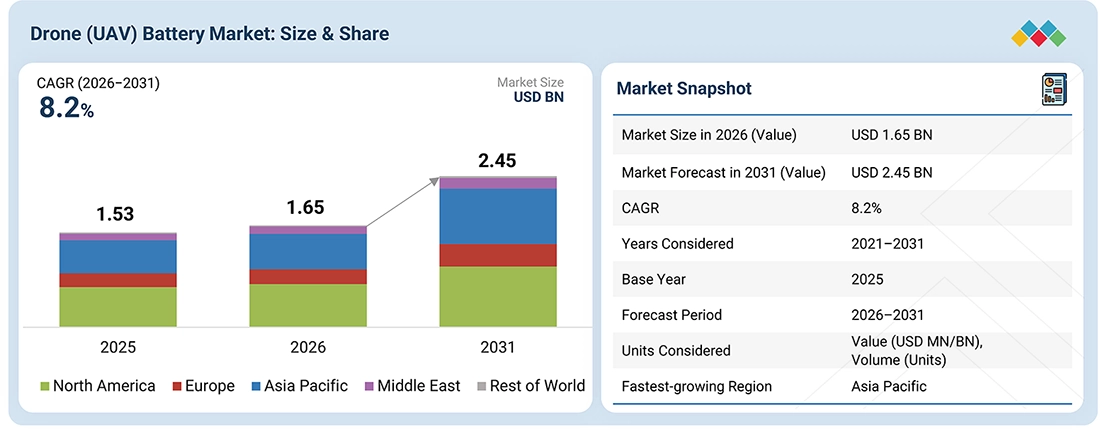
Source: Secondary Research, Interviews with Experts, MarketsandMarkets Analysis
TRENDS & DISRUPTIONS IMPACTING CUSTOMERS' CUSTOMERS
The drone (UAV) battery market is evolving as manufacturers develop batteries with higher energy density and longer flight endurance. Battery companies are also focusing on fast-charging technologies, improved thermal management, and lightweight designs for different UAV applications. Growing adoption of solid-state batteries, fuel cells, and other advanced power technologies is supporting the development of longer-endurance drones. These developments are encouraging manufacturers to improve battery performance, reduce weight, and support the increasing power requirements of autonomous UAVs.
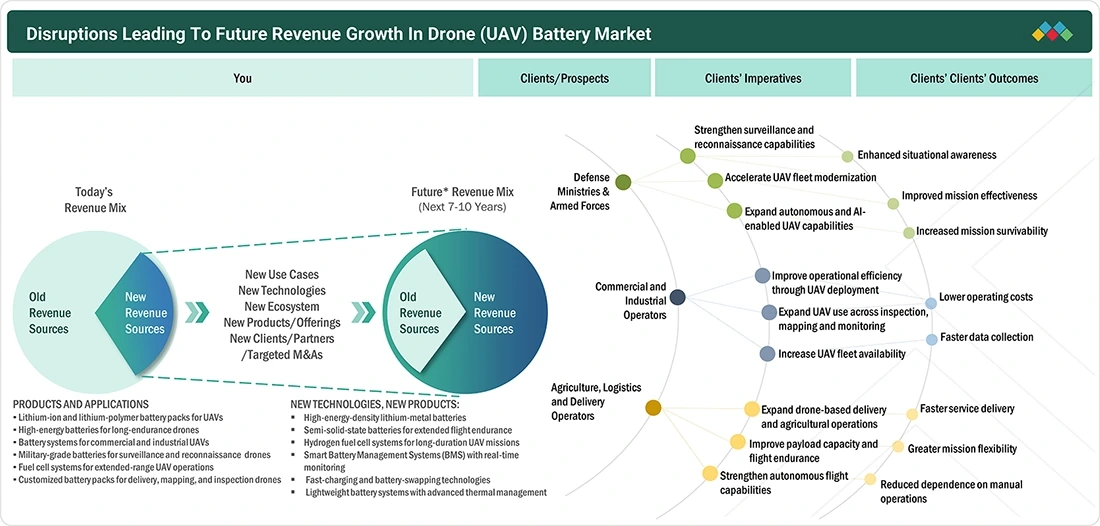
Source: Secondary Research, Interviews with Experts, MarketsandMarkets Analysis
DRONE (UAV) BATTERY MARKET DYNAMICS

Level
-
Rising Adoption of Drones Across Commercial and Defense Applications

-
Growing Demand for Longer Flight Endurance and Higher Energy Efficiency


Level
-
High Cost of Advanced Battery Technologies and Raw Material Price Volatility

-
Limited Battery Life and Degradation Over Repeated Charging Cycles


Level
-
Development of High-Energy-Density Batteries and Alternative Power Technologies

-
Integration of Fast-Charging and Battery-Swapping Technologies


Level
-
Battery Weight, Thermal Management, and Safety Requirements in High-Performance UAVs

-
Maintaining Battery Performance Under Extreme Operating Conditions

Source: Secondary Research, Interviews with Experts, MarketsandMarkets Analysis
Driver: Rising Adoption of Drones Across Commercial and Defense Applications
The growing use of drones across commercial and defense applications is increasing demand for reliable and high-performance battery systems. Drones are being deployed for surveillance, inspection, mapping, agriculture, delivery and reconnaissance missions. This wider adoption is creating demand for batteries that can provide longer flight times and consistent power output. Expansion of drone fleets across different industries is further supporting market growth.
Restraint: High Cost of Advanced Battery Technologies and Raw Material Price Volatility
Advanced UAV batteries require high-performance cells and specialized components, which can increase overall production costs. Prices of key battery materials such as lithium, nickel, and cobalt can also fluctuate based on supply and demand conditions. These factors can increase battery prices for drone manufacturers and operators. Higher costs may limit the adoption of advanced battery technologies in price-sensitive applications.
Opportunity: Development of High-Energy-Density Batteries and Alternative Power Technologies
The development of high-energy-density batteries is creating opportunities to improve drone flight time without adding significant weight. Manufacturers are also exploring solid-state batteries, fuel cells and other alternative power technologies for longer-endurance UAVs. These technologies can support drones used for extended missions and high-power applications. Continued research and partnerships between drone and battery manufacturers can further accelerate product development.
Challenge: Battery Weight, Thermal Management, and Safety Requirements in High-Performance UAVs
Battery manufacturers face challenges in reducing weight while maintaining sufficient energy capacity and power output. Higher power requirements can also generate heat, which requires effective thermal management during drone operations. Battery safety is another concern due to risks associated with overheating, damage, and repeated charging cycles. Maintaining performance and safety under different operating conditions remains a key challenge for UAV battery manufacturers.
DRONE (UAV) BATTERY MARKET: COMMERCIAL USE CASES ACROSS INDUSTRIES
| COMPANY | USE CASE DESCRIPTION | BENEFITS |
|---|---|---|
 |
Development of intelligent flight batteries for consumer, commercial, and enterprise drones. DJI batteries integrate battery management functions and are designed to support different UAV platforms with varying capacity, voltage, and flight requirements. | Supports longer flight operations, provides battery status monitoring, and improves charging and power management. Intelligent battery functions also help maintain battery condition during storage and operation. |
 |
Development of customized lithium-ion and lithium-polymer batteries for drones and other unmanned systems. The company provides integrated solutions covering battery cells, Battery Management Systems (BMS), and battery structures. | Enables customized battery designs based on UAV size and power requirements. Supports lightweight designs, improved energy performance, and integration with different drone platforms. |
 |
Development of rechargeable and primary battery systems for military and aerospace UAV applications. EaglePicher has supplied lithium-ion battery systems for UAV platforms including the RQ-4 Global Hawk, Aurora Excalibur and X-47B. | Provides high power and extended operating time for demanding UAV missions. Lightweight primary batteries can also support expendable UAV applications where long runtime and low weight are important. |
 |
Development of standard and customized lithium-ion and lithium-polymer battery packs for transportation drones, inspection drones and other professional UAV applications. The company also supplies chargers, power management modules and connectors. | Supports fast charging and high-power loads while providing reliable operation under demanding conditions. Customized battery solutions allow UAV manufacturers to match power systems with specific drone requirements. |
 |
Development of main propulsion batteries for Mini and Small Tactical Unmanned Aerial Systems (UAS) as well as backup batteries for Medium-Altitude Long-Endurance (MALE) UAS. Its batteries are designed for operations in desert, arctic and marine environments. | Provides high energy and power density while maintaining low weight. Smart Battery Management Systems (BMS) support battery monitoring, balancing, safety and mission endurance under demanding operating conditions. |
Logos and trademarks shown above are the property of their respective owners. Their use here is for informational and illustrative purposes only.
DRONE (UAV) BATTERY MARKET ECOSYSTEM
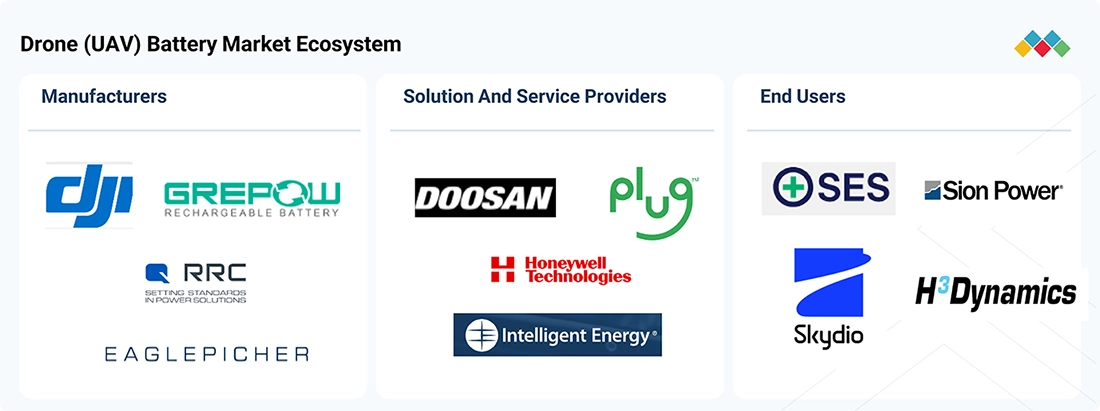
The drone (UAV) battery market includes battery manufacturers, solution and service providers, and drone companies that use advanced battery technologies. DJI, Shenzhen Grepow Battery, RRC Power Solutions, and EaglePicher Technologies are developing battery systems for different UAV applications. Doosan Mobility Innovation, Honeywell, Plug Power, and Intelligent Energy provide alternative power and energy solutions for longer-endurance drone operations. SES, H3 Dynamics, Sion Power, and Skydio represent end users and UAV technology companies that require reliable battery solutions for commercial, industrial, and advanced drone applications. Growing demand for longer flight times, lightweight power systems, and improved energy efficiency is driving collaborations across the UAV battery ecosystem.
Logos and trademarks shown above are the property of their respective owners. Their use here is for informational and illustrative purposes only.
DRONE (UAV) BATTERY MARKET SEGMENTS
Source: Secondary Research, Interviews with Experts, MarketsandMarkets Analysis
Drone (UAV) Battery Market, By Platform
The military segment dominate the market as the increasing use of military UAVs for surveillance, reconnaissance, intelligence, and tactical missions is driving demand for reliable battery systems. Military drones require high power output and longer endurance to support extended operations. The growing deployment of unmanned systems is also increasing the need for batteries that can perform under demanding mission conditions.
Drone (UAV) Battery Market, By Capacity
The 5–20 Ah segment leads the market as this capacity range is gaining demand from compact and mid-sized UAVs used for commercial, industrial, and surveillance applications. Batteries in this range provide a practical balance between energy storage, flight endurance, and overall battery weight. Growing use of drones for mapping, inspection, and agriculture is supporting demand for these battery packs.
Drone (UAV) Battery Market, By Technology
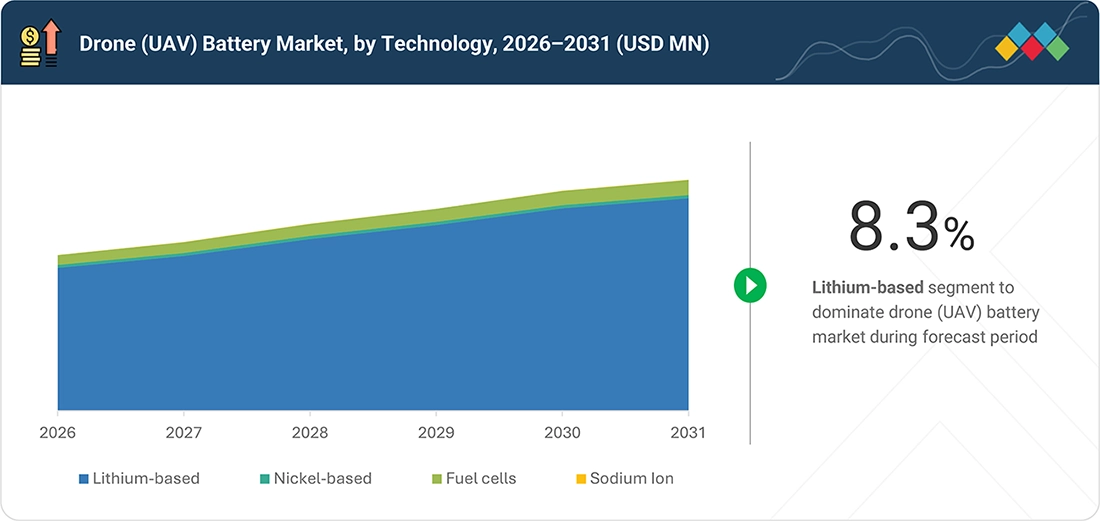
Lithium-based batteries dominate the market as they are widely used in UAVs because they offer high energy density with relatively low weight. These characteristics help drones achieve longer flight times while maintaining payload capacity. Continued improvements in lithium-ion, lithium-polymer, and lithium-metal technologies are further supporting their use in UAV platforms.
Drone (UAV) Battery Market, By Component
Cells dominate the market as growing demand for higher energy density and improved power output increases the need for advanced battery cells in UAV battery packs. Cell selection directly affects battery weight, capacity, discharge performance, and flight endurance. Improvements in high-performance cell designs are supporting the development of more efficient UAV battery systems.
Drone (UAV) Battery Market, By Point of Sale
The OEM segment dominates the market because rising integration of batteries directly into new UAV platforms is supporting demand through the OEM channel. Drone manufacturers require battery packs that are customized to match the aircraft's power requirements, weight limits, and available space. Increasing focus on integrated battery management and platform-level reliability is further supporting OEM battery procurement.
DRONE (UAV) BATTERY MARKET REGION
Asia Pacific to be fastest-growing region in global drone (UAV) battery market during forecast period
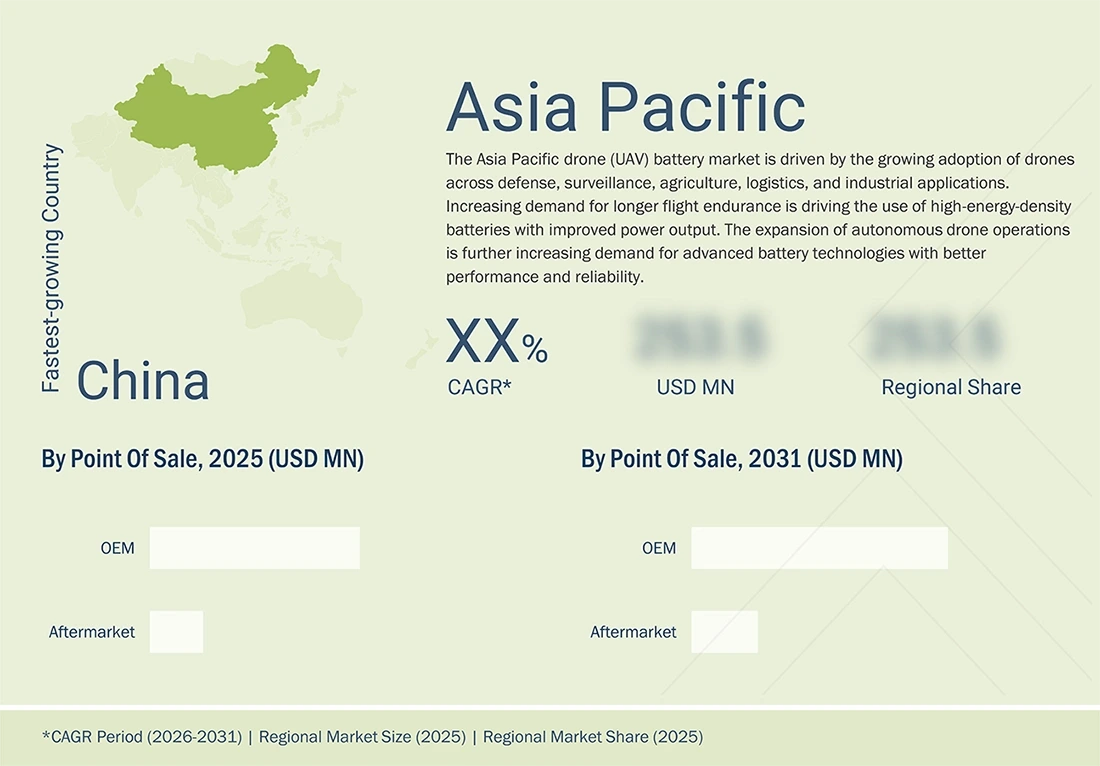
The Asia Pacific region is expected to grow at the fastest rate due to rising drone production and increasing use of UAVs across commercial, industrial, and defense applications. Countries such as China, Japan, South Korea, and India are investing in domestic drone manufacturing and battery technologies. Growing demand for drones in agriculture, logistics, infrastructure inspection and surveillance is increasing the need for reliable battery systems. Investments in high-energy-density batteries and local battery supply chains are further supporting market growth across the region.
DRONE (UAV) BATTERY MARKET: COMPANY EVALUATION MATRIX
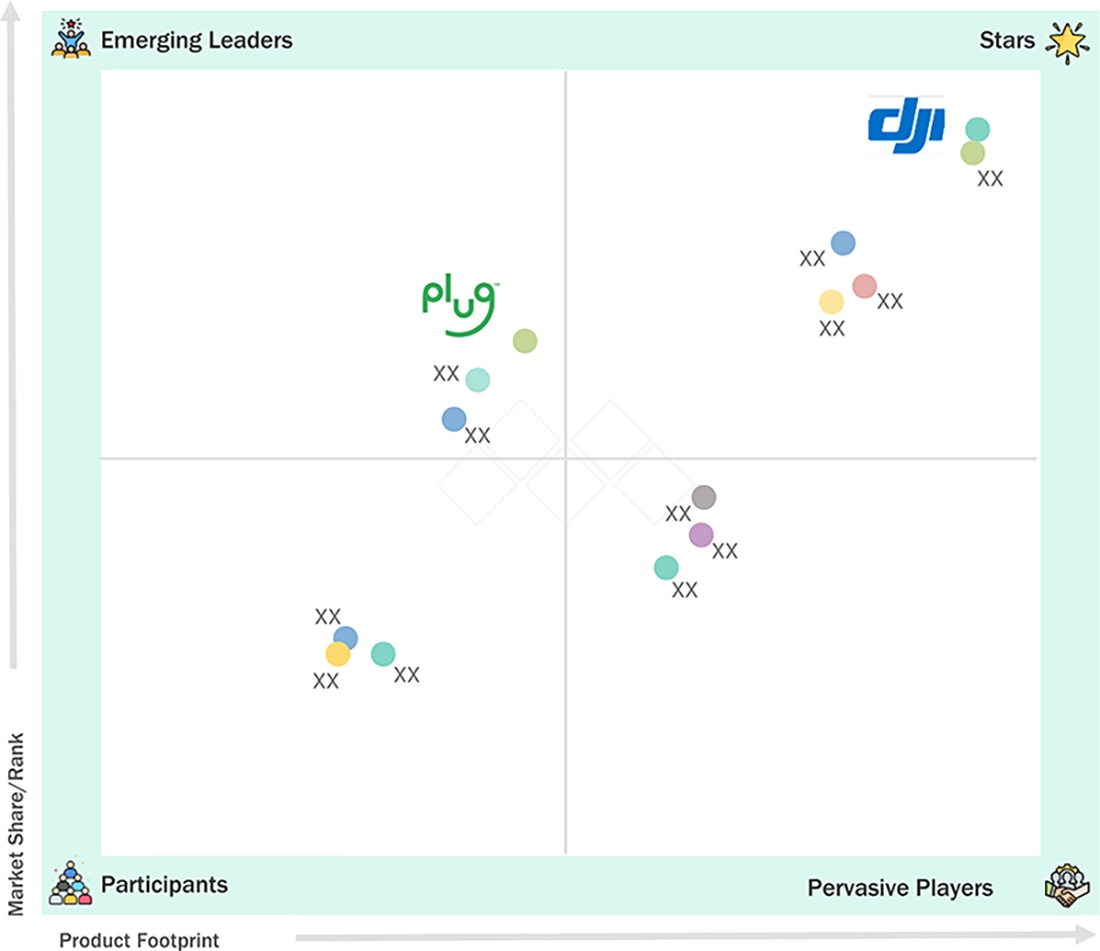
DJI is a leading player in the drone (UAV) battery market with a strong focus on intelligent battery systems for consumer, commercial, and enterprise drones. Its battery solutions are designed to support reliable flight performance with features for battery monitoring, power management, and extended flight operations. Plug Power Inc. is an emerging company in the market with growing capabilities in hydrogen fuel cell technology for unmanned aerial systems. The company is developing fuel cell solutions that can support longer flight endurance and reduce the limitations of conventional battery systems.
Source: Secondary Research, Interviews with Experts, MarketsandMarkets Analysis
KEY DRONE (UAV) BATTERY MARKET PLAYERS
List of Top Drone (UAV) Battery Market Companies
- DJI (China)
- EaglePicher Technologies (US)
- RRC Power Solutions GmbH (Germany)
- Shenzhen Grepow Battery Co., Ltd. (China)
- Epsilor-Electraic Fuel Ltd. (Israel)
- Tadiran Batteries (Israel)
- Plug Power Inc. (US)
- SES AI Corporation (US)
- Sion Power Corporation (US)
- Intelligent Energy Limited (UK)
- H3 Dynamics Holdings Pte. Ltd. (Singapore)
- Honeywell International Inc. (US)
- Inventus Power (US)
- MMC (China)
- Doosan Mobility Innovation (South Korea)
WHAT IS IN IT FOR YOU: DRONE (UAV) BATTERY MARKET REPORT CONTENT GUIDE
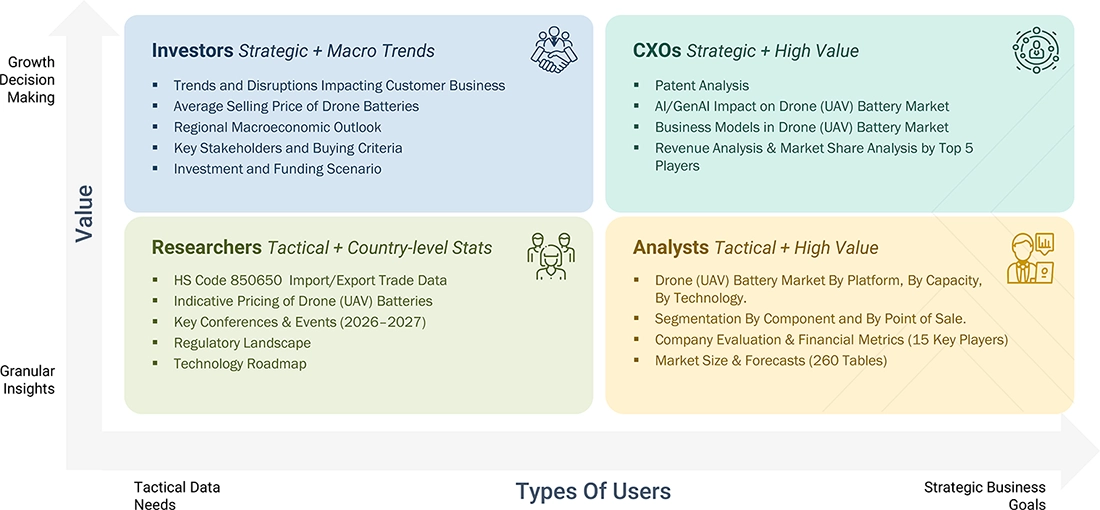
DELIVERED CUSTOMIZATIONS
We have successfully delivered the following deep-dive customizations:
| CLIENT REQUEST | CUSTOMIZATION DELIVERED | VALUE ADDS |
|---|---|---|
| Leading Manufacturer | Additional segment breakdown for countries | Additional country-level market sizing tables for segments/subsegments covered at the regional/global level to gain an understanding of market potential by each country |
| Emerging Leader | Additional company profiles | Competitive information on targeted players to gain granular insights into direct competition |
| Regional Market Leader | Additional country market estimates | Additional country-level deep dive for a more targeted understanding of the total addressable market |
RECENT DEVELOPMENTS
- 6/1/2026 12:00:00 AM : Sion Power completed flight testing of its Licerion Strike lithium-metal battery pack on an Astro Max unmanned aircraft. The battery achieved 364 Wh/kg at the pack level and delivered 60 minutes of flight time compared with 33 minutes using a conventional lithium-ion pack.
- 6/1/2025 12:00:00 AM : DJI launched the Matrice 400 enterprise drone with the TB100 Intelligent Flight Battery. The 977 Wh lithium-ion battery supports up to 400 charge cycles and enables long-endurance operations with fast charging and low-temperature heating capabilities.
- 2/1/2025 12:00:00 AM : Shenzhen Grepow Battery Co., Ltd. introduced a semi-solid-state battery for commercial drones with an energy density of up to 350 Wh/kg. The battery is designed for applications such as logistics, inspection, agriculture and industrial operations where longer flight endurance is required.
Table of Contents
 Exclusive indicates content/data unique to MarketsandMarkets and not available with any competitors.
Methodology
The study followed four main steps to estimate the size of the drone (UAV) battery market. Secondary research was conducted to collect data on drone battery technologies, battery capacities, component types, drone applications, production volumes, and industry developments across key markets. These findings were validated through primary interviews with drone manufacturers, battery manufacturers, suppliers, system integrators, and industry experts. The research analyzed drone adoption, battery demand, technology developments, production trends, and application requirements to assess market demand. Market estimates were then segmented by platform, capacity, technology, point of sale, component, and region. Data triangulation was applied to validate the final figures for each segment and subsegment.
Secondary Research
Secondary research was conducted to build the foundation for the drone (UAV) battery market study. Data were collected from drone industry reports, battery manufacturers, aviation authorities, drone manufacturers, and regulatory organizations related to unmanned aerial vehicles. Company information was reviewed through annual reports, product documents, press releases, and investor presentations of drone and battery manufacturers. The study also examined industry articles, white papers, and research studies related to battery technologies, energy density, charging systems, battery management systems, and UAV applications. Additional insights were gathered from industry associations and market platforms to analyze market trends, technology developments, drone adoption, battery production, and demand across key regions.
Primary Research
Primary research was conducted after key insights from secondary analysis were identified. The study team engaged with executives from drone manufacturers, battery manufacturers, battery component suppliers, system integrators, and industry experts involved in the drone (UAV) battery market. Discussions covered battery technology providers, cell manufacturers, battery management system suppliers, drone companies, and other industry stakeholders across major markets. Interviews were conducted through calls and written correspondence to validate market size estimates, production trends, customer requirements, battery performance, and technology developments. These inputs helped refine perspectives on competition, product development, supply chain activities, and investment trends while improving overall data accuracy.
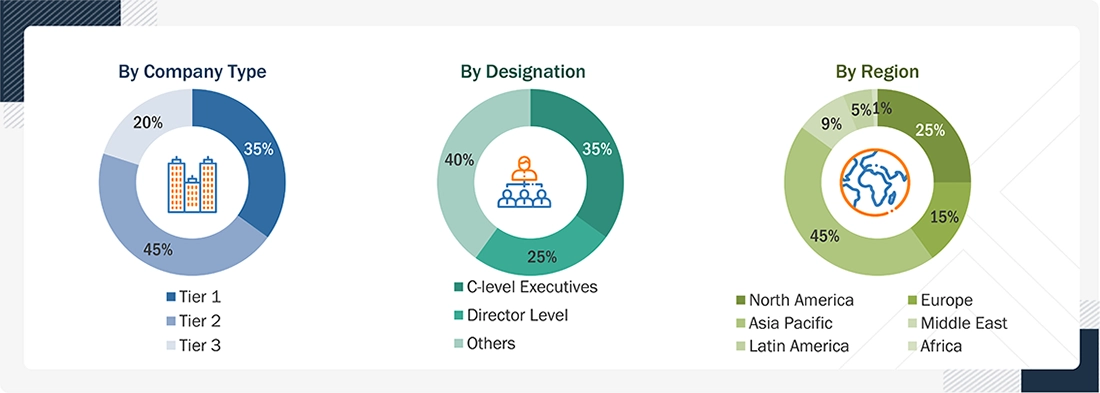
To know about the assumptions considered for the study, download the pdf brochure
Market Size Estimation
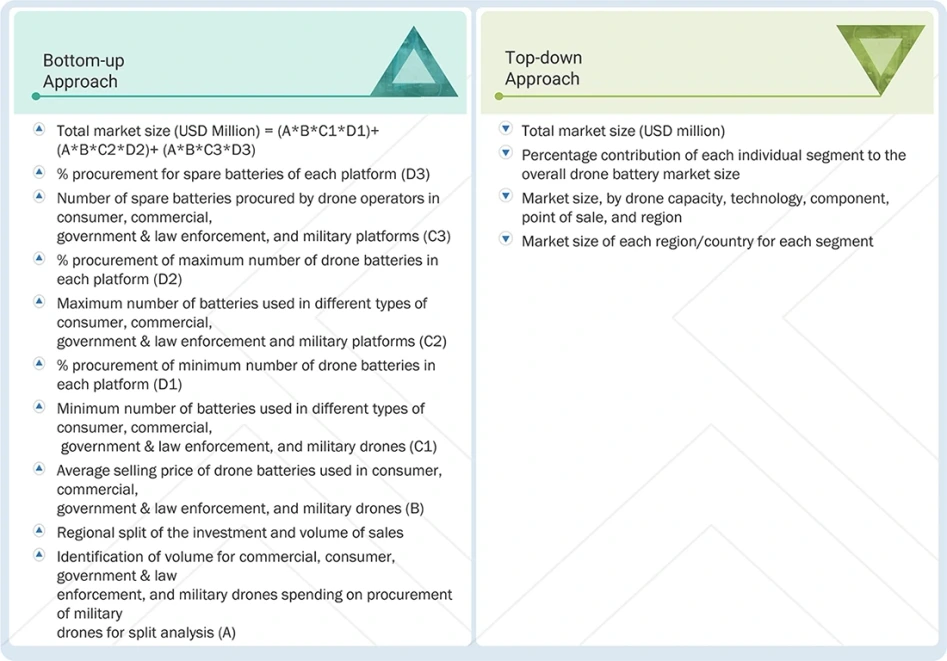
The top-down and bottom-up methods were used to estimate and validate the size of the drone battery market. The research process involved several steps to ensure accuracy.
- Key companies active in the drone battery market were identified through secondary research. Their market share was evaluated using a combination of primary inputs and published data. This included reviewing annual reports, financial disclosures, certification updates, and public filings from various organizations. Interviews were also conducted with industry participants such as company executives, program managers, operators, infrastructure providers, and aviation experts. These inputs were used to validate assumptions and refine market size estimates across regions.
- All percentage shares, segment splits, and market breakdowns were first developed using secondary information. These values were then verified through primary discussions with industry participants.
- The analysis evaluated key factors shaping the drone battery market, including
defense spending trends, drone battery procurement programs, autonomous technology developments, payload integration capabilities, and surveillance requirements. Each factor was assessed through primary research and used to develop both quantitative and qualitative market estimates for this report.
Drone (UAV) Battery Market: Top-Down and Bottom-Up Approach
Data Triangulation
After determining the overall market size, the total market was divided into multiple segments and subsegments. The data triangulation and market breakdown procedures described below were carried out, where applicable, to complete the overall market analysis and determine the estimated market figures for the segments and subsegments. The data were triangulated by examining various factors and trends from both demand and supply sides. Additionally, the market size was validated using the top-down and bottom-up approaches.
Market Definition
A drone battery is a device made up of one or more electrochemical cells with external connections to store energy and provide power to the drone’s electric motors and other onboard electronic systems. It includes integrated modules such as cells, a battery management system (BMS), connectors, and enclosures. The configuration of the battery, whether series or parallel cell arrangements, is designed to meet specific power output and energy capacity needs based on the drone’s application, weight class, and mission duration.
Drone batteries are typically manufactured using lithium-ion, lithium-polymer, lithium-metal, nickel, sodium-ion, and fuel cells. These batteries support diverse drone uses, including inspection and monitoring, surveying and mapping, agriculture, cargo transport, passenger air mobility, and military operations. They are utilized across different drone structures and serve consumer, commercial, government, and defense sectors.
Key Stakeholders
- Drone (UAV) manufacturers developing platforms for commercial, industrial, agricultural, logistics, and defense applications
- Battery manufacturers producing lithium-ion, lithium-polymer, lithium-metal, sodium-ion, and other advanced battery systems
- Battery cell manufacturers supplying high-energy-density cells for UAV battery packs
- Battery management system (BMS) suppliers providing monitoring, thermal management, protection, and battery optimization technologies
- Battery component suppliers providing connectors, enclosures, electrodes, separators, and thermal management components
- Drone operators and service providers using UAVs for inspection, mapping, surveying, agriculture, delivery, and surveillance
- Defense organizations and military forces procuring UAVs and high-performance battery systems for reconnaissance, surveillance, and tactical missions
- Charging system manufacturers developing fast-charging, portable, automated, and field-deployable charging solutions for drones
- Electric motor and propulsion system manufacturers supplying motors, electronic speed controllers, and power systems that determine UAV energy requirements
- Raw material suppliers providing lithium, nickel, cobalt, graphite, and other materials used in battery production
- Battery testing and certification organizations supporting safety, performance, reliability, and regulatory compliance of UAV batteries.
Report Objectives
- To define, describe, and forecast the size of the drone (UAV) battery market by platform, capacity, technology, component, and point of sale
- To forecast the size of market segments with respect to key countries in the following regions: North America, Europe, Asia Pacific, the Middle East, and the Rest of the World (RoW)
- To identify and analyze drivers, restraints, opportunities, and challenges influencing the growth of the market
- To identify industry trends, market trends, and technology trends currently prevailing in the market
- To provide an overview of the regulatory landscape with respect to global drone battery (UAV) market regulations
- To analyze micromarkets with respect to individual growth trends, prospects, and their contribution to the overall market
- To analyze opportunities in the market for stakeholders by identifying key market trends
- To profile key market players and comprehensively analyze their market share and core competencies
- To analyze the degree of competition in the market by identifying growth strategies, such as agreements, acquisitions, partnerships, collaborations, and product launches, adopted by leading market players
- To identify detailed financial positions, key products, and unique selling points of leading market players.
Available customizations:
MarketsandMarkets offers the following customizations for this market report:
- Additional country-level analysis of the drone (UAV) battery market
- Profiling of other market players (up to 5)
Product Analysis
- Product matrix, which provides a detailed comparison of the product portfolio of each company in the drone (UAV) battery market
Key Questions Addressed by the Report
What is the projected size of the drone (UAV) battery market by 2031?
The drone (UAV) battery market is estimated at USD 1.65 billion in 2026 and is projected to reach USD 2.45 billion by 2031, growing at a CAGR of 8.2%. Increasing drone adoption across defense, commercial, and industrial applications is supporting market growth.
What are the major factors driving the drone (UAV) battery market?
Rising drone adoption across commercial and defense applications and growing demand for longer flight endurance and higher energy efficiency are the primary drivers. Increasing use of drones for surveillance, inspection, mapping, agriculture, delivery, and reconnaissance is creating demand for reliable, high performance battery systems.
Which region is expected to grow fastest in the drone (UAV) battery market?
Asia Pacific is expected to be the fastest growing region during the forecast period. Rising drone production and investments in domestic manufacturing and battery technologies across China, Japan, South Korea, and India are supporting regional growth.
Which platform segment is projected to register the highest growth?
The commercial platform segment is expected to grow at the highest CAGR of 11.9% from 2026 to 2031. Expanding commercial drone applications and demand for reliable batteries that support longer flight times are contributing to this growth.
Which battery capacity segment leads the drone (UAV) battery market?
The 5 to 20 Ah segment leads the market. This capacity range provides a practical balance between energy storage, flight endurance, and battery weight for compact and mid sized UAVs used in commercial, industrial, and surveillance applications.
What are the key technology trends in the drone (UAV) battery market?
Key trends include higher energy density, fast charging, improved thermal management, and lightweight battery designs. Solid state batteries, fuel cells, and other advanced power technologies are also being explored to support longer endurance and the power requirements of autonomous UAVs.
What opportunities exist in the drone (UAV) battery market?
Developing high energy density batteries and alternative power technologies presents significant opportunities. Integrating fast charging and battery swapping technologies can also help improve drone operating efficiency and support longer or more frequent missions.
What are the major restraints affecting the drone (UAV) battery market?
High costs of advanced battery technologies and raw material price volatility can limit adoption, particularly in price sensitive applications. Limited battery life and degradation over repeated charging cycles are also important restraints.
Which battery technologies and components dominate the market?
Lithium based batteries dominate because they provide high energy density at relatively low weight. Cells are the leading component segment, as cell design directly affects battery capacity, weight, discharge performance, and flight endurance.
Who are the key players in the drone (UAV) battery market?
Key players include DJI, Shenzhen Grepow Battery Co., Ltd., EaglePicher Technologies, RRC Power Solutions GmbH, Epsilor Electric Fuel Ltd., Tadiran Batteries, Plug Power, SES AI Corporation, Sion Power, and Intelligent Energy. DJI is identified as a leading player, while Plug Power is recognized as an emerging company focused on hydrogen fuel cell technology for unmanned aerial systems.


Personalize This Research
- Triangulate with your Own Data
- Get Data as per your Format and Definition
- Gain a Deeper Dive on a Specific Application, Geography, Customer or Competitor
- Any level of Personalization
Let Us Help You
- What are the Known and Unknown Adjacencies Impacting the Drone (UAV) Battery Market
- What will your New Revenue Sources be?
- Who will be your Top Customer; what will make them switch?
- Defend your Market Share or Win Competitors
- Get a Scorecard for Target Partners

Custom Market Research Services
We Will Customise The Research For You, In Case The Report Listed Above Does Not Meet With Your Requirements
Get 10% Free CustomisationTESTIMONIALS
- Canada Drone Battery Market
- US Drone Battery Market
- UK Drone Battery Market
- France Drone Battery Market
- Germany Drone Battery Market
- Italy Drone Battery Market
- Russia Drone Battery Market
- Sweden Drone Battery Market
- China Drone Battery Market
- India Drone Battery Market
- Japan Drone Battery Market
- Australia Drone Battery Market
- South Korea Drone Battery Market
- Saudi Arabia Drone Battery Market
- UAE Drone Battery Market
- Israel Drone Battery Market
- Turkey Drone Battery Market
- Rest Of Europe Drone Battery Market
- Rest Of Asia Pacific Drone Battery Market
- Rest Of Middle East Drone Battery Market






Growth opportunities and latent adjacency in Drone (UAV) Battery Market