100 Electronic Warfare Companies: Key Players and Competitive Landscape
Electronic warfare (EW) has become a critical capability in contemporary military operations, where communication networks, radar systems, satellite navigation, targeting equipment, and electronic sensors play an increasingly important role. Armed forces depend on these technologies to coordinate operations, detect threats, share intelligence, and maintain situational awareness. As military systems become more connected, protecting the electromagnetic spectrum and disrupting an adversary's use of it are becoming central defense priorities.
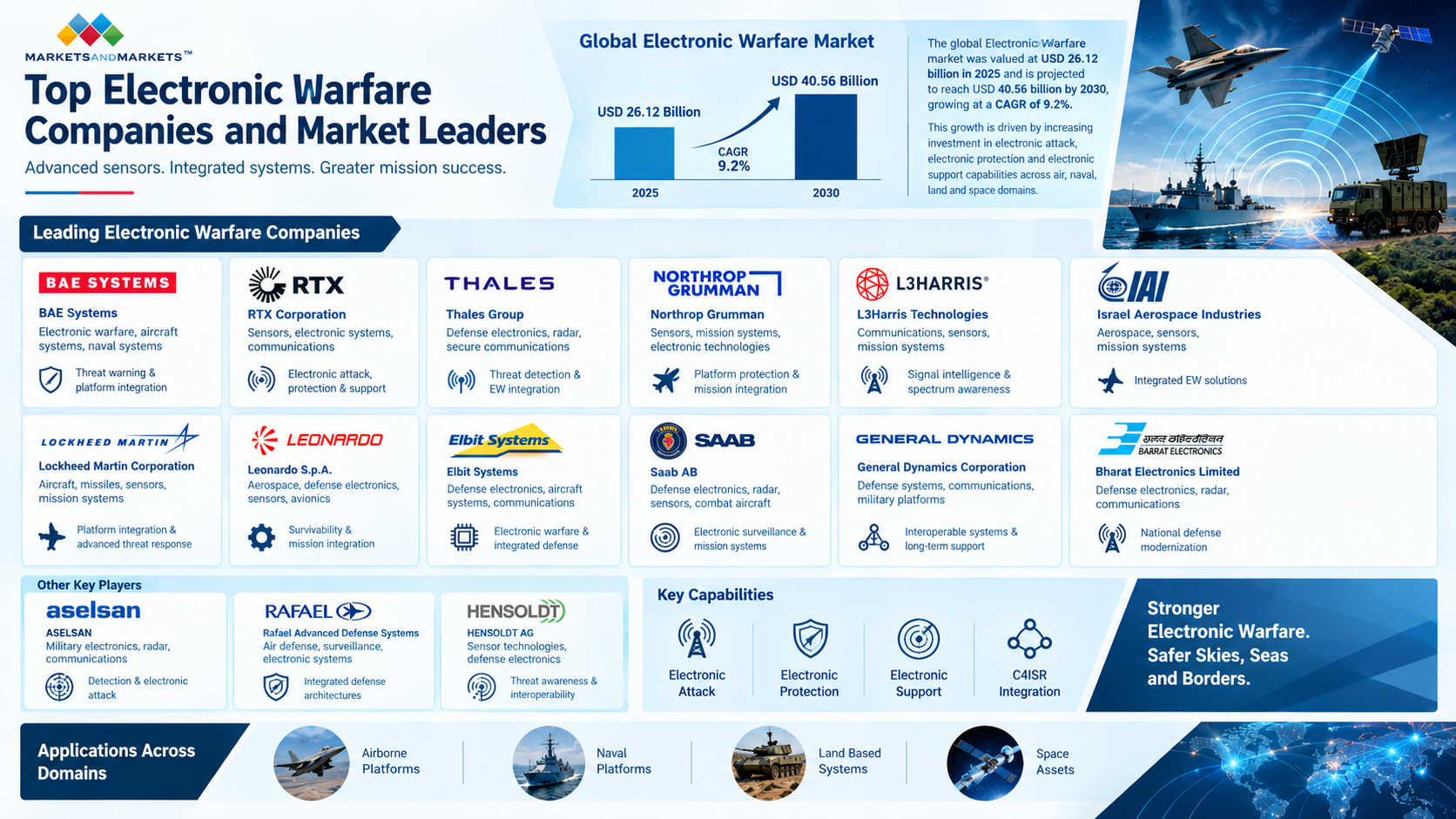
According to MarketsandMarkets, the Global Electronic Warfare Market was valued at USD 26.12 billion in 2025 and is projected to reach USD 40.56 billion by 2030. The supplied forecast identifies a compound annual growth rate (CAGR) of 9.2%. This expansion reflects growing investment in electronic attack, electronic protection, and electronic support capabilities across airborne, naval, land based, and space related defense applications.
Electronic warfare companies develop technologies that help military forces detect, analyze, protect, and operate within contested electromagnetic environments. Their portfolios can include radar warning receivers, electronic support systems, jamming equipment, signal intelligence capabilities, electronic countermeasures, threat detection software, and integrated mission systems. These technologies support both offensive and defensive operations, depending on the platform and mission.
The competitive landscape includes large aerospace and defense contractors, specialist electronic systems manufacturers, radar and sensor developers, and providers of software defined and digitally enabled defense technologies. Established companies compete through research and development, platform integration, long term defense contracts, and the ability to supply reliable equipment for demanding operational environments. Specialist firms contribute focused expertise in signal processing, electronic intelligence, threat identification, and spectrum management.
The growing complexity of modern threats is also changing the requirements for electronic warfare systems. Military operators need capabilities that can respond to rapidly changing signal environments, distinguish relevant threats, and coordinate with radar, communications, command and control, and other defense systems. Software adaptability, processing speed, system interoperability, and upgradeability are therefore important competitive considerations.
This article examines the electronic warfare market, its growth drivers, leading companies, major technologies, regional opportunities, and competitive landscape. It also provides a broad directory of 100 companies associated with electronic warfare and related defense electronics. The directory is intended as an industry overview, not an official ranking of the world's largest EW companies.
Market Size and Forecast
The supplied market figures indicate continued demand for electronic warfare systems as military organizations modernize their capabilities for operating in contested electromagnetic environments. EW technology supports the detection of electronic threats, protection of friendly communications and navigation, and disruption of adversary systems.
|
Market Metric |
Value |
|---|---|
|
Market size in 2025 |
USD 26.12 billion |
|
Projected market size in 2030 |
USD 40.56 billion |
|
Reported CAGR |
9.2% |
|
Main demand drivers |
Defense modernization, spectrum dominance, advanced radar and communication threats |
|
Major platforms |
Airborne, land, naval, space, unmanned and autonomous systems |
|
Core capabilities |
Electronic support, electronic attack and electronic protection |
Top 10 Key Takeaways
- The supplied global Electronic Warfare Market figures project growth from USD 26.12 billion in 2025 to USD 40.56 billion by 2030.
- The provided CAGR is 9.2%, although its stated 2026 to 2031 period does not align with the supplied market size years.
- BAE Systems, RTX, Thales, Northrop Grumman, and L3Harris Technologies are identified among the leading market participants.
- Electronic warfare includes electronic support, electronic attack, and electronic protection.
- Defense modernization and the increasing sophistication of radar, communications, navigation, and missile guidance systems support market demand.
- Software defined systems and AI enabled signal analysis are becoming increasingly important for adaptable EW capabilities.
- Electronic protection is identified as the largest capability segment in the current MarketsandMarkets report overview.
- Land based platforms are identified as the largest platform segment in that report overview.
- Europe is projected to register the fastest regional growth in the current report outlook.
- The wider industry includes major defense contractors, specialized EW developers, sensor manufacturers, and companies supplying related defense electronics.
Key Growth Drivers in the Electronic Warfare Market
Increasing Focus on Electromagnetic Spectrum Dominance
Modern military operations rely on the electromagnetic spectrum for communications, radar surveillance, navigation, targeting, intelligence collection, and coordination. As these systems become more interconnected, the ability to use the spectrum effectively while limiting an adversary's access to it has become a significant defense priority.
Electronic warfare systems help military forces detect electronic activity, assess potential threats, protect friendly equipment, and interfere with hostile electronic capabilities where authorized. The need to maintain operational effectiveness in environments affected by jamming, deception, and electronic surveillance supports investment in EW equipment across multiple military platforms.
Defense Modernization and Replacement of Legacy Systems
Defense forces are upgrading older electronic warfare equipment to address increasingly sophisticated radar, communication, and targeting systems. Legacy equipment may have limited processing capacity, restricted frequency coverage, or less flexibility when responding to changing signal environments.
Modernization programs create opportunities for companies offering digital receivers, advanced signal processing, software defined systems, electronic protection equipment, and integrated EW suites. Procurement can involve both new platforms and upgrades to aircraft, naval vessels, ground vehicles, and existing military infrastructure. The ability to integrate new technology without extensive disruption to existing platforms can be an important purchasing consideration.
Growing Sophistication of Radar and Communication Threats
Advances in radar, guided weapons, communication networks, and electronic sensors are increasing the complexity of the electromagnetic environment. Military forces need capabilities that can recognize relevant signals, interpret potential threats, and support timely decisions.
This creates demand for electronic support measures, signal intelligence, radar warning receivers, and electronic attack systems. Companies that combine sensing hardware with adaptable software and effective data analysis can address requirements for improved situational awareness and electronic protection.
Expansion of Unmanned and Autonomous Platforms
Unmanned aerial vehicles and other autonomous platforms are becoming relevant to both electronic warfare missions and the wider threat environment. Military organizations are evaluating ways to integrate electronic sensing and protection into platforms that operate alongside crewed aircraft, naval systems, and ground forces.
This creates demand for compact equipment, efficient power management, low weight, reliable data links, and integration with mission systems. Electronic warfare capabilities may also support the protection of unmanned platforms from hostile interference. Suppliers must balance capability with size, weight, power, cost, and platform compatibility.
AI Enabled and Software Defined Electronic Warfare
Artificial intelligence and software defined architectures are influencing the development of EW systems. Software based signal processing can help equipment adapt to new requirements, while AI supported analytics can assist with signal classification, pattern recognition, and the prioritization of potential threats.
The shift toward adaptable systems also changes the competitive landscape. Hardware remains essential, but software, computing capability, data processing, and upgrade pathways can influence long term product value. Companies that can maintain reliable performance while updating systems to address evolving threats may be better positioned to support long lifecycle defense programs.
Rising Geopolitical Tensions and Multi Domain Operations
Security concerns across multiple regions are encouraging governments to strengthen military readiness and invest in capabilities that support operations across air, land, sea, and space. Electronic warfare is relevant to these operations because it can affect communications, sensing, navigation, and the exchange of information.
Defense customers increasingly need EW systems that can coordinate with broader command, control, communications, computers, intelligence, surveillance, and reconnaissance architectures. This encourages suppliers to prioritize interoperability, secure data exchange, and compatibility with existing equipment.
Key Electronic Warfare Companies and Their Competitive Positioning
The electronic warfare market includes established defense contractors with broad system integration capabilities and specialized suppliers focused on sensing, electronic attack, communications, signal intelligence, and electronic protection. The current MarketsandMarkets report identifies BAE Systems, RTX, Thales, Northrop Grumman, and L3Harris Technologies among its leading players. Its broader company list also includes Israel Aerospace Industries, Lockheed Martin, Leonardo, Elbit Systems, Saab, General Dynamics, Bharat Electronics, ASELSAN, Rafael Advanced Defense Systems, and HENSOLDT.
The company profiles below describe their broad market relevance. They are not a ranked list by revenue or market share.
BAE Systems
BAE Systems is a major defense technology provider with capabilities across electronic warfare, electronic systems, combat aircraft equipment, naval systems, and mission integration. Its EW activities are relevant to aircraft survivability, threat warning, electronic countermeasures, and integrated defense electronics.
The company competes through its experience in complex defense programs, established customer relationships, and ability to integrate electronic warfare technologies with military platforms. Its broad portfolio supports applications where electronic protection must operate alongside other aircraft or platform mission systems.
RTX Corporation
RTX Corporation participates in electronic warfare through its defense and mission systems businesses, including Raytheon and Collins Aerospace capabilities. Its wider technology base covers sensors, electronic systems, communications, and defense integration.
RTX's competitive relevance comes from its ability to contribute to electronic attack, electronic support, electronic protection, and associated platform systems. Its experience across multiple defense domains is valuable to customers seeking EW solutions that can integrate with existing military infrastructure.
Thales Group
Thales Group operates across defense electronics, radar, secure communications, aerospace, and digital security. Its electronic warfare portfolio includes technologies associated with threat detection, electronic support, electronic countermeasures, and platform protection.
The company's combination of sensing, communications, and mission systems is relevant to integrated EW deployments. Thales is also identified among the leading market participants in the MarketsandMarkets research, reflecting its established role in defense electronics.
Northrop Grumman
Northrop Grumman Corporation develops advanced defense systems, sensors, mission equipment, and electronic technologies. Its experience in airborne systems and integrated defense programs is relevant to electronic warfare applications that require threat awareness and platform protection.
The company competes in programs where EW capabilities need to operate alongside radar, communications, mission computers, and other defense systems. Its established position in military aerospace and defense integration supports its relevance to the market.
L3Harris Technologies
L3Harris Technologies provides communications, sensors, mission systems, and electronic technologies for defense and government customers. Its wider capabilities are relevant to signal intelligence, electronic support, electronic countermeasures, and spectrum awareness.
L3Harris is one of the leading companies highlighted in the MarketsandMarkets electronic warfare research. Its competitive position is supported by its focus on mission systems and technologies that help military customers detect, interpret, and respond to electromagnetic threats.
Israel Aerospace Industries
Israel Aerospace Industries develops aerospace platforms, sensors, mission systems, and defense technologies. Its broader portfolio is relevant to electronic warfare applications across airborne and other defense environments.
The company's market relevance reflects demand for integrated systems that combine detection, analysis, and electronic countermeasure capabilities. EW integration with radar, communications, and other mission equipment remains important for customers seeking comprehensive platform protection.
Lockheed Martin Corporation
Lockheed Martin Corporation is a major defense contractor involved in military aircraft, missiles, sensors, mission systems, and integrated defense technologies. These capabilities create links with electronic warfare programs that require platform integration and advanced threat response.
Lockheed Martin's competitive position is supported by its experience delivering complex military systems and working with defense customers on long term modernization programs. The company is identified in MarketsandMarkets coverage as an important electronic warfare participant and an emerging leader in its evaluation matrix.
Leonardo S.p.A.
Leonardo S.p.A. develops aerospace platforms, defense electronics, sensors, avionics, and security systems. These areas are relevant to EW capabilities used for threat detection, platform survivability, and mission integration.
Leonardo's broad defense electronics portfolio positions it to participate in projects where electronic warfare equipment must work alongside radar, communications, and other mission systems. It is included among the key players identified in the MarketsandMarkets report.
Elbit Systems
Elbit Systems Ltd. develops defense electronics, aircraft systems, communications, sensors, and integrated military solutions. Its portfolio is relevant to electronic warfare across airborne and land based applications.
The company's position in the market reflects demand for integrated defense capabilities that connect electronic warfare with other mission technologies. MarketsandMarkets has also reported a 2026 modernization contract involving networked land EW systems, software defined radios, and autonomous capabilities.
Saab AB
Saab AB operates across defense electronics, radar, sensors, combat aircraft, and military systems. Its capabilities are relevant to electronic surveillance, signal awareness, and integrated defense operations.
Saab's broad defense portfolio supports applications where electronic warfare must be integrated with surveillance and mission systems. The company is among the established European suppliers included in the MarketsandMarkets electronic warfare company list.
General Dynamics Corporation
General Dynamics Corporation develops defense systems, military platforms, communications equipment, and mission technologies. Its relevance to electronic warfare includes the integration of electronic systems into broader land, naval, and defense architectures.
The company participates in a market where customers require interoperable equipment and long term support for complex military platforms. Its inclusion in electronic warfare industry coverage reflects the importance of large defense integrators alongside specialist EW suppliers.
Bharat Electronics Limited
Bharat Electronics Limited develops defense electronics, radar, communications, electronic systems, and other military technologies. Its portfolio is relevant to national defense modernization and electronic systems integration.
Domestic defense procurement and the need to strengthen local technology capabilities create opportunities for suppliers such as Bharat Electronics. The company's inclusion among key electronic warfare participants highlights the role of regional defense electronics manufacturers in the global competitive landscape.
ASELSAN
ASELSAN develops military electronics, radar, communications, and electronic warfare equipment. Its capabilities are relevant to detection, threat classification, electronic attack, and mobile defense applications.
ASELSAN's product development demonstrates the importance of regional defense suppliers in the EW market. MarketsandMarkets reported the launch of KORAL AD in May 2026, a mobile land based radar EW system combining electronic support and electronic attack functions.
Rafael Advanced Defense Systems
Rafael Advanced Defense Systems develops defense technologies for air defense, surveillance, electronic systems, and military protection. Its broader portfolio is relevant to integrated defense architectures where electronic warfare capabilities operate alongside other sensors and response systems.
Rafael's participation illustrates the role of specialized defense technology companies in addressing evolving electronic and aerial threats. Its market relevance is supported by the growing need for interoperable systems that protect military assets and support situational awareness.
HENSOLDT AG
HENSOLDT AG specializes in sensor technologies and defense electronics, including radar, optronics, and electronic systems. These capabilities are relevant to electronic support, threat awareness, and the sensing layer of integrated EW architectures.
HENSOLDT illustrates the importance of specialist sensor providers within the market. As customers seek more integrated electronic warfare capabilities, sensing performance and interoperability with other defense systems remain essential factors in system selection.
Speak Our Industry Analyst to Know More: https://www.marketsandmarkets.com/speaktoanalystNew.asp?id=1301
Key Market Trends and Insights
AI and Adaptive Electronic Warfare
AI and machine learning are increasingly relevant to the analysis of complex electromagnetic environments. Electronic warfare systems may need to process large volumes of signal information and identify changes in activity under time constraints. AI supported analysis can assist with signal classification, pattern recognition, and prioritization, while operators retain oversight of consequential decisions.
Adaptive systems are also becoming important because the electromagnetic environment can change quickly. Software based architectures can make it easier to update signal processing functions and add capabilities without replacing every hardware component. This can improve flexibility, although implementation depends on computing resources, validated software, cybersecurity, and integration requirements.
Electronic Protection and Spectrum Resilience
Electronic protection is essential when military systems must continue operating in environments affected by interference, jamming, or electronic deception. Protection can involve equipment design, signal processing, resilient communications, navigation support, and techniques for maintaining system performance under interference.
The current MarketsandMarkets report identifies electronic protection as the largest capability segment. This reflects the importance of preserving the effectiveness of friendly systems while adversaries attempt to disrupt communications, navigation, sensing, and targeting.
Software Defined EW Systems
Software defined electronic warfare architectures support changes to system behavior through software updates and reconfigurable processing. This approach can provide flexibility as signal environments, mission requirements, and threat characteristics evolve.
For defense buyers, the benefits depend on the system's architecture, the ability to verify software updates, and compatibility with existing equipment. For suppliers, software can become a differentiator alongside hardware performance, long term support, and integration expertise.
Integration Across Multiple Domains
Electronic warfare capabilities increasingly need to coordinate with other military systems across airborne, land, naval, space, and unmanned platforms. This integration helps military organizations share information and coordinate their response to electronic threats.
Cross domain operations also create technical challenges. Systems must exchange information securely, support different communication standards, and operate within platform specific power, size, and environmental constraints. Companies with broad system integration capabilities may have an advantage in programs that span multiple platforms.
Unmanned Platforms and Compact EW Equipment
The use of unmanned systems creates opportunities for smaller and lighter electronic warfare equipment. Payloads designed for unmanned platforms must meet strict limits on weight, energy consumption, heat dissipation, and available space.
This encourages development of compact sensors, embedded computing, efficient RF components, and modular mission equipment. As unmanned platforms become more integrated into defense operations, suppliers may find opportunities in both EW payloads and systems designed to protect unmanned assets from electronic interference.
Procurement and Lifecycle Modernization
Defense procurement remains an important route to market for electronic warfare suppliers. Government customers need systems that meet technical specifications, integrate with existing platforms, and remain supportable over long service lives.
Procurement decisions may involve hardware performance, software upgradeability, training, maintenance, interoperability, cybersecurity, and supply chain reliability. Companies that can provide sustained support throughout a platform's lifecycle may be better positioned for long term programs.
Electronic Warfare Market Segmentation
The market can be analyzed by offering, capability, spending, platform, and region. These categories help explain how military organizations procure EW technologies and how suppliers position their products.
|
Segmentation Category |
Main Segments |
Market Relevance |
|---|---|---|
|
By offering |
Receivers, jammers, anti jam systems, EW suites, software |
Covers the hardware and software used to detect, disrupt, and protect electronic systems |
|
By capability |
Electronic support, electronic attack, electronic protection |
Represents the main operational functions of electronic warfare |
|
By spending |
Research, development, test and evaluation; procurement |
Reflects investment in new capabilities and acquisition of fielded systems |
|
By platform |
Airborne, land, naval, space, unmanned and autonomous, multidomain |
Addresses platform specific requirements and integrated operations |
|
By region |
North America, Europe, Asia Pacific, Middle East, Rest of the World |
Reflects geographic differences in modernization, budgets, and procurement |
Offering Insights
Receivers and related sensing equipment help detect and analyze electronic signals. Jammers and electronic attack equipment are designed to disrupt or interfere with selected adversary systems under authorized operating conditions. Anti jam systems support the resilience of friendly communications, navigation, and other electronic functions.
EW suites combine multiple capabilities into integrated equipment, while software provides signal processing, control, analysis, and upgrade functions. Demand for integrated suites and adaptable software reflects the need to coordinate equipment rather than operate isolated components.
Capability Insights
Electronic support focuses on detecting, intercepting, identifying, and analyzing electromagnetic emissions to support situational awareness and decision making.
Electronic attack involves actions intended to disrupt, degrade, deceive, or deny an adversary's use of the electromagnetic spectrum.
Electronic protection focuses on preserving the performance of friendly systems in the presence of electronic attack or interference. These capabilities are complementary, and many modern defense architectures combine all three.
Spending Insights
Research and development spending supports the creation and evaluation of new EW technologies. This includes work on sensors, signal processing, software defined architectures, and systems designed to meet changing operational requirements.
Procurement covers the acquisition of equipment for operational use, including new systems and upgrades to existing platforms. MarketsandMarkets identifies procurement as the dominant spending segment in its current forecast, reflecting continued demand for modernized and expanded electronic warfare capabilities.
Platform Insights
Airborne EW systems support aircraft survivability, threat warning, and mission effectiveness. Land based systems support ground forces, tactical formations, and fixed installations. Naval systems operate within maritime environments, where ships must maintain situational awareness and protect their electronic systems.
Space and unmanned applications introduce distinct engineering requirements, including weight, power, thermal management, and integration with other payloads. Multidomain systems aim to coordinate EW information and functions across platforms and operating environments.
Regional Insights
North America
North America is an important center for electronic warfare research, procurement, and system integration. The region includes major defense contractors and specialist suppliers with capabilities across airborne EW, radar, electronic support, communications, and mission systems.
Demand is supported by defense modernization and the need to maintain the operational effectiveness of military platforms in contested electromagnetic environments. Established suppliers compete for government programs, while smaller companies contribute focused capabilities in signal processing, RF technology, embedded computing, and software.
Europe
Europe is expected to register the fastest growth in the current MarketsandMarkets report outlook. Defense modernization, regional security concerns, and investment in interoperable military systems are supporting demand for electronic warfare capabilities.
The region includes established suppliers such as BAE Systems, Thales, Leonardo, Saab, HENSOLDT, Rheinmetall, Indra, Terma, and Elettronica Group. Their capabilities span electronic systems, sensors, radar, aircraft protection, and defense integration.
European procurement also creates opportunities for suppliers that can support national requirements while ensuring compatibility with allied systems. Local industrial participation, supply chain resilience, and long term support may influence purchasing decisions.
Asia Pacific
Asia Pacific includes defense electronics manufacturers and aerospace companies in India, Japan, South Korea, China, and other markets. Regional procurement priorities vary, but electronic warfare is relevant to military modernization, communications resilience, surveillance, and platform protection.
Companies such as Bharat Electronics, ASELSAN's regional peers, Hanwha Systems, LIG Nex1, Mitsubishi Electric, NEC, and other defense technology providers contribute to the broader industry ecosystem. Domestic industrial development can influence procurement, while partnerships with international suppliers can provide access to additional technologies.
Middle East
The Middle East presents opportunities for electronic warfare and related defense electronics as governments invest in military modernization, surveillance, and the protection of strategic assets. The need to integrate sensors, communications, and electronic protection into broader defense architectures can create demand for complete systems as well as specialized components.
Regional suppliers and international contractors may compete through local partnerships, technology transfer arrangements where permitted, and long term sustainment support. Procurement remains dependent on national defense priorities, budget availability, and applicable export controls.
Rest of the World
Other markets may adopt electronic warfare technologies as part of broader defense modernization programs. The scale and pace of procurement can vary significantly according to budget, threat assessment, technical capability, and existing platform inventories.
For suppliers, opportunities may include upgrading legacy systems, supplying modular equipment, and supporting integration with existing radar and communication networks. Training, maintenance, and lifecycle support can be especially important where local technical resources are limited.
Growth Opportunities in the Electronic Warfare Market
Development of AI Enabled EW Capabilities
AI enabled analysis offers opportunities for suppliers developing software that can process complex signal environments and support faster threat assessment. Electronic warfare systems must operate against evolving signals and technologies, making adaptability an important consideration.
Companies that combine specialized hardware with reliable software, processing, and upgrade capabilities can differentiate their offerings. The opportunity extends to new systems as well as software upgrades for existing platforms.
Modernization of Existing Military Platforms
Upgrading existing aircraft, ships, ground vehicles, and defense installations creates demand for electronic warfare equipment that can integrate with legacy systems. Many customers need improved capability without replacing an entire platform.
Suppliers can address this opportunity through modular architectures, compatible interfaces, improved signal processing, and lifecycle support. Successful upgrades require careful assessment of space, power, cooling, cybersecurity, and integration constraints.
Compact Systems for Unmanned Platforms
The expansion of unmanned and autonomous platforms creates opportunities for compact EW equipment. Suppliers that develop lightweight sensors, embedded computing, and efficient electronic components can support platforms with strict payload limits.
These systems must also meet reliability and environmental requirements while integrating with communications, navigation, and mission equipment. Miniaturization and power efficiency are important development priorities.
Integrated Multidomain Defense Solutions
Military customers increasingly need electronic warfare systems that exchange information with sensors, communications networks, command systems, and other defense capabilities. This creates opportunities for companies that can integrate hardware and software across several platforms.
Large defense contractors can use their system integration experience to compete for complex programs, while specialist suppliers can contribute particular technologies through partnerships. Interoperability and secure information exchange are likely to remain important purchasing criteria.
Regional Defense Industrial Development
Governments seeking greater domestic control over defense technology can create opportunities for local electronics manufacturers and international companies with authorized regional partnerships. Relevant activities may include system assembly, component manufacturing, testing, maintenance, and technology development.
Companies that understand local procurement requirements and can provide long term support may be better positioned to participate in these programs. However, market access depends on national regulations, export controls, security requirements, and procurement decisions.
Challenges Facing the Electronic Warfare Industry
Rapidly Changing Threat Environments
Electronic warfare technologies must respond to changes in radar, communications, navigation, and other electronic systems. Equipment designed around earlier threat characteristics may require updates to remain effective.
Continuous development and testing can increase costs and extend program timelines. Suppliers need to maintain adaptable architectures while ensuring that software and hardware updates meet operational requirements.
High Research and Development Costs
Advanced electronic warfare systems can require specialized RF components, signal processing hardware, software, testing facilities, and integration with military platforms. Development costs can be substantial, particularly for systems intended to operate across multiple domains.
Companies must balance innovation with affordability, manufacturing readiness, and long term support. Smaller suppliers may face additional challenges when pursuing large defense programs that require extensive qualification and sustained production capacity.
Integration with Legacy Defense Infrastructure
Many defense platforms have long service lives and use different generations of hardware, software, and communications standards. Integrating new EW equipment with these systems can require substantial engineering work.
Compatibility issues can affect system performance, upgrade schedules, and total ownership costs. Suppliers that support modular architectures and well defined interfaces may help customers manage integration complexity.
Cybersecurity and Software Reliability
Software defined EW systems depend on reliable computing, secure data handling, and controlled software updates. Vulnerabilities in connected systems can affect operational reliability or expose sensitive information.
Manufacturers must consider cybersecurity throughout the development and support lifecycle. Secure development practices, testing, configuration management, and timely maintenance are important to maintaining system integrity.
Export Controls and Procurement Complexity
Electronic warfare technologies may be subject to national security restrictions, export controls, and specialized procurement procedures. These requirements can affect which customers companies can serve and how systems can be transferred or supported.
Long procurement cycles can also create uncertainty for manufacturers investing in new technology. Suppliers must account for customer qualification requirements, government approvals, contract schedules, and changing defense priorities.
Future Outlook
The global Electronic Warfare Market is positioned for continued development as armed forces seek to preserve operational effectiveness in increasingly contested electromagnetic environments. The supplied forecast places the market at USD 26.12 billion in 2025, with a projected value of USD 40.56 billion by 2030 and a reported CAGR of 9.2%. These figures should be interpreted with the forecast period clarification provided earlier in the article.
Competitive activity is likely to center on electronic support, electronic attack, electronic protection, and integrated EW suites. Established defense contractors are positioned to compete through platform integration, long term procurement relationships, and broad mission system portfolios. Specialist companies contribute expertise in RF sensing, signal analysis, electronic countermeasures, testing, and software.
AI enabled analytics, software defined architectures, compact electronic systems, and multidomain integration are important areas of technological development. They can help defense organizations adapt systems to changing operating requirements, although performance depends on testing, system integration, cybersecurity, and the characteristics of the threat environment.
Regional defense modernization will continue to influence market opportunities. Europe is identified as the fastest growing region in the current MarketsandMarkets report outlook, while North America and Asia Pacific remain important areas for defense electronics development and procurement.
For companies competing in this market, long term success will depend on combining dependable hardware with adaptable software, effective integration, lifecycle support, and compliance with procurement and export requirements. The competitive landscape will continue to include both large defense contractors and specialized technology suppliers, with opportunities shaped by the specific requirements of military customers.
Frequently Asked Questions
1. What is the projected size of the Electronic Warfare Market?
According to the figures supplied for this article, the global Electronic Warfare Market was valued at USD 26.12 billion in 2025 and is projected to reach USD 40.56 billion by 2030. The supplied CAGR is 9.2%, although the stated 2026 to 2031 period does not align with those market size years.
2. Which companies are the leading players in the Electronic Warfare Market?
MarketsandMarkets identifies BAE Systems, RTX, Thales, Northrop Grumman, and L3Harris Technologies among the leading players. Other companies on its key player list include Israel Aerospace Industries, Lockheed Martin, Leonardo, Elbit Systems, Saab, General Dynamics, Bharat Electronics, ASELSAN, Rafael Advanced Defense Systems, and HENSOLDT.
3. What are the main capabilities of electronic warfare systems?
The three core capabilities are electronic support, electronic attack, and electronic protection. Electronic support detects and analyzes electromagnetic activity, electronic attack seeks to disrupt or deceive adversary systems, and electronic protection helps maintain the performance of friendly systems in contested environments.
4. Which technologies are shaping the electronic warfare industry?
Important technology areas include software defined systems, AI supported signal analysis, advanced RF components, electronic support measures, electronic countermeasures, and integrated mission software. These technologies help suppliers address evolving threats and improve system adaptability.
5. Which region is expected to grow fastest in the Electronic Warfare Market?
Europe is projected to register the fastest growth in the current MarketsandMarkets report outlook. Defense modernization, regional security priorities, and investment in interoperable military capabilities are identified as important factors supporting regional demand.

This FREE sample includes market data points, ranging from trend analyses to market estimates & forecasts. See for yourself.
SEND ME A FREE SAMPLE