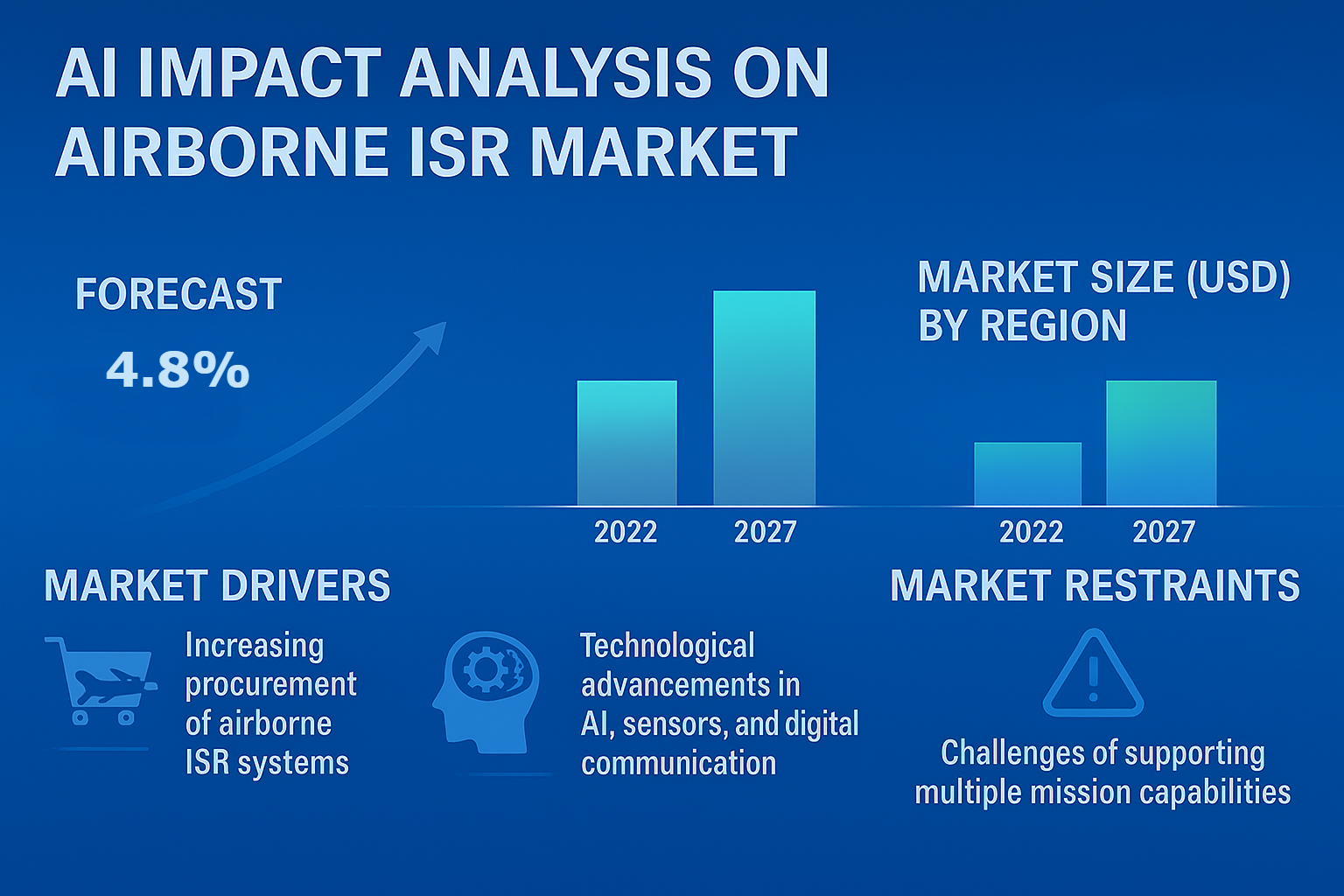
AI Impact Analysis on Airborne ISR Industry
Why AI Is Defining the Next Generation of ISR
Over the past decade, the airborne Intelligence, Surveillance, and Reconnaissance market in North America has undergone a paradigm shift fueled by artificial intelligence. Once defined by human analysts poring over feeds from electro optical, infrared, or radar sensors, ISR platforms are now gaining onboard intelligence. Today’s systems fuse multi sensor inputs, identify threats autonomously, forecast adversary behavior, and adjust missions dynamically all with minimal latency. As demand for situational awareness grows from counterterrorism to environmental monitoring AI stands at the core of an ISR transformation where speed, precision, and ethical use matter more than ever.
AI Powered Sensor Fusion in Airborne ISR
Airborne ISR units such as the MQ-9 Reaper, Northrop Grumman RQ-4 Global Hawk, and smaller drones now host diverse payloads including radar, EO/IR, SIGINT interceptors, and hyperspectral instruments. Historically, each sensor stream required separate analysis by a ground operator or analyst. AI now enables real time fusion melding radar tracks with thermal images and signal intercepts. This creates a unified operating picture where objects of interest stand out clearly amid cluttered terrain. AI models trained on multi sensor datasets detect and prioritize entities that warrant attention, drastically reducing operator workload and enabling rapid responses to threats or emergencies.
In North America, where both tactical and strategic ISR missions are critical from maritime patrols along the Pacific and Gulf Coast to border security across landfrontiers sensor fusion offers a force multiplier. It streamlines decision making and enhances mission effectiveness, enabling airborne platforms to sense complex scenarios more holistically than ever.
Real Time Target Detection and Classification
Beyond fusion, AI enables onboard target detection and classification with unprecedented speed and accuracy. Deep learning models running edge side on aircraft identify vehicles, ships, aircraft, and even dismounted persons with sub second latency. These systems analyze motion patterns, shape, heat signatures, and radar cross sections to differentiate threats from benign objects. In clandestine scenarios surveillance across forested borders or refugee movement after natural disasters this immediacy enables timely alerts to commanders and first responders.
Enhanced by edge compute capabilities onboard unmanned systems, AI powered classification is no longer confined to ground operations. North American defense platforms are now shipping pre trained neural models that improve over time through software updates, with human in the loop oversight to prevent misidentification. As ISR fleets scale and missions grow more complex, this ability to autonomously interpret and flag events remains central to operational value.
Predictive Intelligence and Threat Forecasting
Traditionally, threat assessments relied on human analysts who detected patterns across dispersed sensor data. AI changes this by enabling predictive forecasting. By analyzing historical ISR data including logistics movements, convoy habits, timing patterns, or weapon signatures machine learning identifies future risk windows. This allows preemptive positioning of ISR assets before adversaries act, optimizing surveillance coverage and minimizing operational risk.
In Northern border regions or shared airspace zones, predictive intelligence guides the persistent positioning of drones to deter threats before they emerge. This strategic shift from reactive to proactive ISR marks a major shift enabled by AI.
Automated Mission Planning and Dynamic Re Tasking
Dynamic battlefield environments demand flexibility. When new priority areas emerge, AI enabled ISR systems can re task themselves from base station inputs or autonomously onboard. These platforms adjust altitude, speed, flight paths, or sensor engagement in real time. Integration with Air Tasking Order networks allows rapid retasking without manual plotting.
In North America’s layered ISR architecture where unmanned platforms support manned aircraft AI streamlines coordination. ISR assets can exchange clearance, maneuver, and deconflict in real time, ensuring awareness is maintained while avoiding mishaps.
Cognitive Electronic Warfare Integration
Advanced adversaries increasingly use anti access and electronic warfare tactics designed to blind ISR platforms. AI bolsters resilience by identifying jamming, spoofing, or deception techniques and automatically adjusting sensor parameters. Cognitive EW systems can hop frequencies, filter interference, or re point antennas adaptively to preserve geo location accuracy.
During joint U.S. Canadian interoperability exercises, ISR fleets explore cognitive EW to ensure ISR continuity in contested RF environments. As North American airspace becomes electronically active due to expanding commercial drone traffic and communications infrastructure, this capability is vital.
AI Enhanced GEOINT and Image Recognition
Satellite feeds and airborne imagery from high resolution sensors are processed using convolutional neural networks to analyze land use changes, infrastructure construction, and maritime movements. AI understands terrain contexts, identifies vehicles in dense terrain, and detects subtle activity like new landing zones or unusual traffic corridors.
Real time imagery overlays on intelligence maps support integrated GEOINT summaries. Agencies use this to monitor illegal pipeline encroachments, construction near sensitive installations, or search and rescue.
Get AI Impact Analysis on Airborne ISR Market, Request Pdf Brochure: https://www.marketsandmarkets.com/pdfdownloadNew.asp?id=262860641
AI in Signal Intelligence (SIGINT) Analysis
Intercepted RF communications and telemetry once took hours or days to analyze. AI now ingests massive RF datasets onboard ISR platforms, identifying signatures, beacon sources, and mapping communication networks. These models locate emitter locations using time difference of arrival, signal intensity, and digital modulation patterns.
Onboard AI assists safer reconnaissance. Pilots shying away from hostile emitters gain real time situational warnings. North American defense agencies favor real time SIGINT mapping to identify new threats without risking human operators.
Onboard Edge AI for Tactical ISR Platforms
Edge AI hardware like NVIDIA Jetson, Intel Movidius, and ARM based NPUs are now deployed on platforms like MQ-1 Predator or MQ-9 Reaper. With AI models optimized for size and power constraints, ISR data can be processed onboard without satellite relays.
Edge presence shortens the sensor to shooter loop and ensures awareness even when radios are degraded. Small and medium ISR platforms can now carry advanced algorithms for object recognition and mission automation thanks to low latency inference.
AI Enabled Data Management and Decision Support
ISR platforms generate terabytes of data per flight: video, radar hits, metadata, and logs. AI systems are required to sift through this deluge to flag high priority events, summarize flight findings, and offer human operators actionable intelligence rather than raw feeds.
Decision support systems generate mission reports, summary products, and trending visuals to commanders. They also integrate with allied command centers for multi domain awareness across land, sea, and cyber.
Ethical, Legal, and Policy Implications
As AI assumes more autonomous roles in ISR from identifying targets to rerouting missions ethical and legal concerns rise. Who is accountable for a false identification or civilian misclassifications? How do analysts ensure fairness, compliance with international law, and protection of citizen privacy in North America’s densely populated border regions?
Agencies now debate transparency of AI models, establishing audit trails for model decisions. Privacy safeguards may require redaction of civilian faces or non threat entities before data cross border. The notion of human in the loop review remains central, although use case dependent thresholds for immediacy may allow temporary human oversight after mission pilots start.
Future Trends and Market Outlook
The convergence of AI and airborne ISR is driving a rapid evolution of capabilities in North America. AI enabled sensor fusion, real time classification, and predictive intelligence are becoming baseline requirements for any ISR platform assessing the contested Arctic or countering emerging drone threats along coastlines.
Industry leaders in platforms and AI are collaborating through contracts and testing environments such as Project Liberty Lifter and ANG innovation packages. Defense budgets now allocate specific funding for AI integration into current ISR fleets.
Looking ahead, we expect greater reliance on edge microservices, federated learning in ISR networks, and transparent AI pipelines that balance autonomy, oversight, and accountability. The next generation of airborne ISR platforms will be trusted to act more independently, armed with real world data refined by continuous AI retraining, and governed by frameworks that prioritize safe, lawful, and robust deployment.
Final Thoughts
Artificial intelligence is redefining the airborne ISR market in North America. Once intensive missions across terrain, naval, border, and urban theaters are now executed with smart sensor networks, onboard autonomy, and deeper data insights. Yet, as autonomy deepens, questions of ethics, oversight, and transparency emerge.
The future of airborne ISR lies at the intersection of human expertise and machine precision. With AI as both engine and compass, airborne ISR will become faster, sharper, and more accountable ushering in a new era of safer skies, sustainable security, and informed decision making.
Related Report:
Airborne ISR Market by Application (Search and Rescue, Border and Maritime Patrol, Target Acquisition and Tracking, Critical Infrastructure Protection, Tactical Support), Solution, Platform, End-user, and Region- Global Forecast

This FREE sample includes market data points, ranging from trend analyses to market estimates & forecasts. See for yourself.
SEND ME A FREE SAMPLE






