AI Impact Analysis on Aircraft Gearbox Market
The global aircraft gearbox market is entering a new era of technological transformation driven by accelerating innovation in artificial intelligence. Gearboxes have always been among the most critical components in aircraft propulsion, enabling the transfer, reduction, or modulation of power from engines to rotors, fans, or auxiliary systems. While historically mechanical in nature, today’s gearbox systems have become deeply intertwined with advanced digital technologies, especially AI, which is redefining how gearboxes are designed, manufactured, monitored, and maintained.
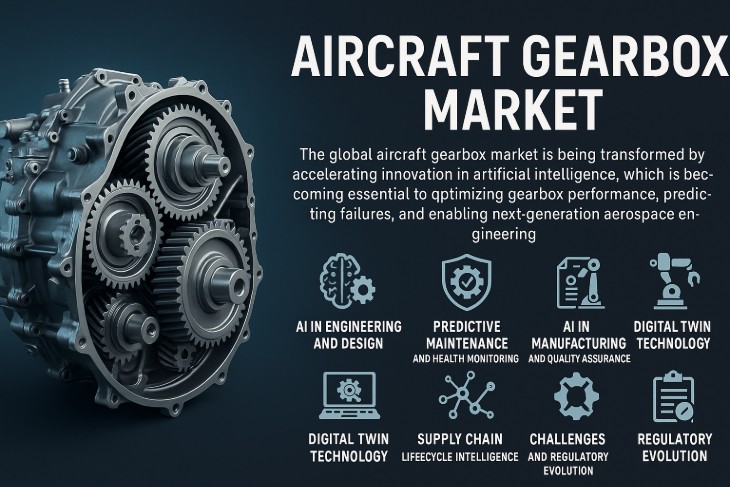
As the global aviation industry moves toward higher operational efficiency, greater safety, and stricter sustainability standards, AI has emerged as the most influential force shaping the future of propulsion systems. From helicopters and turboprops to emerging electric and hybrid aircraft platforms, AI is becoming essential to optimizing gearbox performance, predicting failures before they occur, reducing lifecycle costs, and enabling the next generation of aerospace engineering.
Between 2025 and 2035, the integration of AI across the gearbox value chain is expected to transform the market from a mechanical engineering driven industry to a digitally intelligent ecosystem where machine learning, automation, and data analytics shape performance outcomes. This blog explores how AI will influence the aircraft gearbox market through design, manufacturing, predictive maintenance, digital twin technology, supply chain intelligence, regulatory development, and future propulsion innovations.
Understanding the Aircraft Gearbox Market in the AI Age
Aircraft gearboxes play a foundational role in ensuring power efficiency and structural integrity across aircraft propulsion systems. Their primary purpose is to manage torque conversion, speed optimization, and power distribution across various aviation platforms. Traditional gearbox systems rely heavily on precision milled components, material engineering, lubrication quality, and periodic maintenance to achieve reliability. However, the limitations of legacy systems, combined with rising demand for enhanced aircraft safety and lower operating costs, are driving the integration of AI across gearbox operations.
The global aircraft gearbox market includes power transmission gearboxes, accessory gearboxes, reduction gearboxes, and main rotor gearboxes used primarily in helicopters. Widespread demand across commercial aviation, military fleets, business jets, UAVs, and emerging urban air mobility platforms is increasing pressure on manufacturers to innovate. AI supports this evolution by providing systems with the ability to understand their environment, learn from operating conditions, and self optimize for superior performance.
This transition is being accelerated by broader industry forces. Air travel demand is rising, propulsion systems are becoming more electric and hybridized, materials science is advancing rapidly, and airlines are prioritizing predictive efficiency over mechanical redundancy. AI positions gearbox systems at the center of this transformation by enabling real time decision making, faster failure detection, automated control, and long term lifecycle intelligence.
AI in Aircraft Gearbox Engineering and Design
The design of aircraft gearboxes requires extreme precision. Gear meshing, load distribution, vibration characteristics, thermal properties, surface finishing, and material fatigue must be analyzed across thousands of operational scenarios. Traditionally, these analyses relied on manual engineering calculations, physical modeling, and iterative testing cycles that were time consuming and expensive.
AI is revolutionizing gearbox engineering through generative design systems that automatically create optimized configurations based on performance requirements. Machine learning models simulate how gears behave under fluctuating loads, extreme temperatures, or vibration acceleration. These models can identify structural weaknesses long before prototyping, significantly accelerating the development timeline.
Neural networks assist in selecting advanced materials for high durability-to-weight ratios. AI can predict how composite materials, alloys, and coatings will behave under rotational stress and frictional heat. This leads to lighter, stronger gearboxes that enhance engine efficiency and reduce emissions.
AI also optimizes gear tooth profiles, bearing alignment, shaft geometry, and lubrication channels. Instead of running thousands of repetitive simulations manually, engineers use AI driven simulation engines that evaluate multiple variables simultaneously. The result is superior gearbox performance achieved at a fraction of the traditional engineering cost and time.
AI’s integration into gearbox design contributes not only to enhanced reliability and safety but also supports the development of next generation propulsion systems, including hybrid electric and hydrogen powered aircraft where gearbox optimization becomes even more critical.
AI-Driven Predictive Maintenance and Health Monitoring
Maintenance costs are among the largest operational expenditures in aviation. Gearbox failures can result in catastrophic engine damage, unscheduled downtime, flight delays, emergency landings, and significant financial losses. Traditional maintenance schedules rely on fixed intervals based on flight hours or cycles, which may lead to premature part replacement or undetected degradation.
AI transforms gearbox maintenance through condition based monitoring powered by advanced sensor arrays that continuously measure vibration, temperature, torque, sound patterns, lubrication flow, and gear meshing noise. These sensors feed real time data into AI algorithms that learn the normal operating behavior of the gearbox and instantly detect deviations.
Machine learning algorithms identify early signs of gear pitting, bearing wear, misalignment, and lubrication breakdown long before they would be detected during routine inspections. This predictive approach reduces maintenance costs, enhances reliability, and increases aircraft availability.
In military aviation, where mission critical reliability is essential, AI driven predictive maintenance provides real time insights into gearbox health even during high stress operations such as combat maneuvers or extreme weather flights. In commercial fleets, predictive maintenance enhances safety, reduces delays, and extends component lifespan.
As aircraft systems become increasingly digitally connected, AI based gearbox health monitoring will integrate with broader Aircraft Health Monitoring Systems (AHMS), creating a holistic ecosystem where engines, gearboxes, avionics, and flight systems collaborate to predict and prevent failures autonomously.
AI in Gearbox Manufacturing and Quality Assurance
Aircraft gearbox manufacturing requires exceptional precision. The slightest deviations in material quality, machining accuracy, or surface finishing can compromise performance. AI supports next generation manufacturing through smart automation and advanced data analytics.
AI powered machine vision systems inspect gears and shafts at microscopic resolution, detecting imperfections invisible to the human eye. Automated robotic systems guided by AI optimize milling, grinding, and finishing processes to maintain strict tolerance controls. AI also predicts tool wear and dynamically adjusts machining parameters to maintain consistent output quality.
In heat treatment and surface hardening, machine learning models analyze temperature distribution, material microstructure, and cooling patterns to ensure optimal strength and fatigue resistance. AI driven quality assurance processes evaluate gearbox balance, acoustic signatures, and load bearing performance with unmatched accuracy.
This level of precision reduces manufacturing defects, minimizes rework, and shortens production cycles. By 2035, AI enabled smart factories will produce gearboxes that are more durable, lighter, and more energy efficient than any legacy system could achieve.
AI-Enabled Digital Twin Technology for Gearbox Optimization
Digital twin technology is one of the most transformative AI applications in aerospace gearbox development. A digital twin is a virtual replica of a physical gearbox, continuously updated with data from sensors during operation.
AI uses this data to simulate stress patterns, thermal expansion, lubrication distribution, vibration behavior, and fatigue accumulation in real time. These continuously evolving simulations allow engineers to predict failure points, assess performance inefficiencies, and optimize designs without physically testing new components.
Digital twins accelerate certification timelines, reduce testing requirements, and enable predictive maintenance strategies that increase fleet readiness. AI powered digital twins can replicate thousands of operational scenarios that would otherwise require extensive flight testing, significantly reducing development costs.
As aircraft propulsion becomes more complex, with hybrid drive motors and distributed propulsion architectures, digital twins will become indispensable in modeling gearbox interactions across multiple power sources. By 2035, digital twins will form the backbone of AI driven gearbox lifecycle intelligence.
AI in Supply Chain and Lifecycle Management
The aircraft gearbox supply chain is global and complex, involving precision machining facilities, material suppliers, component manufacturers, and maintenance networks across multiple continents. Any disruption can significantly affect delivery timelines for aircraft OEMs and operators.
AI enhances supply chain resilience through real time demand forecasting, supplier performance tracking, and risk prediction. Machine learning models analyze historical data, component wear rates, maintenance schedules, and flight patterns to predict inventory needs with greater accuracy.
AI also monitors potential disruptions such as material shortages, logistics delays, or geopolitical risks. In environmentally regulated markets, AI helps track the sources and certifications of raw materials used in gear manufacturing. Blockchain integrated with AI enhances part traceability, reducing counterfeit risks and ensuring compliance with airworthiness regulations.
Lifecycle management of gearbox components becomes more efficient as AI continually tracks operational aging, maintenance history, and performance degradation. This information supports better procurement planning, cost optimization, and sustainability initiatives across the gearbox industry.
Get AI Impact Analysis on Aircraft Gearbox Market, Request Pdf Brochure: https://www.marketsandmarkets.com/pdfdownloadNew.asp?id=241445553
AI for Performance Enhancement and Efficiency
Aircraft gearboxes endure extreme operating environments involving high torque, rotational speed, lubrication temperature, and dynamic load variations. AI enhances gearbox performance through continuous optimization during flight.
Real time AI algorithms analyze gearbox operating conditions and adjust lubrication flow, load distribution, and rotational speed alignment to minimize friction losses. AI based thermodynamic models regulate cooling and lubrication systems to ensure optimal thermal behavior.
AI also reduces vibration and mechanical noise by predicting irregularities in rotational dynamics and dynamically correcting them. These efficiency improvements contribute to lower fuel burn, reduced emissions, and enhanced flight stability.
In hybrid electric or distributed propulsion aircraft, AI manages power transmission intelligently across multiple motors and gear sets, improving overall propulsion efficiency. This capability will be critical for next generation sustainable aircraft where gearbox performance becomes central to reducing environmental impact.
Key Players and Technological Advancements
The aircraft gearbox market is led by major OEMs such as Safran, Liebherr, Pratt & Whitney, Rolls Royce, and Airbus Helicopters. These companies are investing heavily in AI driven gearbox research and integrating digital tools across the production and maintenance ecosystem.
AI partnerships are forming between aerospace companies and technology leaders like NVIDIA, Siemens, Microsoft, Dassault Systèmes, and Google Cloud. Startups specializing in predictive maintenance, digital twin modeling, and machine vision systems are playing an important role in accelerating AI adoption.
Defence organizations and research institutions are contributing to the development of advanced materials, generative gearbox designs, and AI driven diagnostics. Collaborative R&D projects are focused on electric aircraft gearboxes, autonomous maintenance planning, and AI assisted certification processes.
The integration of AI into every stage of gearbox development and operation represents the largest technological leap since the introduction of computer aided design decades ago.
Challenges, Cybersecurity, and Regulatory Evolution
Despite its enormous potential, AI adoption in the aircraft gearbox market faces significant challenges. Certification remains one of the most complex issues because aviation authorities require clear, deterministic explanations for any algorithm affecting safety critical systems. AI’s probabilistic nature complicates this.
Cybersecurity risks increase as gearboxes become more connected. AI based diagnostics, cloud platforms, and digital twins expose new data vulnerabilities that must be protected against cyber intrusion. Regulatory agencies such as the FAA and EASA are developing new frameworks for AI certification, algorithm transparency, and data integrity.
Integrating AI with legacy aircraft systems requires careful engineering, particularly when retrofitting older fleets. Ensuring human oversight in AI driven maintenance decisions is essential for safety assurance. Ethical concerns around automated decision making, data privacy, and continuous monitoring must be addressed through comprehensive policy frameworks.
The next decade will require harmonized global standards to govern the safe and responsible use of AI in aviation propulsion systems, including gearboxes.
AI-Powered Gearboxes and Aviation 2035
By 2035, aircraft gearboxes will evolve into intelligent, self learning mechanical systems capable of real time performance optimization, autonomous diagnostics, and predictive lifecycle management. AI will drive new engineering innovations that result in lighter, quieter, more durable, and more energy efficient gear systems.
Next generation propulsion systems, including hydrogen engines, hybrid electric configurations, and distributed electric propulsion networks, will rely on AI optimized gearboxes to deliver stable, efficient power transmission. Autonomously controlled lubrication systems and vibration regulation engines will extend gearbox lifespan far beyond current limits.
AI will support fully automated maintenance planning, reduce ground time, enhance fleet reliability, and lower operational costs. Digital twin technology will evolve into full scope propulsion twins that integrate engine, gearbox, and electrical power systems into a unified intelligence model.
This transformation marks the beginning of a new age in aerospace propulsion where mechanical engineering and artificial intelligence converge to shape the future of aviation performance and sustainability.
Related Report:
Aircraft Gearbox Market by Type (Accessory, Reduction, Actuation, Tail Rotor, Auxiliary Power Unit), Component (Gear, Housing, Bearings), Application (Engine, Airframe), Platform (Military, Civil), End Use (OEM, Aftermarket), and Region - Global Forecast to 2028

This FREE sample includes market data points, ranging from trend analyses to market estimates & forecasts. See for yourself.
SEND ME A FREE SAMPLE






