AI Impact Analysis on Europe High-torque Synchronous Motor Industry
Europe High-Torque Synchronous Motor Market and AI Integration
The European high torque synchronous motor market is undergoing a fundamental transformation, largely driven by the rapid adoption of Artificial Intelligence across industries. These motors, known for their precision, durability, and efficiency, are widely deployed in heavy duty applications including steel manufacturing, mining, electric vehicles, aerospace, and marine propulsion. Europe’s focus on sustainability, electrification, and digitalization has created a fertile environment for integrating AI into these systems. AI is no longer a secondary tool but a central enabler of design innovation, predictive maintenance, energy optimization, and industrial automation. From regulatory compliance to emerging applications in electric mobility and aerospace electrification, the role of AI is becoming increasingly significant. As Europe positions itself as a leader in industrial digitalization under frameworks such as Industry 4.0 and the EU Green Deal, high torque synchronous motors enhanced by AI are poised to define the next era of energy efficient, reliable, and intelligent machinery.
AI in High-Torque Synchronous Motor Design Optimization
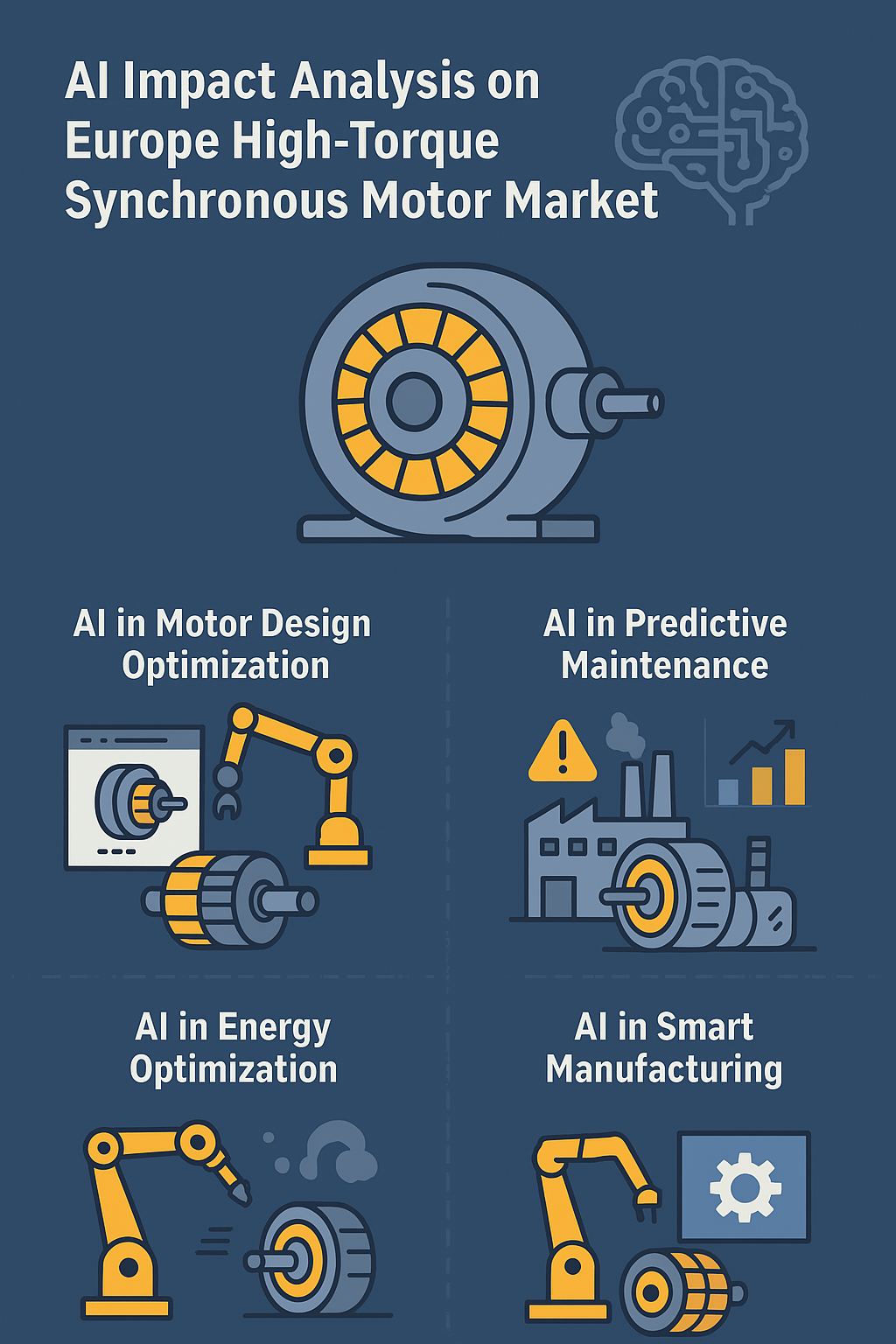
Designing motors that deliver both high torque and energy efficiency is a complex task. Traditionally, engineers relied on incremental improvements in materials, geometries, and cooling systems. Today, AI is revolutionizing this process. Machine learning algorithms allow engineers to analyze thousands of rotor and stator design variations in simulation environments before physical prototyping. This speeds up the innovation cycle and reduces development costs. AI also aids in selecting materials with optimal magnetic properties, balancing torque output with weight and durability. Digital twin models powered by AI provide a virtual testing ground, predicting how motors will perform under various loads, speeds, and environmental conditions. By simulating real world stress, these models help design motors with improved torque density while minimizing vibration and noise. Generative AI tools are further enabling lightweight yet structurally strong motor designs that meet the stringent requirements of aerospace and electric vehicle industries. Thermal management is another area where AI is critical, predicting hot spots and recommending designs that prevent overheating. As a result, AI is not only accelerating motor innovation but also ensuring reliability and safety in applications that demand uncompromising performance.
AI in Predictive Maintenance and Condition Monitoring
Predictive maintenance has become one of the most valuable AI applications in the motor industry. High torque synchronous motors are often used in mission critical applications where downtime is costly. AI powered predictive maintenance systems continuously monitor vibration patterns, temperature fluctuations, and electrical signatures to detect anomalies. These insights allow operators to schedule maintenance only when necessary, reducing unplanned failures and extending the lifespan of equipment. IoT enabled sensors feed real time data into AI algorithms, which then identify early warning signs of component degradation such as bearing wear, winding insulation breakdown, or rotor misalignment. AI driven prognostics go a step further, estimating the remaining useful life of critical components and optimizing spare part inventories. Root cause analysis powered by machine learning ensures that recurring issues are addressed effectively. In European industries where operational efficiency is paramount, AI enhanced predictive maintenance not only reduces downtime but also lowers costs, helping companies remain competitive in a rapidly evolving global market.
Enhancing Efficiency and Energy Optimization with AI
Energy efficiency is central to Europe’s industrial policies, and AI is a crucial enabler of optimizing synchronous motor performance. High torque motors consume significant power, especially in heavy industries. AI based control algorithms optimize speed and torque in real time, ensuring motors draw only the energy required for specific tasks. Adaptive load balancing allows motors to respond dynamically to fluctuating operational demands, reducing energy waste. Machine learning models help identify inefficiencies such as harmonic losses and correct them through smarter controllers. AI also improves power factor correction, ensuring smoother integration with industrial power systems. In variable speed applications, AI dynamically adjusts performance parameters, delivering optimal efficiency without sacrificing torque output. Integration with smart grids is another emerging area, where AI ensures motors contribute to grid stability while reducing peak demand stress. For European industries striving to meet strict carbon reduction targets, AI enabled energy optimization represents both a compliance tool and a competitive advantage.
AI in Smart Manufacturing and Industrial Automation
Industry 4.0 has placed automation and digitalization at the center of European manufacturing, and high torque synchronous motors play a critical role in this shift. AI enhances their performance in robotic applications where precision torque control is vital. By integrating motors with AI driven SCADA and MES systems, manufacturers gain real time visibility and control over production processes. AI optimizes synchronization between multiple motors operating in assembly lines, reducing cycle times and increasing throughput. Smart factories leverage AI to autonomously adjust motor performance based on process variations, ensuring consistent product quality. Edge AI capabilities bring intelligence closer to the motor itself, reducing latency in decision making. The result is higher productivity, improved energy savings, and reduced downtime. European manufacturers are also deploying AI powered motors in collaborative robotics, where safety and precision are essential for human machine collaboration. This integration of AI with synchronous motors is laying the foundation for fully autonomous factories, where machines optimize themselves without human intervention.
AI Applications in Electric Vehicles and Mobility Solutions
The transition to electric mobility in Europe is accelerating, and high torque synchronous motors are at the heart of this revolution. AI optimizes the relationship between motors and batteries, ensuring energy flow is managed efficiently to extend vehicle range. Machine learning algorithms predict driving conditions and adjust torque output to deliver smoother acceleration and improved energy use. AI also enhances regenerative braking, capturing more energy and feeding it back into the system. Thermal management in EV motors, a critical challenge, benefits from AI predictive models that prevent overheating and extend motor life. In autonomous vehicles, AI integration ensures propulsion systems adapt seamlessly to dynamic driving conditions. Lightweight motor designs, achieved through AI generative modeling, help increase vehicle efficiency without compromising power. With Europe leading the EV transition, supported by strong regulatory frameworks and consumer demand, AI enhanced synchronous motors are pivotal in driving innovation and competitiveness in the automotive sector.
Get AI Impact Analysis on Europe High-Torque Synchronous Motor Market, Request Pdf Brochure: https://www.marketsandmarkets.com/pdfdownloadNew.asp?id=118919631
AI in Aerospace and Marine Propulsion Systems
Aerospace and marine industries in Europe are under increasing pressure to adopt cleaner propulsion systems, and synchronous motors play a significant role in electrification projects. AI enhances torque management in hybrid electric aircraft propulsion systems, ensuring reliable performance under varying loads and altitudes. Predictive AI models help identify potential faults in aerospace motors, where safety margins are non negotiable. Lightweight designs enabled by AI tools also reduce overall aircraft weight, improving fuel efficiency. In the marine sector, AI supports high torque synchronous motors used in propulsion systems for commercial ships, ferries, and naval vessels. Smart monitoring ensures motors perform efficiently even in harsh marine environments. Digital twin technology enables simulation of entire propulsion systems, predicting wear and optimizing performance before actual deployment. EU regulations encouraging decarbonization in both aviation and shipping further reinforce the need for AI driven innovation in these sectors. As Europe pushes forward with electrification in transport, AI’s role in aerospace and marine propulsion systems will continue to expand.
AI and Regulatory Compliance in Europe
Europe has some of the most stringent regulations governing industrial equipment, particularly regarding energy efficiency and environmental sustainability. AI assists manufacturers of high torque synchronous motors in meeting these requirements by automating compliance monitoring. Machine learning systems analyze motor performance data to ensure adherence to IEC and EN standards. AI driven digital audit tools streamline certification processes, reducing the time and cost required for compliance. Environmental policies such as the EU Green Deal and the Eco Design Directive require motors to meet energy efficiency benchmarks, and AI helps manufacturers optimize performance to meet these criteria. Smart reporting tools generate compliance documentation automatically, simplifying interactions with regulatory bodies. Beyond environmental compliance, AI also plays a role in cybersecurity, protecting connected motors from potential threats in digitally integrated industries. By enabling continuous monitoring and adjustment, AI ensures synchronous motors remain compliant not only at the point of certification but throughout their operational lifespan.
Market Challenges and Risks of AI Integration
Despite its transformative potential, AI integration into the high torque synchronous motor market is not without challenges. High implementation costs can deter smaller manufacturers from adopting AI technologies. Cybersecurity risks remain a concern as connected systems are vulnerable to hacking and data breaches. Dependence on large datasets poses another risk, particularly in industries where data quality or availability is limited. Retrofitting legacy systems with AI driven components can be technically complex and expensive. There is also a shortage of skilled professionals capable of bridging the gap between motor engineering and AI technologies. Over reliance on AI could pose risks in mission critical applications if algorithms malfunction. Interoperability across industries remains a challenge as AI solutions may not seamlessly integrate with existing systems. Intellectual property issues and ethical concerns, especially in defense related applications, add further complexity. Additionally, global supply chain disruptions in rare earth materials used in motor manufacturing create uncertainty for European producers. Addressing these challenges will be essential for unlocking the full potential of AI in the sector.
Future Outlook of AI in Europe’s High-Torque Synchronous Motor Market
The future of the European high torque synchronous motor market is increasingly tied to AI advancements. Smart grids integrated with AI will allow motors to become active components of energy systems, contributing to demand side management and renewable integration. Digital twin technology will become more sophisticated, enabling complete lifecycle management from design to decommissioning. In electric mobility, AI will play a decisive role in extending vehicle range and improving efficiency. Aerospace and marine industries will increasingly depend on AI for meeting electrification and decarbonization goals. Hybrid propulsion systems combining renewable energy with synchronous motors will gain traction, optimized by AI algorithms for maximum performance. Collaborative partnerships between AI startups, motor OEMs, and research institutions will accelerate innovation. Europe’s leadership in AI adoption, supported by strong regulatory frameworks and sustainability goals, positions it as a global leader in next generation motor technologies. Over the next decade, AI will be the defining factor in shaping a smart, sustainable, and competitive high torque synchronous motor ecosystem across Europe.
The Europe high torque synchronous motor market is at a pivotal moment, with Artificial Intelligence redefining how motors are designed, maintained, and deployed across industries. From predictive maintenance and energy optimization to electric mobility and aerospace electrification, AI is delivering measurable improvements in efficiency, reliability, and sustainability. While challenges such as cybersecurity, cost, and regulatory complexity persist, the long term outlook is overwhelmingly positive. Europe’s commitment to sustainability and digital transformation ensures that AI enhanced synchronous motors will play a central role in shaping the continent’s industrial future. As the demand for smarter, greener, and more efficient solutions continues to rise, the convergence of AI and motor technology will not only drive innovation but also reinforce Europe’s position as a global leader in industrial electrification.
Related Report:
Europe High-torque Synchronous Motor Market for Marine by Application (Propulsion, Auxiliary Systems, Deck Machinery), Vessel Type (Yachts, Ferries, Containers, Bulk Carriers, Tankers, Corvettes, Submarines), Torque and Power - Regional Forecast to 2030

This FREE sample includes market data points, ranging from trend analyses to market estimates & forecasts. See for yourself.
SEND ME A FREE SAMPLE






