AI Impact Analysis on Hypersonic Weapons Industry
The hypersonic weapons market is rapidly evolving into one of the most strategically significant areas of defense technology. These advanced weapons, capable of flying at speeds exceeding Mach 5, are redefining modern warfare with their ability to evade conventional missile defenses and deliver precise strikes across continents within minutes. As geopolitical tensions rise and the arms race intensifies, Artificial Intelligence is emerging as the linchpin technology in advancing hypersonic weapon capabilities. AI is not just a component but a critical enabler that enhances guidance, control, targeting, materials engineering, testing, and threat response. This fusion of AI and hypersonic technology is reshaping global military doctrines, forcing defense organizations to re evaluate how they build, test, and deploy strategic deterrents.
AI in Hypersonic Targeting and Trajectory Optimization
One of the key challenges in hypersonic flight is maintaining control and precision at extreme speeds. Traditional algorithms are often too slow or inflexible to manage the complex physics involved in real time trajectory correction. AI addresses this challenge through machine learning models that analyze vast datasets of atmospheric conditions, target behaviors, and structural responses to optimize trajectories dynamically. These AI models enable hypersonic missiles to adjust their flight path mid course, accounting for wind shear, temperature fluctuations, and potential evasive maneuvers by targets. This leads to significantly enhanced strike accuracy and mission success. Additionally, AI improves the integration of target acquisition data from multiple platforms including satellites, ISR drones, and radar arrays, providing a unified, intelligent picture of the battlespace and enabling smarter engagement decisions.
AI-Driven Navigation and Flight Control Systems for Hypersonic Vehicles
Navigating at hypersonic speeds demands systems that can process real time data faster than human operators or traditional flight computers. AI driven flight control systems are being designed to handle these conditions with deep learning algorithms capable of instantaneous response and prediction. These systems interpret onboard sensor data, environmental variables, and mission parameters to maintain optimal flight control throughout the hypersonic vehicle’s journey. The complexity of maintaining stability at such high speeds, especially during transitions from boost to glide or sustained scramjet propulsion, makes AI essential. AI allows for autonomous navigation decisions, enabling hypersonic weapons to adapt to threats, reroute in real time, and maximize stealth. Furthermore, AI based guidance platforms support autonomous target acquisition, especially in GPS denied environments, reducing dependence on external command centers.
AI in Hypersonic Missile Defense and Threat Detection
While much of the focus has been on developing hypersonic weapons, defending against them has become equally critical. AI is playing a pivotal role in hypersonic missile defense by enabling faster detection, tracking, and interception decisions. Conventional missile defense systems struggle to deal with the speed and unpredictable flight patterns of hypersonic weapons. AI powered radar systems can fuse data from multiple sensors to track these threats with higher accuracy. Machine learning models trained on hypersonic flight patterns can predict the likely trajectory of incoming weapons, allowing for more timely deployment of countermeasures. AI also aids in filtering false positives from radar noise, increasing the efficiency of threat detection systems. Defense programs in the U.S., China, Russia, and allied countries are investing in AI enhanced early warning systems that can integrate with kinetic interceptors and directed energy weapons, marking a new era in missile defense strategies.
Role of AI in Materials Science and Thermal Management for Hypersonics
Hypersonic flight subjects materials to extreme thermal and mechanical stresses, necessitating the development of advanced thermal protection systems and structural integrity solutions. AI is accelerating materials innovation by processing high volume experimental data and identifying novel material combinations. AI algorithms can predict the thermal and mechanical performance of new composites under hypersonic conditions, drastically reducing the time required for materials testing and certification. AI assists in simulating how different coatings and insulators behave during re entry or sustained hypersonic flight. This accelerates the development of lightweight, heat resistant materials that are essential for mission success. AI is also used in real time thermal management during flight, with onboard systems adjusting internal cooling pathways based on heat flux predictions. The intersection of AI and materials science is helping manufacturers meet the stringent demands of hypersonic durability and performance.
AI-Enhanced Simulation and Testing of Hypersonic Weapon Systems
Testing hypersonic weapons is inherently complex and costly due to their high speeds and unique flight environments. AI is reducing this burden by transforming simulation and test environments. Digital twins, powered by AI, replicate the exact conditions of hypersonic flight, allowing for real time analysis and predictive modeling. These simulations offer insights into aerodynamics, control responses, stress distribution, and system failures, all before physical prototypes are built. AI driven simulations also allow for scenario based testing, such as evading missile defense or striking mobile targets, making them invaluable for defense planners. In the physical test phase, AI systems are used to monitor telemetry data and identify anomalies in real time. The result is shorter development cycles, reduced R&D costs, and higher reliability in deployed systems. AI is becoming an indispensable asset in validating and certifying next gen hypersonic systems under rigorous military standards.
Autonomous Hypersonic Weapon Platforms Powered by AI
Autonomy is becoming a defining trait of modern hypersonic weapons, and AI is the backbone of this transformation. Fully autonomous hypersonic platforms are being developed to carry out long range strike missions with minimal human oversight. These platforms leverage AI for navigation, threat detection, target recognition, and engagement decisions. Swarming capabilities are also being explored, where multiple hypersonic units coordinate their flight paths and attack vectors autonomously to overwhelm enemy defenses. This type of AI coordination requires decentralized computing, fast communication protocols, and advanced decision making models. Moreover, autonomous hypersonic vehicles are being designed to execute complex missions such as surveillance, electronic warfare, and anti access/area denial (A2/AD) suppression, making them strategic multipliers. With AI in control, these systems offer enhanced survivability, operational independence, and mission versatility, pushing the boundaries of what hypersonic technologies can achieve in modern combat scenarios.
Get AI Impact Analysis on Hypersonic Weapons Market, Request Pdf Brochure: https://www.marketsandmarkets.com/pdfdownloadNew.asp?id=99668237
AI in Hypersonic Weapon-C4ISR Integration
AI is essential for integrating hypersonic weapons into broader Command, Control, Communications, Computers, Intelligence, Surveillance, and Reconnaissance (C4ISR) systems. These systems must operate seamlessly in multi domain warfare environments, linking space based assets, airborne surveillance, naval platforms, and ground units. AI enables real time decision making across this complex network by processing vast streams of sensor and communication data. Hypersonic weapons, when linked to AI enhanced C4ISR frameworks, can receive updated target coordinates mid flight, coordinate with other assets for synchronized strikes, and adapt missions based on evolving battlefield intelligence. AI also allows for predictive analysis of enemy movements and proactive targeting of mobile or hidden threats. The integration of AI in C4ISR systems is transforming hypersonic weapons into adaptive, networked tools of strategic dominance. This capability not only enhances mission effectiveness but also provides a significant deterrent factor in geopolitical conflicts.
AI-Based Risk Mitigation and Cybersecurity for Hypersonic Programs
As hypersonic programs rely increasingly on AI and digital systems, they become susceptible to cyber threats, data breaches, and adversarial attacks. AI plays a crucial role in mitigating these risks by enhancing system resilience and safeguarding sensitive mission data. Advanced AI driven cybersecurity solutions are being embedded into hypersonic platforms to detect intrusions, neutralize malware, and ensure data integrity during flight. These systems use machine learning to identify unusual behaviors in system operations, which could indicate a breach or spoofing attempt. Moreover, AI enhances encryption algorithms, making communications between hypersonic weapons and command centers more secure. Another area of growing interest is the use of AI for adversarial testing, where simulated attacks are used to probe vulnerabilities in AI decision models and develop robust countermeasures. Securing AI itself is critical in maintaining the strategic advantage that hypersonic capabilities offer. Defense agencies are beginning to adopt zero trust architectures and autonomous threat hunting protocols, powered by AI, to future proof hypersonic programs.
Market Forecast and Global Defense Strategy: The Future of AI in Hypersonics
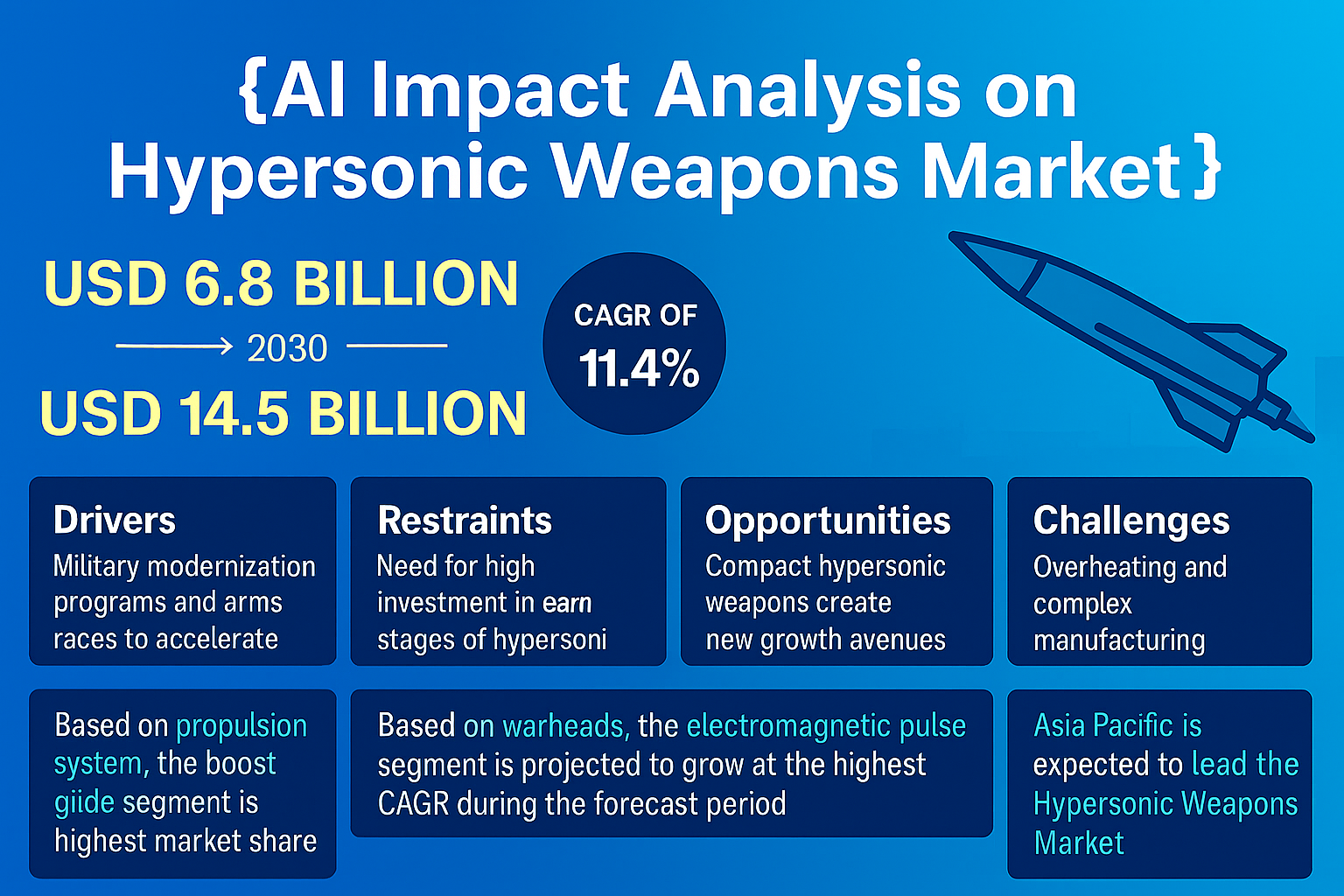
The future of the hypersonic weapons market is inextricably linked to AI adoption. Countries investing in AI enhanced hypersonic technologies are positioning themselves at the forefront of next generation warfare. The market for AI integrated hypersonic systems is expected to grow at a double digit CAGR through 2030, with major defense contractors and aerospace firms expanding their portfolios to include smart, autonomous weapon platforms. Government R&D funding is also increasingly earmarked for AI based guidance systems, thermal prediction models, and autonomous targeting platforms. In addition to traditional defense giants like the U.S., Russia, and China, emerging economies are also entering the space, often through AI first development strategies to leapfrog legacy technologies. Strategic alliances, joint ventures, and defense pacts are forming around AI hypersonic research, indicating that global defense strategy is aligning toward intelligent, high speed deterrence. This evolution is not merely technological—it is redefining power projection, deterrence theory, and geopolitical stability in the 21st century.
The integration of Artificial Intelligence into the hypersonic weapons market is not just enhancing performance metrics—it is redefining the fundamentals of modern warfare. AI is enabling smarter navigation, more precise targeting, autonomous mission execution, and faster threat detection. It is accelerating material science innovations, optimizing testing processes, and fortifying cyber defense layers. As countries race to gain supremacy in this new domain, AI will be the key differentiator that determines the strategic relevance and effectiveness of hypersonic systems. The market landscape will increasingly be shaped by those who can seamlessly integrate AI across the lifecycle of hypersonic weapon development—from design and deployment to defense and deterrence. The future of hypersonic warfare is not just fast, it is intelligent, adaptive, and relentlessly evolving.
Related Reports:
Hypersonic Weapons Market Size, Share, Trends Growth Report by Type (Hypersonic Missiles, Hypersonic Gliding Vehicles), Domain (Land, Naval, Airborne), Range (Short-range, Medium-range, Long-range), Subsystem and Region (North America, Europe, Asia Pacific, ROW) - Global Forecast to 2030

This FREE sample includes market data points, ranging from trend analyses to market estimates & forecasts. See for yourself.
SEND ME A FREE SAMPLE






