AI Impact Analysis on LEO PNT Industry
The global connectivity ecosystem is undergoing a revolutionary transformation as Low Earth orbit (LEO) satellite networks emerge as a cornerstone for precise Positioning, Navigation, and Timing (PNT) services. The increasing reliance on digital infrastructure, autonomous systems, and resilient navigation frameworks has created a strong demand for more accurate and secure PNT systems. Traditional Global Navigation Satellite Systems (GNSS) such as GPS, Galileo, and GLONASS have served the world well for decades, but they face limitations related to latency, interference, and vulnerability to jamming or spoofing.
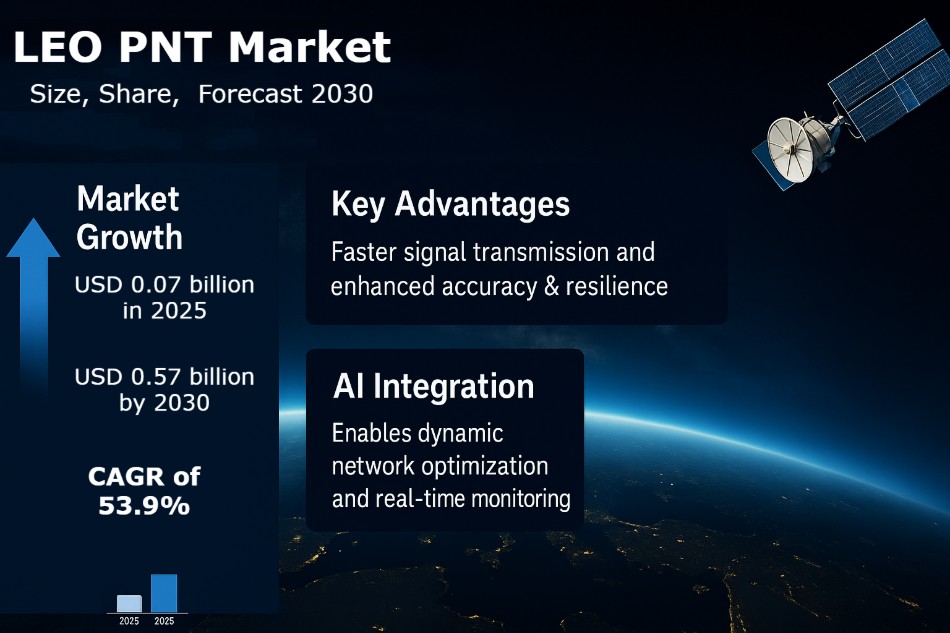
This is where the LEO PNT market becomes critical. With thousands of satellites orbiting closer to Earth, LEO constellations offer faster signal transmission, improved accuracy, and greater resilience. When combined with Artificial Intelligence (AI), these systems are transforming how navigation, communication, and timing are delivered. AI enables dynamic network optimization, real time signal integrity monitoring, and autonomous constellation management, creating a new standard of intelligent satellite based navigation.
Between 2025 and 2035, the AI-integrated LEO PNT market will emerge as one of the most disruptive technological domains, reshaping industries ranging from defense and telecommunications to transportation, financial systems, and autonomous mobility.
Understanding the LEO PNT Market Landscape
Positioning, Navigation, and Timing form the invisible foundation of modern civilization. Everything from global trade to aviation safety, emergency response, and financial transactions depends on precise timing and location data. Traditionally, this information has been delivered through Medium Earth Orbit (MEO) systems like GPS and Galileo. However, with growing congestion, urban signal blockages, and interference threats, these systems face operational challenges.
LEO PNT systems operate at altitudes between 500 and 2000 kilometers, offering shorter transmission paths and faster updates. This proximity reduces latency and enhances positioning precision. Companies such as Xona Space Systems, TrustPoint, and OneWeb are pioneering AI powered LEO PNT solutions designed for both military and commercial applications. These new networks promise sub meter accuracy, global redundancy, and immunity to traditional GNSS vulnerabilities.
The rise of autonomous vehicles, drones, and precision agriculture further accelerates the need for intelligent, high frequency navigation data. The integration of AI in LEO PNT operations represents a convergence of space technology and computational intelligence, fundamentally redefining how location data is captured, processed, and delivered.
Artificial Intelligence: The Catalyst of Modern PNT Systems
Artificial intelligence has become the defining enabler of next generation PNT capabilities. Its ability to analyze vast data streams, predict system behavior, and automate decision making brings unprecedented adaptability to satellite networks. Traditional PNT systems rely on static algorithms and pre defined models, but AI introduces real time learning, allowing systems to evolve dynamically based on environmental and operational changes.
AI enhances every stage of the PNT value chain from satellite manufacturing and orbit control to signal calibration and user side positioning. Machine learning models are used to refine orbital predictions, manage timing synchronization, and detect anomalies in data transmission. This intelligence enables more stable signals, fewer errors, and higher continuity, especially in environments where signals are traditionally weak, such as urban canyons or high latitude regions.
For LEO constellations, AI driven automation is crucial to managing hundreds or even thousands of satellites simultaneously. Predictive algorithms ensure that resources are allocated efficiently while minimizing power consumption and maximizing coverage. By 2035, AI will serve as the “brain” behind all LEO based PNT systems, ensuring seamless coordination between orbital assets and terrestrial infrastructures.
AI in Enhancing Signal Integrity and Anti-Jamming Capabilities
Signal reliability is the most critical factor in any navigation system. Traditional GNSS signals can be jammed or spoofed relatively easily because they are weak and predictable. LEO PNT systems, enhanced with AI, offer an entirely new layer of signal security and integrity.
AI algorithms continuously analyze signal strength, frequency patterns, and environmental conditions to detect interference in real time. Machine learning models trained on vast datasets can identify abnormal signal behaviors that might indicate jamming or spoofing attacks. Once detected, AI driven adaptive beamforming can reroute or modify signals, ensuring continuity of service.
Artificial intelligence also facilitates predictive threat analysis. Instead of reacting to interference, the system can anticipate it based on historical data and dynamically adjust frequency allocation or satellite beam orientation. This proactive defense approach makes AI powered LEO PNT systems ideal for military operations and critical infrastructure.
As global security threats evolve, AI’s role in safeguarding PNT integrity will only grow. Autonomous monitoring, anomaly detection, and self healing networks will form the backbone of secure navigation systems by 2035.
AI in Constellation Management and Optimization
Managing large scale LEO constellations is one of the most complex challenges in modern aerospace engineering. Thousands of satellites must operate in coordinated orbits, maintaining precise spacing, communication, and power balance. AI makes this possible through predictive modeling, autonomous control, and continuous optimization.
AI driven systems analyze orbital data to predict collisions, adjust trajectories, and maintain constellation stability. Predictive analytics optimize satellite placement to maximize global coverage while minimizing redundancy. The use of reinforcement learning allows satellites to “learn” how to adjust their orbits autonomously based on environmental feedback such as atmospheric drag or solar activity.
AI also enhances operational efficiency through real time power management. By forecasting user demand and environmental conditions, AI systems allocate energy for propulsion, communication, and payload operations intelligently, reducing waste and extending satellite lifespan.
Digital twins virtual replicas of entire constellations allow engineers to simulate orbital dynamics using AI. These simulations predict the long term behavior of constellations and enable corrective measures before problems occur. AI driven automation will eventually allow fully autonomous constellation management, reducing human intervention and operational costs.
AI for Precision Timing and Synchronization
Timing accuracy is the foundation of global navigation. Even nanosecond level errors can lead to significant positional inaccuracies. AI plays a vital role in ensuring precise time synchronization across multiple satellites and ground systems.
Modern atomic clocks are highly accurate but susceptible to drift over time. AI algorithms monitor timing deviations in real time and correct them through predictive adjustments. Machine learning models can analyze temperature fluctuations, signal distortions, and system noise to fine tune clock frequencies and maintain sub nanosecond synchronization.
AI also facilitates the integration of space based and terrestrial timing systems. In the future, LEO PNT networks will serve as redundant timing backbones for industries like finance, telecommunications, and defense. Quantum timing systems, augmented by AI, will deliver even higher precision, ensuring that every transaction, communication, and navigation operation remains synchronized globally.
By 2035, AI enhanced timing systems will underpin not just navigation but the entire digital economy, enabling everything from automated trading to unmanned traffic management.
AI-Enabled Multi-Sensor Data Fusion and Hybrid PNT
Artificial intelligence is enabling the fusion of data from multiple sensors to create hybrid PNT systems that combine LEO satellite data with signals from terrestrial networks, inertial sensors, and even 5G infrastructure. This hybridization ensures continuous and resilient positioning, even in areas where satellite signals are obstructed.
AI algorithms integrate and weight different data sources, dynamically selecting the most accurate and reliable inputs. For example, when a satellite signal is degraded, AI may rely more heavily on inertial measurement units or cellular triangulation data.
This multi sensor fusion significantly enhances accuracy and continuity. AI powered edge computing enables real time processing at the device level, allowing autonomous vehicles, drones, and maritime systems to make instant navigation decisions.
AI also enhances hybrid PNT by learning environmental characteristics such as terrain, weather, and urban interference patterns. Over time, these systems become context aware, improving navigation reliability in complex environments like cities, forests, or polar regions.
Get AI Impact Analysis on LEO PNT Market, Request Pdf Brochure: https://www.marketsandmarkets.com/pdfdownloadNew.asp?id=20724107
AI’s Role in Market Growth and Business Strategy
Beyond technical innovation, AI is transforming the business models and market strategies of LEO PNT providers. Predictive analytics enable operators to forecast demand, manage capacity, and optimize pricing models. By analyzing user behavior, industry demand, and regional connectivity needs, AI driven systems support better decision making and resource allocation.
AI is also being used to predict revenue streams and optimize supply chains. Satellite manufacturers and service providers can use AI to identify the best markets for deployment, evaluate risk factors, and adjust business models based on global economic indicators.
The rise of subscription based and data-as-a-service models in the PNT domain is largely supported by AI driven customer analytics. For example, AI can tailor service packages based on usage patterns or forecast maintenance requirements for specific satellite fleets.
As investment in commercial space ventures grows, AI will become essential for financial modeling, risk mitigation, and performance prediction. It is not only revolutionizing operations but also shaping the competitive strategies that will define the LEO PNT industry’s next decade.
Regional Developments and Competitive Landscape
North America leads the AI integrated LEO PNT market, driven by strong investment from both defense and commercial sectors. Companies such as Xona Space Systems and TrustPoint are at the forefront of developing AI powered navigation systems that offer high precision and security for both military and civilian applications. The U.S. government’s emphasis on resilient navigation infrastructure ensures continued research and funding for hybrid AI PNT systems.
Europe follows closely with the European Space Agency (ESA) spearheading initiatives in quantum timing, AI based orbit control, and secure navigation protocols. The continent’s focus on regulatory frameworks ensures the responsible use of AI while promoting collaboration among private and public sectors.
Asia-Pacific is emerging as a powerhouse in AI and satellite innovation. China, Japan, and India are investing heavily in LEO constellations that combine AI for autonomous operations, high speed communication, and precision navigation. These nations view AI driven PNT as a dual use capability that enhances both commercial competitiveness and defense readiness.
In the Middle East, AI based navigation systems are being integrated into smart city and defense programs. Meanwhile, Africa and Latin America are beginning to adopt LEO PNT technologies to bridge digital divides and improve disaster management infrastructure.
The competitive landscape is defined by collaborations between space technology providers, AI developers, and telecommunications companies. As 6G networks evolve, these partnerships will intensify, creating integrated ecosystems where terrestrial and non terrestrial networks function as one.
Challenges and Ethical Considerations in AI-Powered LEO PNT
Despite its potential, integrating AI into LEO PNT systems brings challenges related to ethics, data privacy, and reliability. AI’s autonomous decision making introduces risks such as algorithmic bias, data manipulation, and lack of transparency. For navigation systems that underpin critical national infrastructure, these risks must be managed carefully through explainable AI and strict oversight.
Another concern is cybersecurity. As AI models process massive datasets across global networks, ensuring the security of transmitted data is essential. Encryption, anomaly detection, and AI auditing tools will be critical to preventing malicious exploitation of PNT systems.
Standardization also remains a key issue. With multiple constellations operated by different countries and companies, interoperability between systems is not guaranteed. Establishing global frameworks for AI integration in space operations will be vital to ensure reliability and coordination.
Ethical governance will shape how AI PNT systems are deployed in defense, surveillance, and commercial contexts. Transparent AI policies will help balance technological advancement with societal responsibility.
AI-Powered LEO PNT Ecosystem by 2035
By 2035, the integration of Artificial Intelligence into LEO PNT systems will redefine global navigation as we know it. These systems will operate with minimal human intervention, autonomously managing thousands of satellites in synchronized harmony. AI will enable ultra precise global positioning down to the centimeter level, powering autonomous vehicles, drones, shipping fleets, and urban air mobility systems.
Quantum computing and AI will converge to enhance timing precision, while hybrid architectures combining LEO, MEO, and terrestrial systems will ensure continuous, secure connectivity. The synergy between AI, 6G, and edge computing will make positioning services faster, more adaptive, and universally accessible.
LEO PNT networks will also play a key role in supporting national security, disaster management, and global digital transformation. As satellites become intelligent, they will interact not just with ground systems but with each other, forming a distributed, autonomous network capable of self repair and optimization.
The AI-powered LEO PNT ecosystem will underpin everything from future logistics and mobility to deep space exploration and interplanetary navigation. This is more than an evolution of satellite navigation it is the foundation for a connected, intelligent, and resilient global society.
Related Reports:
LEO PNT Market by Hardware (GNSS Module, Time Synchronization, Backhaul Module, Navigation Signal Generation, Signal Transmission Module), End Use (Government & Defense and Others), Frequency, Satellite Mass and Region - Global Forecast to 2030

This FREE sample includes market data points, ranging from trend analyses to market estimates & forecasts. See for yourself.
SEND ME A FREE SAMPLE






