AI Impact Analysis on Marine Propellers Industry
Marine propellers are the backbone of ship propulsion systems, converting rotational energy into thrust to move vessels through water. Traditionally, these propellers come in multiple configurations including fixed pitch, controllable pitch, and ducted variants, each tailored to specific vessel types such as cargo ships, cruise liners, naval vessels, or recreational boats. Innovations in metallurgy, hydrodynamics, and computer aided design have consistently improved propeller efficiency. The recent introduction of artificial intelligence (AI) is driving a new wave of transformation across design, manufacturing, and operational paradigms in marine propulsion.
Current Market Size and Growth Overview
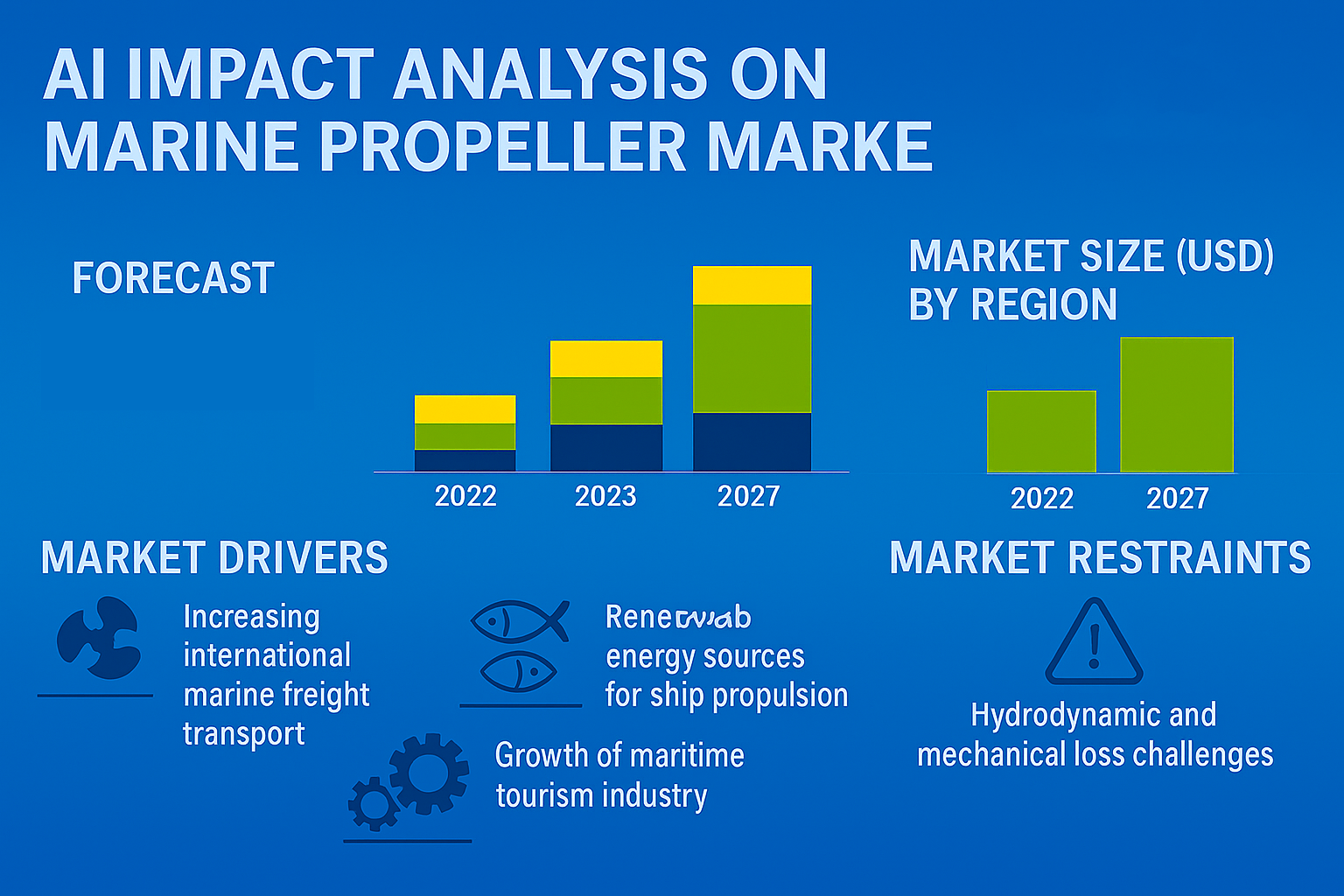
The marine propeller market has been experiencing steady growth owing to rising global trade, increasing naval modernization efforts, and the resurgence of shipbuilding in Asia Pacific regions. As of 2025, the market is estimated to be valued at USD 5.2 billion and is projected to surpass USD 7.6 billion by 2032, registering a CAGR of around 5.5%. Key players include Rolls Royce, Wärtsilä, Hyundai Heavy Industries, Kawasaki Heavy Industries, and Schottel. Market segmentation spans across applications commercial, naval, offshore, and recreational with each segment beginning to adopt AI led technologies at varying rates. The convergence of AI with traditional marine systems is becoming a key differentiator for competitive advantage.
Role of AI in Marine Engineering
Artificial intelligence has become a central force in reshaping the engineering workflows in shipbuilding and marine propulsion. Traditionally, naval architects and engineers relied on iterative hydrodynamic simulations using finite element methods. AI now reduces these iterations by learning from vast datasets to predict optimal design configurations. Algorithms trained on years of operational performance data can now inform design decisions in real time. This not only speeds up development timelines but also enhances the quality of engineering outputs. In propulsion, AI allows adaptive responses to environmental variables like current, wind, and water density, thereby improving thrust efficiency dynamically.
AI Driven Propeller Design and Customization
The use of AI in marine propeller design has enabled the transition from one size fits all to purpose built, performance optimized solutions. Generative design algorithms now play a pivotal role in developing unique blade geometries that account for vessel type, operating conditions, and propulsion goals. These algorithms use AI to explore thousands of configurations, selecting those with the least cavitation, best wake flow characteristics, and highest thrust to drag ratio. As AI continues to integrate with computational fluid dynamics (CFD), designers gain more powerful tools to simulate, test, and refine propeller concepts digitally before moving to production.
Predictive Maintenance of Marine Propellers with AI
One of the most promising applications of AI in the marine propeller market is predictive maintenance. Using real time data from vibration sensors, acoustic monitors, and onboard diagnostic systems, AI models can predict failures before they occur. These predictive systems learn from historical data patterns and operating conditions to detect anomalies in propeller function, such as minor blade fractures or bearing misalignments. This reduces the need for routine dry docking, saves fuel, prevents breakdowns, and extends the lifespan of propulsion systems. For large shipping fleets, this can mean savings in the millions, along with increased uptime and reliability.
AI in Noise and Vibration Reduction
Marine propellers are notorious for producing noise pollution and vibration, which affect marine ecosystems and human comfort aboard vessels. AI is now being leveraged to mitigate these issues through advanced data analytics and modeling. Machine learning algorithms analyze acoustic signatures and identify the sources of vibration at granular levels. Engineers can then redesign propeller blades or modify pitch angles to minimize these disturbances. Additionally, AI controlled actuators can make real time adjustments to blade angles or RPMs during operation, actively damping vibration based on sensor feedback. This leads to quieter vessels and improved passenger experiences.
Fuel Efficiency Optimization Using AI
Fuel is the single largest operational cost in the marine industry, often accounting for over 50% of total voyage expenses. AI helps optimize fuel consumption by dynamically adjusting propulsion settings based on weather, load, and speed. Smart propeller systems analyze real time telemetry to minimize drag and maximize thrust efficiency. AI models also take into account route planning, tidal variations, and engine health to recommend optimal RPMs. Such optimization reduces greenhouse gas emissions and complies with IMO’s strict emission standards, making AI not just a performance tool but also a sustainability enabler.
Get AI Impact Analysis on Marine Propeller Market, Request Pdf Brochure: https://www.marketsandmarkets.com/pdfdownloadNew.asp?id=125429993
Integration of AI in Autonomous Marine Vessels
The rise of autonomous shipping is another frontier where AI enhanced propeller systems are proving critical. Self navigating vessels require propulsion systems that can operate without human intervention while adjusting to changing environmental conditions. AI algorithms power control systems that automatically adjust blade pitch, thrust vector, and rotational speed to optimize navigation and collision avoidance. These intelligent systems work in coordination with onboard sensors like sonar, LiDAR, and GPS, allowing vessels to operate safely even in high traffic or adverse sea conditions. As military and commercial fleets invest in autonomous technologies, AI propelled systems are becoming foundational infrastructure.
Regional and Naval Defense Implications
AI enhanced marine propellers are increasingly being adopted in naval fleets across the U.S., China, and Europe. In military applications, stealth, maneuverability, and operational readiness are paramount. Smart propulsion systems provide quieter operations for submarines, reduce detection risks, and enable rapid response during combat scenarios. Nations are also using AI in combination with digital twins to simulate battle readiness and operational efficiency under different stress scenarios. In Asia Pacific, particularly China and South Korea, there is growing investment in AI driven shipyards capable of mass producing smart naval vessels at scale. These geopolitical developments are reshaping global maritime dominance and fueling market growth.
Future Outlook and Emerging AI Trends in Marine Propulsion
Looking ahead to 2032 and beyond, the marine propeller market is expected to evolve further with emerging technologies like digital twins, AI powered shape memory alloys, and smart surface coatings. Digital twins allow for continuous feedback loops between real world operations and virtual simulations, enabling rapid optimization of propulsion systems. AI will also enable propellers to adapt to micro scale changes in sea salinity, pressure, and flow velocity, acting almost like living systems. The use of bio inspired design, such as whale fin shaped blades, could become commonplace as AI uncovers new efficiency paradigms. Maritime regulations will increasingly mandate smarter, greener ships pushing AI from optional feature to core requirement.
The intersection of AI and the marine propeller market marks a significant milestone in maritime innovation. From design to maintenance, from performance to autonomy, AI is redefining what’s possible in marine propulsion. As the industry continues to navigate increasing demand, environmental regulation, and operational complexity, the role of intelligent propeller systems will become increasingly central. Stakeholders shipbuilders, defense departments, commercial operators, and technology vendors must now invest in AI capabilities to remain competitive in this smart propulsion era. The propeller of the future is not just engineered; it’s intelligent, adaptive, and indispensable.
Related Report:
Marine Propeller Market by Type (Propellers, Thrusters), Application (Merchant Ships, Naval Ships, Boats), Material (Stainless Steel, Aluminium, Bronze, Nickel-Aluminium Bronze), End User, Propulsion, Number of Blades, Region - Global Forecast

This FREE sample includes market data points, ranging from trend analyses to market estimates & forecasts. See for yourself.
SEND ME A FREE SAMPLE






