AI Impact Analysis on Missile Industry in APAC Market
The Asia-Pacific (APAC) missile industry is undergoing one of the most profound transformations in modern defense history. Nations across the region are rapidly modernizing their arsenals, prioritizing next generation missile systems that integrate Artificial Intelligence (AI) for greater accuracy, autonomy, and adaptability. As geopolitical tensions rise and defense budgets expand, AI has become the technological foundation shaping the future of missile design, guidance, and operational decision making.
From China’s hypersonic advancements to India’s AI-integrated defense programs and Japan’s precision strike capabilities, the APAC region stands at the forefront of intelligent missile innovation. Between 2025 and 2035, the convergence of AI, quantum computing, and advanced propulsion will redefine how missiles are developed, deployed, and controlled. This evolution will not only strengthen regional defense postures but also raise ethical, strategic, and stability related concerns that will shape the global military landscape.
Understanding the Missile Industry in the APAC Market
The missile industry in Asia-Pacific has seen significant growth driven by heightened territorial disputes, strategic rivalries, and defense self reliance initiatives. Countries such as China, India, Japan, South Korea, and Australia are investing heavily in long range strike capabilities and anti access/area denial (A2/AD) systems. The regional missile ecosystem encompasses ballistic, cruise, hypersonic, and anti ship missiles, each playing a critical role in deterrence and power projection.
Artificial intelligence has emerged as the most transformative element in this defense modernization cycle. By embedding AI into missile guidance systems, navigation algorithms, and control frameworks, defense agencies can achieve levels of speed and precision previously unattainable. The result is an increasingly autonomous arsenal capable of making complex decisions in real time.
This rapid evolution of the APAC missile market is fueled by three primary forces: technological competitiveness, strategic deterrence, and self reliance. Governments across the region are promoting indigenous development programs to reduce dependency on foreign suppliers, while simultaneously investing in dual use AI technologies that strengthen both commercial and military innovation ecosystems.
The Role of Artificial Intelligence in Next-Generation Missiles
Artificial Intelligence is redefining missile architecture by introducing autonomy, adaptability, and analytical intelligence into systems that were once purely reactive. AI powered guidance systems can process vast amounts of sensor data, enabling missiles to identify and track targets independently even in contested or signal degraded environments.
This new generation of missiles employs machine learning algorithms that continuously learn from previous engagements, refining targeting accuracy and response times. In contrast to traditional pre programmed flight paths, AI integrated systems adapt dynamically to changing battlefield conditions, unpredictable target maneuvers, and countermeasure interference.
In hypersonic and cruise missile applications, AI plays a vital role in optimizing flight profiles, managing thermal stress, and executing mid course corrections. Combined with real time data fusion from satellites, drones, and radar networks, these systems deliver unprecedented precision. By 2035, fully AI enabled missile systems are expected to form the core of both offensive and defensive operations in the region.
AI in Guidance, Navigation, and Control Systems
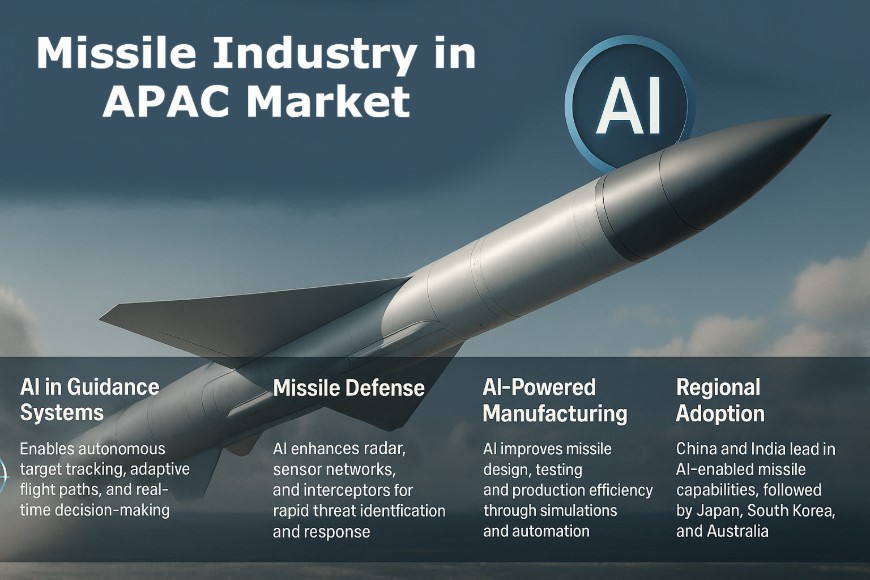
Guidance, navigation, and control (GNC) systems represent the operational heart of any missile. In the APAC market, AI is being integrated to enhance precision, speed, and survivability under complex conditions. Traditional GNC frameworks rely heavily on pre set algorithms and GPS data, which are vulnerable to signal loss or electronic warfare.
AI driven GNC systems can overcome these limitations by using multi sensor fusion techniques that combine inertial navigation, satellite signals, terrain mapping, and image recognition. Deep learning algorithms interpret this data in real time, adjusting flight paths for maximum efficiency and accuracy.
AI enables cruise missiles to analyze terrain features and evade radar detection autonomously. Hypersonic vehicles utilize AI to stabilize control at speeds exceeding Mach 5, where traditional flight control models become unstable. AI also assists in refining Circular Error Probability (CEP), achieving near perfect accuracy in complex target environments.
By merging cognitive algorithms with traditional control systems, APAC nations are creating missiles capable of acting as intelligent, decision making entities rather than passive projectiles.
AI-Driven Missile Defense and Countermeasure Systems
As offensive missile capabilities advance, so too must defensive systems. The Asia-Pacific region faces the dual challenge of developing both sophisticated strike platforms and the means to intercept them. Artificial intelligence is at the center of this evolving defense equation.
AI enhances radar and sensor performance by filtering noise and identifying potential threats faster than human operators. Neural networks can predict missile trajectories, prioritize targets, and assist interceptor systems in optimizing engagement sequences. By learning from historical interception data, AI continually improves accuracy and reduces false alarms.
In complex threat environments where decoys, multiple warheads, or hypersonic vehicles are involved AI algorithms adapt dynamically, ensuring rapid and precise response coordination across defense platforms. Integrated with space based surveillance networks, AI driven missile defense systems enable early warning, predictive tracking, and coordinated engagement across land, sea, and air domains.
This convergence of offense and defense, both powered by AI, is redefining deterrence strategies in the APAC region. The future missile battlefield will be one of machine speed warfare, where decisions occur in milliseconds.
AI in Manufacturing, Testing, and Simulation
Beyond combat operations, AI is revolutionizing how missiles are designed, tested, and manufactured. Defense industries across APAC are leveraging artificial intelligence to shorten development cycles, improve cost efficiency, and enhance product reliability.
AI driven digital twin technology enables engineers to simulate missile performance under various environmental conditions before physical testing. This predictive modeling reduces prototyping costs and accelerates development timelines. Advanced analytics help detect material defects, optimize composite manufacturing, and ensure quality consistency.
During testing and validation, AI analyzes telemetry and sensor data to predict potential failures, refine designs, and increase operational safety. Predictive maintenance powered by AI ensures that launch systems and production lines operate with minimal downtime.
These capabilities are particularly critical as APAC nations pursue indigenous manufacturing. By adopting AI based automation, nations like India, China, and South Korea are strengthening their domestic defense industrial bases, reducing reliance on imports, and achieving self sufficiency in missile technology.
Get AI Impact Analysis on Missile Industry in APAC Market, Request Pdf Brochure: https://www.marketsandmarkets.com/pdfdownloadNew.asp?id=37326539
Regional AI Adoption Trends Across the APAC Missile Industry
The APAC region’s diverse geopolitical and economic landscape has produced varying levels of AI adoption in missile development. China remains the dominant force, leading in autonomous weapon systems, hypersonic flight, and precision guided munitions. Its “intelligentized warfare” doctrine prioritizes the fusion of AI and big data across all military systems, including missiles.
India has accelerated its AI defense integration through organizations like the Defense Research and Development Organisation (DRDO). Programs such as BrahMos-II and Agni are incorporating AI in guidance, targeting, and propulsion optimization. India’s focus on “Atmanirbhar Bharat” (self reliant India) further amplifies domestic innovation in AI enabled defense manufacturing.
Japan and South Korea are investing in AI for precision strike and missile defense systems as part of broader regional deterrence strategies. Japan’s emphasis on long range precision weapons and South Korea’s integration of AI into interceptors like L-SAM and Cheongung highlight this trend. Australia, under the AUKUS alliance, is collaborating with the U.S. and the U.K. to develop autonomous and hypersonic capabilities using AI for next generation defense frameworks.
Smaller ASEAN nations are gradually integrating AI in surveillance and command networks to support regional defense modernization. Collectively, these advancements signal the emergence of an AI driven defense ecosystem that will define the APAC strategic balance through 2035.
AI-Enabled Command, Control, and Communication (C3) Systems
AI’s integration into command, control, and communication (C3) systems is transforming how missile operations are coordinated and executed. C3 relied on human decision making, manual data analysis, and hierarchical command chains. The increasing speed of modern warfare demands real time decision systems capable of processing data and executing actions autonomously.
AI based C3 frameworks fuse information from satellites, radar, drones, and electronic intelligence systems to provide commanders with instant situational awareness. Machine learning algorithms analyze incoming data streams to prioritize threats, allocate resources, and recommend optimal engagement strategies.
In the context of multi domain warfare, AI enables seamless coordination between air, land, naval, and cyber operations. This integration ensures that missile launches, interceptions, and countermeasures occur in a synchronized, data driven manner. AI also enhances communication security through adaptive encryption, ensuring resilience against cyberattacks and electronic jamming.
As APAC militaries modernize, AI driven C3 systems will form the central nervous system of network centric warfare, dramatically increasing decision speed and operational agility.
Key Defense Contractors and AI Collaborations in the APAC Region
The missile industry’s transformation in APAC is being spearheaded by a combination of state owned enterprises, private defense manufacturers, and international collaborations. In China, the China Aerospace Science and Industry Corporation (CASIC) and China Aerospace Science and Technology Corporation (CASC) are leading the integration of AI into hypersonic missile programs and autonomous targeting systems.
India’s DRDO and Bharat Dynamics Limited (BDL) are partnering with domestic startups specializing in AI and data analytics to improve missile efficiency and reduce lifecycle costs. Japan’s Mitsubishi Heavy Industries is developing advanced missile guidance technologies, while South Korea’s LIG Nex1 and Hanwha Systems are integrating AI into both offensive and defensive platforms.
Australia’s defense ecosystem, supported by the AUKUS alliance, is working on AI driven hypersonic and swarm missile projects. Singapore’s Defense Science and Technology Agency (DSTA) focuses on AI enhanced C4ISR (Command, Control, Communications, Computers, Intelligence, Surveillance, and Reconnaissance) systems to strengthen its precision strike capabilities.
Collaborations between APAC nations and Western defense companies, including Lockheed Martin, BAE Systems, and Rafael Advanced Defense Systems, are accelerating regional innovation. By leveraging AI, these partnerships are creating a next generation ecosystem where smart missiles operate within interconnected digital battle networks.
Ethical, Strategic, and Security Implications of AI in Missiles
The integration of artificial intelligence into missile systems presents profound ethical and strategic challenges. The possibility of fully autonomous weapons capable of making lethal decisions without human intervention raises questions about accountability and control.
AI driven warfare introduces uncertainty and unpredictability, as algorithmic errors or misinterpretations could escalate conflicts unintentionally. Governments across APAC are grappling with how to balance technological innovation with ethical responsibility. International frameworks for regulating AI in warfare remain limited, leaving open the risk of an AI arms race.
Cybersecurity is another critical concern. As AI powered missiles rely on digital networks for communication and control, they become potential targets for cyberattacks. Protecting AI models and data integrity will be vital for preventing system manipulation or sabotage.
Ultimately, AI presents both an opportunity and a dilemma for defense policymakers. It enhances national security through technological superiority but simultaneously increases global instability if not properly governed. Establishing norms, transparency measures, and international cooperation will be essential to mitigate these risks.
The AI-Powered Missile Ecosystem of 2035
By 2035, artificial intelligence will be embedded in every layer of the missile industry across the APAC market. Missiles will operate with unprecedented levels of autonomy, supported by AI enhanced command systems and global data connectivity. Quantum computing will further refine targeting accuracy, and predictive AI will enable missiles to adapt dynamically in flight based on real time data.
AI will also transform missile defense, allowing interceptors to respond within microseconds and coordinate engagements across vast networks. Hypersonic weapons powered by AI assisted navigation will redefine strategic deterrence. Swarm based missile systems, guided collectively by AI, will emerge as a new doctrine for both offense and defense.
The future APAC missile ecosystem will be a web of interconnected, intelligent systems capable of operating in contested environments with minimal human input. While this evolution promises unmatched precision and efficiency, it also demands responsible governance, transparency, and international collaboration to ensure stability in a region defined by both innovation and tension.
Related Report:
Asia-Pacific (APAC) Missile Market by (Cruise, Ballistic, Interceptors, Anti-Tank, Anti-Ship, Submarine Launched Missiles), Component (Airframe, Guidance, Navigation, Control, Propulsion, Warhead, Battery), Speed, End User - Regional Forecast to 2030

This FREE sample includes market data points, ranging from trend analyses to market estimates & forecasts. See for yourself.
SEND ME A FREE SAMPLE






