Asia-Pacific (APAC) Missile Market by (Cruise, Ballistic, Interceptors, Anti-Tank, Anti-Ship, Submarine Launched Missiles), Component (Airframe, Guidance, Navigation, Control, Propulsion, Warhead, Battery), Speed, End User - Regional Forecast to 2030

icon1
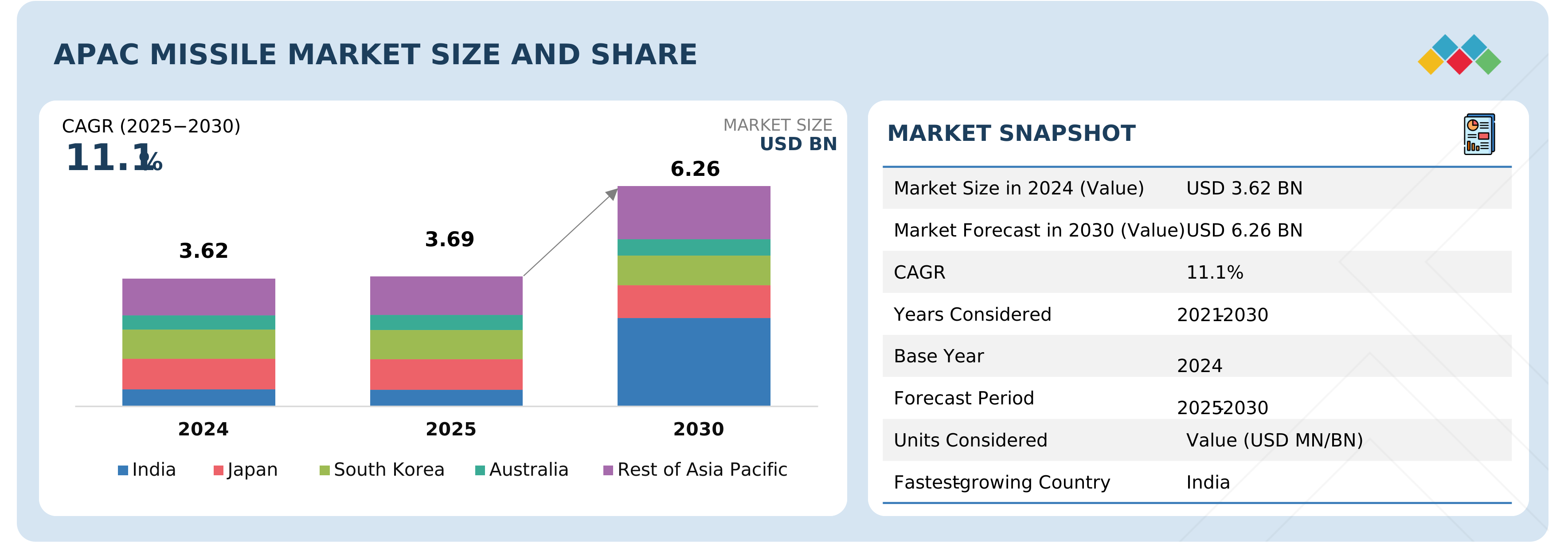
USD 6.26 BN
MARKET SIZE, 2030
icon2
CAGR 11.1%
(2025-2030)
icon3
217
REPORT PAGES
icon4
162
MARKET TABLES

OVERVIEW

Source: Secondary Research, Interviews with Experts, MarketsandMarkets Analysis

The APAC Missile Market is projected to reach USD 6.26 billion by 2030 from USD 3.69 billion in 2025 at a CAGR of 11.1% from 2025 to 2030. The growth is driven by rising defense modernization programs, escalating regional security tensions, and increased investments in advanced missile technologies.

KEY TAKEAWAYS

  • Japan is expected to account for a 23.6% share of the APAC missile market in 2025.
  • By type, the air-to-surface segment is projected to grow at the fastest rate of 20.2%.
  • By component, the warheads segment is projected to grow at the fastest CAGR of 13.1%.
  • By end user, the army segment is expected to account for the largest market share during the forecast period.
  • BrahMos Aerospace, LIG Nex1, and Mitsubishi Heavy Industries were identified as some of the star players in the APAC missile market (global), given their strong market share and product footprint.
  • Tata Advanced Systems, Godrej & Boyce, and Astra Microwave Products Ltd., among others, have distinguished themselves among startups and SMEs by securing strong footholds in specialized niche areas, underscoring their potential as emerging market leaders.

Source: Secondary Research, Interviews with Experts, MarketsandMarkets Analysis

Driver: Escalating geopolitical tensions to prompt missile proliferation

Ongoing border disputes, maritime conflicts, and regional rivalries are pushing APAC countries to rapidly expand missile arsenals for deterrence and preparedness.

Restraint: High development and procurement costs

Indigenous missile development and advanced imports strain defense budgets, limiting smaller economies from large-scale acquisitions.

Opportunity: Strategic integration of hypersonic missiles into joint defense exercises

APAC militaries are increasingly exploring hypersonic systems for multinational drills, boosting interoperability and future readiness.

Challenge: Export control regimes and MTCR compliance constraints

Strict global regulations and technology transfer limits hinder APAC countries from accessing or exporting advanced missile technologies.

Asia-Pacific (APAC) Missile Market: COMMERCIAL USE CASES ACROSS INDUSTRIES

COMPANY USE CASE DESCRIPTION BENEFITS
India’s DRDO and BEL developed and inducted the Akash-NG (Next Generation) Surface-to-Air Missile system (2021–2023), designed for improved range and faster reaction against aerial threats. Provided extended range (up to 70 km), improved reaction time, and higher kill probability, strengthening India’s layered air defense capability
South Korea’s LIG Nex1 successfully developed and delivered the Cheongung-II (M-SAM Block-II) air defense system (2017–2023), deployed to replace legacy Nike and Hawk systems. Offered enhanced interception of ballistic missiles, higher mobility, and improved accuracy, reinforcing South Korea’s missile defense shield
Japan’s Mitsubishi Heavy Industries (MHI), in partnership with the Japanese MoD, advanced the Type 12 Surface-to-Ship Missile modernization program (2022–2025), focusing on extended range and network-centric warfare. Boosted long-range strike capability (up to 1,000 km), reduced reliance on foreign imports, and enhanced deterrence against regional threats

Logos and trademarks shown above are the property of their respective owners. Their use here is for informational and illustrative purposes only.

MARKET ECOSYSTEM

The APAC missile market ecosystem involves government organizations driving R&D and procurement, manufacturers delivering advanced systems, and end users such as regional armed forces driving demand. Collaboration across stakeholders strengthens indigenous development, modernization, and regional defense preparedness.
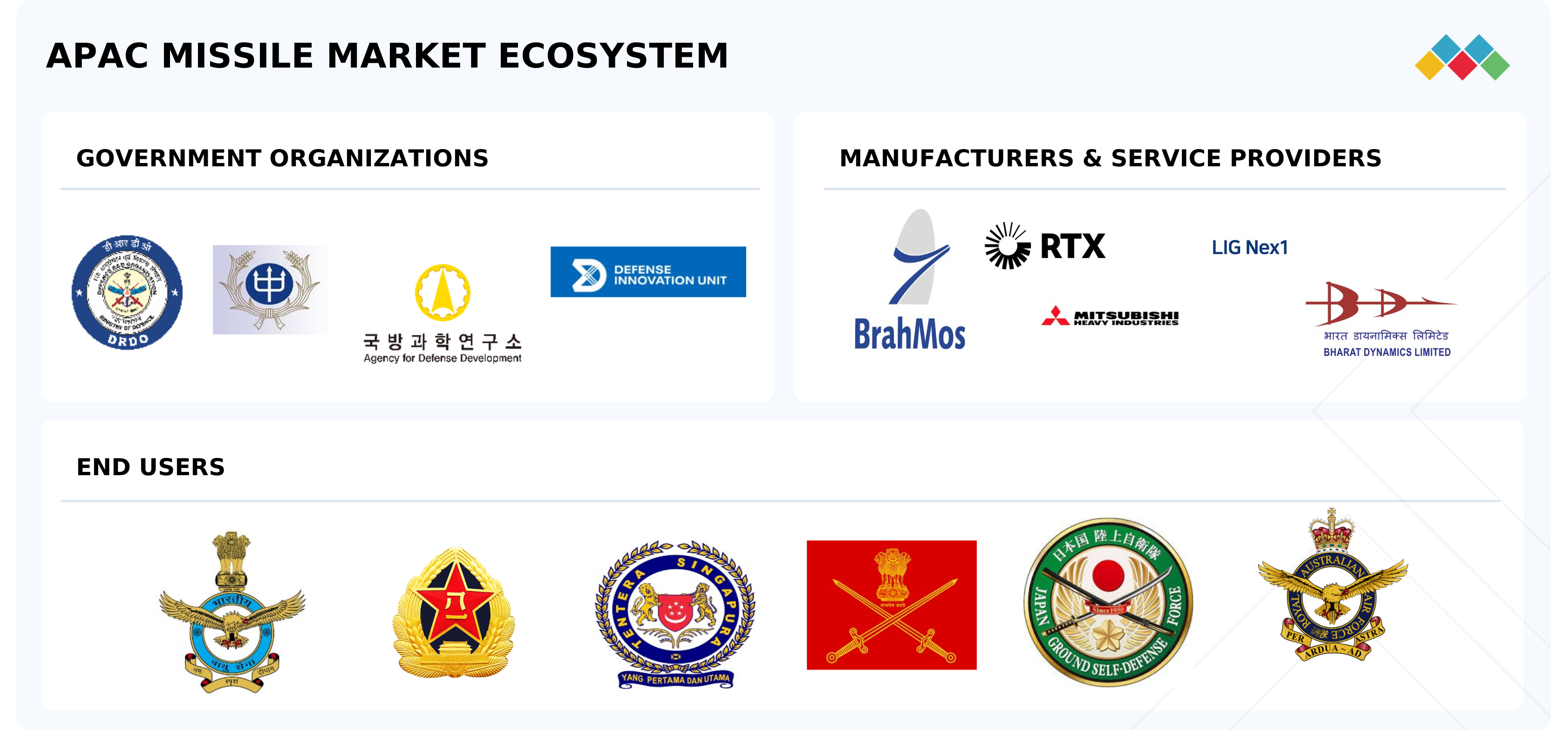
Logos and trademarks shown above are the property of their respective owners. Their use here is for informational and illustrative purposes only.

MARKET SEGMENTS
Source: Secondary Research, Interviews with Experts, MarketsandMarkets Analysis

APAC Missile Market, By Type

Surface-to-surface missiles account for the largest share, driven by their extensive deployment for land-attack and strategic deterrence roles across India and China.

APAC Missile Market, By Component

Guidance, navigation, and control systems dominate the APAC missile market, with countries like India and South Korea investing heavily in precision-strike capabilities and advanced targeting technologies.

APAC Missile Market, By Speed

Supersonic missiles led the APAC missile market with widespread adoption in China, India, and Japan to counter regional threats through high-speed interception and strike systems.

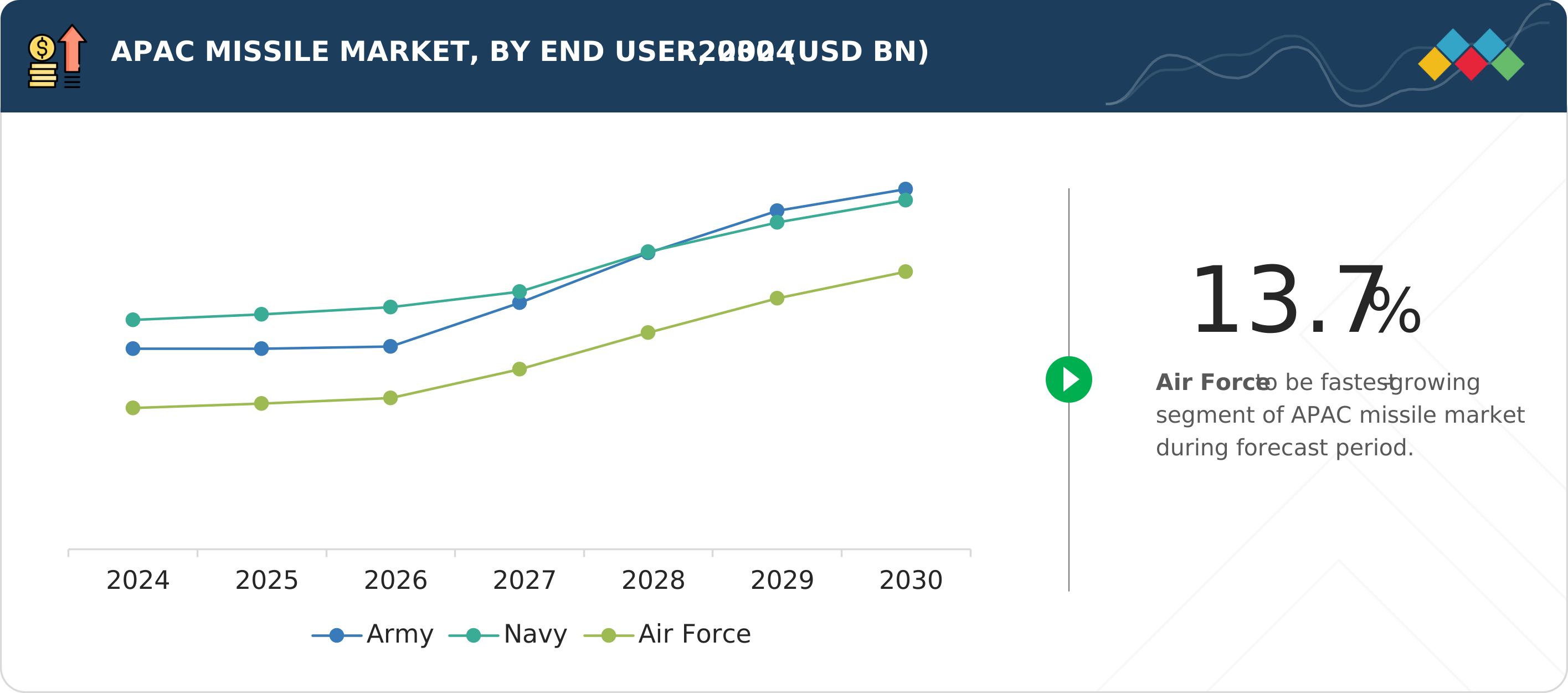
APAC Missile Market, By End User

The Army held the largest share of the APAC missile market supported by ongoing modernization programs in India, South Korea, and China focusing on surface-to-surface and surface-to-air missile systems.

REGION

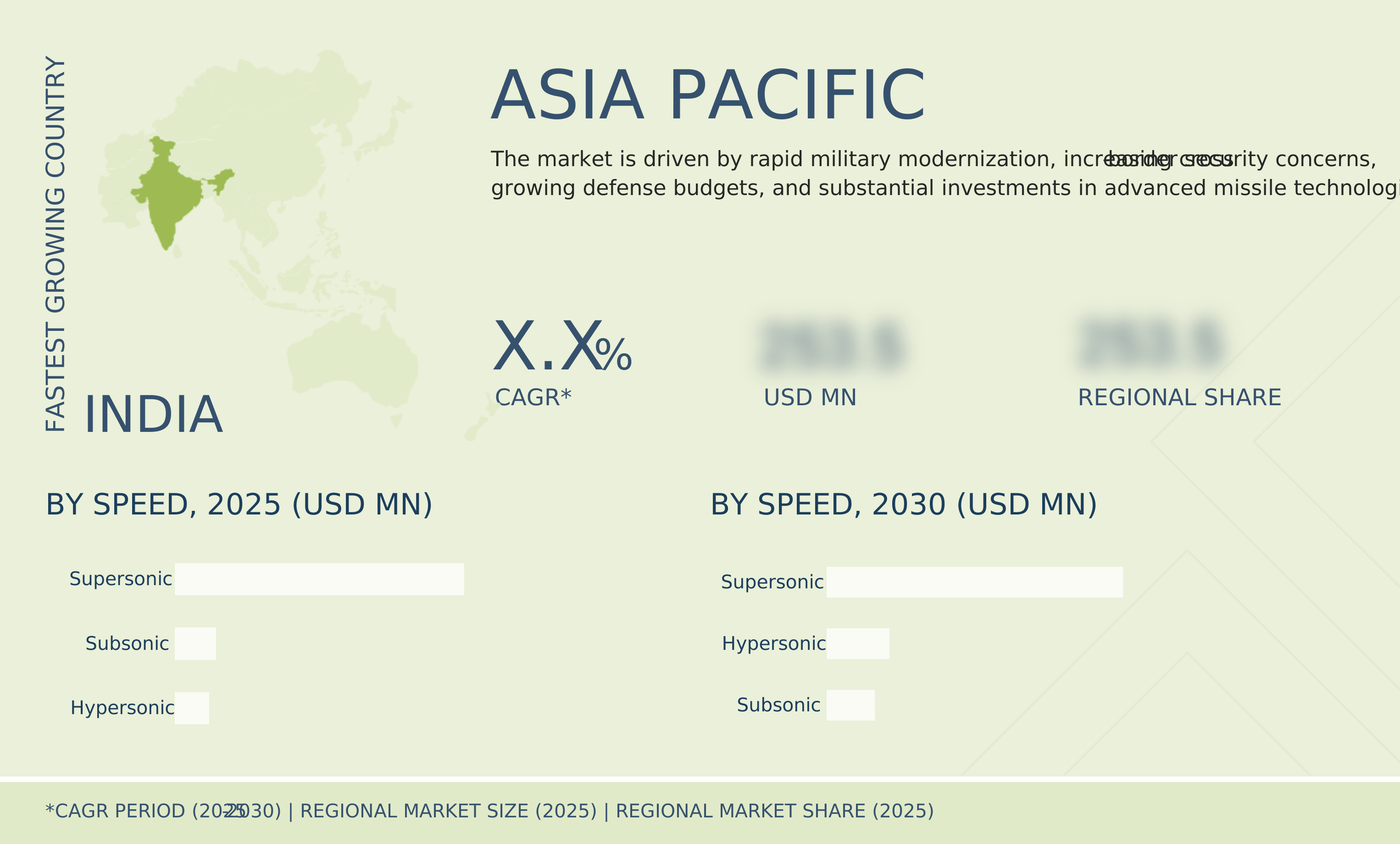
India to be fastest-growing country in APAC missile market during forecast period

India is expected to be the fastest-growing country in the APAC missile market during the forecast period, driven by rising defense modernization programs, escalating border tensions, indigenous missile development initiatives, and strong government support for advanced missile technologies.
Asia-Pacific (APAC) Missile Market: COMPANY EVALUATION MATRIX

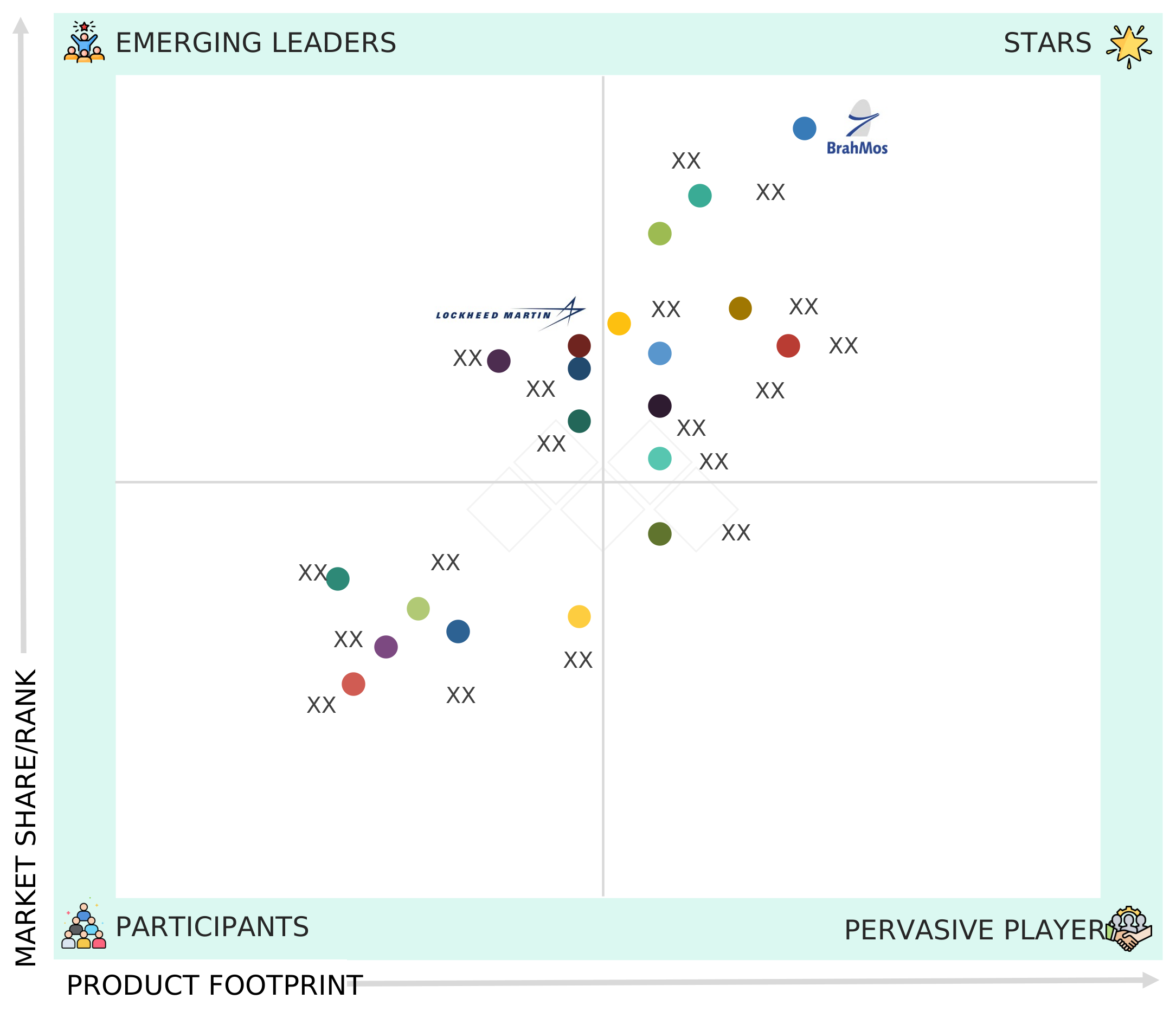
In the APAC missile market matrix, BrahMos (Star) leads with strong market share and broad product adoption, driven by its supersonic capabilities and joint India–Russia development. Lockheed Martin (Emerging Leader) is strengthening its position through advanced missile systems and partnerships in the region, showing potential to move toward the leaders’ quadrant as regional defense demand intensifies.
Source: Secondary Research, Interviews with Experts, MarketsandMarkets Analysis

MARKET SCOPE

REPORT METRIC DETAILS
Market Size in 2024 (Value) USD 3.62 Billion
Market Forecast in 2030 (Value) USD 6.26 Billion
Growth Rate CAGR of 11.1% from 2025 to 2030
Years Considered 2021-2030
Base Year 2024
Forecast Period 2025-2030
Units Considered Value (USD Billion)
Report Coverage Revenue forecast, company ranking, competitive landscape, growth factors, and trends
Segments Covered
  • By Type:
    • Surface-to-Surface
    • Surface-to-Air
    • Air-to-Air
    • Air-to-Surface
    • Subsea-to-Surface
  • By Component:
    • Missile Airframe
    • Guidance Navigation & Control
    • Propulsion Systems
    • Warhead
    • Power Supply
  • By Speed:
    • Subsonic
    • Supersonic
    • Hypersonic
  • By End User:
    • Army
    • Navy
    • and Air Force
Regions Covered Asia Pacific (APAC)

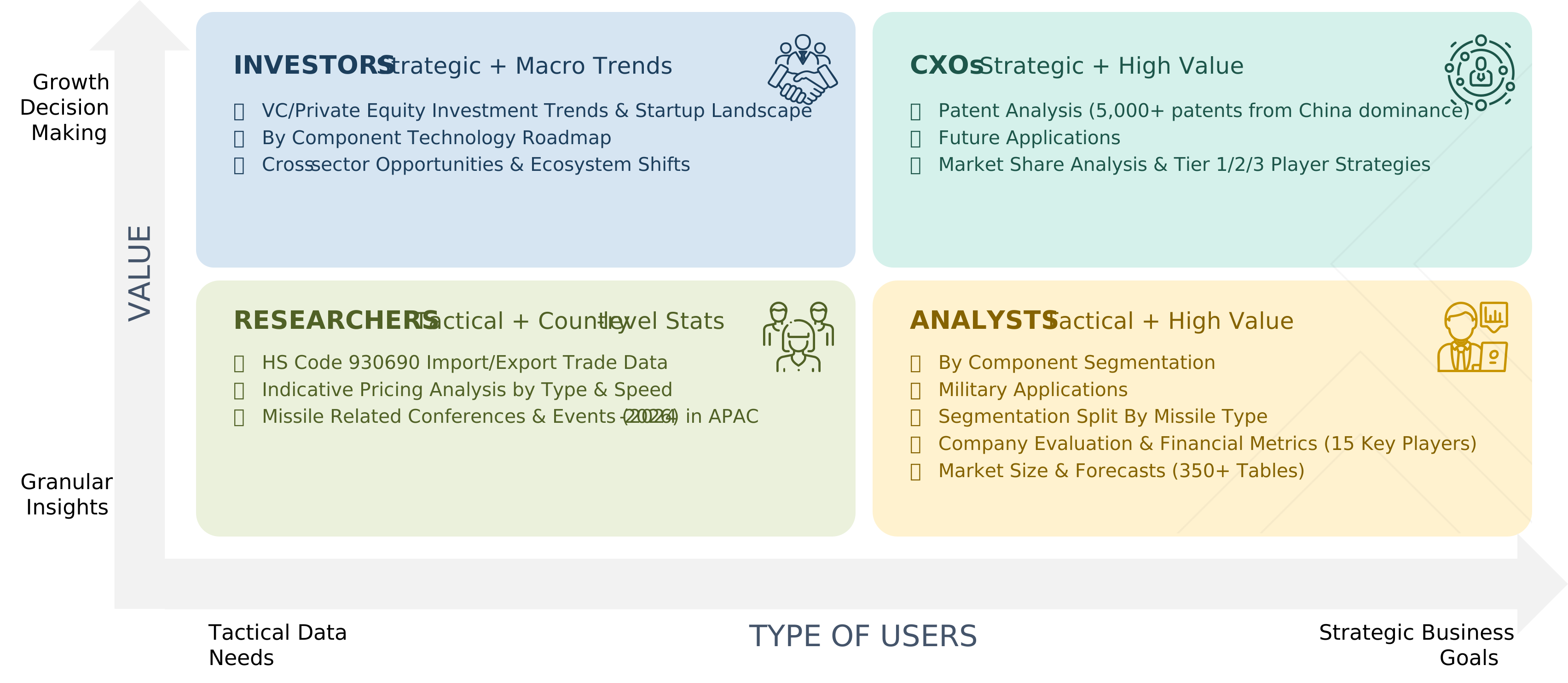
WHAT IS IN IT FOR YOU: Asia-Pacific (APAC) Missile Market REPORT CONTENT GUIDE
DELIVERED CUSTOMIZATIONS

We have successfully delivered the following deep-dive customizations:

CLIENT REQUEST CUSTOMIZATION DELIVERED VALUE ADDS
Leading manufacturer Additional segment breakdown for countries Additional country-level market sizing tables for segments/sub-segments covered at regional/global level to gain an understanding on market potential by each country
Emerging leader Additional company profiles Competitive information on targeted players to gain granular insights on direct competition
Regional market leader Additional country market estimates Additional country-level deep dive for a more targeted understanding on the total addressable market

RECENT DEVELOPMENTS

  • February 2025 : BDL (India) entered a memorandum of understanding (MoU) with Russia’s Rosoboronexport (ROE) to collaborate on Pantsir variants. This air-defense missile-gun system will be manufactured by BDL (India) and supplied to the Indian Armed Forces.
  • April 2024 : RTX (US) received a contract to produce the SM-2 Block IIICU and SM-6 Block IU missiles for USD 344 million. These missiles, intended for the US and allied nations, including Australia, Canada, Japan, and South Korea, will share a common guidance section, target detection device, flight termination system, and electronics unit.
  • January 2024 : Mitsubishi Heavy Industries Ltd. (Japan) and Northrop Grumman Corporation (US) signed a teaming agreement to collaborate on integrated air and missile defense capabilities, contributing to Japan’s defense posture and developing networking solutions.
  • December 2024 : The Japanese Ministry of Defense conducted a series of ground-to-ship test firings of the improved Type 12 surface-to-ship guided missile made by Mitsubishi Heavy Industries Ltd. (Japan).


Table of Contents

Exclusive indicates content/data unique to MarketsandMarkets and not available with any competitors.

TITLE
PAGE NO
1
INTRODUCTION


22
2
RESEARCH METHODOLOGY


26
3
EXECUTIVE SUMMARY


35
4
PREMIUM INSIGHTS


38
5
MARKET OVERVIEW
Analyze Market Structure and Competitive Intensity to Anticipate New Growth Opportunities


40
 
5.1
INTRODUCTION


5.2
MARKET DYNAMICS


5.2.1
DRIVERS


5.2.1.1
Escalating geopolitical tensions to prompt missile proliferation


5.2.1.2
Technological advancements driving modernization of missile systems


5.2.1.3
Need for advanced air defense systems


5.2.1.4
Emergence of hypersonic missile technology


5.2.1.5
Indigenous development enhancing strategic autonomy


5.2.2
RESTRAINTS


5.2.2.1
High development and procurement costs


5.2.2.2
Geopolitical complexities and export control regulations


5.2.2.3
Technological challenges and integration complexity


5.2.3
OPPORTUNITIES


5.2.3.1
Strategic integration of hypersonic missiles into joint defense exercises


5.2.3.2
Advanced materials and additive manufacturing


5.2.3.3
Strengthening missile defense collaborations through trilateral partnerships


5.2.3.4
Dual-use missile technologies for civilian and military advancement


5.2.4
CHALLENGES


5.2.4.1
Export control regimes and MTCR compliance constraints


5.2.4.2
Supply chain vulnerabilities in critical missile subsystems
 
 
5.3
ECOSYSTEM ANALYSIS


5.3.1
PROMINENT COMPANIES


5.3.2
PRIVATE AND SMALL ENTERPRISES


5.3.3
END USERS


5.4
TRENDS AND DISRUPTIONS IMPACTING CUSTOMERS’ BUSINESSES


5.5
VALUE CHAIN ANALYSIS


5.6
PRICING ANALYSIS


5.6.1
INDICATIVE PRICING ANALYSIS, BY TYPE


5.6.2
INDICATIVE PRICING ANALYSIS, BY SPEED


5.7
BILL OF MATERIALS (BOM)


5.8
TECHNOLOGY ROADMAP


5.9
CASE STUDY ANALYSIS


5.9.1
CASE STUDY 1: INDIA RESPONDS TO PAKISTAN’S MISSILE BARRAGE


5.9.2
CASE STUDY 2: SOUTH CHINA SEA DISPUTES DRIVING PHILIPPINE COASTAL DEFENSE MODERNIZATION


5.9.3
CASE STUDY 3: JAPAN’S CHALLENGE OF INDIGENOUS MISSILE PRODUCTION AND REGIONAL THREATS


5.10
TRADE ANALYSIS


5.10.1
IMPORT DATA FOR HS 930690


5.10.2
EXPORT DATA FOR HS CODE 930690


5.11
KEY CONFERENCES AND EVENTS, 2024–2025


5.12
TARIFFS AND REGULATORY LANDSCAPE


5.12.1
TARIFF DATA


5.12.2
REGULATORY BODIES, GOVERNMENT AGENCIES, AND OTHER ORGANIZATIONS


5.13
KEY STAKEHOLDERS AND BUYING CRITERIA


5.13.1
KEY STAKEHOLDERS IN BUYING PROCESS


5.13.2
BUYING CRITERIA


5.14
TECHNOLOGY ANALYSIS


5.14.1
KEY TECHNOLOGIES


5.14.1.1
Seeker and guidance systems


5.14.1.2
Hypersonic propulsion systems


5.14.2
ADJACENT TECHNOLOGIES


5.14.2.1
AI & ML


5.14.2.2
Satellite navigation and space-based ISR


5.14.3
COMPLEMENTARY TECHNOLOGIES


5.14.3.1
Electronic warfare (EW) systems


5.14.3.2
Unmanned aerial vehicles and loitering munitions
 
 
5.15
INVESTMENT AND FUNDING SCENARIO


5.16
IMPACT OF AI/GENERATIVE AI ON APAC MISSILE MARKET


5.16.1
ENHANCED TARGETING AND GUIDANCE


5.16.2
ACCELERATED DESIGN WITH GENERATIVE AI


5.16.3
AUTONOMOUS IN-FLIGHT DECISION-MAKING


5.16.4
AI-DRIVEN MAINTENANCE AND LOGISTICS


5.17
MACROECONOMIC OUTLOOK


5.17.1
INTRODUCTION


5.17.2
INDIA


5.17.3
JAPAN


5.17.4
SOUTH KOREA


5.17.5
AUSTRALIA


5.17.6
TAIWAN


5.17.7
SINGAPORE


5.17.8
INDONESIA


5.17.9
VIETNAM


5.18
IMPACT OF 2025 US TARIFFS—ASIA PACIFIC MISSILE MARKET


6
INDUSTRY TRENDS
The Evolution Of Core Technologies And Recent Patent Filings Across Key Market Players


70
 
6.1
INTRODUCTION


6.2
TECHNOLOGY TRENDS


6.2.1
HYPERSONIC PROPULSION


6.2.2
NETWORK-CENTRIC & DATALINK MISSILES


6.2.3
ADVANCED NAVIGATION AND ANTI-JAMMING SYSTEMS


6.2.4
MODULAR & PLUG-AND-PLAY ARCHITECTURE


6.3
TECHNOLOGY ROADMAP


6.3.1
IMPACT OF MEGA TRENDS


6.3.2
ARTIFICIAL INTELLIGENCE AND MACHINE LEARNING


6.3.3
MULTI-MODE SEEKER FUSION


6.3.4
COGNITIVE ELECTRONIC WARFARE INTEGRATION


6.3.5
FLIGHT PATH OPTIMIZATION


6.3.6
DIGITAL TWIN & SIMULATION-LED MISSILE DESIGN


6.4
SUPPLY CHAIN ANALYSIS


6.5
PATENT ANALYSIS


7
ASIA PACIFIC MISSILE MARKET, BY TYPE
Market Size and Forecast to 2030 – USD Million


79
 
7.1
INTRODUCTION


7.2
SURFACE-TO-SURFACE


7.2.1
CRUISE MISSILES


7.2.1.1
Emphasis on strike capabilities to propel cruise missile development


7.2.1.2
Short range


7.2.1.3
Medium range


7.2.1.4
Long range


7.2.2
BALLISTIC MISSILES


7.2.2.1
Ballistic missile programs advance with strategic focus and next-gen platforms


7.2.2.2
Tactical ballistic missiles (<300 KM)


7.2.2.3
Short-range ballistic missiles (300–1,000 KM)


7.2.2.4
Medium-range ballistic missiles (1,000–3,500 KM)


7.2.2.5
Intermediate-range ballistic missiles (3,500-5,500 KM)


7.2.2.6
Intercontinental ballistic missiles (>5,500 KM)
 
 
7.3
SURFACE-TO-AIR


7.3.1
MOBILE AIR DEFENSE SYSTEMS


7.3.1.1
Technological advancements to offer opportunities for market growth


7.3.2
MAN-PORTABLE AIR DEFENCE SYSTEMS


7.3.2.1
MANPADS to gain traction as nations prioritize rapid-deploy systems
 
 
7.4
AIR-TO-AIR


7.4.1
WITHIN VISUAL RANGE AIR-TO-AIR MISSILES (<40 KM)


7.4.1.1
Focus on agility and close-combat precision to drive demand


7.4.2
BEYOND VISUAL RANGE AIR-TO-AIR MISSILE (> 40KM)


7.4.2.1
High missile range and rising strategic partnerships to drive market
 
 
7.5
AIR-TO-SURFACE


7.5.1
GROUND ATTACK MISSILES


7.5.1.1
Need to strengthen ground attack arsenal through indigenous innovation and strategic enhancements


7.5.2
ANTI-TANK MISSILES


7.5.2.1
Advancing anti-tank missile capabilities with next-gen precision and multi-platform deployment


7.5.3
ANTI-SHIP MISSILES


7.5.3.1
Maritime strategies boost anti-ship deployments with focus on range and versatility
 
 
7.6
SUBSEA-TO-SURFACE


7.6.1
SUBMARINE-LAUNCHED BALLISTIC MISSILES


7.6.1.1
Advancement in SLBMs to strengthen strategic deterrence


7.6.2
SUBMARINE-LAUNCHED CRUISE MISSILES


7.6.2.1
BrahMos to enhance India’s nuclear deterrent and defense readiness
 
8
APAC MISSILE MARKET, BY COMPONENT
Market Size and Forecast to 2030 – USD Million


90
 
8.1
INTRODUCTION


8.2
MISSILE AIRFRAMES


8.2.1
RADOME


8.2.2
BODY


8.2.3
CONTROL SURFACES


8.3
GUIDANCE, NAVIGATION, AND CONTROL


8.3.1
NAVIGATION SYSTEMS


8.3.1.1
Inertial navigation systems


8.3.1.2
GPS


8.3.1.3
SEEKER systems


8.3.1.4
Radar


8.3.1.5
Infrared


8.3.1.6
Radiofrequency


8.3.1.7
Laser


8.3.1.8
Multi-mode


8.3.2
COMMUNICATION LINKS


8.3.3
ONBOARD COMPUTERS & AVIONICS


8.3.4
MOTORS & ACTUATORS


8.4
PROPULSION SYSTEMS


8.4.1
SUSTAINERS


8.4.1.1
Rocket engine


8.4.1.2
Gas turbine engine


8.4.2
BOOSTERS


8.4.3
IGNITERS


8.5
WARHEADS


8.5.1
WARHEADS


8.5.1.1
Blast warheads


8.5.1.2
Fragmentation warheads


8.5.1.3
Continuous rod warheads


8.5.1.4
Shaped charge warheads


8.5.1.5
HESH warheads


8.5.2
DETONATING MECHANISMS


8.5.3
SAFETY & ARMING MECHANISMS


8.6
POWER SUPPLIES


8.6.1
TURBO ALTERNATORS


8.6.2
BATTERIES
 
 
9
APAC MISSILE MARKET, BY SPEED
Market Size and Forecast to 2030 – USD Million


103
 
9.1
INTRODUCTION


9.2
SUBSONIC


9.2.1
APAC ENHANCES PRECISION STRIKE CAPABILITIES THROUGH ADVANCED SUBSONIC MISSILE DEPLOYMENT


9.3
SUPERSONIC


9.3.1
REGIONAL DEMAND RISES FOR SUPERSONIC MISSILES AMID SHIFTING SECURITY DYNAMICS


9.4
HYPERSONIC


9.4.1
NATIONS INVEST IN HYPERSONIC TECHNOLOGY TO STRENGTHEN STRATEGIC DETERRENCE
 
 
10
APAC MISSILE MARKET, BY END USER
Market Size and Forecast to 2030 – USD Million


107
 
10.1
INTRODUCTION


10.2
ARMY


10.2.1
ARMIES ACCELERATE MISSILE INTEGRATION TO ENHANCE STRATEGIC AND TACTICAL RESPONSIVENESS


10.3
NAVY


10.3.1
NAVIES EXPAND MISSILE CAPABILITIES TO REINFORCE MARITIME SUPREMACY AND DETERRENCE POSTURE


10.4
AIR FORCE


10.4.1
NEED TO STRENGTHEN MISSILE INVENTORIES TO SUPPORT HIGH-SPEED PRECISION ENGAGEMENT
 
 
11
APAC MISSILE MARKET, BY COUNTRY
Market Size and Forecast to 2030, Country Level Analysis – USD Million


111
 
11.1
ASIA PACIFIC


11.1.1
ASIA PACIFIC: PESTLE ANALYSIS


11.1.2
INDIA


11.1.2.1
Homegrown manufacturing, rising budget, and strategic ties to drive market


11.1.3
JAPAN


11.1.3.1
Security concerns and technological catch-up to drive market


11.1.4
SOUTH KOREA


11.1.4.1
Ongoing tensions and strategic innovation to drive market


11.1.5
AUSTRALIA


11.1.5.1
Increased defense spending and strategic partnerships to fuel market


11.1.6
TAIWAN


11.1.6.1
Elevated defense spending to fuel missile development initiatives


11.1.7
SINGAPORE


11.1.7.1
Increased defense spending for advanced missile systems to fuel market


11.1.8
INDONESIA


11.1.8.1
Coastal defense with indigenous and imported missile assets to fuel market


11.1.9
VIETNAM


11.1.9.1
Indigenous efforts and strategic partnerships to drive market expansion


11.1.10
REST OF ASIA PACIFIC
 
 
12
COMPETITIVE LANDSCAPE
Market Share Analysis (%) & Competitive Positioning Matrix


134
 
12.1
INTRODUCTION


12.2
KEY PLAYER STRATEGIES/RIGHT TO WIN, 2020–2024


12.3
REVENUE ANALYSIS, 2021–2024


12.4
MARKET SHARE ANALYSIS, 2024


12.5
BRAND/PRODUCT COMPARISON


12.6
COMPANY VALUATION & FINANCIAL METRICS


12.6.1
FINANCIAL METRICS


12.6.2
COMPANY VALUATION


12.7
COMPANY EVALUATION MATRIX: KEY PLAYERS, 2024


12.7.1
STARS


12.7.2
EMERGING LEADERS


12.7.3
PERVASIVE PLAYERS


12.7.4
PARTICIPANTS


12.7.5
COMPANY FOOTPRINT


12.7.5.1
Company footprint


12.7.5.2
Speed footprint


12.7.5.3
Type footprint
 
 
12.8
COMPANY EVALUATION MATRIX: STARTUPS/SMES, 2024


12.8.1
PROGRESSIVE COMPANIES


12.8.2
RESPONSIVE COMPANIES


12.8.3
DYNAMIC COMPANIES


12.8.4
STARTING BLOCKS


12.8.5
COMPETITIVE BENCHMARKING OF KEY STARTUPS/SMES


12.8.5.1
Detailed list of key startups/SMEs


12.8.5.2
Competitive benchmarking of startups/SMEs
 
 
12.9
COMPETITIVE SCENARIO


12.9.1
DEALS


12.9.2
EXPANSIONS


12.9.3
OTHER DEVELOPMENTS
 
 
13
COMPANY PROFILES
In-Depth Profiles of Key Players with SWOT, Financials, and Recent Developments


153
 
13.1
KEY PLAYERS


13.1.1
RTX


13.1.1.1
Business overview


13.1.1.2
Products offered


13.1.1.3
Recent developments


13.1.1.4
MnM view


13.1.2
MITSUBISHI HEAVY INDUSTRIES, LTD.


13.1.3
LIG NEX1


13.1.4
MBDA


13.1.5
BHARAT DYNAMICS LIMITED


13.1.6
BRAHMOS AEROSPACE PRIVATE LIMITED


13.1.7
VEM TECHNOLOGIES


13.1.8
ADANI DEFENCE AND AEROSPACE


13.1.9
KALYANI RAFAEL ADVANCED SYSTEMS PVT. LTD.


13.1.10
L&T MBDA MISSILE SYSTEMS


13.1.11
HANWHA GROUP


13.1.12
NCSIST


13.2
KEY GLOBAL PLAYERS


13.2.1
LOCKHEED MARTIN CORPORATION


13.2.2
NORTHROP GRUMMAN


13.2.3
RAFAEL ADVANCED DEFENSE SYSTEMS LTD.


13.2.4
ROSOBORONEXPORT


13.3
OTHER PLAYERS


13.3.1
BEML LIMITED


13.3.2
TATA ADVANCED SYSTEMS


13.3.3
ASTRA MICROWAVE PRODUCTS LTD


13.3.4
PARAS DEFENCE & SPACE TECHNOLOGIES


13.3.5
CORE CARBIDE TOOLS


13.3.6
GODREJ & BOYCE


13.3.7
APOLLO MICRO SYSTEMS LIMITED


13.3.8
IHI AEROSPACE CO., LTD.


13.3.9
DIEHL STIFTUNG & CO. KG


13.3.10
ROKETSAN
 
 
14
APPENDIX


209
 
14.1
DISCUSSION GUIDE


14.2
ANNEXURE


14.3
KNOWLEDGESTORE: MARKETSANDMARKETS’ SUBSCRIPTION PORTAL


14.4
CUSTOMIZATION OPTIONS


14.5
RELATED REPORTS


14.6
AUTHOR DETAILS


LIST OF TABLES


TABLE 1
APAC MISSILE MARKET: INCLUSIONS & EXCLUSIONS


TABLE 2
USD EXCHANGE RATES


TABLE 3
BOTTOM-UP APPROACH FOR APAC MISSILE MARKET


TABLE 4
RISK ASSESSMENT OF RESEARCH LIMITATIONS


TABLE 5
ASIA PACIFIC: ONGOING MISSILE R&D PROGRAMS


TABLE 6
ASIA PACIFIC: INDIGENOUS MISSILE PRODUCTION CAPABILITIES


TABLE 7
ASIA PACIFIC: TRILATERAL DEFENSE COLLABORATION MILESTONES IN MISSILE DOMAIN (2022–2025)


TABLE 8
ASIA PACIFIC: KEY DUAL-USE TECHNOLOGY INVESTMENT INITIATIVES (2020–2024)


TABLE 9
ROLE OF COMPANIES IN ECOSYSTEM


TABLE 10
INDICATIVE PRICING ANALYSIS OF MISSILES, BY TYPE (USD MILLION)


TABLE 11
INDICATIVE PRICING ANALYSIS, BY COMPONENT (USD MILLION)


TABLE 12
BILL OF MATERIALS (BOM) ANALYSIS FOR MISSILES


TABLE 13
ASIA PACIFIC: EVOLUTION OF MISSILE TECHNOLOGIES


TABLE 14
KEY CONFERENCES AND EVENTS, 2024−2026


TABLE 15
TARIFFS FOR BOMBS, GRENADES, TORPEDOS, MINES, MISSILES, OTHER AMMUNITION AND PROJECTILES, AND PARTS (HS CODE: 930690)


TABLE 16
ASIA PACIFIC: REGULATORY BODIES, GOVERNMENT AGENCIES, AND OTHER ORGANIZATIONS


TABLE 17
INFLUENCE OF STAKEHOLDERS ON BUYING PROCESS, BY SPEED (%)


TABLE 18
KEY BUYING CRITERIA FOR MISSILES, BY TYPE


TABLE 19
US: IMPORTED MISSILE VOLUME, 2020?2024


TABLE 20
ASIA PACIFIC MISSILE MARKET: LIST OF MAJOR PATENTS (2021–2025)


TABLE 21
APAC MISSILE MARKET, BY TYPE, 2021–2024 (USD MILLION)


TABLE 22
APAC MISSILE MARKET, BY TYPE, 2025–2030 (USD MILLION)


TABLE 23
APAC SURFACE-TO-SURFACE MISSILES MARKET, BY TYPE, 2021–2024 (USD MILLION)


TABLE 24
APAC SURFACE-TO-SURFACE MISSILES MARKET, BY TYPE, 2025–2030 (USD MILLION)


TABLE 25
APAC SURFACE-TO-AIR MISSILE MARKET, BY TYPE, 2021–2024 (USD MILLION)


TABLE 26
APAC SURFACE-TO-AIR MISSILE MARKET, BY TYPE, 2025–2030 (USD MILLION)


TABLE 27
APAC AIR-TO-AIR MISSILE MARKET, BY TYPE, 2021–2024 (USD MILLION)


TABLE 28
APAC AIR-TO-AIR MISSILE MARKET, BY TYPE, 2025–2030 (USD MILLION)


TABLE 29
APAC AIR-TO-SURFACE MISSILE MARKET, BY TYPE, 2021–2024 (USD MILLION)


TABLE 30
APAC AIR-TO-SURFACE MISSILE MARKET, BY TYPE, 2025–2030 (USD MILLION)


TABLE 31
APAC SUBSEA-TO-SURFACE MISSILE MARKET, BY TYPE, 2021–2024 (USD MILLION)


TABLE 32
APAC SUBSEA-TO-SURFACE MISSILE MARKET, BY TYPE, 2025–2030 (USD MILLION)


TABLE 33
APAC MISSILE MARKET, BY COMPONENT, 2021–2024 (USD MILLION)


TABLE 34
APAC MISSILE MARKET, BY COMPONENT, 2025–2030 (USD MILLION)


TABLE 35
APAC MISSILE GUIDANCE, NAVIGATION, AND CONTROL MARKET, BY COMPONENT, 2021–2024 (USD MILLION)


TABLE 36
APAC MISSILE GUIDANCE, NAVIGATION, AND CONTROL MARKET, BY COMPONENT, 2025–2030 (USD MILLION)


TABLE 37
APAC MISSILE PROPULSION SYSTEMS MARKET, BY COMPONENT, 2021–2024 (USD MILLION)


TABLE 38
APAC MISSILE PROPULSION SYSTEMS MARKET, BY COMPONENT, 2025–2030 (USD MILLION)


TABLE 39
APAC MISSILE WARHEADS MARKET, BY COMPONENT, 2021–2024 (USD MILLION)


TABLE 40
APAC MISSILE WARHEADS MARKET, BY COMPONENT, 2025–2030 (USD MILLION)


TABLE 41
APAC MISSILE POWER SUPPLY MARKET, BY TYPE, 2021–2024 (USD MILLION)


TABLE 42
APAC MISSILE POWER SUPPLY MARKET, BY TYPE, 2025–2030 (USD MILLION)


TABLE 43
APAC MISSILE MARKET, BY SPEED, 2021–2024 (USD MILLION)


TABLE 44
APAC MISSILE MARKET, BY SPEED, 2025–2030 (USD MILLION)


TABLE 45
APAC MISSILE MARKET, BY END USER, 2021–2024 (USD MILLION)


TABLE 46
APAC MISSILE MARKET, BY END USER, 2025–2030 (USD MILLION)


TABLE 47
ASIA PACIFIC MISSILE MARKET, BY COUNTRY, 2021–2024 (USD MILLION)


TABLE 48
ASIA PACIFIC MISSILE MARKET, BY COUNTRY, 2025–2030 (USD MILLION)


TABLE 49
INDIA: MISSILE MARKET, BY TYPE, 2021–2024 (USD MILLION)


TABLE 50
INDIA: MISSILE MARKET, BY TYPE, 2025–2030 (USD MILLION)


TABLE 51
INDIA: MISSILE MARKET, BY SPEED, 2021–2024 (USD MILLION)


TABLE 52
INDIA: MISSILE MARKET, BY SPEED, 2025–2030 (USD MILLION)


TABLE 53
INDIA: MISSILE MARKET, BY END USER, 2021–2024 (USD MILLION)


TABLE 54
INDIA: MISSILE MARKET, BY END USER, 2025–2030 (USD MILLION)


TABLE 55
JAPAN: MISSILE MARKET, BY TYPE, 2021–2024 (USD MILLION)


TABLE 56
JAPAN: MISSILE MARKET, BY TYPE, 2025–2030 (USD MILLION)


TABLE 57
JAPAN: MISSILE MARKET, BY SPEED, 2021–2024 (USD MILLION)


TABLE 58
JAPAN: MISSILE MARKET, BY SPEED, 2025–2030 (USD MILLION)


TABLE 59
JAPAN: MISSILE MARKET, BY END USER, 2021–2024 (USD MILLION)


TABLE 60
JAPAN: MISSILE MARKET, BY END USER, 2025–2030 (USD MILLION)


TABLE 61
SOUTH KOREA: MISSILE MARKET, BY TYPE, 2021–2024 (USD MILLION)


TABLE 62
SOUTH KOREA: MISSILE MARKET, BY TYPE, 2025–2030 (USD MILLION)


TABLE 63
SOUTH KOREA: MISSILE MARKET, BY SPEED, 2021–2024 (USD MILLION)


TABLE 64
SOUTH KOREA: MISSILE MARKET, BY SPEED, 2025–2030 (USD MILLION)


TABLE 65
SOUTH KOREA: MISSILE MARKET, BY END USER, 2021–2024 (USD MILLION)


TABLE 66
SOUTH KOREA: MISSILE MARKET, BY END USER, 2025–2030 (USD MILLION)


TABLE 67
AUSTRALIA: MISSILE MARKET, BY TYPE, 2021–2024 (USD MILLION)


TABLE 68
AUSTRALIA: MISSILE MARKET, BY TYPE, 2025–2030 (USD MILLION)


TABLE 69
AUSTRALIA: MISSILE MARKET, BY SPEED, 2021–2024 (USD MILLION)


TABLE 70
AUSTRALIA: MISSILE MARKET, BY SPEED, 2025–2030 (USD MILLION)


TABLE 71
AUSTRALIA: MISSILE MARKET, BY END USER, 2021–2024 (USD MILLION)


TABLE 72
AUSTRALIA: MISSILE MARKET, BY END USER, 2025–2030 (USD MILLION)


TABLE 73
TAIWAN: MISSILE MARKET, BY TYPE, 2021–2024 (USD MILLION)


TABLE 74
TAIWAN: MISSILE MARKET, BY TYPE, 2025–2030 (USD MILLION)


TABLE 75
TAIWAN: MISSILE MARKET, BY SPEED, 2021–2024 (USD MILLION)


TABLE 76
TAIWAN: MISSILE MARKET, BY SPEED, 2025–2030 (USD MILLION)


TABLE 77
TAIWAN: MISSILE MARKET, BY END USER, 2021–2024 (USD MILLION)


TABLE 78
TAIWAN: MISSILE MARKET, BY END USER, 2025–2030 (USD MILLION)


TABLE 79
SINGAPORE: MISSILE MARKET, BY TYPE, 2021–2024 (USD MILLION)


TABLE 80
SINGAPORE: MISSILE MARKET, BY TYPE, 2025–2030 (USD MILLION)


TABLE 81
SINGAPORE: MISSILE MARKET, BY SPEED, 2021–2024 (USD MILLION)


TABLE 82
SINGAPORE: MISSILE MARKET, BY SPEED, 2025–2030 (USD MILLION)


TABLE 83
SINGAPORE: MISSILE MARKET, BY END USER, 2021–2024 (USD MILLION)


TABLE 84
SINGAPORE: MISSILE MARKET, BY END USER, 2025–2030 (USD MILLION)


TABLE 85
INDONESIA: MISSILE MARKET, BY TYPE, 2021–2024 (USD MILLION)


TABLE 86
INDONESIA: MISSILE MARKET, BY TYPE, 2025–2030 (USD MILLION)


TABLE 87
INDONESIA: MISSILE MARKET, BY SPEED, 2021–2024 (USD MILLION)


TABLE 88
INDONESIA: MISSILE MARKET, BY SPEED, 2025–2030 (USD MILLION)


TABLE 89
INDONESIA: MISSILE MARKET, BY END USER, 2021–2024 (USD MILLION)


TABLE 90
INDONESIA: MISSILE MARKET, BY END USER, 2025–2030 (USD MILLION)


TABLE 91
VIETNAM: MISSILE MARKET, BY TYPE, 2021–2024 (USD MILLION)


TABLE 92
VIETNAM: MISSILE MARKET, BY TYPE, 2025–2030 (USD MILLION)


TABLE 93
VIETNAM: MISSILE MARKET, BY SPEED, 2021–2024 (USD MILLION)


TABLE 94
VIETNAM: MISSILE MARKET, BY SPEED, 2025–2030 (USD MILLION)


TABLE 95
VIETNAM: MISSILE MARKET, BY END USER, 2021–2024 (USD MILLION)


TABLE 96
VIETNAM: MISSILE MARKET, BY END USER, 2025–2030 (USD MILLION)


TABLE 97
REST OF ASIA PACIFIC: MISSILE MARKET, BY TYPE, 2021–2024 (USD MILLION)


TABLE 98
REST OF ASIA PACIFIC: MISSILE MARKET, BY TYPE, 2025–2030 (USD MILLION)


TABLE 99
REST OF ASIA PACIFIC: MISSILE MARKET, BY SPEED, 2021–2024 (USD MILLION)


TABLE 100
REST OF ASIA PACIFIC: MISSILE MARKET, BY SPEED, 2025–2030 (USD MILLION)


TABLE 101
REST OF ASIA PACIFIC: MISSILE MARKET, BY END USER, 2021–2024 (USD MILLION)


TABLE 102
REST OF ASIA PACIFIC: MISSILE MARKET, BY END USER, 2025–2030 (USD MILLION)


TABLE 103
OVERVIEW OF STRATEGIES ADOPTED BY KEY PLAYERS IN ASIA PACIFIC MISSILE MARKET, 2020–2024


TABLE 104
ASIA PACIFIC MISSILE MARKET: DEGREE OF COMPETITION


TABLE 105
ASIA PACIFIC MISSILE MARKET: SPEED FOOTPRINT


TABLE 106
ASIA PACIFIC MISSILE MARKET: TYPE FOOTPRINT


TABLE 107
ASIA PACIFIC MISSILE MARKET: DETAILED LIST OF KEY STARTUPS/SMES


TABLE 108
ASIA PACIFIC MISSILE MARKET: COMPETITIVE BENCHMARKING OF STARTUPS/SMES


TABLE 109
ASIA PACIFIC MISSILE MARKET: DEALS, JANUARY 2021–MAY 2025


TABLE 110
ASIA PACIFIC MISSILE MARKET: EXPANSIONS, JANUARY 2021–MAY 2025


TABLE 111
ASIA PACIFIC MISSILE MARKET: OTHER DEVELOPMENTS, JANUARY 2021–MAY 2025


TABLE 112
RTX: COMPANY OVERVIEW


TABLE 113
RTX: PRODUCTS OFFERED


TABLE 114
RTX: OTHER DEVELOPMENTS, JANUARY 2021–MAY 2025


TABLE 115
MITSUBISHI HEAVY INDUSTRIES, LTD.: COMPANY OVERVIEW


TABLE 116
MITSUBISHI HEAVY INDUSTRIES, LTD.: PRODUCTS OFFERED


TABLE 117
MITSUBISHI HEAVY INDUSTRIES, LTD.: OTHER DEVELOPMENTS, JANUARY 2021–MAY 2025


TABLE 118
LIG NEX1: COMPANY OVERVIEW


TABLE 119
LIG NEX1: PRODUCTS OFFERED


TABLE 120
LIG NEX1: OTHER DEVELOPMENTS, JANUARY 2021–MAY 2025


TABLE 121
MBDA: COMPANY OVERVIEW


TABLE 122
MBDA: PRODUCTS OFFERED


TABLE 123
MBDA: DEALS, JANUARY 2021–MAY 2025


TABLE 124
BHARAT DYNAMICS LIMITED: COMPANY OVERVIEW


TABLE 125
BHARAT DYNAMICS LIMITED: PRODUCTS OFFERED


TABLE 126
BHARAT DYNAMICS LIMITED: DEALS, JANUARY 2021–MAY 2025


TABLE 127
BHARAT DYNAMICS LIMITED: EXPANSIONS, JANUARY 2021–MAY 2025


TABLE 128
BHARAT DYNAMICS LIMITED: OTHER DEVELOPMENTS, JANUARY 2021–MAY 2025


TABLE 129
BRAHMOS AEROSPACE PRIVATE LIMITED: COMPANY OVERVIEW


TABLE 130
BRAHMOS AEROSPACE PRIVATE LIMITED: PRODUCTS OFFERED


TABLE 131
BRAHMOS AEROSPACE PRIVATE LIMITED, JANUARY 2021–MAY 2025


TABLE 132
BRAHMOS AEROSPACE PRIVATE LIMITED: EXPANSIONS, JANUARY 2021–MAY 2025


TABLE 133
BRAHMOS AEROSPACE PRIVATE LIMITED: OTHER DEVELOPMENTS, JANUARY 2021–MAY 2025


TABLE 134
VEM TECHNOLOGIES: COMPANY OVERVIEW


TABLE 135
VEM TECHNOLOGIES: PRODUCTS OFFERED


TABLE 136
VEM TECHNOLOGIES: OTHER DEVELOPMENTS, JANUARY 2021–MAY 2025


TABLE 137
ADANI DEFENCE AND AEROSPACE: COMPANY OVERVIEW


TABLE 138
ADANI DEFENCE AND AEROSPACE: PRODUCTS OFFERED


TABLE 139
ADANI DEFENCE AND AEROSPACE: DEALS, JANUARY 2021–MAY 2025


TABLE 140
ADANI DEFENCE AND AEROSPACE: EXPANSIONS, JANUARY 2021–MAY 2025


TABLE 141
KALYANI RAFAEL ADVANCED SYSTEMS PVT. LTD.: COMPANY OVERVIEW


TABLE 142
KALYANI RAFAEL ADVANCED SYSTEMS PVT. LTD.: PRODUCTS OFFERED


TABLE 143
KALYANI RAFAEL ADVANCED SYSTEMS PVT. LTD.: OTHER DEVELOPMENTS, JANUARY 2021–MAY 2025


TABLE 144
L&T MBDA MISSILE SYSTEMS LIMITED: COMPANY OVERVIEW


TABLE 145
L&T MBDA MISSILE SYSTEMS LIMITED: PRODUCTS OFFERED


TABLE 146
L&T MBDA MISSILE SYSTEMS LIMITED: OTHER DEVELOPMENTS, JANUARY 2021–MAY 2025


TABLE 147
HANWHA GROUP: COMPANY OVERVIEW


TABLE 148
HANWHA GROUP: PRODUCTS OFFERED


TABLE 149
NCSIST: COMPANY OVERVIEW


TABLE 150
NCSIST: PRODUCTS OFFERED


TABLE 151
LOCKHEED MARTIN CORPORATION: COMPANY OVERVIEW


TABLE 152
LOCKHEED MARTIN CORPORATION: PRODUCTS OFFERED


TABLE 153
LOCKHEED MARTIN CORPORATION: OTHER DEVELOPMENTS, JANUARY 2021–MAY 2025


TABLE 154
NORTHROP GRUMMAN: COMPANY OVERVIEW


TABLE 155
NORTHROP GRUMMAN: PRODUCTS OFFERED


TABLE 156
NORTHROP GRUMMAN: OTHER DEVELOPMENTS, JANUARY 2021–MAY 2025


TABLE 157
RAFAEL ADVANCED DEFENSE SYSTEMS LTD.: COMPANY OVERVIEW


TABLE 158
RAFAEL ADVANCED DEFENSE SYSTEMS LTD.: PRODUCTS OFFERED


TABLE 159
ROSOBORONEXPORT: COMPANY OVERVIEW


TABLE 160
ROSOBORONEXPORT: PRODUCTS OFFERED


TABLE 161
ROSOBORONEXPORT: DEALS, JANUARY 2021–MAY 2025


TABLE 162
ROSOBORONEXPORT: OTHER DEVELOPMENTS, JANUARY 2021–MAY 2025


LIST OF FIGURES


FIGURE 1
APAC MISSILE MARKET: MARKETS & REGIONS COVERED


FIGURE 2
RESEARCH DESIGN MODEL


FIGURE 3
RESEARCH DESIGN


FIGURE 4
BOTTOM-UP APPROACH


FIGURE 5
TOP-DOWN APPROACH


FIGURE 6
DATA TRIANGULATION


FIGURE 7
SURFACE-TO-SURFACE TO HOLD LARGEST MARKET SHARE IN 2025


FIGURE 8
HYPERSONIC TO REGISTER HIGHEST CAGR DURING FORECAST PERIOD


FIGURE 9
ARMY TO SECURE LEADING POSITION DURING FORECAST PERIOD


FIGURE 10
GUIDANCE, NAVIGATION, AND CONTROL TO HOLD LARGEST SHARE OF COMPONENTS MARKET DURING FORECAST PERIOD


FIGURE 11
SURFACE-TO-SURFACE SEGMENT TO ACCOUNT FOR HIGHEST SHARE IN 2030


FIGURE 12
SUPERSONIC SEGMENT TO DOMINATE MARKET IN 2025


FIGURE 13
GUIDANCE, NAVIGATION, AND CONTROL TO RETAIN MARKET DOMINANCE DURING FORECAST PERIOD


FIGURE 14
AIR FORCE TO REGISTER HIGHEST DEMAND FOR MISSILES AND MISSILE PARTS THROUGHOUT FORECAST PERIOD


FIGURE 15
ASIA PACIFIC MISSILE MARKET: DRIVERS, RESTRAINTS, OPPORTUNITIES, CHALLENGES


FIGURE 16
ASIA PACIFIC MISSILE MARKET: ECOSYSTEM ANALYSIS


FIGURE 17
ASIA PACIFIC MISSILE MARKET: TRENDS AND DISRUPTIONS IMPACTING CUSTOMERS’ BUSINESSES


FIGURE 18
ASIA PACIFIC MISSILE MARKET: VALUE CHAIN ANALYSIS


FIGURE 19
BILL OF MATERIALS FOR MISSILES


FIGURE 20
ASIA PACIFIC: ROADMAP FOR MISSILE TECHNOLOGIES


FIGURE 21
IMPORT DATA FOR HS CODE 930690, BY COUNTRY, 2020–2024 (USD THOUSAND)


FIGURE 22
EXPORT DATA OF HS CODE 930690, BY COUNTRY, 2020–2024 (USD THOUSAND)


FIGURE 23
INFLUENCE OF STAKEHOLDERS ON BUYING PROCESS, BY SPEED


FIGURE 24
KEY BUYING CRITERIA FOR MISSILES, BY TYPE


FIGURE 25
ASIA PACIFIC MISSILE MARKET: INVESTMENT AND FUNDING SCENARIO


FIGURE 26
ASIA PACIFIC MISSILE MARKET: SUPPLY CHAIN ANALYSIS


FIGURE 27
ASIA PACIFIC MISSILE MARKET: OVERVIEW OF PATENTS GRANTED


FIGURE 28
APAC MISSILE MARKET, BY TYPE, 2025–2030 (USD MILLION)


FIGURE 29
WARHEAD SEGMENT TO LEAD MARKET DURING FORECAST PERIOD


FIGURE 30
HYPERSONIC SEGMENT TO REGISTER HIGHEST GROWTH


FIGURE 31
AIR FORCE TO LEAD MARKET DURING FORECAST PERIOD


FIGURE 32
ASIA PACIFIC MISSILE MARKET SNAPSHOT


FIGURE 33
REVENUE ANALYSIS OF TOP FIVE PLAYERS, 2021–2024


FIGURE 34
ASIA PACIFIC MISSILE MARKET SHARE ANALYSIS OF KEY PLAYERS, 2024


FIGURE 35
ASIA PACIFIC MISSILE MARKET: BRAND/PRODUCT COMPARATIVE ANALYSIS


FIGURE 36
FINANCIAL METRICS OF PROMINENT PLAYERS


FIGURE 37
VALUATION OF PROMINENT PLAYERS


FIGURE 38
ASIA PACIFIC MISSILE MARKET: COMPANY EVALUATION MATRIX (KEY PLAYERS), 2024


FIGURE 39
ASIA PACIFIC MISSILE MARKET: COMPANY FOOTPRINT


FIGURE 40
ASIA PACIFIC MISSILE MARKET: COMPANY EVALUATION MATRIX (STARTUPS/SMES), 2024


FIGURE 41
RTX: COMPANY SNAPSHOT


FIGURE 42
MITSUBISHI HEAVY INDUSTRIES, LTD.: COMPANY SNAPSHOT


FIGURE 43
LIG NEX1: COMPANY SNAPSHOT


FIGURE 44
BHARAT DYNAMICS LIMITED: COMPANY SNAPSHOT


FIGURE 45
HANWHA AEROSPACE: COMPANY SNAPSHOT


FIGURE 46
LOCKHEED MARTIN CORPORATION: COMPANY SNAPSHOT


FIGURE 47
NORTHROP GRUMMAN: COMPANY SNAPSHOT


FIGURE 48
RAFAEL ADVANCED DEFENSE SYSTEMS LTD.: COMPANY SNAPSHOT


Methodology

This research study on the Asia-Pacific (APAC) missile market involved extensively using secondary sources, directories, and databases, such as Hoovers, Bloomberg BusinessWeek, and Factiva, to identify and collect information relevant to the market. Primary sources included industry experts, service providers, manufacturers, solution providers, technology developers, alliances, and organizations related to all segments of this industry’s value chain. In-depth interviews with primary respondents, including key industry participants, subject matter experts, industry consultants, and C-level executives, were conducted to obtain and verify critical qualitative and quantitative information about the Asia-Pacific (APAC) missile market and assess the market’s growth prospects.

Secondary Research

The market share of companies in the Asia-Pacific (APAC) missile market was determined using the secondary data acquired through paid and unpaid sources and by analyzing the product portfolios of major companies operating in the market. These companies were rated based on the performance and quality of their products. Primary sources further validated these data points.

Secondary sources referred to for this research study on the Asia-Pacific (APAC) missile market included government sources, such as the country’s defense budget; SIPRI; corporate filings, such as annual reports, investor presentations, and financial statements; and trade, business, and professional associations; among others. Secondary data was collected and analyzed to determine the overall size of the Asia-Pacific (APAC) missile market, which primary respondents further validated.

Primary Research

After acquiring information on the Asia-Pacific (APAC) missile market scenario through secondary research, extensive primary research was conducted. Several primary interviews were conducted with market experts from the demand and supply sides across major countries of the Asia Pacific region. Primary data was collected through questionnaires, emails, and telephone interviews.
Asia-Pacific (APAC) Missile Market
 Size, and Share

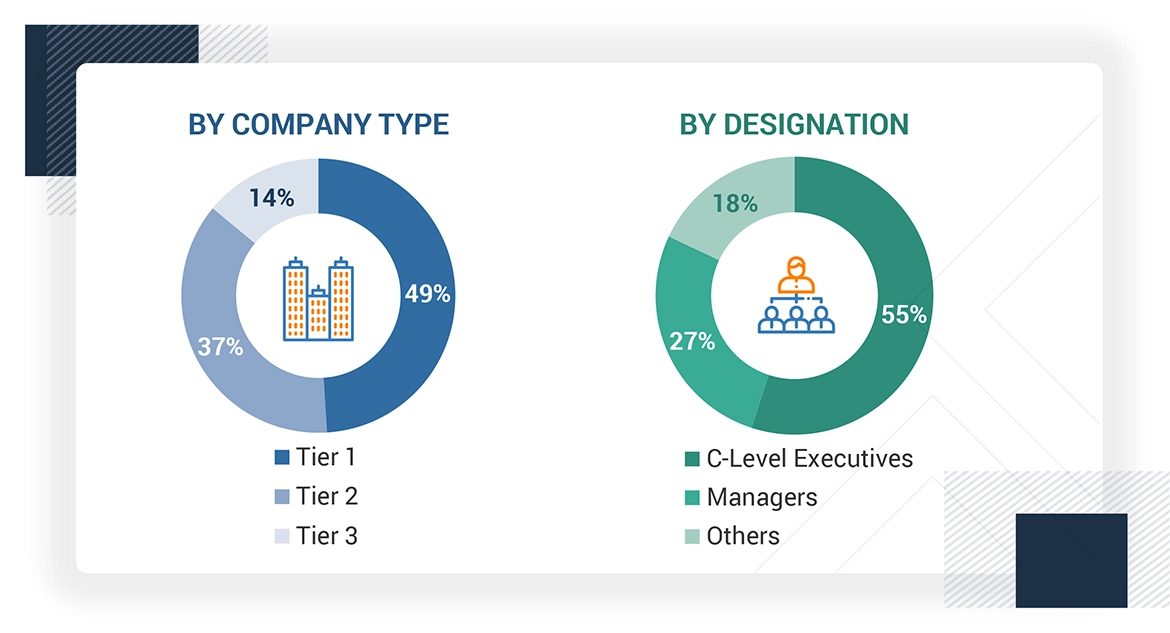
Note 1: C-level Executives include the CEO, COO, and CTO, among others.

Note 2: Others include sales managers, marketing managers, and product managers.

Note 3: Tiers of companies have been defined based on their total revenue as of 2024 (Tier 1 = > USD 1 billion, Tier 2 = USD 100 million to USD 1 billion, and Tier 3 = < USD 100 million).

To know about the assumptions considered for the study, download the pdf brochure

Market Size Estimation

All percentage shares, splits, and breakdowns were determined using secondary sources and verified through primary sources. All possible parameters that affect the markets covered in this research study were accounted for, viewed in extensive detail, verified through primary research, and analyzed to obtain the final quantitative and qualitative data. This data was consolidated, enhanced with detailed inputs, analyzed by MarketsandMarkets, and presented in this report.

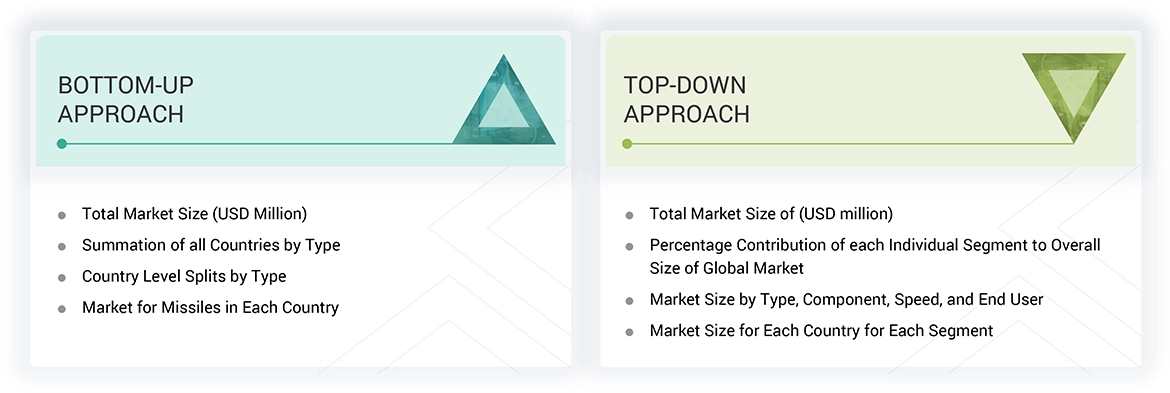
  • Both top-down and bottom-up approaches were used to estimate and validate the Asia-Pacific (APAC) missile market size.
  • Key players were identified through secondary research, and their market ranking was determined through primary and secondary research. This included a study of annual and financial reports of the top market players and extensive interviews with leaders, including CEOs, directors, and marketing executives.

Asia-Pacific (APAC) Missile Market : Top-Down and Bottom-Up Approach
Asia-Pacific (APAC) Missile Market Top Down and Bottom Up Approach

Data Triangulation

After arriving at the overall size of the Asia-Pacific (APAC) missile market from the market size estimation process explained above, the total market was split into several segments and subsegments. Wherever applicable, data triangulation and market breakdown procedures described below were implemented to complete the overall market engineering process and arrive at the exact statistics for various market segments and subsegments. The data was triangulated by studying different factors and trends from the demand and supply sides. Additionally, the market size was validated using both top-down and bottom-up approaches.

Market Definition

A missile is a weapon designed to be launched or propelled toward a target to deliver an explosive payload, offering precision-strike capability across tactical and strategic scenarios. These airborne weapons combine propulsion, guidance, and warhead subsystems to engage targets at ranges from a few kilometers to intercontinental distances.

The Asia-Pacific (APAC) missile market includes producing and procuring missiles within APAC countries for strategic and tactical applications. The market is segmented by type, component, speed, end user, and region. By type, the Asia-Pacific (APAC) market is divided into surface-to-surface, surface-to-air, air-to-air, air-to-surface, and subsea-to-surface segments.

Key Stakeholders

  • Missile Manufacturers
  • Defense Contractors
  • Original Equipment Manufacturers
  • Military Service Providers
  • Payload & Warhead Suppliers
  • Research Organizations
  • Investors and Venture Capitalists
  • Ministries of Defense
  • R&D Companies

Report Objectives

  • To define, describe, and forecast the size of the Asia-Pacific (APAC) missile market based on type, component, speed, end user, and country
  • To identify and analyze key drivers, restraints, opportunities, and challenges influencing market growth
  • To strategically analyze micromarkets with respect to individual growth trends, prospects, and their contribution to the market
  • To analyze opportunities for stakeholders in the market by identifying key market trends
  • To analyze competitive developments, such as contracts, acquisitions, expansions, agreements, joint ventures, partnerships, product developments, and research and development (R&D) activities in the market
  • To provide a detailed competitive landscape of the market, in addition to an analysis of business and corporate strategies adopted by leading market players
  • To strategically profile key market players and comprehensively analyze their core competencies

Available Customizations

Along with the market data, MarketsandMarkets offers customizations to meet the specific needs of companies. The following customization options are available for the report:

Product Analysis

  • Product matrix, which gives a detailed comparison of the product portfolio of each companyy

Company Information

  • Detailed analysis and profiling of additional market players (up to five)

Key Questions Addressed by the Report

What is the current size of the Asia-Pacific (APAC) missile market?
The Asia-Pacific (APAC) missile market is estimated to be valued at USD 3.69 billion (in market size) in 2025. It is projected to reach USD 6.26 billion by 2030, at a CAGR of 11.1%.
Who are the winners in the Asia-Pacific (APAC) missile market?
RTX Corporation (US), Mitsubishi Heavy Industries Ltd. (Japan), LIG Nex1 (South Korea), MBDA (France), and Bharat Dynamics Limited (India) are the most prominent companies in the market.
Name a few technological advancements in the market.
  • Recent breakthroughs in seeker design, like modular multi-spectral sensors paired with adaptive guidance software, have given APAC missiles unprecedented responsiveness and target discrimination in contested environments.
  • Innovations in composite propellant formulations and precision additive manufacturing have produced lighter, more efficient booster assemblies, extending the range and streamlining logistics for regional strike systems.
What are the factors driving the growth of the market?
Intensifying regional security challenges are prompting Asia Pacific governments to dedicate record defense budgets to layered air- and missile-defense systems, sustaining robust procurement of interceptors, cruise missiles, and precision-strike munitions.
Which region is estimated to account for the largest Asian-Pacific (APAC) missile market share in 2025?
Japan is projected to account for the largest share of the Asia-Pacific (APAC) market in 2025.

 

Request Customization

Personalize This Research

  • Triangulate with your Own Data
  • Get Data as per your Format and Definition
  • Gain a Deeper Dive on a Specific Application, Geography, Customer or Competitor
  • Any level of Personalization
Request A Free Customisation

Let Us Help You

  • What are the Known and Unknown Adjacencies Impacting the Asia-Pacific (APAC) Missile Market

  • What will your New Revenue Sources be?
  • Who will be your Top Customer; what will make them switch?
  • Defend your Market Share or Win Competitors
  • Get a Scorecard for Target Partners
Customized Workshop Request

Custom Market Research Services

We Will Customise The Research For You, In Case The Report Listed Above Does Not Meet With Your Requirements

Get 10% Free Customisation

Growth opportunities and latent adjacency in Asia-Pacific (APAC) Missile Market

DMCA.com Protection Status