AI Impact Analysis on Robotic Warfare Industry
AI in Robotic Warfare
The evolution of warfare has always been shaped by technological advances, from gunpowder and tanks to aircraft and satellites. Today, the defining shift is being driven by artificial intelligence and robotics. The Robotic Warfare Market represents one of the fastest growing areas in global defense, where machines are no longer just tools but active participants in combat strategy. Artificial intelligence has amplified the role of robotics in modern military doctrines, enabling autonomous systems to carry out reconnaissance, logistics, and even offensive operations with unprecedented efficiency. By integrating AI, robotic warfare has moved beyond remote controlled platforms into self directed systems capable of adapting to battlefield dynamics.
AI in Autonomous Ground Combat Robots
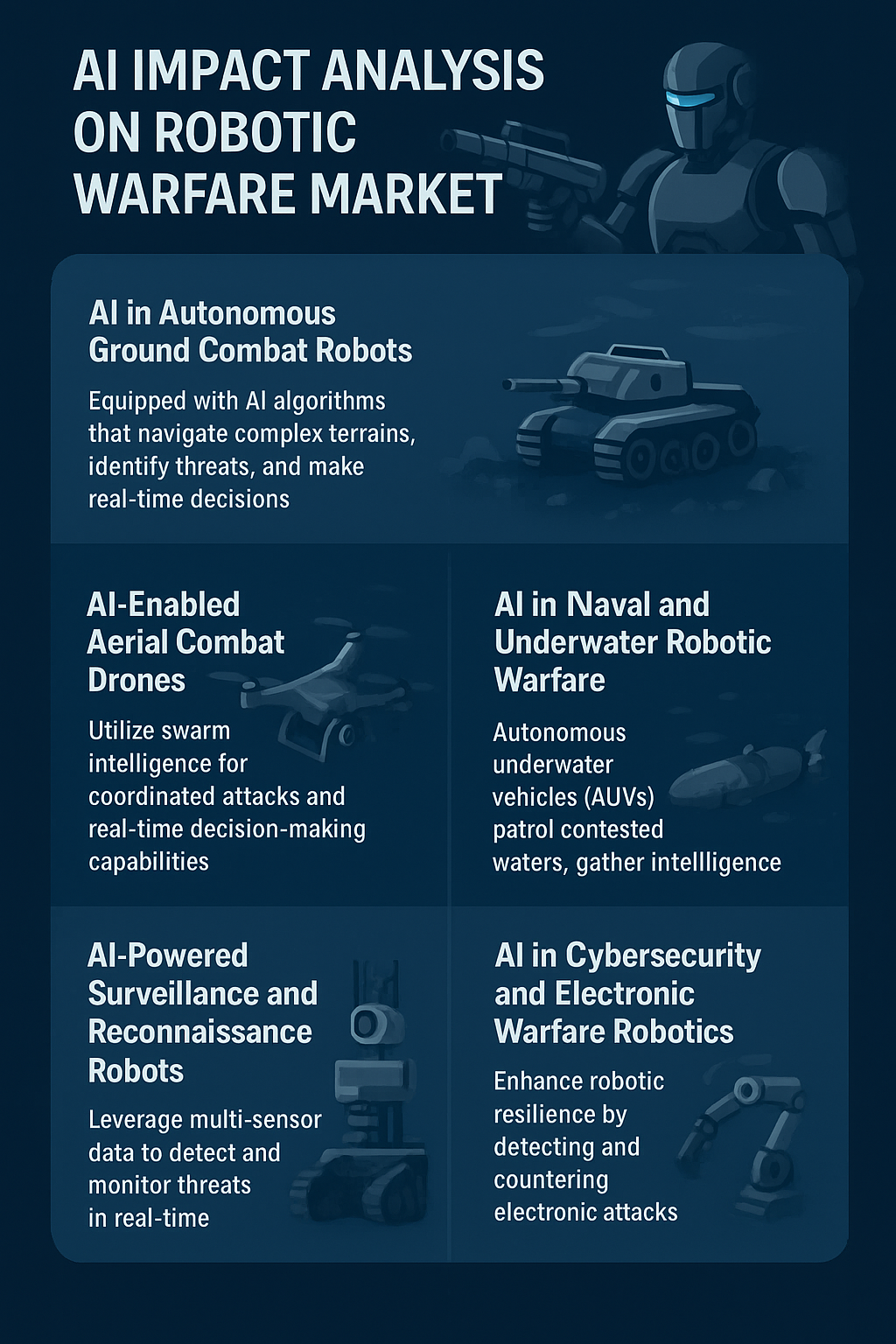
Autonomous ground combat robots are among the most promising advancements in the robotic warfare market. These robots are equipped with AI algorithms that allow them to navigate complex terrains without direct human input. In urban combat zones or rugged battlefield landscapes, AI enables these systems to assess obstacles, detect ambushes, and reroute in real time. Beyond navigation, artificial intelligence is also critical in target identification and threat assessment. Combat robots can distinguish between hostile forces and civilians, prioritize threats, and adjust weapon deployment accordingly. This capability reduces human error and accelerates decision making, giving militaries a significant tactical advantage in high pressure scenarios.
AI-Enabled Aerial Combat Drones
The use of unmanned aerial vehicles has already transformed warfare, but AI is pushing aerial combat drones to new frontiers. Swarm intelligence, powered by AI, allows groups of drones to operate cohesively as a unit, overwhelming defenses through coordinated strikes. This form of collective behavior mirrors patterns found in nature, such as flocks of birds or swarms of insects, but with precision guided weapons and surveillance technology integrated. Beyond swarm operations, AI also supports real time decision making in aerial missions. Combat drones can evaluate weather conditions, radar detection risks, and enemy countermeasures instantaneously, adjusting flight paths or attack strategies without waiting for human input. This level of autonomy is redefining the speed and complexity of air warfare.
AI in Naval and Underwater Robotic Warfare
Naval warfare has historically relied on human crews navigating ships and submarines, but AI enabled robots are reshaping underwater combat. Autonomous underwater vehicles (AUVs) now patrol contested waters, capable of conducting stealth reconnaissance, planting mines, or detecting enemy submarines. Artificial intelligence allows these underwater systems to identify patterns of enemy movement and adapt to shifting underwater currents. In mine countermeasures, AI enables robots to detect, classify, and neutralize threats with precision, minimizing risks to human divers. Naval robotic warfare also extends to surface operations, where unmanned surface vehicles use AI navigation and sensor fusion to carry out escort missions, intelligence gathering, and anti submarine defense, all while reducing exposure to human crews.
AI-Powered Surveillance and Reconnaissance Robots
Surveillance and reconnaissance form the backbone of modern military operations, and AI powered robots are revolutionizing this domain. Equipped with multi sensor arrays, these robots can gather high resolution imagery, thermal signatures, and signals intelligence simultaneously. Artificial intelligence is essential in processing this massive flow of data in real time, turning raw input into actionable insights for commanders. AI enabled multi sensor fusion further strengthens decision making, as it integrates radar, optical, infrared, and acoustic data streams to provide comprehensive situational awareness. This reduces blind spots on the battlefield and ensures that military leaders have accurate intelligence to guide strategy and prevent surprise attacks.
AI in Cybersecurity and Electronic Warfare Robotics
Modern warfare extends beyond physical battlefields into cyberspace, and robotic systems are now being integrated with AI to combat electronic threats. Cybersecurity in robotic warfare is critical, as autonomous systems are vulnerable to hacking and manipulation. Artificial intelligence strengthens robotic resilience by detecting anomalies in system behavior and identifying potential cyber intrusions. Furthermore, autonomous response systems equipped with AI can counter electronic warfare attacks in real time, such as jamming attempts or spoofed GPS signals. By empowering robotic platforms to adapt instantly to electronic threats, militaries ensure their systems remain operational and effective under hostile digital conditions.
Get AI Impact Analysis on Robotic Warfare Market, Request Pdf Brochure: https://www.marketsandmarkets.com/pdfdownloadNew.asp?id=206201612
Predictive Maintenance and AI in Robotic Systems
The effectiveness of robotic warfare systems depends not only on their performance in combat but also on their long term reliability. AI driven predictive maintenance has emerged as a key advantage in extending the lifecycle of robotic fleets. By analyzing data from onboard sensors, AI can detect early signs of component fatigue, overheating, or system malfunctions before they cause critical failures. This proactive approach reduces downtime, optimizes resource allocation, and ensures that robotic systems remain battle ready at all times. Lifecycle management is further enhanced by AI’s ability to learn from historical maintenance patterns, continuously improving the efficiency of supply chains and repair strategies.
AI in Human-Machine Collaboration on the Battlefield
Although robotic warfare emphasizes autonomy, the future battlefield will be defined by effective collaboration between humans and machines. Artificial intelligence enhances this collaboration by allowing robotic systems to interpret soldier commands, anticipate needs, and adapt to unpredictable situations. Robotic assistance ranges from carrying heavy supplies and providing battlefield medical aid to operating alongside infantry units in combat. AI ensures that robots can understand contextual cues, reducing the cognitive burden on soldiers and minimizing fatigue. This collaboration reduces human risk in high threat zones, while also ensuring that robots augment, rather than replace, human decision making in critical missions.
Ethical and Regulatory Challenges of AI in Robotic Warfare
While AI driven robotic warfare presents significant advantages, it also raises ethical and regulatory concerns. The most pressing issue revolves around autonomous lethal decision making, where machines determine whether to engage targets without human oversight. Critics argue that this undermines accountability and increases the risk of unintended civilian casualties. Global discussions on regulations for lethal autonomous weapon systems (LAWS) are ongoing, but progress is uneven across regions. International organizations and defense policymakers are grappling with the balance between technological advancement and humanitarian law. Ethical frameworks and global treaties will play a decisive role in shaping the acceptable boundaries of AI in robotic warfare.
Future Outlook: AI and Next-Gen Robotic Warfare Systems
Looking ahead, the Robotic Warfare Market is poised for exponential growth as AI integrates with emerging technologies. Quantum computing promises to accelerate the processing capabilities of robotic systems, enabling faster battlefield simulations and tactical predictions. Advanced robotics, combined with AI, will produce systems capable of adaptive learning, enhancing their ability to handle unforeseen challenges in combat environments. The strategic implications of these advancements are profound, as they are expected to redefine global defense competition and shift the balance of power. Nations that lead in AI driven robotic warfare will command significant geopolitical influence, making this a priority area for investment and innovation.
Related Reports:
Robotic Warfare Market by Capability (Unmanned Platforms & Systems, Exoskeleton & Wearables, Target Acquisition Systems, Turret and Weapon Systems), Application, Mode of Operation, Domain, and Region - Global Forecast to 2028

This FREE sample includes market data points, ranging from trend analyses to market estimates & forecasts. See for yourself.
SEND ME A FREE SAMPLE






