AI Impact Analysis on Space-Based Solar Power Industry
AI in Space-Based Solar Power
The Space Based Solar Power (SBSP) market represents one of the most ambitious frontiers in renewable energy. By capturing solar energy in space and transmitting it to Earth, SBSP has the potential to provide continuous, sustainable power unaffected by atmospheric conditions or the day night cycle. The complexity of designing, deploying, and managing these systems requires advanced intelligence beyond traditional engineering. Artificial intelligence is playing a central role in making SBSP a viable reality. From satellite design to energy transmission, ground based reception, and lifecycle management, AI is the underlying technology that ensures efficiency, accuracy, and resilience. As global demand for clean energy accelerates, the fusion of SBSP and AI is expected to revolutionize how the world generates and consumes electricity.
AI in Satellite Design and Deployment for SBSP
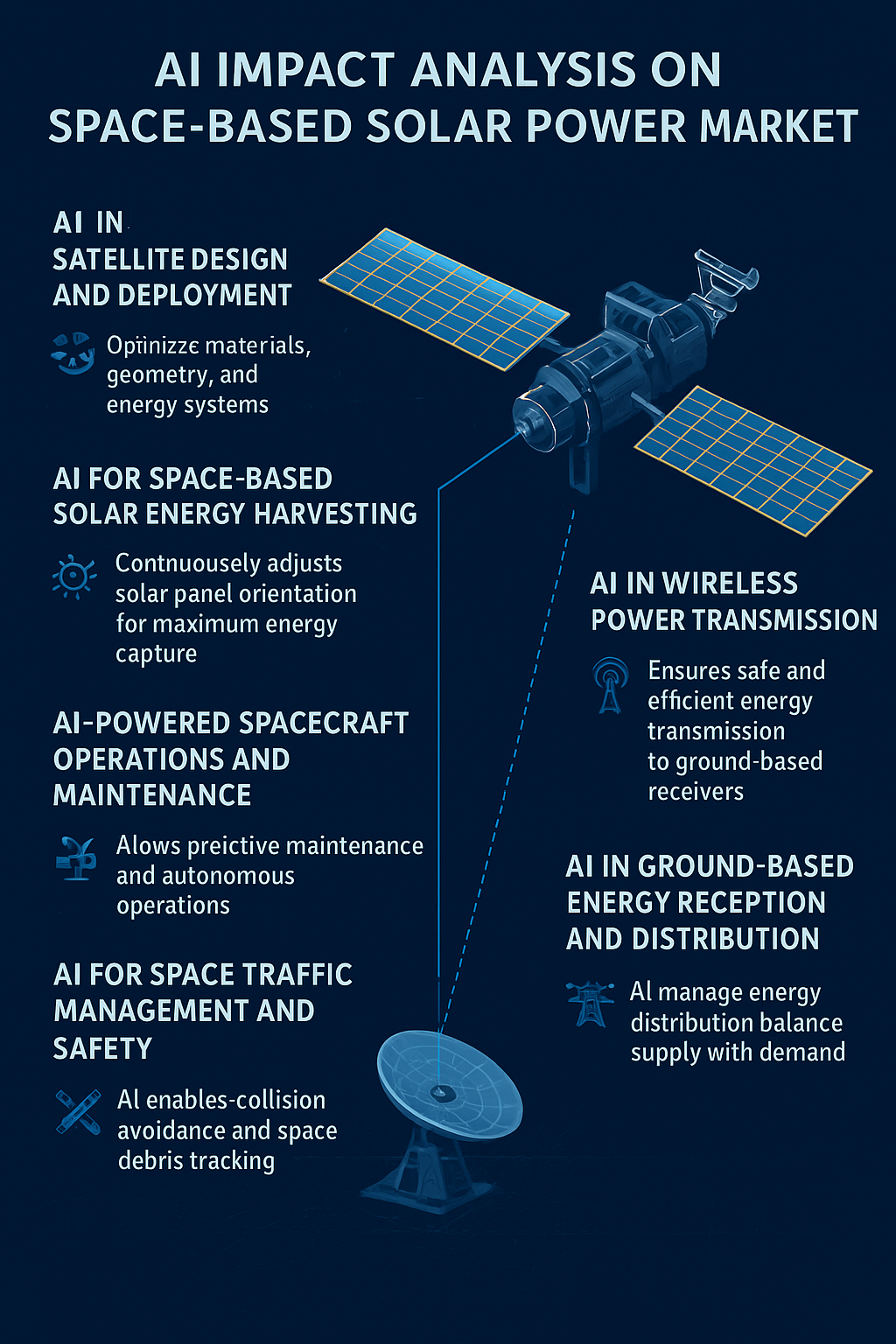
One of the first areas where AI is transforming the SBSP market is satellite design and deployment. Building satellites capable of efficiently harvesting solar energy in orbit requires advanced optimization across materials, geometry, and energy systems. AI powered generative design algorithms can evaluate thousands of structural configurations to create satellites that are lightweight yet durable enough to withstand space radiation, micrometeoroids, and temperature extremes. Deployment of these satellites also benefits from AI. Autonomous decision making algorithms ensure precise orbit insertion and adjustment, minimizing the need for human intervention. With AI, constellations of solar satellites can autonomously synchronize and reposition themselves to maintain optimal alignment with the Sun and ensure maximum power output.
AI for Space-Based Solar Energy Harvesting
The efficiency of SBSP systems depends largely on how much solar energy satellites can capture. AI has become indispensable in enhancing this process. Machine learning models analyze data from solar sensors to continuously improve energy harvesting strategies. Satellites equipped with AI can adaptively adjust their solar panel orientation in real time, ensuring maximum exposure to sunlight regardless of orbital variations. This adaptive control is crucial for maintaining consistent power levels across seasons and different orbital inclinations. AI can also detect performance degradation in solar panels, predicting when maintenance or replacement will be required, thereby extending the operational life of SBSP systems and maximizing their return on investment.
AI in Wireless Power Transmission
A critical challenge in SBSP is transmitting the captured solar energy from orbit to Earth without significant losses. This is achieved through wireless power transmission, typically using microwaves or lasers. AI dramatically improves the safety and efficiency of this process. Real time beam alignment powered by AI ensures that transmission remains focused on ground based rectennas, even in the face of orbital shifts or atmospheric disturbances. Machine learning algorithms also monitor the transmission for anomalies, instantly correcting errors to prevent power losses or safety risks. AI ensures that the power beams remain stable and efficient, making wireless transmission a reliable bridge between orbital satellites and Earth based power grids.
AI-Powered Spacecraft Operations and Maintenance
Maintaining SBSP satellites in orbit presents one of the greatest challenges in the market. Manual intervention is costly and often impractical. AI enables autonomous spacecraft operations and predictive maintenance to overcome this obstacle. Satellites embedded with AI algorithms can monitor their own health, detect anomalies such as micro cracks, overheating, or component malfunctions, and initiate corrective actions. AI can trigger reconfiguration of systems or rerouting of energy flows to bypass damaged modules. Predictive analytics ensures that potential failures are identified before they escalate, reducing downtime and prolonging mission lifespans. Autonomous repair systems guided by AI will eventually enable satellites to self repair or collaborate with robotic assistants in orbit, drastically reducing operational costs.
AI in Ground-Based Energy Reception and Distribution
Once energy is transmitted from space, AI also plays a key role in managing its reception and integration into Earth’s power grids. AI enabled smart grids are capable of dynamically balancing incoming SBSP energy with local energy demand. By forecasting usage patterns in real time, AI ensures that the distributed energy is allocated efficiently, preventing overloads and ensuring grid stability. AI can predict regional demand fluctuations, rerouting excess power to storage systems or alternative locations. This creates a seamless integration of space based solar energy into national and international grids, ensuring that the renewable energy provided is as reliable as conventional sources.
Get AI Impact Analysis on Space-Based Solar Power Market, Request Pdf Brochure: https://www.marketsandmarkets.com/pdfdownloadNew.asp?id=117709727
AI for Space Traffic Management and Safety
As the number of satellites in orbit increases, space traffic management is becoming a growing concern. AI has emerged as a crucial tool for ensuring the safety of SBSP satellites and their supporting infrastructure. AI powered collision avoidance systems allow satellites to autonomously adjust their orbits when potential collisions with debris or other satellites are detected. AI algorithms continuously monitor the surrounding orbital environment, mapping the movement of space debris that could threaten solar power satellites. With SBSP systems expected to require large satellite constellations, AI will be vital in managing orbital congestion, maintaining safety, and ensuring uninterrupted energy transmission.
AI in Cost Optimization and Resource Management
Developing and deploying SBSP systems involves high costs in research, manufacturing, and logistics. AI is helping reduce these costs significantly by optimizing resource allocation. AI models can simulate and predict the performance of SBSP systems before physical prototypes are built, cutting down on R&D expenditures. In manufacturing, AI driven robotics streamline the production of satellite components, reducing time and material wastage. AI also improves supply chain management, forecasting material demands and optimizing logistics for space launches. These applications make SBSP projects more financially viable, encouraging greater investment from both governments and private companies.
Regional and Strategic AI Adoption in SBSP
Different regions are approaching the integration of AI into SBSP with varying strategies. In the United States, government backed projects and private space companies are leveraging AI to accelerate SBSP research and deployment, with defense applications being a strong driver. Europe is focusing on sustainability and international collaboration, applying AI to ensure that SBSP projects align with climate goals. In Asia Pacific, particularly in China and Japan, aggressive investments in AI and space technologies are creating a competitive environment for SBSP leadership. AI is not only shaping technical capabilities but also influencing geopolitical strategies, as nations view SBSP as both an energy solution and a strategic advantage.
Future Outlook: AI and Next-Gen SBSP Systems
Looking forward, AI will be inseparable from the next generation of space based solar power systems. Autonomous megaconstellations of satellites powered by AI are expected to dominate the market, offering scalable and resilient energy generation capabilities. AI will also play a pivotal role in integrating SBSP into global energy ecosystems, ensuring sustainable power generation that supports climate action. Beyond Earth, AI enabled SBSP systems could even power lunar bases, Mars missions, and deep space exploration. Ethical and regulatory frameworks will be needed to govern the safe use of AI and wireless energy transmission, but the long term outlook is one of rapid growth and transformative impact.
Related Report:
Space-Based Solar Power Market by Beam Type (Laser Beam Power Transmission, Microwave Power Transmission), End Users (Government and Defense, Commercial), Application (Terrestrial, Space) and Region - Global Forecast to 2040

This FREE sample includes market data points, ranging from trend analyses to market estimates & forecasts. See for yourself.
SEND ME A FREE SAMPLE






