AI Impact Analysis on Space Launch Industry
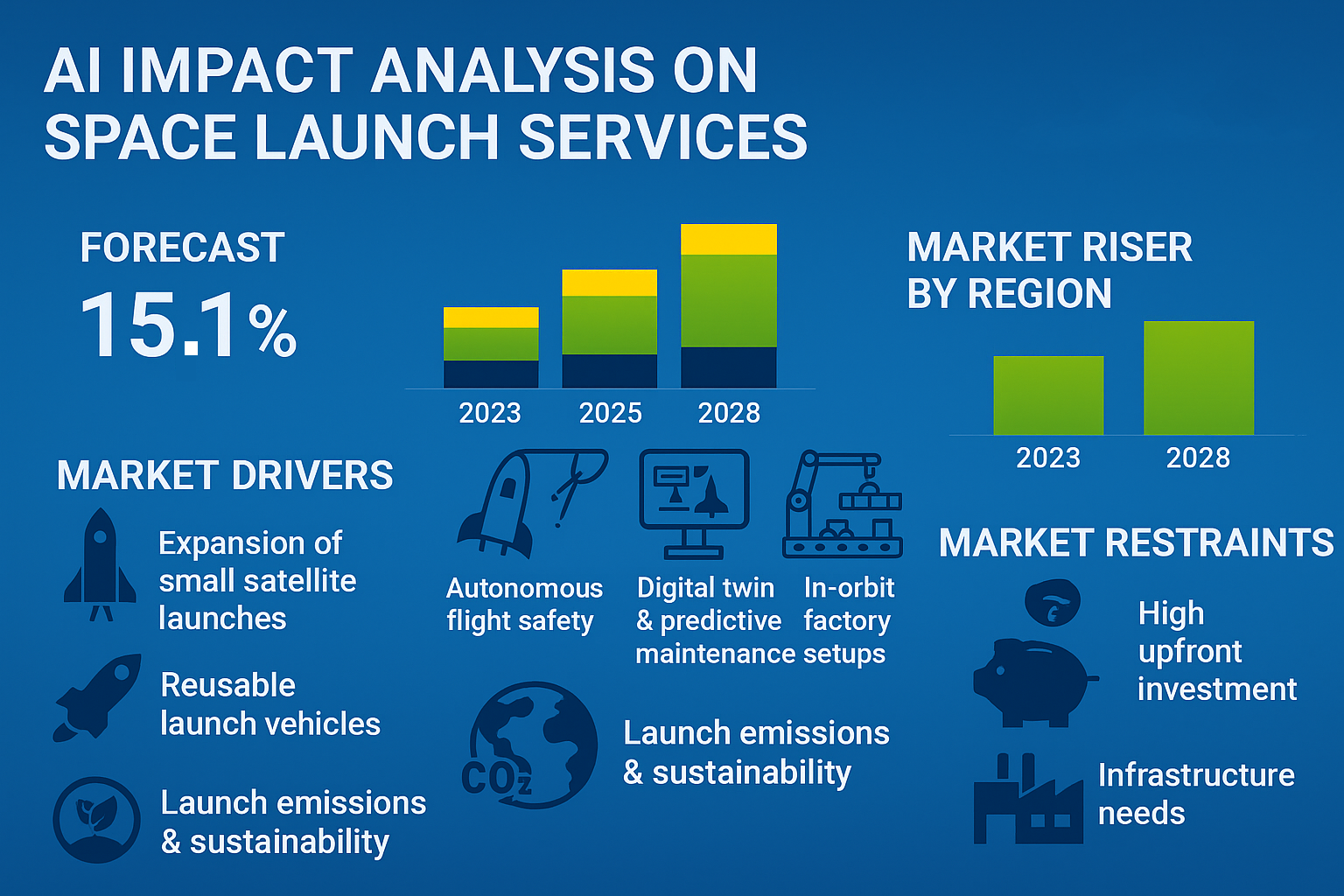
The Global Space Launch Services Market has undergone significant transformation, growing from approximately USD 16.9 billion in 2022 to an estimated USD 29.6 billion by 2027, with projections reaching a remarkable CAGR of around 15.1%. North America dominates this market, supported by heavy investment and innovation from companies like SpaceX and Rocket Lab. Breakthroughs in reusable rockets have been transformative, dramatically lowering launch costs SpaceX alone projects revenues near USD 15.5 billion in 2025, driven by Falcon and Starship deployment. Over this expansive growth trajectory, artificial intelligence (AI) is poised to reshape nearly every stage of the space launch ecosystem.
1. AI Powered Launch Vehicle Design Optimization
AI is shifting rocket design from rule based engineering toward generative and data driven models. By simulating aerodynamic behavior, stress responses, and thermal dynamics, AI accelerates structural iteration cycles. Machine learning can optimize fuel mass flow rates and thrust to weight profiles for actual flight conditions. Digitally driven optimization across launch domains helps reduce lifecycle costs while improving reliability.
2. AI in Launch Simulation and Testing
Digital twins and AI driven simulations allow real time anomaly detection during engine tests and countdown operations. Adaptive learning models simulate multi stage separation, nozzle performance, and weather impacts. AI enhanced virtual reality testing reduces the need for expensive test firings and enables risk forecasting for reuse scenarios .
3. AI for Payload Scheduling and Integration
AI streamlines payload planning by automating manifest creation and mass balancing calculations. Satellites, cargo, and crew modules can be optimally placed based on orbital mechanics, risk profiles, and subsystem interactions. AI can also flag payload compatibility issues or safety checks during integration, reducing mission countdown errors and preserving launch schedules.
4. AI in Ground Control and Monitoring Systems
From telemetry to fuel systems, AI enhances ground station awareness. Predictive diagnostics identify anomalies in sensors, valves, and data buses, enabling pre emptive maintenance. During launch, AI cross validates telemetry from multiple sensors, monitors weather conditions, and intervenes in control networks troubleshooting countdowns autonomously and providing operators with proactive alerts.
5. AI Enabled Launch Windows and Orbital Calculations
Orbital insertion accuracy depends on minute calculations. AI can optimize launch windows by simulating trajectory alternatives accounting for weather, wind shear, and the space environment. When deploying satellites, AI can dynamically alter stage separation timing for precision insertion. These algorithms allow reusable and expendable vehicles to operate with higher confidence at lower delta v costs.
6. AI in Reusable Rocket Operations
Reusable boosters rely on tight margin trajectories and exact reentry controls. AI works through sensor suites to adjust engines and control surfaces in real time, guiding rockets back to drone ships with high precision . Predictive models help forecast landing zone viability and accelerate refurbishment decisions cutting turnaround and refurbishment costs by 20–30 % in some analyses.
Get AI Impact Analysis on Space Launch Services Market, Request Pdf Brochure: https://www.marketsandmarkets.com/pdfdownloadNew.asp?id=132122845
7. AI for Satellite Deployment and Orbit Insertion
Post launch payload separation benefits from AI powered verifications ensuring safe distances, verifying telemetry, and autonomously adjusting thrusters for drift compensation. Multi payload launches like realerted constellations can be precision sequenced with AI guided control of deployers and final insertion maneuvers.
8. AI Based Cost and Supply Chain Optimization
Launch services depend on complex supply chains. AI enhances forecasting for heaters, valves, electronics, and composite tanks; optimizes vendor delivery based on predictive lead times; flags risks from geopolitics or production delays; and adjusts contract scheduling with local and global providers. This improves inventory efficiency and mission cadence.
9. AI in Regulatory Compliance and Risk Analysis
Launch services must comply with aerospace regulations, vibration standards, export controls, and environmental impact policies. AI parses and tracks policy changes, automates documentation flows, and provides audit trails. Risk modules model geopolitical sanctions, licensing delays, or orbital debris avoidance helping firms build compliant launch programs.
10. Future Outlook: AI’s Role in Next-Gen Launch Systems
In parallel with JADC2 and satellite constellations, AI will support next gen spaceports capable of rapid reconfigurations, strapped stage flights, and even in orbit manufacturing referenced toward zero gravity production lines . AI powered spacecraft systems may autonomously manage entire mission lifecycles from launch to docking to long duration operation raising the stakes for intelligent architecture in future launch ecosystems.
Strategic & Market Implications
North America’s launch services market, already at nearly USD 21 billion in 2025 with forecasts approaching USD 58 billion by 2033, stands strongly in global decision making. AI names in design, simulation, and operations provide differentiation for companies expanding fleets, increasing launch cadence, and pursuing new frequencies. SpaceX reports targeting 170 launches in 2025, Rocket Lab’s Neutron boosts smallsat market reach , and Blue Origin's Jarvis and Sierra Black OS bring AI into rocketry reinforcing North America’s technological leadership.
AI integration is reshaping the space launch services sector in practical ways from vehicle design and simulation to ground systems and supply chains. As launch cadence intensifies and reusable models proliferate, AI will serve as the operational spine ensuring cost efficiency, reliability, and mission success. For North America to remain dominant, integration of AI into tech, process, and strategy is not optional it is critical for next generation launch services.
Related Report:
Space Launch Services Market by Service Type (Pre-launch, Post Launch), Payload (Satellite, Human Spacecraft, Cargo, and Space Probes), End User (Commercial, Military and Government), Orbit, Launch Vehicle, Launch type and Region - Global Forecast to 2027

This FREE sample includes market data points, ranging from trend analyses to market estimates & forecasts. See for yourself.
SEND ME A FREE SAMPLE






