AI Impact Analysis on Tactical Data Link Industry
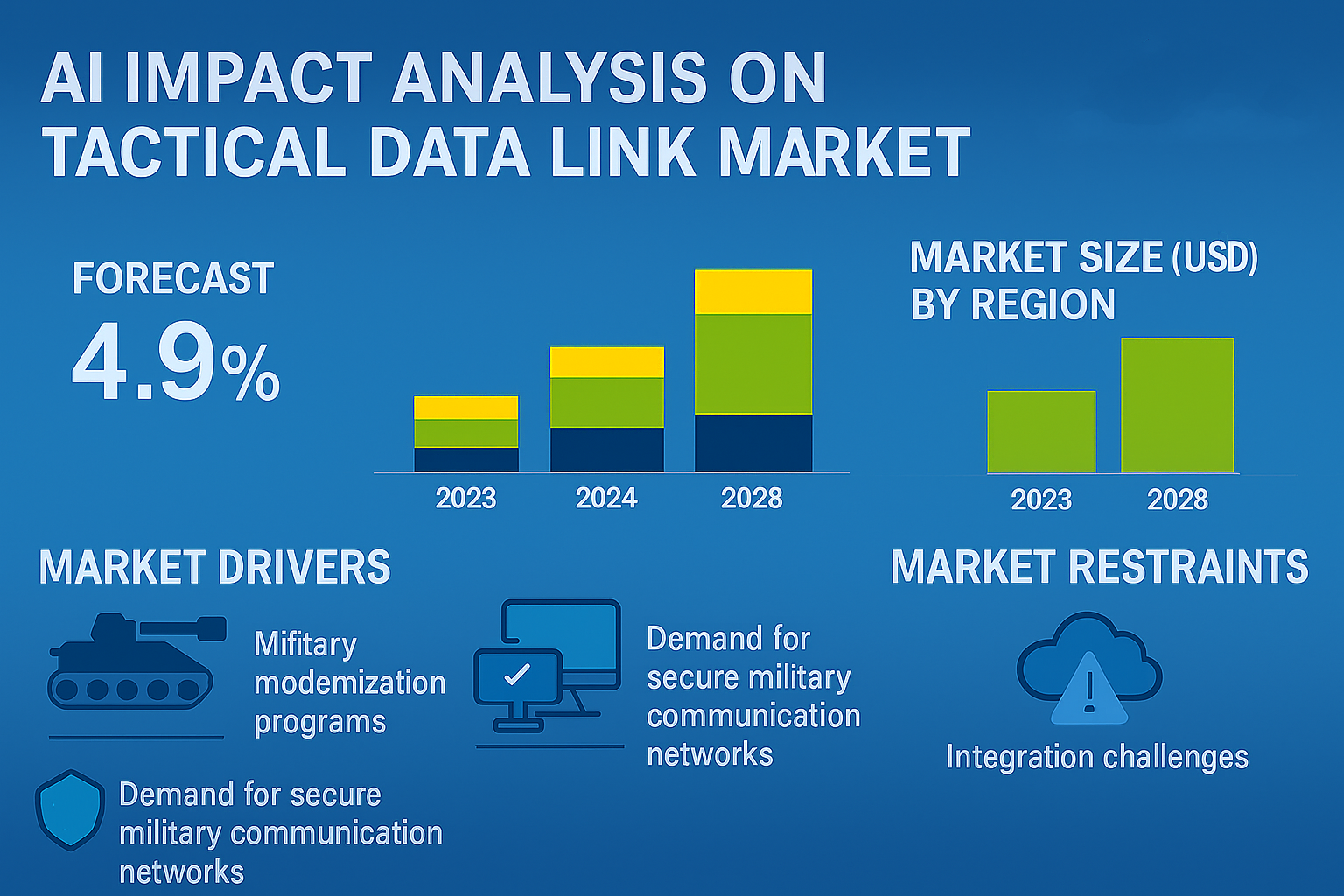
The Tactical Data Link (TDL) Market, pivotal to modern military command and control, stood at approximately USD 8.1 billion globally in 2022 and is expected to grow at a 4.9 % CAGR through 2030, reaching nearly USD 10.3 billion by 2027. North America commands over half of this market share, driven by extensive defense spending and modernization efforts. Artificial Intelligence now serves as a cornerstone for the evolution of TDLs by enhancing reliability, resilience, cybersecurity, and interoperability. This blog delves into ten critical domains where AI is transforming traditional TDL capabilities, ensuring TDL relevance in future combat environments.
AI Enabled Data Prioritization in Tactical Networks
AI based systems can dynamically prioritize mission critical messages such as targeting data or voice commands over less urgent telemetry. During peak network congestion or intentional jamming, AI manages prioritization to ensure command and control integrity persists. Unlike static priority tables, machine learning adapts to evolving mission phases and threat levels, elevating essential traffic while deferring non essential payloads until bandwidth allows.
Real Time Threat Detection Using AI in TDL
Tactical data flow is vulnerable to spoofing, jamming, and cyber intrusions. AI driven pattern recognition and anomaly detection continuously analyze data streams across Link 16, Link 22, and JREAP. This real time vetting identifies irregular patterns such as false entity declarations or signal manipulations and flags suspicious nodes. Command centers can then reroute operations around compromised networks, preserving operational security and mission integrity.
Enhancing Interoperability Among Multi Domain Forces
Joint missions require seamless data exchange across platforms: manned aircraft, naval vessels, ground units, and UAVs using distinct protocols. AI bridges these differences via automated protocol translation and waveform mapping. It transforms Link 16 packets into Link 22 or VMF formats on the fly, enabling mesh architectures that unify disparate networks without manual reprogramming. This cross domain integration empowers joint forces with cohesive situational overlays during complex operations.
AI for Cybersecurity in Tactical Data Links
Cyber threats in TDL extend beyond the electromagnetic domain. AI augments cybersecurity by monitoring every packet for anomalous behavior flagging unusual request patterns, abnormal data egress, or micro timing irregularities. Zero trust models enforced via AI can quarantine suspicious nodes, rotate encryption keys autonomously, and isolate compromised links. This fortifies TDL as the backbone of secure tactical communications.
Optimizing Bandwidth and Latency with AI
In remote or contested environments, bandwidth is limited and latency can spike severely. AI driven traffic management optimizes usage by identifying low priority payloads that can be delayed or compressed, dynamically adjusting encryption overhead, and recommending waveform classes best suited for current link conditions. This ensures real time flow of critical data even when resources are constrained.
AI Driven Predictive Maintenance of TDL Hardware
Grounded operations due to failed modems, radios, or antennas can compromise missions. AI enabled predictive diagnostics analyze hardware telemetry RF power levels, voltage trends, temperature anomalies to predict failures before they occur. Cloud or edge based AI systems trigger maintenance alerts, schedule proactive hardware swaps, and optimize overhaul cycles, improving readiness and cost predictability.
Get AI Impact Analysis on Tactical Data Link Market, Request Pdf Brochure: https://www.marketsandmarkets.com/pdfdownloadNew.asp?id=76169438
Enhanced Tactical Situational Awareness Through AI
Tactical networks ingest vast sensor feeds from multiple domains: EW systems, radar, AIS, UAV telemetry. AI fuses this into cohesive Common Operational Pictures (COP), tagging entities with dynamic threat levels, predicting their intent, and presenting commanders with limited clutter overlays. These intelligent visualizations enable rapid decision making and routing of high value assets in real time.
Autonomous Decision Support with AI
Embedded AI agents deployed at command nodes or onboard platforms analyze COP data and mission directives to recommend actions: re tasking ISR assets, shifting fire control priorities, or suggesting deconflicted comms schedules. These decision aids surface options while respecting rules of engagement, saving cognitive load and speeding tactical decisions under stress.
Enhancing SATCOM Integration in TDL via AI
Modern TDLs blend line of sight and beyond line of sight communications via SATCOM nodes. AI orchestrates seamless hand offs known as SATCOM ON THE MOVE or SATCOM ON THE PAUSE by selecting optimal pathways based on signal geometry, link quality, and surge capacity. It adjusts waveforms, bandwidth allocations, and routing rules, ensuring continuity across platforms while minimizing latency and spectrum footprint.
Future Outlook: AI’s Role in Next Gen TDL Systems
As joint architectures evolve toward 6th generation combat systems under JADC2 and MUM T frameworks, the TDL market will demand AI native designs. These include cognitive radios capable of negotiating protocols autonomously, adaptive waveform synthesis, AI driven cybersecurity modules, and self optimizing mesh networks scalable across large battlefield zones. AI enabled TDLs stand at the core of next gen command and control ecosystems.
AI is redefining the Tactical Data Link landscape in North America across critical domains: data prioritization, security, hardware resilience, situational awareness, and multi domain interoperability. With North America accounting for roughly 50 % of the global TDL market, and projected global growth to USD 10.3 billion by 2027 at a CAGR of around 4.9%, AI's role in this sector will only deepen. For defense stakeholders, investing in AI infused TDLs ensures resilient, adaptive, and future proof communications systems for complex operational environments.
Related Report:
Tactical Data Link Market by Data Link Type (Link 11, LINK 16, Link 22, Others), (Application (Command & Control, ISR, EW, Radio Communication), Platform, Component, Frequency, Point of Sale, Military Standard, and Region - Global Forecast to 2027

This FREE sample includes market data points, ranging from trend analyses to market estimates & forecasts. See for yourself.
SEND ME A FREE SAMPLE






