AI in Solid Rocket Motors Industry: North America’s Shift
The aerospace and defense sectors in North America are undergoing a profound technological evolution, with artificial intelligence emerging as a pivotal force in reshaping the development and operation of solid rocket motors. Long regarded as workhorses of space and military missions, solid fuel rocket engines are known for their reliability and rapid thrust delivery. However, the complexity involved in optimizing design, enhancing performance, and ensuring safety has historically depended on manual simulations, trial and error formulations, and extensive physical testing. The advent of artificial intelligence is now disrupting this paradigm, infusing the sector with data driven intelligence and autonomous decision making. From predictive analytics to smart manufacturing, AI is unlocking new levels of performance and efficiency across the value chain of solid propulsion systems.
AI Powered Design Optimization for Rocket Motor Engineering
Designing solid rocket motors has traditionally been a resource intensive endeavor, involving complex aerodynamic and thermodynamic modeling. Engineers had to simulate combustion chamber dynamics, nozzle expansion ratios, and thermal shielding mechanisms through laborious iterations. AI is changing this equation by introducing generative design algorithms and machine learning models that analyze historical flight data, material characteristics, and combustion profiles to propose optimal configurations. Instead of running thousands of manual simulations, engineers can now input mission parameters and let AI systems recommend high performance designs. This not only speeds up development timelines but also produces more efficient and lightweight solid propulsion systems. In North America, where commercial space launch companies and defense contractors race to improve thrust to weight ratios and payload capacities, this AI driven design optimization offers a critical advantage.
Intelligent Propellant Formulation and Chemical Efficiency
The performance of solid propellant rocket motors heavily depends on the chemical formulation of their fuel. Traditionally, the balance between oxidizers, binders, and metallic additives was achieved through extensive lab testing. Artificial intelligence is transforming this approach by using machine learning to simulate and predict burn characteristics of various compositions. AI algorithms can now evaluate thousands of fuel formulations in silico, optimizing for factors such as burn rate, pressure exponent, ignition delay, and specific impulse. These simulations take into account mission profiles, temperature sensitivity, and storage longevity, allowing developers to tailor propellants with unparalleled precision. This has major implications for North American missile propulsion systems, where reliability, responsiveness, and shelf life are mission critical parameters. AI also enables formulation of more eco friendly solid propellant technologies by identifying green substitutes without compromising performance.
Predictive Maintenance for Enhanced Reliability and Lifespan
Solid rocket motors operate under extreme pressure and temperature conditions, placing immense stress on components like combustion chambers, casings, and nozzles. Previously, identifying wear and tear or potential points of failure relied on scheduled inspections and static metrics. AI has introduced a predictive maintenance model where embedded sensors and edge computing units continuously monitor parameters such as vibration, thermal loads, and structural integrity during test firings and deployments. Machine learning algorithms analyze this real time data to forecast potential failures, enabling preemptive servicing or component replacement. This is especially critical for solid fuel rocket engines used in North America's strategic defense systems, where unexpected failures can have severe consequences. With predictive insights, maintenance costs are reduced, and system availability is significantly increased, boosting the overall reliability of aerospace defense operations.
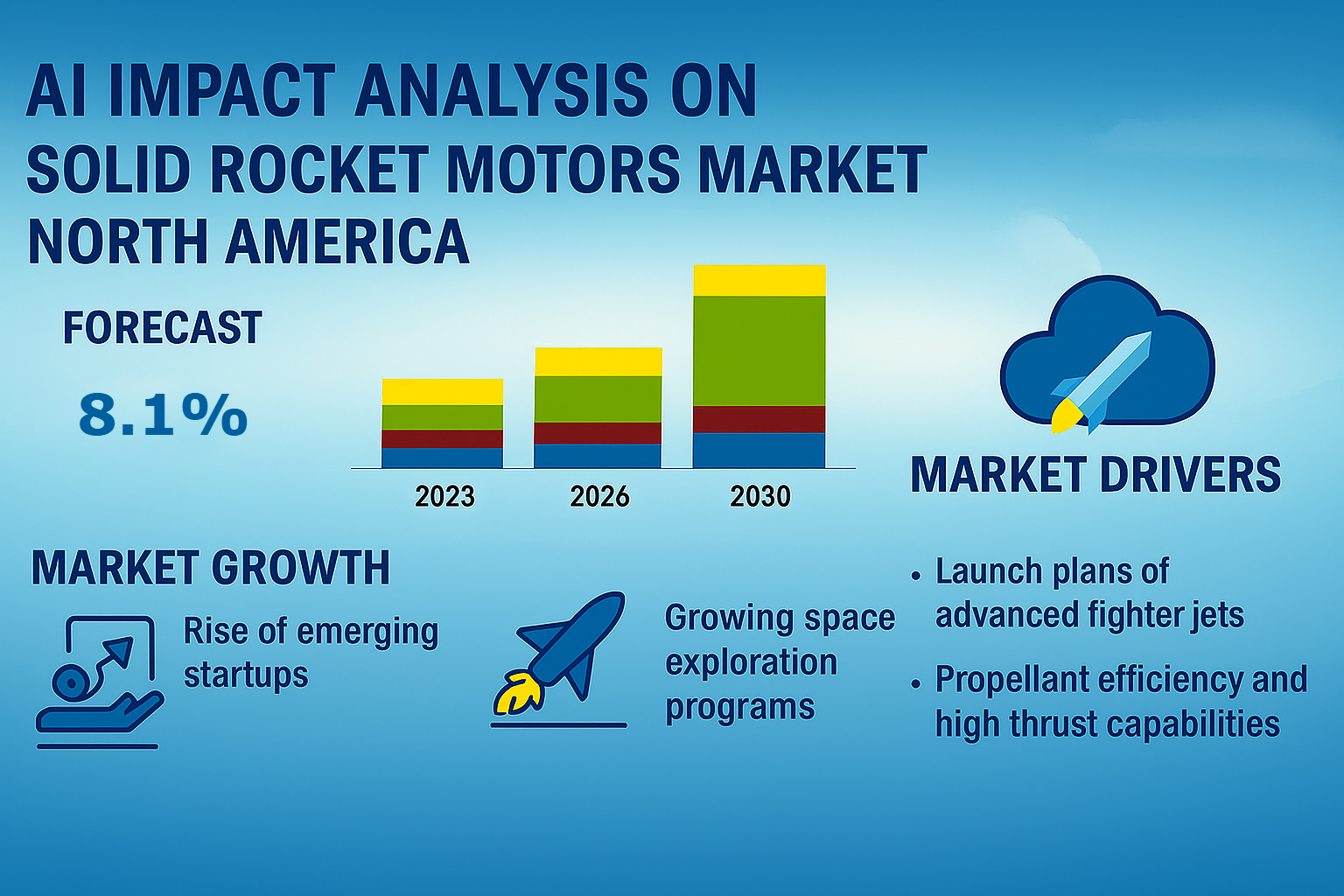
Smart Manufacturing and Robotic Automation in Propulsion
The production of solid rocket motors involves sensitive and potentially hazardous processes, including mixing and casting energetic materials, precision machining of motor casings, and curing of composite insulators. Artificial intelligence is revolutionizing manufacturing by integrating robotics, computer vision, and process automation. Smart manufacturing platforms now utilize AI to control environmental parameters, monitor batch consistency, and detect anomalies during each stage of production. In North America, where industrial automation is advancing rapidly, this integration ensures higher throughput and product uniformity while reducing safety risks to human operators. Robots guided by AI driven instructions can now handle casting and curing operations with micron level accuracy, while adaptive control systems automatically adjust process variables to maintain quality assurance. This combination of AI and automation leads to faster production cycles, safer work environments, and more scalable manufacturing of solid propulsion systems.
AI Enhanced Quality Control and Non Destructive Testing
Ensuring the structural integrity of solid rocket motors is essential for both safety and performance. Traditional inspection methods such as X ray or ultrasonic testing are time consuming and prone to human error. AI is bringing a new dimension to quality control through automated visual inspection and intelligent non destructive evaluation (NDE). High resolution imaging systems paired with AI algorithms can detect micro cracks, voids, inclusions, and other defects that may be invisible to the human eye. These systems analyze patterns and irregularities across large volumes of data to identify early signs of structural weaknesses. In North America, where aerospace component quality standards are among the most stringent globally, this AI driven inspection technology enables faster certification, reduces rework, and improves customer confidence in the performance of solid propellant rocket motors.
Optimizing Supply Chains for Rocket Motor Development
The development of solid rocket motors depends on a highly specialized and often fragile supply chain, encompassing raw material providers, propellant chemical suppliers, and specialized manufacturing partners. Any disruption can cause major delays and cost overruns. AI is now playing a central role in predicting and managing supply chain risks. Machine learning models forecast material availability, lead times, and supplier reliability using real time and historical data. AI systems also recommend optimal procurement schedules and inventory management strategies, ensuring that solid propulsion projects remain on time and within budget. North American aerospace companies are increasingly deploying digital twins of their supply chains, allowing them to simulate the effects of geopolitical events, regulatory changes, or natural disasters on material flows. These insights allow for preemptive mitigation and improved decision making, thereby supporting uninterrupted production of missile propulsion systems and launch vehicles.
Request Pdf Brochure to Know More About How AI is Solid Rocket Motors Market in North America: https://www.marketsandmarkets.com/pdfdownloadNew.asp?id=161743301
Accelerating Testing and Simulation through AI
Physical testing of solid rocket motors is an expensive and time consuming process that often involves high risk environments and elaborate safety protocols. AI is reducing the reliance on full scale tests by enabling high fidelity digital simulations that accurately mimic real world operational conditions. By feeding historical test data into machine learning models, engineers can now predict how new designs or fuel formulations will perform under various scenarios. These simulations can replicate combustion dynamics, nozzle expansion patterns, and casing stress under flight conditions, all within a virtual environment. In North America, where rapid iteration is key to maintaining a competitive edge in both space launch and defense sectors, AI powered testing offers immense time and cost savings. It also supports rapid prototyping and real time mission planning for solid propellant technologies used in both orbital and suborbital applications.
Launch Data Analytics and Post Mission Diagnostics
Once a solid rocket motor is deployed during a launch, it generates vast amounts of telemetry, including thrust curves, heat signatures, structural vibrations, and burnout data. AI is making it possible to analyze this information in real time and post mission to gain critical insights. Intelligent analytics platforms process thousands of data points per second, correlating them with mission success or anomalies. These platforms help engineers fine tune future designs, modify control algorithms, or adjust burn profiles for improved outcomes. The ability to close the feedback loop between launch performance and design iteration is a major advantage for North American missile defense programs and private space companies, particularly in reusability and rapid deployment scenarios. This also supports enhanced mission assurance and reduced system development time for solid fuel rocket engines.
Strategic Integration in Military Systems and Autonomous Platforms
AI is not just supporting the development of solid rocket motors it is actively shaping their integration into advanced weapon and launch platforms. In modern military systems, AI is used to control targeting mechanisms, flight trajectories, and payload delivery, enabling greater accuracy and adaptability. For solid propulsion systems used in cruise missiles, interceptors, and tactical rockets, AI coordinates the ignition timing, vector control, and propulsion sequencing. It also supports autonomous decision making in flight, allowing systems to reroute or reorient mid air based on updated threat data or mission priorities. In North America, where military modernization is a national priority, the convergence of AI and solid propulsion technologies underpins many next generation defense systems. This strategic integration elevates solid rocket motors from static power sources to dynamic, responsive tools of precision engagement.
Sustainable Propulsion and Environmental Optimization
The aerospace industry is increasingly focused on reducing the environmental footprint of propulsion systems. While liquid engines have made strides in green propellants, solid propellant technologies have traditionally lagged behind. AI is now being employed to model and predict the environmental impact of various propellant combinations, combustion byproducts, and launch emissions. These simulations allow researchers to test new binders, oxidizers, and additives that lower carbon output or produce less toxic exhaust gases. Additionally, AI helps balance environmental performance with mechanical efficiency, ensuring that eco friendly fuels do not compromise thrust or burn stability. In North America, where environmental regulations and public scrutiny are becoming more stringent, the use of AI to develop greener solid fuel rocket engines could be pivotal in ensuring the industry’s long term sustainability.
AI Is Igniting a New Era in Solid Propulsion Systems
As artificial intelligence continues to embed itself deeply into every aspect of the aerospace and defense sectors, its impact on the Solid Rocket Motors Market in North America is becoming profoundly transformative. What was once a domain governed by traditional engineering practices and incremental innovation is now being accelerated by intelligent systems capable of reasoning, adapting, and optimizing far beyond human speed or capacity.
As we look ahead, the solid rocket propulsion landscape will be shaped by intelligent systems capable of making millions of decisions per second, learning from real world missions, and optimizing for outcomes humans could never fully predict. In this future, AI won’t just be a tool in the hands of engineers it will be a co architect of the propulsion systems that power the next wave of exploration, defense, and technological leadership.
Related Report:
Solid Rocket Motors Market by Platform (Missiles, Rocket Artillery, Space Launch Vehicles), End User (Government & Defense, Commercial), Component (Propellants, Nozzle, Igniter, Motor Casing) and Region - Global Forecast to 2029

This FREE sample includes market data points, ranging from trend analyses to market estimates & forecasts. See for yourself.
SEND ME A FREE SAMPLE






