Why Are Drone Detection, Tracking, and Identification Systems Becoming So Important
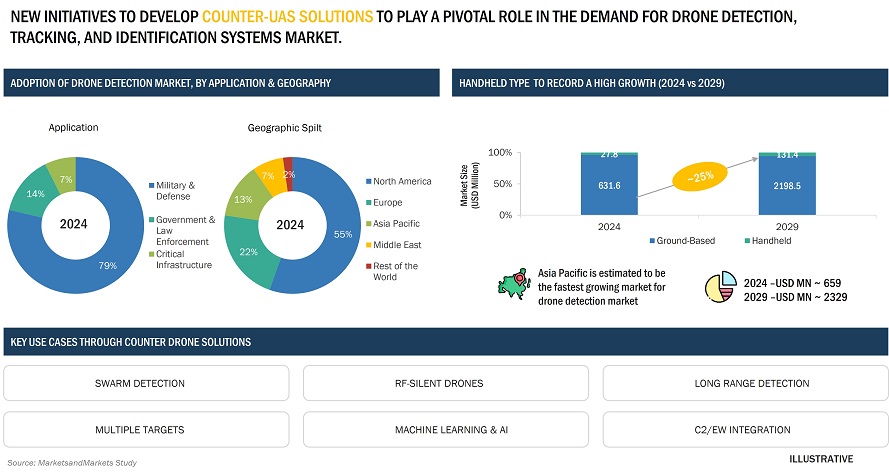
The global Drone Detection Market was valued at USD 659.4 million in 2024, and is projected to grow from USD 845.8 million in 2025 to USD 2,329.9 million by 2029 at a CAGR of 28.7% during the forecast period.
Have you ever wondered how security forces identify and respond to small drones flying in restricted airspace? As drones become more common in military, government, and commercial use, the need to detect, track, and identify them has become critical. These systems now form the first line of defense in the broader Counter-Unmanned Air Systems (C-UAS) ecosystem. Before any neutralization or interception takes place, detection systems alert operators to where a drone is, what type it might be, and how it’s behaving.
In 2024, the military and defense community lead adoption, accounting for nearly 79% of total demand. Their goal is clear to secure borders, airbases, and mission zones from aerial threats. But they’re not the only ones investing. Government and law enforcement agencies (around 14%) are deploying detection tools for crowd control, public safety, and event monitoring. Meanwhile, critical infrastructure operators (about 7%) airports, power plants, and data centers are quietly building detection networks to prevent unwanted drone incursions.
https://www.marketsandmarkets.com/Market-Reports/drone-detection-market-199519485.html
When we examine the geographical landscape, North America holds the largest share, accounting for 55% of the global market in 2024, thanks to strong defense spending and regulatory support. Europe (22%) continues to expand its integration of detection systems in both civil and defense sectors. However, Asia Pacific (13%) is the fastest-growing region, with countries like India, Japan, and South Korea heavily investing in detection, tracking, and identification systems as part of national airspace defense programs.
Expanding Use Cases Driving Drone Detection Adoption
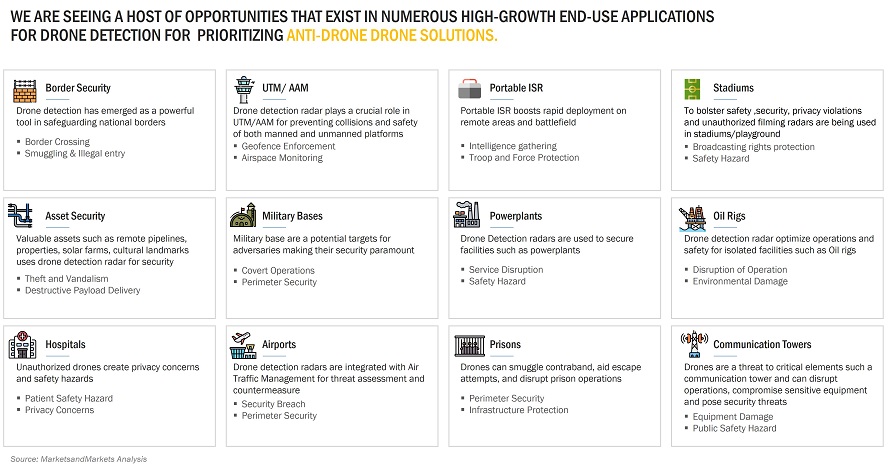
Drone detection represents the front-line layer of Counter-UAS operations, focused on identifying, tracking, and classifying unauthorized unmanned aerial systems entering protected airspace. The market has rapidly expanded due to rising drone proliferation across commercial, defense, and illicit activities including border intrusion, smuggling, and critical infrastructure surveillance. Today’s detection ecosystems integrate multi-sensor architectures such as Radio Frequency (RF) scanners, radar, electro-optical/infrared (EO/IR) cameras, acoustic arrays, and emerging passive detection technologies to achieve high-probability, low-false-alarm situational awareness. Growth is strongly influenced by urban security requirements, airport protection mandates, and government investments in layered air defense modernization.
Near and Long-Term Opportunities Shaping the Drone Detection Market
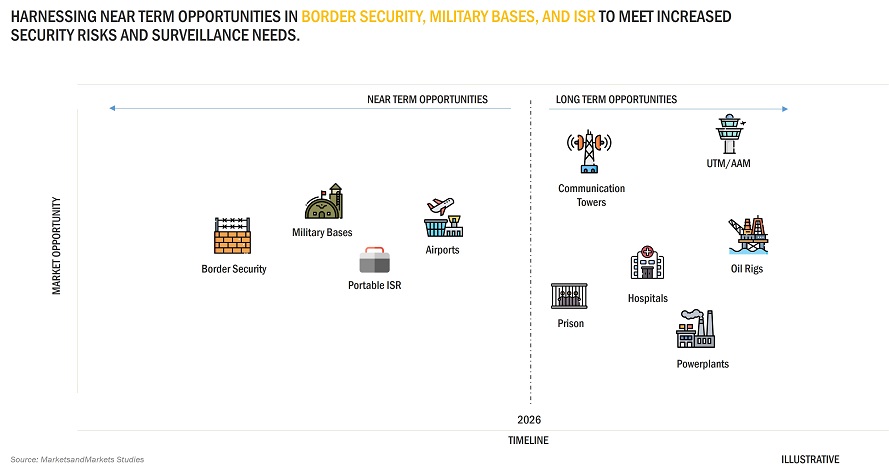
Drone detection technologies are witnessing strong market traction as defense and security agencies focus on mitigating rapidly rising threats from unauthorized and hostile drones. Near term opportunities are being driven by mission critical use cases where the frequency and impact of drone intrusions are already high, and investment decisions are fast-tracked. Border security remains a key priority for national agencies to prevent illegal infiltration, smuggling, and reconnaissance activities along sensitive frontiers. Military bases increasingly require advanced perimeter surveillance to identify covert aerial threats, ensuring proactive force protection. Portable ISR systems are also gaining adoption for quick deployment in contested zones and tactical operations. Airports represent another major near term growth area as regulators push for airspace protection and anti-drone countermeasures to reduce runway disruption and safety hazards.
Beyond 2026, the market will expand into broader civil infrastructure and public safety domains. Communication towers, powerplants, and oil rigs face operational and environmental risks from drone interference, driving long term modernization spending. Hospitals and prisons are emerging adopters, addressing privacy concerns, smuggling incidents, and safety vulnerabilities. UTM/AAM ecosystems will also rely heavily on drone detection to ensure safe coexistence of crewed and uncrewed traffic. Overall, evolving threat scenarios and regulatory mandates are unlocking a multi-year demand cycle for drone detection solutions across both defense and commercial sectors.
A Multi-Layer Business Model Enabling End-to-End Anti-Drone Capabilities
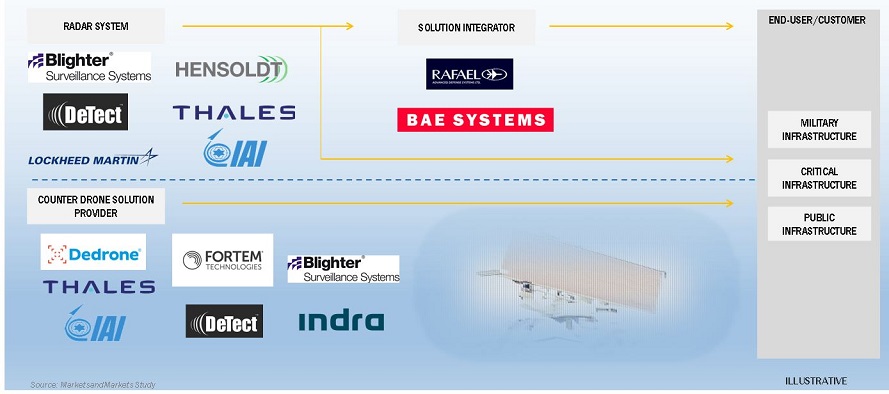
The drone detection radar market is supported by a diversified ecosystem consisting of specialized radar manufacturers, integrated counter-drone system providers, and prime defense integrators delivering fully operational solutions to end users. Radar system OEMs such as Blighter Surveillance Systems, Hensoldt, Thales, DeTect, Lockheed Martin, and Israel Aerospace Industries (IAI) focus on delivering the core sensing technologies required to detect, track, and classify small, low-altitude UAV threats. Their offerings form the foundational layer of the detection architecture, enabling long-range surveillance and high-accuracy threat alerts.
Solution integrators including Rafael and BAE Systems combine multiple sensor modalities, command-and-control systems, and effectors to provide end-to-end anti-drone capabilities tailored to operational environments. This includes alignment with existing security infrastructure, airspace management systems, and defense networks. Meanwhile, counter-drone technology providers such as Dedrone, Fortem Technologies, Indra, Thales, Blighter, DeTect, and IAI deliver modular, plug-and-play solutions with RF analytics, AI-assisted classification, and scalable deployment models suited for civilian and commercial sites.
The demand landscape spans military, critical infrastructure, and public infrastructure protection, reflecting the broadening impact of drone incursions. From securing bases and national borders to safeguarding airports, communication networks, and energy assets, these business models collectively ensure that customers can adopt detection solutions aligned to mission needs, threat levels, and regulatory environments.
Market Positioning and Partnering Strategy for Drone Detection Leaders
Through targeted Voice of Customer and Threat Scenario Validation, we will align drone detection solution providers with the most urgent end-user requirements, including detection range, false alarm reduction, classification accuracy, and integration with existing security and Command and Control (C2) networks. By identifying operational gaps across military, critical, and public infrastructure environments, we will help clients accelerate their innovation roadmaps and enhance deployment readiness. Concurrently, strategic Insights and Whitepapers will position clients as leading authorities in airspace security and counter-drone intelligence, strengthening executive visibility and customer trust in growth-focused segments.
We will map the highest-value use cases spanning border surveillance, airport protection, energy security, and UTM/AAM traffic management to quantify near-term monetization opportunities. Joint Technical Briefings and Interoperability Workshops with industry stakeholders will foster collaboration and advance standards for scalable drone detection deployment.
Our Detect, Track & Counter Competitiveness module will deliver deep benchmarking across sensor technologies, system architectures, and AI-driven analytics to refine product positioning in a rapidly expanding market. Finally, our Global Partner Ecosystem Development program will enable clients to identify system integrators, OEM allies, and channel partners, thereby accelerating regional access and strengthening their influence within the evolving counter-UAS security value chain.
Related Reports:
Drone (UAV) Detection, Tracking, and Identification Market by Technology (Radar, RF Scanner, Optical), Application (Critical Infrastructure, Airport, Stadium, Prison, Power Plant, Oil & Gas, Border Security, Military), Type (Ground-Based, Handheld), Range and Region - Global Forecast to 2029
Contact:
Mr. Rohan Salgarkar
MarketsandMarkets™ INC.
630 Dundee Road
Suite 430
Northbrook, IL 60062
USA : 1-888-600-6441
[email protected]

This FREE sample includes market data points, ranging from trend analyses to market estimates & forecasts. See for yourself.
SEND ME A FREE SAMPLE






