LEO Satellite PNT Market Growth in North America
The Low Earth Orbit (LEO) Satellite Positioning, Navigation, and Timing (PNT) Market in North America is rapidly evolving into one of the most transformative sectors in the modern aerospace and defense industry. As dependence on satellite based timing and navigation grows across defense, transportation, telecommunications, and smart infrastructure, the limitations of traditional Global Navigation Satellite Systems (GNSS) have created opportunities for next generation LEO based PNT solutions. Unlike high altitude Medium Earth Orbit (MEO) or Geostationary Earth Orbit (GEO) systems, LEO satellites orbit closer to Earth, offering reduced latency, improved signal resilience, and higher positioning accuracy. This technological leap is enabling North American governments and private enterprises to develop more secure, reliable, and high performance navigation systems resilient to jamming and spoofing threats.
The rise of small satellite constellations and commercial LEO networks in the United States and Canada has accelerated the region’s dominance in space based navigation technologies. Driven by increasing investments from aerospace innovators, defense agencies, and tech corporations, the LEO PNT market is emerging as a critical enabler of autonomous systems, space situational awareness, and advanced communication networks.
Market Overview and Growth Forecast (2025–2030)
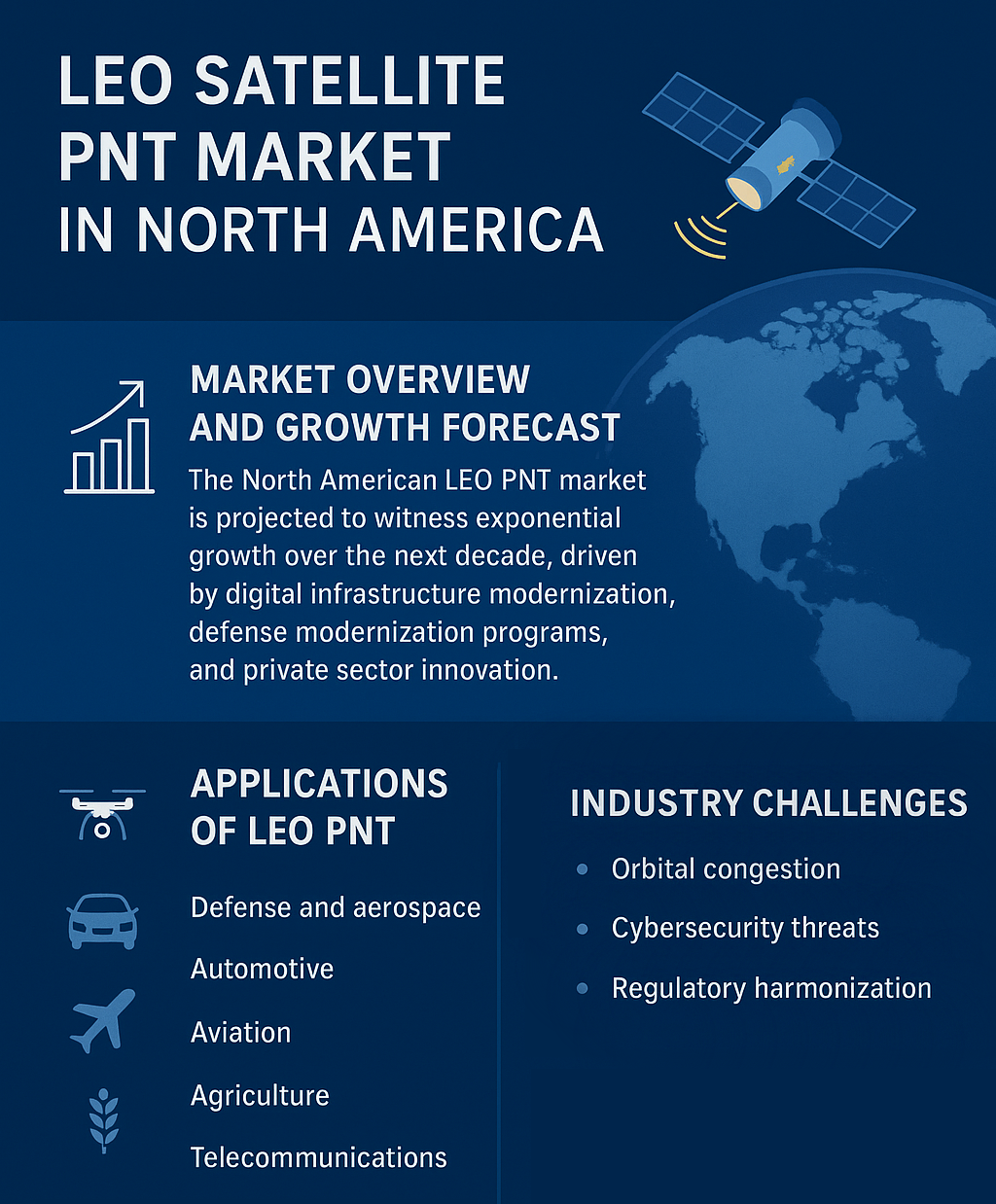
The North American LEO PNT Industry is projected to witness exponential growth over the next decade, driven by the convergence of digital infrastructure modernization, defense modernization programs, and private sector innovation. Between 2025 and 2035, the market is expected to expand at a double digit CAGR, supported by increasing adoption in precision agriculture, military surveillance, autonomous vehicles, and 5G synchronization systems.
In the United States, the Department of Defense (DoD) has prioritized LEO PNT as part of its strategic resilience initiative, focusing on reducing reliance on traditional GPS constellations. The demand for redundancy and signal assurance has pushed investments in LEO based PNT solutions that can complement or serve as backups to GPS, ensuring uninterrupted operations during satellite outages or cyber disruptions.
Canada is also investing in satellite based infrastructure under its national space strategy to support Arctic navigation, resource monitoring, and defense applications. The regional growth trajectory is strengthened by increasing public private partnerships, with North American firms like Xona Space Systems, TrustPoint, and L3Harris Technologies leading innovation in compact, high accuracy, and secure PNT systems.
Technological Advancements in LEO PNT Systems
Technology remains the backbone of the North American LEO PNT revolution. Key advances in low latency communication, precise clock synchronization, and AI assisted error correction are enabling LEO satellites to deliver centimeter level accuracy. Unlike traditional GNSS that suffer from long signal paths and weak penetration, LEO systems leverage multi orbit synchronization and advanced signal processing to overcome interference challenges.
AI and machine learning algorithms are increasingly used to predict signal distortion caused by atmospheric or space weather conditions, thereby enhancing real time navigation accuracy. Furthermore, microatomic clocks embedded in satellite payloads ensure ultra stable timing essential for 5G base station coordination and high frequency trading systems.
The integration of optical inter satellite links (OISL) further strengthens LEO networks by allowing seamless data transfer across satellites without dependence on ground infrastructure. North American companies are leading in this area, with Microchip Technology Inc. providing next generation timing and synchronization components, and CACI International Inc. advancing RF and optical communication systems that underpin resilient PNT architecture.
Key Applications of LEO PNT in North America
LEO based PNT technology is being deployed across multiple industries, each benefiting from enhanced precision, reliability, and security. In defense and aerospace, LEO PNT enables secure navigation and timing for drones, hypersonic weapons, and battlefield communications, addressing vulnerabilities associated with GPS jamming. The U.S. military’s integration of commercial LEO constellations into mission planning reflects the growing importance of resilient space infrastructure.
In the automotive sector, LEO PNT enhances autonomous vehicle navigation by improving localization accuracy in urban environments, where traditional satellite signals often degrade. Similarly, in aviation, these systems support flight safety and route optimization, particularly in polar regions where existing GNSS coverage is limited.
The agricultural sector benefits from precise timing and positioning for field mapping, crop monitoring, and autonomous farming machinery. Telecommunications and financial services also rely on LEO PNT for synchronization of network clocks and transaction systems, ensuring continuity of service in critical operations.
Role of LEO Constellations in Enhancing PNT Accuracy and Resilience
LEO constellations play a pivotal role in redefining navigation accuracy and resilience across North America. With satellites orbiting closer to Earth typically between 500 to 1,200 kilometers LEO systems can provide stronger and more stable signals than MEO based GNSS. This proximity minimizes signal degradation and latency, offering near real time updates crucial for defense, transportation, and financial systems.
In contrast to traditional GPS, which relies on 24 satellites in MEO, LEO PNT networks can deploy hundreds of small satellites to ensure global redundancy and resilience. These dense constellations allow continuous coverage, even in urban canyons or mountainous terrains. The high frequency of satellite passes also enhances the availability and reliability of navigation data, reducing the probability of system wide outages.
The U.S. and Canada are actively collaborating to deploy LEO constellations integrated with ground based augmentation systems, providing hybrid navigation that combines the strengths of terrestrial and space based networks.
Strategic Initiatives and Government Programs in North America
The North American space policy framework is increasingly focused on developing secure and redundant PNT systems that reduce dependency on GPS alone. The U.S. Department of Defense and the Department of Transportation have both funded pilot projects to evaluate LEO PNT capabilities for national resilience. The Federal Aviation Administration (FAA) and the U.S. Space Force have partnered with private companies to test real time PNT services supporting aviation safety and defense readiness.
In Canada, the Canadian Space Agency and Defense Research and Development Canada (DRDC) are investing in next generation satellite networks for Arctic navigation and secure communications. These efforts are aligned with broader continental security objectives under the NORAD modernization program.
Public private collaboration forms the backbone of North America’s LEO PNT strategy. Partnerships with commercial providers like Xona Space Systems and TrustPoint are helping to accelerate deployment timelines while leveraging private innovation to meet public security standards.
Integration of AI and Quantum Technologies in LEO PNT Systems
Artificial Intelligence (AI) and quantum computing are transforming the operational efficiency of LEO based PNT systems in North America. AI driven predictive models can identify and mitigate potential errors caused by ionospheric disturbances or orbital drift, allowing continuous accuracy optimization. Machine learning enhances satellite health monitoring, ground station scheduling, and collision avoidance, ensuring operational sustainability in dense orbital environments.
Quantum technologies are introducing revolutionary advancements in signal encryption and timing synchronization. Quantum clocks offer stability beyond traditional atomic standards, while quantum key distribution (QKD) ensures secure data transmission resistant to cyber threats. Companies like CACI International and Microchip Technology are incorporating AI and quantum innovations into their PNT solutions to meet defense grade security and timing requirements.
Get More Info on LEO (Satellite) PNT Market North America, Request Pdf Brochure: https://www.marketsandmarkets.com/pdfdownloadNew.asp?id=206201612
Competitive Landscape and Key Market Players
North America hosts some of the most innovative players driving the global LEO PNT market. Xona Space Systems, Inc. (US) stands at the forefront, developing small satellite constellations capable of delivering high precision, encrypted navigation services to both commercial and defense sectors. Its PULSAR constellation is recognized as a major step toward resilient GPS alternatives.
TrustPoint, Inc. (US) focuses on rapid deployment and advanced encryption of LEO based navigation signals. Its modular satellite platform offers scalability and flexibility, appealing to both governmental and enterprise clients seeking secure PNT data.
L3Harris Technologies, Inc. (US) integrates PNT capabilities into defense and aerospace systems, leveraging its extensive experience in communication, sensor, and surveillance technologies.
CACI International Inc. (US) contributes expertise in electromagnetic spectrum operations, developing advanced RF communication systems that enhance PNT reliability.
Microchip Technology Inc. (US) plays a vital role in providing timing and synchronization hardware critical for satellite payloads, 5G infrastructure, and autonomous systems. Collectively, these players form the competitive backbone of the North American LEO PNT ecosystem.
Challenges and Limitations in LEO PNT Deployment
Despite its vast potential, the LEO PNT market in North America faces several technical and regulatory challenges. Orbital congestion due to the rapid proliferation of satellites increases the risk of collisions and signal interference. Space debris management remains a pressing concern, requiring coordinated international frameworks.
Cybersecurity threats also pose significant risks. As PNT systems support national security and critical infrastructure, safeguarding signal integrity against spoofing or jamming is paramount. Regulatory harmonization across U.S. and Canadian space authorities is another hurdle, particularly concerning spectrum allocation and data sharing protocols.
The integration of LEO PNT with legacy GNSS systems requires precise interoperability, demanding advanced signal processing algorithms and cross network calibration to ensure seamless performance across multi orbit architectures.
Future Outlook: Next Generation PNT Solutions for North America
The future of the LEO PNT market in North America is geared toward hybrid architectures combining LEO, MEO, and terrestrial systems. These multi layered networks will ensure maximum resilience against disruptions and provide ultra accurate positioning for emerging applications such as autonomous air mobility, maritime surveillance, and deep space navigation.
The integration of LEO PNT into 6G networks will further enhance synchronization capabilities, supporting real time communication and data transfer across billions of connected devices. Government funding, alongside private innovation, will continue to shape the competitive and technological landscape of the North American market.
By 2035, North America is expected to dominate the global LEO PNT ecosystem through its robust industrial base, regulatory foresight, and sustained investment in next generation satellite infrastructure.
Future Outlook
The LEO (Satellite) PNT Market in North America represents a pivotal transformation in the future of navigation and timing systems. With government support, technological innovation, and strong participation from key players like Xona Space Systems, TrustPoint, L3Harris Technologies, CACI International, and Microchip Technology, the region is positioned to lead the global shift toward resilient, secure, and high performance PNT architectures. As demand for precision and reliability continues to grow across defense, transportation, and communications, LEO PNT will become the cornerstone of North America’s strategic digital and spatial infrastructure.
Related Report:
LEO PNT Market by Hardware (GNSS Module, Time Synchronization, Backhaul Module, Navigation Signal Generation, Signal Transmission Module), End Use (Government & Defense and Others), Frequency, Satellite Mass and Region - Global Forecast to 2030

This FREE sample includes market data points, ranging from trend analyses to market estimates & forecasts. See for yourself.
SEND ME A FREE SAMPLE






