Danaher Corporation (US) and Thermo Fisher Scientific Inc. (US) are the leading key players in the Oligonucleotide Synthesis Market
The global oligonucleotide synthesis market is projected to reach USD 32.72 billion by 2031, up from USD 14.64 billion in 2026, at a CAGR of 17.4% over the forecast period. The market is experiencing rapid growth, fueled by advances in RNA therapeutics, CRISPR gene editing, and personalized medicine. Manufacturers are increasingly incorporating artificial intelligence and digital control systems into synthesis workflows. This automation significantly optimizes high-throughput custom oligo production, reduces human error, and lowers operational costs.
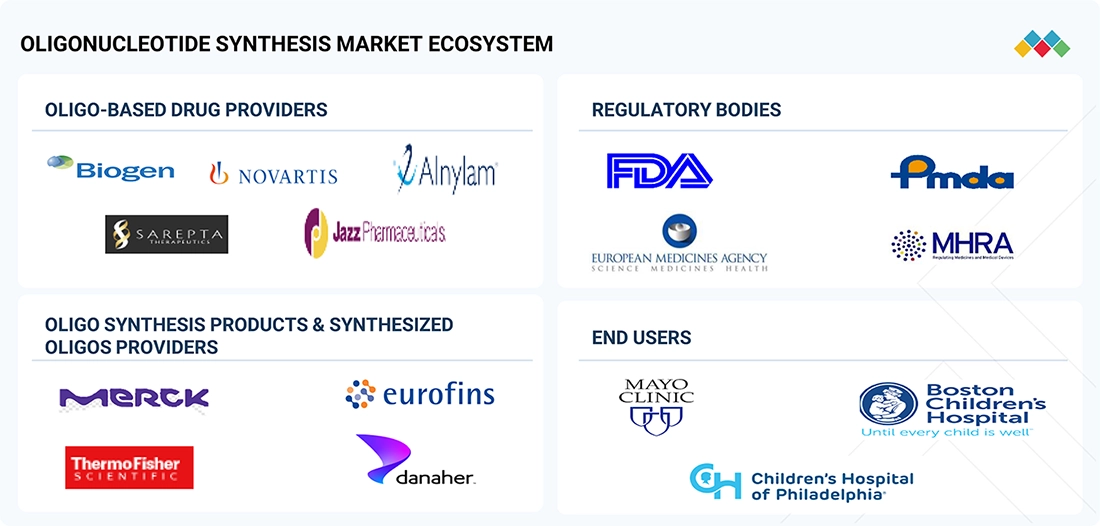
The global market for oligonucleotide synthesis products and oligonucleotides is highly competitive, with companies such as Danaher Corporation (US), Thermo Fisher Scientific Inc. (US), Merck KGaA (Germany), LGC Limited (UK), Eurofins Scientific (Luxembourg), Agilent Technologies, Inc. (US), Kaneka Corporation (Japan), Maravai Lifesciences (US), Azenta US Inc. (US), Twist Bioscience (US), and GenScript (US). These market players have pursued strategies such as product launches, acquisitions, agreements, collaborations, and expansions to strengthen their market positions.
Prominent players in the oligonucleotide therapeutics market are Alnylam Pharmaceuticals, Inc. (US), Biogen (US), Novartis AG (Switzerland), Sarepta Therapeutics, Inc. (US), Astellas Pharma Inc. (Japan), Ionis Pharmaceuticals, Inc. (US), Jazz Pharmaceuticals Plc (Ireland), and Nippon Shinyaku, Co. Ltd. (Japan).
To know about the assumptions considered for the study download the pdf brochure
Key Oligonucleotide Synthesis Products and Synthesized Oligonucleotides providers
Danaher Corporation (US): Danaher is a key player in the oligonucleotide synthesis products and synthesized oligonucleotides market. Integrated DNA Technologies (IDT), a subsidiary of Danaher Corporation, along with its sister company, Cytiva, offer a variety of products. Its portfolio includes custom DNA/RNA oligos, oligo pools, antisense oligonucleotides, DsiRNAs, custom PCR/qPCR primers and probes, guide RNAs, donor oligos, and GMP oligos, and services with extensive customization options. Geographically, the company operates in over 50 countries spanning North America, the Asia Pacific, Europe, the Middle East, and Africa. IDT and Cytiva have focused on organic growth strategies, emphasizing expansions and partnerships. For instance, in 2023, Integrated DNA Technologies opened a therapeutic oligonucleotide manufacturing facility in Coralville, Iowa. This state-of-the-art facility is designed to produce reagents for cGMP cell & gene therapy, including single-guide RNAs and HDR donor oligonucleotides. The facility includes eight ISO cleanrooms, purification suites, chemical distribution & storage areas, quality control laboratories, analytical spaces for product testing, and ancillary & office spaces. Shell spaces are also set aside for future expansion.
Thermo Fisher Scientific (US): Thermo Fisher is a leading player in the oligonucleotide synthesis products and synthesized oligonucleotides market in 2025. This significant share is due to a strong product portfolio, including custom DNA oligos, primers, probes, and large-scale oligo synthesis. The company undertakes various organic and inorganic strategies to strengthen its position in the market. The company also has a strong geographic presence and operates in over 50 countries across North America, Europe, the Asia-Pacific, and Latin America. The company supports research, diagnostic, and regulated applications with oligonucleotide offerings for customers requiring scalable, quality-controlled oligo supply.
Merck KGaA (Germany): Merck KGaA, through its Life Science business, is a key provider in the oligonucleotide synthesis market, supplying both synthesized oligos and enabling synthesis reagents. The company offers a broad custom portfolio covering DNA and RNA oligos, qPCR probes, NGS oligos, RNAi oligos, and predesigned primers for molecular biology and functional genomics. For regulated and commercial use, Merck provides Custom cGMP Oligos manufactured in dedicated synthesis, purification, and quality-control laboratories. For supporting products, Merck’s Proligo portfolio includes phosphoramidites, solid supports, CPG, liquid reagents, activators, capping/oxidation reagents, dyes, labels, and linkers. Overall, a strong product portfolio and a significant geographic presence support Merck’s strategic position in this market.
- Eurofins Scientific
- Agilent Technologies, Inc.
- LGC Limited
- Twist Bioscience
- GenScript
- Maravai LifeSciences Holdings, Inc.
- Kaneka Corporation
- Azenta US Inc.
- OligoMaker ApS
- Biolegio B.V.
- Biolytic Lab Performance
- Revvity (through Horizon Discovery)
- BioSynthesis Inc.
- Creative Biogene
- REPROCELL Inc. (through BioServe)
- Biocomma Limited
Key oligonucleotide-based drug providers
Alnylam Therapeutics (US): Alnylam is a key player in oligonucleotide therapeutics, with RNAi therapeutics that are siRNA-based medicines designed for sequence-specific gene silencing. Its commercial portfolio includes AMVUTTRA, ONPATTRO, GIVLAARI, and OXLUMO, along with partner-commercialized RNAi products such as Leqvio and Qfitlia. In 2025, the FDA approved AMVUTTRA for ATTR amyloidosis with cardiomyopathy, expanding Alnylam’s TTR franchise into a broader cardiometabolic indication. The company continues to advance a deep RNAi pipeline across TTR amyloidosis, cardiovascular, metabolic, neuroscience, hematology, rare, and other therapeutic areas. Overall, Alnylam’s approved siRNA drug portfolio, partner-commercialized RNAi products, and expanding clinical pipeline position it as a leading player in oligonucleotide therapeutics.
Biogen (US): Biogen is also a leading company in the oligonucleotide-based drugs market. The recent FDA accelerated approval of QALSODY (Tofersen) for the treatment of amyotrophic lateral sclerosis (ALS) in adults, along with the growing adoption of Spinzara, a blockbuster oligonucleotide-based drug the company has offered since 2016, supports its leading market position. The company operates an oligonucleotide synthesis manufacturing (OSM) facility in North Carolina, which produces antisense oligonucleotide drugs such as Spinzara and other candidates currently in development. It employs various strategies to strengthen its market presence, including expansions and collaborations. For instance, in February 2025, Biogen and Stoke Therapeutics, Inc. collaborated to develop and commercialize Zorevunersen, an investigational antisense oligonucleotide (ASO) for treating Dravet syndrome.
Novartis AG (Switzerland): Novartis is a global innovative medicines company and a key player in the oligo-based therapeutics market, particularly through RNA-targeted cardiovascular medicines. The company’s marketed oligonucleotide therapy is Leqvio (inclisiran), the first-and-only approved small interfering RNA (siRNA) therapy to reduce LDL cholesterol. In 2025, Leqvio generated ~USD 1.2 billion in net sales, up ~59% year over year, and achieved blockbuster status. Beyond Leqvio, Novartis is advancing oligonucleotide assets, including pelacarsen, an antisense oligonucleotide targeting lipoprotein(a). Overall, its commercial siRNA franchise, oligonucleotide pipeline, and xRNA platform investments position Novartis as a key player in oligo-based therapeutics.
- Ionis Pharmaceuticals (US)
- Sarepta Therapeutics, Inc.
- AstraZeneca PLC (UK)
- Jazz Pharmaceuticals PLC
- Astellas Pharma Inc.
- Geron Corporation (US)
- NS Pharma, Inc. (Japan/US)
- Novo Nordisk A/S (Denmark)
- Sanofi S.A. (France)
- Arrowhead Pharmaceuticals, Inc.
Market Ranking
Market competition is analyzed across two landscapes: oligonucleotide synthesis products & synthesized oligonucleotides and oligonucleotide-based drugs.
The market for oligonucleotide synthesis products and synthesized oligonucleotides is consolidated, dominated by five key players who collectively hold approximately 50-60% of the total market share. Danaher Corporation (US) has a significant market share, reflecting its extensive influence through a diverse product portfolio. Thermo Fisher Scientific Inc. (US) holds the largest market share, owing to its wide range of oligonucleotide products, including primers, probes, custom oligos, reagents, and custom oligo modifications. Merck KGaA (Germany), LGC Limited (UK), and Eurofins Scientific (Luxembourg) have also captured significant portions of the market by focusing on research and development to introduce innovative products that strengthen their market presence. Growth opportunities in the Asia Pacific and Latin American markets also encourage these companies to enhance their presence in these regions. Regional & emerging players hold the remaining 40-50% of the market, leading to significant consolidation. Several key factors contribute to the growth of this market, including technological advancements, product innovation, strategic partnerships, and the increasing demand from pharmaceutical & biopharmaceutical companies.
The oligonucleotide-based drug market is highly consolidated, with the top five players holding 85-90% of the market. The companies that account for most of the market include Alnylam Pharmaceuticals, Inc. (US), Novartis AG (Switzerland), Biogen (US), Sarepta Therapeutics, Inc. (US), and Astellas Pharma Inc. (Japan). Key companies have successfully launched oligonucleotide-based drugs for specific applications, steadily increasing their revenue. Their significant market share results from innovative, first-in-class product launches, strategic partnerships, and rising demand for personalized medicine. Meanwhile, regional and emerging players account for the remaining 10-15% of the market.
Related Reports:
Oligonucleotide Synthesis Market by Offering [Synthesis Products (Consumables, Equipment), Synthesized Oligos (DNA, RNA), Oligo-based Drugs (ASO, siRNA), Therapy Area [Rare Diseases, Neurology, Oncology], Competition - Global Forecast to 2031
Contact:
Mr. Rohan Salgarkar
MarketsandMarkets™ INC.
1615 South Congress Ave.
Suite 103, Delray Beach, FL 33445
USA : 1-888-600-6441
[email protected]

This FREE sample includes market data points, ranging from trend analyses to market estimates & forecasts. See for yourself.
SEND ME A FREE SAMPLE

