Precision-Guided Munition Companies - Lockheed Martin Corporation (US) and RTX (US) are the Key Players
The precision-guided munitions market is estimated to be USD 37.24 billion in 2025 and is projected to reach USD 49.71 billion by 2030, at a CAGR of 5.9%. The precision-guided munitions (PGM) market is projected to reach significant value by 2030, driven by a compound annual growth rate fueled by evolving operational requirements. Key growth drivers include increasing demand for precision strike capabilities on modern battlefields, the integration of electric and hybrid power systems, and the rising deployment of autonomous and unmanned combat platforms.
Leading companies in the PGM market include Lockheed Martin (US), RTX (US), Northrop Grumman (US), BAE Systems (UK), and Leonardo S.p.A. (Italy). These firms have adopted comprehensive growth strategies focused on product innovation, government contracts, strategic collaborations, certifications, acquisitions, and sustained R&D investment.
To know about the assumptions considered for the study download the pdf brochure
Major Precision-Guided Munition Companies Include:
- Northrop Grumman (US)
- RTX (US)
- General Dynamics Corporation (US)
- BAE Systems (UK)
- Lockheed Martin Corporation (US)
- MBDA (France)
- Israel Aerospace Industries (Israel)
- QinetiQ (UK)
- Boeing (US)
- Aselsan AS (Turkey),
Lockheed Martin Corporation (US)
Lockheed Martin Corporation is a leading defense technology and aerospace systems firm strategically located in the precision-guided munitions (PGM) market. Through its missiles and fire control (MFC) business segment, the firm offers a diversified portfolio of next-generation precision strike solutions to enable multi-domain operations for US domestic defense customers and international defense customers globally.
Its portfolio of precision munitions includes established programs such as the guided multiple launch rocket system (GMLRS) and next-generation solutions such as the precision strike missile (PrSM) and joint air-to-ground missile (JAGM). These solutions are designed to meet the contemporary battlefield requirements, including long-range engagement, high-precision lethality, and interoperability among platforms in air, land, and sea environments.
Lockheed Martin enjoys a competitive edge through ongoing investment in next-generation guidance technology, modular payload architecture, and network-enabled targeting. Its PGMs are fully compatible with the strategic shift to dispersed operations, rapid response, and minimum collateral effects.
RTX (US)
RTX Corporation, one of the major US-based defense and aerospace firms, enjoys a strong market position in the PGM segment with its Raytheon business segment. RTX has spent decades specializing in advanced weapon systems and offers a broad spectrum of PGMs that enhance high-precision engagement capabilities for tactical air, naval, and ground platforms.
Its portfolio comprises cornerstone initiatives like Paveway series of laser-guided bombs, StormBreaker (GBU-53/B) tri-mode seeker-capable bomb, and Excalibur precision-guided artillery projectile. These weapons are operated by several US armed force branches and allied nations, providing greater accuracy, mission flexibility, and operational effectiveness in conventional and asymmetric combat environments.
RTX continues to invest in cutting-edge seeker technologies, net-enabled munitions, and multi-mode guidance to enable dynamic targeting, all-weather operation, and in-flight retargeting. Its PGMs are completely interoperable with current command-and-control architectures and directly contribute to joint fires and precision strike doctrine.
Through strong government collaboration, foreign military sales, and joint development initiatives, RTX maintains a secure global presence. As militaries globally focus on precision, reduced collateral engagement, and platform flexibility, RTX will be well set to address requirements in the future and continue dominance in the progressive precision strike industry.
Northrop Grumman (US)
Northrop Grumman Corporation holds a leading position in the precision-guided munitions (PGM) sector through its world-class guidance system, navigation system, and precision strike subsystem competence. The organization is not primarily a producer of integrated PGM platforms like guided missiles or missiles, but is a premier supplier of enabling technologies propelling next-generation munitions to use in air, land, sea, and space environments. This gives a strong foundation for future expansion and growth opportunities.
Its offerings consist of inertial navigation systems (INS), seeker systems, target and control systems, and modular warhead sections as part of various US and allied weapon platforms. Its capabilities are employed in such programs as the precision strike missile (PrSM), joint direct attack munition (JDAM) upgrades, and hypersonic glide vehicles, reflecting its value in legacy modernization and new systems.
The company is also working on autonomous targeting, AI fusion, and hard navigation systems, particularly for use in GPS-denied or contested electronic warfare environments—technologies increasingly important to the operational effectiveness of modern PGMs.
BAE Systems (UK)
BAE Systems plc, one of the largest defense contractors in the world, has a growing and diversified stake in the PGM sector, mainly based on its competence in the domains of munition guidance kits, precision artillery solutions, and warhead technologies. It offers a wide range of air, land, and naval precision strike programs to NATO-aligned and global defense customers.
One of BAE Systems’ strongest contributions is in programs such as the Advanced Precision Kill Weapon System (APKWS)—a laser-guided rocket technology that converts run-of-the-mill 70 mm rockets into accurate air-to-surface PGMs. Widely used on both rotary- and fixed-wing aircraft, APKWS has seen strong adoption for missions requiring precise accuracy and reduced collateral damage.
In the ground domain, BAE Systems produces precision-guided artillery rounds and guidance systems, such as those used in extended-range and GPS-denied environments. It also leads in providing fuzing solutions, navigation parts, and electronic subsystems for integration into partner-led PGM platforms.
Boeing (US)
Boeing Company, a prime defense and aerospace contractor, is a significant player in the PGM market, particularly as an originator and producer of air-launched precision strike weaponry. Boeing’s greatest contribution has been the Joint Direct Attack Munition (JDAM) program, a globally accepted solution for converting unguided bombs into GPS-guided all-weather munitions. JDAM systems are used by over 30 countries and are the backbone of precision air-to-ground weapons for most Western and allied air forces.
In addition to JDAM, Boeing’s PGM product family includes the Small Diameter Bomb (SDB) Increment I, which is designed to deliver high-accuracy, low-collateral damage at long standoff ranges. The systems are compatible with a wide variety of fighter aircraft and UAVs and are optimized for today’s battlefield environments, requiring surgical strike capability and scalable payload.
Boeing is investing in network-enabled PGM upgrades, glide-range enhancement, and modular guidance kits, making its munitions extremely pertinent against future threats. Boeing sustains a strong export position in the PGM field through government-to-government sales, international collaborations, and licensed production arrangements.
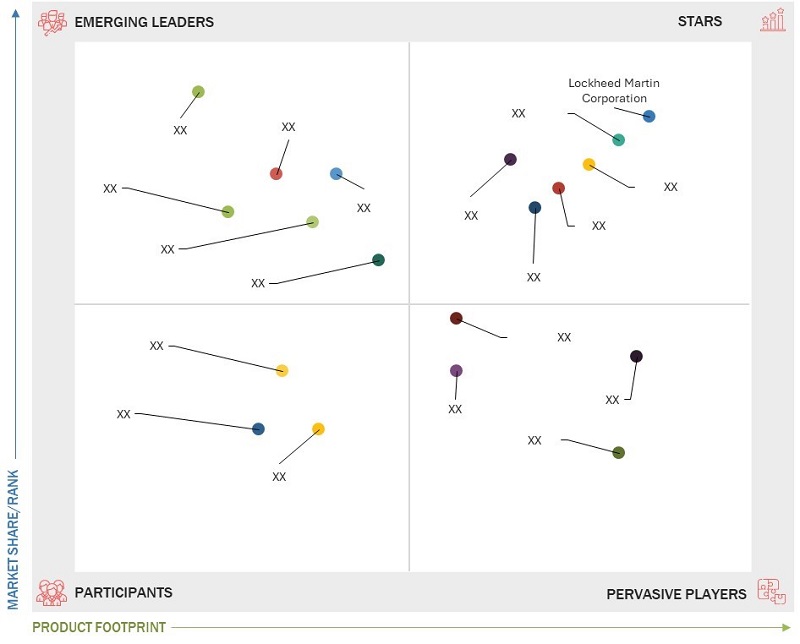
Precision-Guided Munitions Market: Company Evaluation Matrix (Key Players), 2024
Related Reports:
Precision-Guided Munition Market by Product (Tactical Missile, Interceptor Missile, Torpedoes, Rockets, Loitering Munition), System (Guidance & Navigation, Target Acquisition), Launch Platform, Speed, Mode of Operation, Region - Global Forecast to 2030
Contact:
Mr. Rohan Salgarkar
MarketsandMarkets™ INC.
630 Dundee Road
Suite 430
Northbrook, IL 60062
USA : 1-888-600-6441
[email protected]

This FREE sample includes market data points, ranging from trend analyses to market estimates & forecasts. See for yourself.
SEND ME A FREE SAMPLE






