Beyond Radar Jamming: How Cognitive Electronic Warfare Is Transforming Modern Battlefields
Electronic Warfare Market Snapshot
| METRIC | DETAILS |
|---|---|
| Market Size 2026 | USD 32.35 Billion |
| Market Size 2031 | USD 64.66 Billion |
| CAGR | 14.9% |
| Fastest Growing Region | Europe |
| Europe CAGR | 18.7% |
| Fastest Growing Platform | Unmanned and Autonomous Systems |
| Platform CAGR | 23.7% |
| Fastest Growing Offering | Software |
| Largest Capability Segment | Electronic Protection |
| Dominant Spending Segment | Procurement |
Market Size and Forecast
- Electronic Warfare Market Size in 2026: USD 32.35 Billion
- Electronic Warfare Market Size in 2031: USD 64.66 Billion
- CAGR from 2026 to 2031: 14.9%
- Europe Expected to Be Fastest Growing Regional Market
- Europe CAGR During Forecast Period: 18.7%
- Unmanned and Autonomous Platform Segment CAGR: 23.7%
- Software Segment Expected to Record Fastest Growth
- Electronic Protection Remains Largest Capability Segment
- Procurement Continues as Dominant Spending Category
Key Takeaways
- Cognitive electronic warfare is transforming military operations from reactive jamming to adaptive spectrum dominance.
- Artificial intelligence is enabling real time signal classification and threat response.
- Traditional radar jamming is becoming less effective against agile and adaptive threats.
- Software defined EW architectures are accelerating system flexibility.
- Unmanned and autonomous platforms represent the fastest growing deployment segment.
- Electronic protection remains essential for mission continuity in contested environments.
- Europe is emerging as the fastest growing electronic warfare market.
- AI and machine learning are improving spectrum awareness and operational effectiveness.
- Multi domain warfare increasingly depends on electromagnetic superiority.
- Cognitive EW is becoming a critical capability for future military modernization.
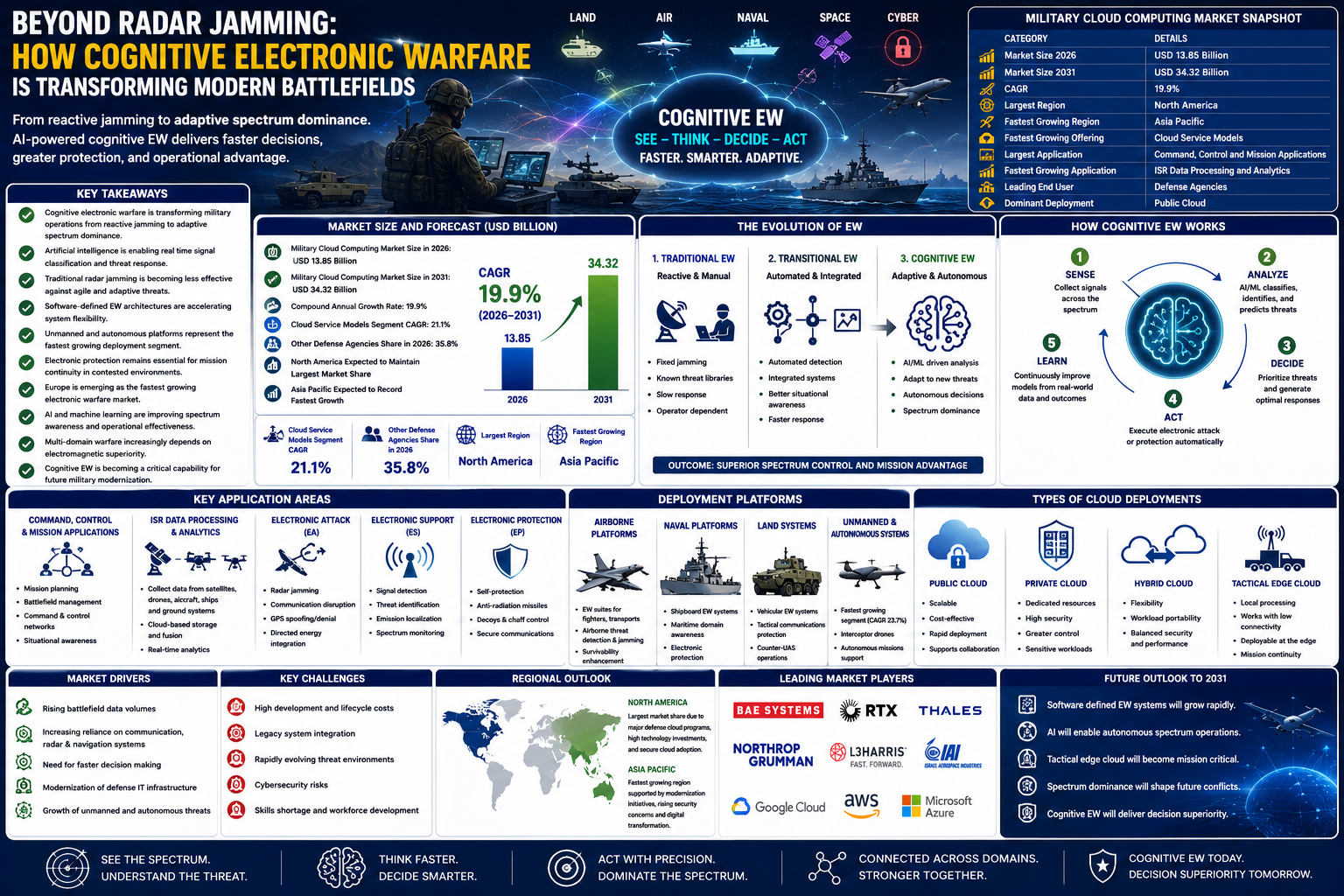
Modern warfare is no longer determined solely by kinetic capabilities. Control of the electromagnetic spectrum has become one of the most decisive factors in military success. Communication networks, radar systems, navigation technologies, precision weapons, unmanned platforms, and command networks all depend on uninterrupted access to electromagnetic signals.
For decades, electronic warfare primarily focused on radar jamming and signal disruption. These methods proved effective against traditional threats, but modern battlefields have become far more complex. Adversaries now deploy agile radar systems, adaptive communication networks, autonomous drones, sophisticated electronic attack systems, and rapidly evolving spectrum tactics.
As threats become more dynamic, military organizations require electronic warfare capabilities that can learn, adapt, and respond in real time. This requirement is driving the emergence of cognitive electronic warfare.
The Electronic Warfare Market is estimated at USD 32.35 billion in 2026 and is projected to reach USD 64.66 billion by 2031 at a CAGR of 14.9%. Growth is being fueled by increasing reliance on communication, radar, navigation, and targeting systems in modern military operations. At the center of this transformation is the shift from conventional jamming techniques toward intelligent and adaptive cognitive electronic warfare systems.
The Evolution of Electronic Warfare in Modern Combat
From Basic Signal Disruption to Spectrum Operations
Electronic warfare has evolved significantly since its earliest applications. Initial systems focused primarily on intercepting enemy communications and disrupting radar systems.
As military technologies advanced, electronic warfare expanded into three primary mission areas:
Electronic Support
Detecting, identifying, and monitoring electromagnetic emissions.
Electronic Attack
Disrupting, degrading, or denying adversary systems.
Electronic Protection
Ensuring friendly systems remain operational despite hostile electronic activity.
The Growing Importance of Electromagnetic Superiority
Modern military operations rely heavily on uninterrupted access to communication, radar, navigation, and targeting systems. The ability to control and protect the electromagnetic spectrum directly impacts mission effectiveness.
Electronic warfare is no longer a supporting capability. It has become a core element of operational success across land, naval, air, cyber, and space domains.
Download PDF Brochure: https://www.marketsandmarkets.com/requestsampleNew.asp?id=1301
Lessons from Recent Military Operations
Recent conflicts have demonstrated the importance of electronic warfare in countering drones, disrupting communications, protecting military networks, and supporting precision operations.
These lessons have accelerated investment in more intelligent and adaptive EW systems.
What Is Cognitive Electronic Warfare?
Understanding Cognitive EW
Cognitive electronic warfare refers to advanced EW systems that can sense, learn, analyze, and adapt to changing electromagnetic environments with minimal human intervention.
Unlike traditional systems that rely heavily on predefined threat libraries, cognitive EW systems continuously evaluate signals and adjust responses dynamically.
Key Characteristics of Cognitive EW
Adaptive Spectrum Awareness
Systems continuously monitor changing signal environments.
Autonomous Threat Recognition
Unknown threats can be identified without waiting for manual updates.
Dynamic Response Generation
Countermeasures can be adjusted in real time.
Continuous Learning
Algorithms improve performance based on operational experience.
Why Cognitive EW Matters
Military forces increasingly operate in contested electromagnetic environments where adversaries constantly modify tactics and signal characteristics.
Cognitive EW provides the flexibility required to maintain effectiveness against rapidly evolving threats.
Why Traditional Radar Jamming Is No Longer Enough
The Limitations of Legacy Jamming Techniques
Traditional electronic attack methods often rely on predefined responses against known threats.
Modern adversaries are deploying technologies specifically designed to overcome these approaches.
Emerging Threat Challenges
Frequency Hopping Systems
Communication networks rapidly change frequencies to avoid detection and disruption.
Low Probability of Intercept Radars
Advanced radar systems are harder to detect and target.
Multifunction Radar Systems
Single systems perform multiple operational functions simultaneously.
Autonomous Threat Platforms
Unmanned systems increasingly employ adaptive communication and navigation techniques.
The Need for Intelligent Spectrum Operations
Future electronic warfare requires systems capable of understanding, predicting, and adapting to electromagnetic activity rather than simply transmitting jamming signals.
This requirement is driving adoption of cognitive EW technologies.
Artificial Intelligence as the Brain of Cognitive Electronic Warfare
AI Driven Signal Analysis
Artificial intelligence is becoming one of the most important enablers of cognitive electronic warfare.
AI algorithms can process vast amounts of signal data significantly faster than traditional analytical methods.
Key AI Applications in Electronic Warfare
Signal Classification
AI can identify and categorize signals automatically.
Threat Detection
Machine learning models can recognize patterns associated with hostile activity.
Anomaly Identification
Unknown or unusual signals can be detected more quickly.
Automated Decision Support
AI assists operators by recommending response options.
Accelerating Response Times
Modern electromagnetic environments change rapidly. AI enables electronic warfare systems to analyze conditions and recommend actions within operationally relevant timeframes.
This capability is particularly important when facing autonomous systems and rapidly changing threat environments.
Spectrum Dominance Through Adaptive Electromagnetic Operations
Understanding Spectrum Dominance
Spectrum dominance refers to the ability to use the electromagnetic environment effectively while restricting an adversary's ability to do the same.
It represents one of the most important objectives of modern electronic warfare.
Dynamic Spectrum Management
Cognitive EW systems support dynamic management of frequencies, signals, and communications resources.
Benefits include:
Improved Situational Awareness
Operators gain a clearer understanding of spectrum activity.
Better Resource Allocation
Signals and frequencies can be managed more efficiently.
Reduced Interference
Friendly systems experience fewer disruptions.
Enhanced Mission Flexibility
Forces can adapt quickly to changing operational conditions.
Electromagnetic Maneuver Warfare
Military organizations increasingly view the spectrum as a maneuver space similar to land, sea, air, and cyber domains.
Cognitive EW systems support active maneuver within this environment to gain operational advantage.
Cognitive Electronic Warfare Applications Across Military Platforms
Airborne Platforms
Aircraft remain among the most advanced electronic warfare platforms.
Systems such as integrated EW suites provide:
Threat Detection
Identifying radar and missile activity.
Electronic Protection
Protecting aircraft systems from hostile electronic attacks.
Targeting Support
Enhancing mission effectiveness.
Survivability Improvements
Reducing vulnerability in contested environments.
Naval Platforms
Warships increasingly depend on cognitive EW systems to monitor maritime electromagnetic environments and counter emerging threats.
Land Based Systems
Land forces use electronic warfare capabilities to improve battlefield awareness, protect communications, and support tactical operations.
Unmanned and Autonomous Platforms
The unmanned and autonomous platform segment is projected to register the highest CAGR of 23.7% during the forecast period.
This growth reflects increasing deployment of EW capabilities on drones and autonomous systems.
Cognitive Electronic Warfare in Multi Domain Warfare
Supporting Joint Operations
Modern military missions require coordination across multiple operational domains.
Cognitive EW systems facilitate information sharing and spectrum awareness across:
Land Forces
Supporting tactical operations and force protection.
Air Forces
Enhancing survivability and mission effectiveness.
Naval Forces
Supporting maritime security and situational awareness.
Space Assets
Protecting satellite communications and navigation systems.
Cyber Operations
Integrating electronic and cyber activities.
Enabling Decision Superiority
The ability to gather information, analyze threats, and respond quickly provides significant operational advantages.
Cognitive EW contributes directly to faster and more informed decision making.
Countering Advanced Threats and Autonomous Systems
Addressing Next Generation Threats
Modern militaries face increasingly sophisticated threats including:
Advanced Radar Systems
More difficult to detect and disrupt.
Autonomous Drones
Capable of operating independently.
Swarming Technologies
Multiple coordinated unmanned systems.
Adaptive Communication Networks
Designed to resist disruption.
Counter Drone Electronic Warfare
One of the fastest growing applications for cognitive EW involves detecting, tracking, and disrupting unmanned aerial systems.
Adaptive electronic warfare systems can respond more effectively to changing drone communication patterns.
Protecting Against Electronic Deception
AI powered EW systems help identify false signals and deceptive tactics designed to confuse military operators.
Challenges Facing Cognitive Electronic Warfare Adoption
High Development Costs
Electronic warfare systems require sophisticated radio frequency technologies, sensors, processors, software, and integration efforts.
These requirements increase engineering complexity and lifecycle costs.
Rapidly Changing Threat Environments
One of the most significant challenges involves maintaining effectiveness against evolving threats.
Adversaries continuously modify:
Frequencies
Waveforms
Communication Methods
Signal Characteristics
Electronic Attack Techniques
As a result, systems require continuous updates and adaptation.
Integration Complexity
Cognitive EW systems must operate across multiple platforms including aircraft, naval vessels, vehicles, drones, and command systems.
Ensuring interoperability remains a major challenge.
Trust and Human Oversight
Military organizations must balance automation with appropriate human supervision to ensure operational reliability.
The Future Battlefield: How Cognitive EW Will Shape Warfare by 2031
The Rise of Software Defined Electronic Warfare
The software segment is expected to experience the fastest growth during the forecast period.
Software defined architectures allow electronic warfare systems to adapt more quickly to new threats through updates rather than hardware modifications.
AI Enabled Electronic Protection
Electronic protection remains the largest capability segment because maintaining operational effectiveness in contested environments is critical.
Future systems will use AI to continuously protect friendly communications, navigation systems, and mission networks.
Autonomous Spectrum Operations
Future cognitive EW systems are expected to:
Detect Threats Automatically
Classify Signals in Real Time
Recommend Countermeasures
Adapt to New Threats
Support Human Decision Makers
These capabilities will significantly improve operational effectiveness.
Europe Emerging as a Major Growth Center
Europe is projected to be the fastest growing electronic warfare market with a CAGR of 18.7%.
Growth is supported by increased defense spending, modernization initiatives, and investments in advanced EW capabilities designed to strengthen spectrum superiority.
Key Players in the Electronic Warfare Ecosystem
The electronic warfare market includes a broad ecosystem of technology providers, system integrators, component suppliers, and defense organizations.
Major participants include:
- BAE Systems
- RTX
- Thales
- Northrop Grumman
- L3Harris Technologies
- Israel Aerospace Industries
These organizations are supporting development across electronic support, electronic attack, electronic protection, AI enabled EW, software defined architectures, and multi domain spectrum operations.
Future Outlook
Electronic warfare is entering a new era. Traditional radar jamming remains important, but modern military operations require capabilities that can adapt to increasingly complex and contested electromagnetic environments.
The electronic warfare market is projected to grow from USD 32.35 billion in 2026 to USD 64.66 billion by 2031 as defense organizations prioritize spectrum superiority, mission resilience, and operational effectiveness. Growth is being driven by rising dependence on communication, radar, navigation, and targeting systems, along with increasing adoption of AI enabled and software defined EW technologies.
Cognitive electronic warfare represents the next stage of this evolution. By combining artificial intelligence, machine learning, adaptive spectrum awareness, and autonomous decision support, these systems can detect, analyze, and respond to threats more effectively than traditional approaches.
As military operations become increasingly dependent on electromagnetic superiority, cognitive electronic warfare will play a central role in protecting forces, disrupting adversaries, supporting multi domain operations, and enabling decision superiority across future battlefields.
Important FAQs
What is cognitive electronic warfare?
Cognitive electronic warfare uses artificial intelligence and adaptive technologies to detect, analyze, learn from, and respond to electromagnetic threats in real time.
Why is traditional radar jamming becoming less effective?
Modern threats employ frequency hopping, low probability of intercept radars, adaptive communications, and autonomous systems that can reduce the effectiveness of fixed jamming techniques.
How does AI improve electronic warfare?
AI enables automated signal classification, threat detection, anomaly identification, response generation, and faster decision support in dynamic spectrum environments.
What is driving growth in the electronic warfare market?
Growth is being driven by increasing reliance on communication, radar, navigation, targeting systems, spectrum superiority requirements, and AI enabled EW technologies.
Which region is expected to grow the fastest?
Europe is projected to be the fastest growing electronic warfare market with a CAGR of 18.7% during the forecast period.
Which platform segment is growing the fastest?
The unmanned and autonomous platform segment is expected to register the highest CAGR of 23.7% between 2026 and 2031.
Why are software defined EW systems important?
Software defined architectures allow faster updates, greater adaptability, and improved responses to evolving electromagnetic threats.
What is electronic protection?
Electronic protection involves safeguarding friendly communication, navigation, radar, and mission systems against electronic attacks and interference.
How does cognitive EW support multi domain warfare?
Cognitive EW enhances situational awareness, spectrum control, threat response, and coordination across land, air, naval, cyber, and space domains.
What is the future of cognitive electronic warfare?
Future systems are expected to feature autonomous spectrum operations, AI driven threat analysis, adaptive electronic attack capabilities, and deeper integration with multi domain military operations.

This FREE sample includes market data points, ranging from trend analyses to market estimates & forecasts. See for yourself.
SEND ME A FREE SAMPLE





