How RevOps Can Improve Pipeline Coverage Without More Tools
February 20, 2026
Every RevOps leader has sat in the same conversation. The quarter is two-thirds through. The pipeline coverage ratio looks reasonable on paper — maybe 3.2x — but the forecast feels thin. When you push on it, the same problems surface: stale opportunities, deals with no confirmed next step, accounts that haven't been touched in weeks. The coverage is there. The quality is not.
The instinctive response is to add something. A new intent data provider. An outreach sequencing tool. Another data enrichment layer. Sometimes that instinct is right. More often, it is not. The problem is not that the team lacks data. The problem is that the data they have is fragmented across too many places to be useful in the moment that matters.
This article is about what RevOps leaders actually control — and what the highest-performing teams do differently to build and maintain pipeline coverage without making the stack more complicated.
Pipeline coverage is a ratio. Most organizations define it as total pipeline value divided by revenue target. A 3x coverage ratio means the team has three dollars of pipeline for every dollar of quota.
The ratio is useful as a directional signal. It is not useful as a measure of pipeline health. A 3x coverage ratio built from deals that have been sitting in Stage 2 for ninety days, contacts who have left the company, and opportunities with no identified champion is not 3x real coverage. It is closer to 1x with a lot of noise on top.
What the ratio cannot tell you:
RevOps leaders who focus only on the ratio are measuring the archive. The more useful question is: what is happening inside the accounts we own right now — and how much of that are we converting into active pipeline?
That question requires a different kind of infrastructure than most sales stacks provide. For more on how pipeline quality differs from pipeline quantity, read common pipeline gaps sales leaders miss.
The average enterprise sales stack now includes a CRM, an intent data layer, a sales engagement platform, a conversation intelligence tool, a contact data provider, and — increasingly — one or more AI writing assistants. Each tool was bought to solve a real problem. Together, they create a new one.
Sellers do not have a data problem. They have a synthesis problem. To understand a single account well enough to take meaningful action, a seller today has to:
That process takes between 30 minutes and two hours per account. A seller carrying 30 to 50 target accounts cannot do this at frequency. So they pick the accounts that feel most promising and let the rest sit. Pipeline coverage does not collapse dramatically — it erodes slowly, account by account, week by week.
Adding another tool to this process does not reduce the research burden. It adds another tab to the rotation.
"The problem is not that the team lacks data. The problem is that the data they have lives in too many places to be useful when a decision needs to be made."
What RevOps actually needs to fix is not a gap in the tool suite. It is the fragmentation that the tool suite has created. See how the best teams are addressing this in why AI sales tool convergence is reshaping how teams work.
Pipeline coverage weakens not because opportunities do not exist, but because sellers find them too late. By the time a sales team identifies that a key account has announced a new initiative, restructured a buying center, or entered a fiscal planning window, a competitor has often already had the first conversation.
This is signal latency — the gap between when something changes inside a target account and when your team acts on it. Most organizations operate with signal latency measured in weeks. High-performing organizations close that gap to days.
The accounts that contribute to pipeline coverage gaps are rarely accounts with no opportunity. They are more often accounts that have opportunities your team has not yet identified, or accounts where the window for engagement has passed because no one was watching closely enough.
Signal-driven revenue execution is the operational shift that fixes this. It means building a system that continuously watches accounts and surfaces the signal before it becomes obvious — before the inbound form fill, before the competitor engagement, before the renewal conversation your champion no longer controls.
RevOps owns the system that connects account data to seller behavior. That is where the leverage is. Not in writing better sequences. Not in building more sophisticated lead scoring models. In changing what information sellers have access to, how quickly they have it, and how clearly it tells them where to act.
There are four specific levers RevOps controls that directly affect pipeline coverage quality:
Most organizations monitor accounts on a quarterly or monthly cadence, driven by QBR cycles or manual research. What changes inside a target account — a leadership hire, an earnings call signal, an expansion announcement — does not follow a quarterly schedule. The organizations that build the most consistent pipeline coverage are the ones that have moved account monitoring from periodic to continuous.
This does not require hiring more people. It requires a system that watches accounts between human touches and surfaces what has changed, ranked by relevance to your offerings. The Account Intelligence layer in SalesPlay operates this way — connecting to Salesforce-linked accounts and tracking business movement without requiring sellers to manually check in.
Most sales teams create pipeline opportunities based on one of three triggers: an inbound request, a seller instinct, or a scheduled touch. None of these are systematic. The result is uneven pipeline creation — some accounts over-covered, many under-covered.
What RevOps can build instead is a system that identifies where budget, priorities, or strategic initiatives inside a target account align with your product offerings — before a seller has to guess. Finding real pipeline is about precision, not volume.
Pipeline coverage numbers often inflate because opportunities are created with no verified stakeholder attached. A deal with a contact who has left the company, or an opportunity tied to a buying center that no longer controls the relevant budget, is not real coverage.
RevOps should measure not just how many opportunities exist, but how many have an active, relevant contact attached — someone in the right role, at the right level, with context specific enough to drive a real conversation. See how teams are approaching this in contact enrichment for B2B sales.
The most actionable RevOps metric most teams do not track: how long does it take from the moment something material changes inside a target account to the moment a qualified opportunity appears in Salesforce? The shorter that window, the higher the quality of the coverage. Turning account changes into qualified pipeline is the operational goal — and it is now measurable.
The difference between teams that maintain consistent pipeline coverage and those that do not is usually not talent or effort. It is the operating model.
| Situation | Fragmented Stack | Unified Motion |
|---|---|---|
| Account changes inside a target account | Seller finds out in a news alert, two weeks later, if they set one up | System surfaces the change automatically, tied to relevant opportunity context |
| Identifying pipeline in dormant accounts | Manager pushes seller to revisit account; seller does manual research for 45 minutes | Opportunities ranked by signal relevance are already waiting in the account view |
| New seller taking over an account | Reads old notes, schedules meetings with colleagues, spends 2–3 weeks ramping | Opens account view, sees 5-year context, current signals, and prioritized opportunities |
| Building pipeline coverage before quarter end | Manager runs account review calls, sellers scramble to identify what's moveable | RevOps already has a view of where opportunities exist by account, ranked by signal strength |
| Maintaining relevance inside live deals | Seller relies on memory and last call notes; context drifts | Account context updates as the account moves; seller always has current angle |
The path to better pipeline coverage is not through a new platform. It is through collapsing the fragmentation that already exists.
SalesPlay is built for this specific problem. It works with Salesforce — connecting to the accounts already in the CRM — and operates as a continuous intelligence layer on top of them. No new data entry. No parallel CRM. No additional system to maintain.
What it changes is the workflow. Instead of sellers navigating between tools to piece together account context, they open a single view that already has it. Instead of RevOps waiting for sellers to manually create pipeline, the system surfaces where opportunities exist across the account list and tells sellers where to act.
The agents that power this motion work in sequence:
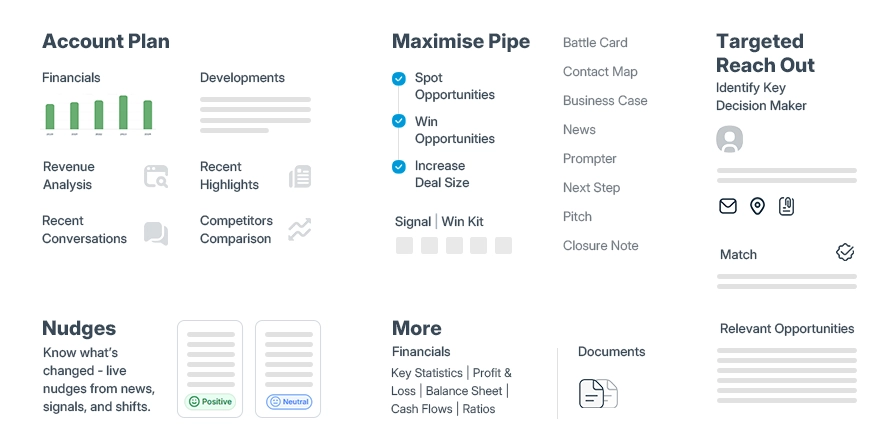
The Account Intelligence Agent watches Salesforce-connected accounts continuously — tracking financial changes, key developments, leadership movement, and business signals. This feeds the Spot Opportunities Agent, which identifies where those signals align with your offerings, ranks them by relevance, and attaches the relevant buying centers and contacts. Sellers review those opportunities, select the ones worth pursuing, and push them into the Win Opportunities Agent — which generates the battle card, messaging, and outreach in one step. The Signals Agent runs continuously underneath all of this, filtering noise and surfacing what has changed that creates a genuine reason to engage.
For a deeper look at how this works end-to-end, see how sales leaders use revenue intelligence to create pipeline and pipeline generation for enterprise sales teams using account signals.
RevOps leaders who implement a continuous account intelligence motion describe three consistent shifts.
Instead of spending forecast calls reviewing what sellers have logged, RevOps teams can see which accounts have signals that have not yet been converted to opportunity. The question moves from "what is in the pipeline?" to "what should be in the pipeline?" For a practical framework, read building predictable pipeline from strategic accounts.
When account signals are tracked systematically, RevOps can see which accounts across the territory have had no signal-triggered engagement in a given window. This surfaces the accounts that are falling through the cracks before they show up as missed opportunities at quarter end. This is the operational foundation behind identifying pipeline inside dormant accounts.
When a seller takes over a new territory or account set, the context they need is already in the system. Five-year revenue history, recent business changes, current signals, and prioritized opportunities — all accessible without requiring institutional knowledge transfer. This is one of the most underrated benefits of a continuous account intelligence motion. For the broader case, see AI sales forecasting and pipeline strategy for 2026.
RevOps leaders evaluating how to fix pipeline coverage often arrive at this question: do we need a new point solution, or do we consolidate what we already have?
Intent data platforms like 6sense and Bombora identify accounts showing anonymous research behavior. They are useful for top-of-funnel identification, but they do not tell sellers what to say, who to contact inside a specific buying center, or what the specific opportunity context is. See a direct comparison at SalesPlay vs. 6sense.
Conversation intelligence tools like Gong analyze what happens inside sales calls after the opportunity is created. They are useful for coaching and deal risk identification, but they do not help create pipeline. See how they differ at SalesPlay vs. Gong.
Sales engagement platforms like Outreach and Salesloft automate message delivery. They help sellers execute outreach at scale but do not generate the signal or context that makes the outreach worth sending. See the comparison at SalesPlay vs. Outreach.
The gap in most stacks is the layer that sits between account monitoring and seller execution — the system that connects what is changing inside accounts to where to act, who to engage, and what to say. That is where revenue intelligence operates, and it is the layer that most directly improves pipeline coverage quality.
If you are building a plan to improve pipeline coverage for the next quarter, here is what to focus on — in order of impact.
For each opportunity in the current pipeline, assess: Is there a verified contact still in the relevant role? Has the account had material movement in the last 60 days? Is the opportunity tied to a specific account signal or to a generic "good fit" judgment? Opportunities that fail all three criteria are holding up your ratio without contributing to real coverage. See where hidden revenue gaps appear in B2B pipelines.
Look across your target account list. Which accounts have seen no seller activity tied to a specific account signal in the last 90 days? Those are the accounts most likely to have untapped pipeline. The reason they have not been pursued is almost always the same: the seller does not have the time to research them, so they focus on the accounts they already know. How to generate pipeline from existing accounts is the most underused motion in enterprise sales.
The coverage problem cannot be solved at the individual seller level. It requires a system that watches accounts at a frequency no human can match. Whether through SalesPlay or another platform, the infrastructure shift is from periodic human research to continuous automated monitoring with human decision-making on top. Read operationalizing account intelligence for the implementation path.
Start tracking how long it takes from a verified account signal to a qualified opportunity in Salesforce. Set a target. Review it in forecast calls. This single metric, tracked consistently, will surface more pipeline coverage insight than any coverage ratio report. See how leading teams are approaching pipeline forecasting that actually works.
The teams that maintain consistent, high-quality pipeline coverage are not the ones with the most tools, the most SDRs, or the most aggressive prospecting cadences. They are the teams with the best-connected system between what is happening inside their accounts and what their sellers do every morning.
RevOps leaders own that system. The opportunity is not to add more inputs. It is to reduce the distance between signal and action — to make it faster, clearer, and more consistent to identify where pipeline exists and what to do about it.
That is what a continuous account intelligence motion delivers. Not more data. Not more outreach. Fewer decisions made in the dark.
Explore what this looks like in practice: how SalesPlay tells sellers where to focus, or see the broader context in what pipeline generation really means in enterprise sales.
A commonly cited benchmark is 3x to 4x pipeline coverage — meaning the pipeline value is three to four times the revenue target. However, the ratio alone is misleading. Coverage built from stale opportunities, misqualified accounts, or contacts who have left the company distorts the number. The more meaningful question is how much of your pipeline is grounded in verified, current account signals. A 3x pipeline filled with real, signal-backed opportunities is materially stronger than a 5x pipeline built from guesswork.
Most pipeline coverage problems are not caused by a lack of tools — they are caused by fragmentation. Sellers jump between CRM, intent data platforms, news sources, LinkedIn, and email tools to piece together a picture of each account. Each additional tool adds another source to reconcile. What fixes pipeline coverage is a system that continuously watches accounts, connects signals to opportunities, and tells sellers where to act — without adding to the research burden.
RevOps improves pipeline coverage by changing how existing accounts are monitored and how opportunities are surfaced. Instead of relying on sellers to manually research accounts and identify timing, RevOps deploys a system that tracks account signals continuously and surfaces qualified opportunities when conditions align. This means the same team can cover more ground, with better context, and engage at the right moment — without adding headcount.
Signal-based pipeline generation means identifying opportunities inside existing accounts based on business movements — leadership changes, expansion signals, budget cycles, initiative announcements, or operational shifts — rather than waiting for inbound intent or relying on cold outreach cadences. It connects what is changing inside an account to what your team sells, then tells sellers when and how to engage.
6sense focuses on intent data and account scoring for top-of-funnel identification. Gong focuses on conversation intelligence and deal coaching post-call. SalesPlay operates differently: it continuously watches Salesforce-connected target accounts, detects business movement, connects signals to specific opportunities and contacts, and tells sellers exactly where to act, who to engage, and what to say. It is a continuous execution layer that spans from account monitoring to outreach to meeting prep.
Yes. SalesPlay connects to Salesforce and works with existing account data. It does not replace the CRM — it operates as a co-pilot layer on top of it, continuously monitoring the accounts already in Salesforce and surfacing what is changing, what opportunities exist, and what action to take.
Beyond the raw coverage ratio, leading RevOps teams measure pipeline coverage quality through: signal-triggered opportunity rate (how many deals were opened based on verified account movement), average days from signal to opportunity creation, coverage per seller across assigned accounts, and percentage of pipeline with confirmed stakeholder contacts attached. These indicators separate healthy pipeline from inflated numbers.
Account intelligence gives sellers and RevOps leaders a continuously updated view of what is happening inside target accounts — financial changes, leadership shifts, operational signals, and strategic initiatives. When this intelligence is connected to your product offerings and buying centers, it transforms account monitoring from a passive research task into an active pipeline creation motion. Sellers know which accounts are moving, why they matter now, and who to engage.
SalesPlay connects to your Salesforce accounts and surfaces the opportunities, signals, and contacts your team is missing — without adding another tool to research.


Category: Uncategorized Tags: ai, AIOps, Artificial Intelligence, cloud, cloud platform, Cybersecurity, Information and Communications Technology , VR