Lead Nurture Workflows That Align Sales and RevOps
February 20, 2026
Most lead nurture programs in enterprise sales are solving the wrong problem. They optimize for email open rates, sequence completion, and MQL volume — metrics that look healthy inside a marketing dashboard but have little bearing on whether a seller can actually close something.
Meanwhile, RevOps spends weeks building nurture logic in their automation platform. Sellers ignore it, route around it, or run their own cadences in parallel. The pipeline looks active. The deal quality does not reflect it.
This is not a content problem or a tooling problem. It is an alignment problem — a breakdown in the handoff between RevOps-designed workflows and how sellers actually work. The consequences are predictable: pipeline gaps that surface too late in the quarter to correct, outreach that lands without context, and RevOps unable to explain why a well-designed sequence produced nothing actionable.
This article explains what causes that breakdown, what a properly aligned lead nurture workflow looks like in practice, and how the dynamic changes when nurturing is grounded in account intelligence rather than lead scoring.
When RevOps designs a nurture workflow, they typically start from the marketing side: form fills, content downloads, webinar attendance, email engagement. Leads accumulate points. At some threshold, they get routed to sales as MQLs.
This model was built for inbound lead volumes. It does not translate well to enterprise sales, where target accounts are already known, buying decisions involve multiple stakeholders, and timing is driven by business events inside the account — not website behavior. The structural mismatch between this process and enterprise selling is also why traditional pipeline generation breaks at scale — the same assumptions that made lead scoring work for inbound funnels create friction in account-based execution.
Different definitions of "ready." RevOps defines readiness as a lead score crossing a threshold. Sales defines readiness as a signal that the account is in motion — a leadership change, a budget announcement, a product initiative, a competitive shift. These are rarely the same event, and the mismatch means sales gets handed leads they cannot act on.
Generic messaging that sellers will not put their name on. Automated nurture sequences are built for scale, not specificity. When a seller sees a nurture email go out to their account contact that references nothing relevant to that contact's actual situation, they lose confidence in the program. The contact experience suffers. The seller disconnects from the workflow entirely.
Handoff without context. Even when RevOps correctly identifies a warm lead and routes it to sales, the handoff often includes a lead score and a name — not the full account picture. The seller has to research the account from scratch, reconstruct context from CRM notes, and determine their own angle. Time gets lost. Momentum does not transfer. This is the operational reality behind accounts that appear dormant but are not — they were never truly quiet, they just never received outreach that reflected what was happening inside them.
The alignment gap between sales and RevOps is rarely about intentions. Both teams want the same outcome. The gap exists because they are operating from different data, different signals, and different timelines — with no shared operational layer connecting them.
Alignment is not achieved by holding more sync meetings or giving sellers access to the marketing automation dashboard. It requires a shared, working definition of what a nurturable opportunity looks like — and a system that builds workflows around that definition rather than around engagement metrics.
In practice, a lead nurture workflow that aligns sales and RevOps has three structural properties.
Traditional nurture workflows start with a contact and try to move them through a funnel. Aligned workflows start with an opportunity — a specific reason why a specific account has a need for a specific offering right now — and then identify which contacts are relevant to that opportunity. This shift is precisely what transforms lead nurturing from a volume play into a genuine pipeline driver.
When you start from the opportunity, every message in the nurture sequence can be grounded in something real. The contact receives communication relevant to their role, their company's situation, and the specific challenge the opportunity addresses. It does not feel like generic nurture. It feels like someone who understands their business.
The most effective nurture sequences are not built on a calendar. They are built on account signals — observable changes inside a target account that create a genuine reason to engage. Revenue teams that have moved to a signal-driven execution framework consistently report higher response rates and shorter sales cycles, because outreach lands when the account is actually in motion rather than when a sequence timer fires.
Signals that warrant entering or accelerating a nurture sequence include:
When outreach is triggered by a genuine signal, sellers can reference it directly. The contact's question shifts from "why are they contacting me?" to "how did they know we were looking at this?" That shift changes the quality of every conversation downstream.
When a nurtured contact converts to an active opportunity, the seller who picks it up needs the full picture without reconstructing it: what triggered the nurture sequence, what signals the account showed, what messages the contact already received, what the opportunity context is, and what the next logical step looks like. Teams that have operationalized account intelligence inside the sales workflow describe the handoff quality improvement as the single biggest change in seller experience — not the nurture content itself, but what the seller inherits when they take over.
A lead nurture workflow that actually advances pipeline has six components working in sequence. Each one depends on the previous.
Before any nurture activity begins, the team needs a current, consolidated view of the account — not a static CRM record or a spreadsheet from last quarter. A live view that reflects what is happening inside the account today: financially, organizationally, and strategically. The quality of account intelligence determines the quality of every message that follows.
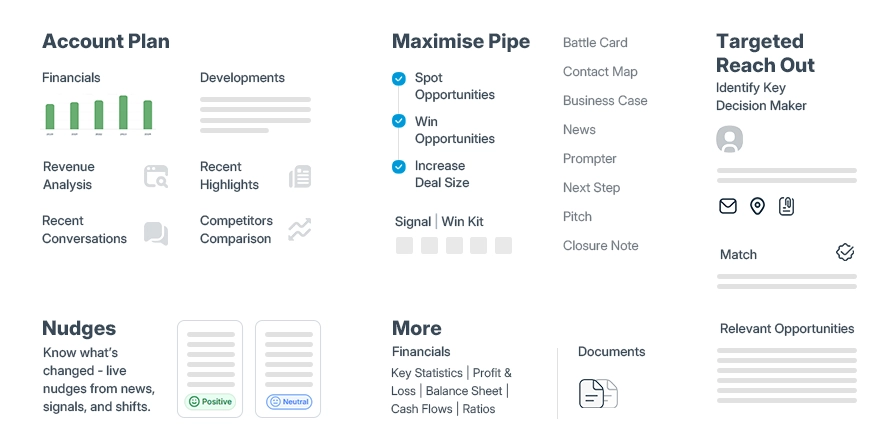
For enterprise sales teams, the gap between having fresh account context and working from stale CRM data is the gap between building predictable pipeline from strategic accounts and chasing reactive leads. SalesPlay's Account Intelligence Agent addresses this directly — continuously watching Salesforce-connected accounts, tracking multi-source changes, and consolidating five-year financial context, key business developments, and relevant signals into a single living view. When a seller or RevOps leader opens an account, they see what changed and why it matters, without opening a second tab.
Every nurture campaign should be built around a specific, identified opportunity — not a hypothesis that a contact might be interested in a product category. Most teams skip this step, which is why their nurture sequences become a volume play: high send counts, low conversion, and no insight into why it is not working.
SalesPlay's Spot Opportunities Agent handles opportunity identification systematically — scanning account signals, detecting where account priorities and business movements align with specific offerings, and ranking opportunities by relevance. Sellers see not just "there is an opportunity here" but the signal that triggered it, the supporting context, and which contact is most relevant. This is the operational starting point for generating pipeline from accounts you already own rather than starting every quarter from cold outreach.
Once an opportunity is identified, the next question is who to reach. In enterprise sales, this is rarely one person. Deals involve multiple stakeholders across buying centers, and the right message varies by role, seniority, and function. Effective lead nurture workflows map contacts to opportunities specifically — not generically.
The economic buyer hears about business outcomes. The technical evaluator hears about implementation and integration. The end user hears about day-to-day impact. Applying contact enrichment strategies that tie individuals to buying center roles is what makes nurture feel personalized at scale — not personalization tokens in an email header, but genuine relevance to what each person actually cares about.
With the opportunity defined and contacts mapped, the nurture campaign can be built. Each message should reference the specific opportunity, connect to the contact's role, and build on the previous touch without repeating it.
This is where most teams hit a scaling problem. Writing genuinely personalized, sequenced emails for multiple contacts across multiple opportunities is time-intensive. Most teams either write one generic sequence and apply it everywhere, or they write excellent campaigns for a handful of priority accounts and leave the rest underserved. The result is a coverage problem that looks like a content problem. For teams trying to understand how to nurture leads consistently across a large account portfolio without burning seller capacity, this is where automation earns its place — at the drafting layer, not the strategy layer.
SalesPlay's Auto-Nurture Agent solves this directly. Sellers select an opportunity, select the relevant contacts, set the number of touches and timing, and SalesPlay drafts every email — personalized by opportunity context and individual contact. Every message is distinct. Campaigns run automatically after seller approval. No one writes from scratch.
Account conditions change. A contact you are nurturing gets promoted. The account announces a new initiative. A competitor makes a move. Any of these developments should update your nurture approach — and a static sequence cannot respond to them.
SalesPlay's Signals Agent continuously surfaces account-level developments during an active campaign. If a material change happens inside a target account, it surfaces immediately — giving sellers and RevOps a decision point: pause, accelerate, or adjust messaging. Teams that have built account-change-to-pipeline workflows treat the Signals Agent as an early warning system for deals that need to move faster than the original sequence assumed.
When a nurtured contact responds or shows strong engagement, the seller who picks it up needs everything in one place: the opportunity summary, what the contact has already seen, the account's current state, and a clear next step. SalesPlay's Win Opportunities and Meeting Prep agents ensure this handoff is complete — battle cards, messaging, next-step guidance, and a one-page meeting prep document ready before the first conversation.
This is the difference between a seller who shows up prepared and a seller who spends the first 20 minutes of a call reconstructing context the system already had. Sales leaders who have moved to using revenue intelligence to direct where sellers focus describe the meeting prep step as the most visible change in seller confidence and deal quality.
Alignment does not mean both teams do everything. It means each team owns the stages they are best positioned to execute, with clean handoffs between them. Clarity of ownership at each stage eliminates the most common source of misalignment: both teams assuming the other is handling something, and neither actually handling it.
| Workflow Stage | RevOps Owns | Sales Owns | Shared |
|---|---|---|---|
| Account intelligence & signal monitoring | Signal source configuration, data quality | Account interpretation, prioritization | Shared view in platform |
| Opportunity identification | Relevance criteria & offering mapping | Judgment on which to pursue | Opportunity scoring logic |
| Contact mapping | Buying center definitions | Relationship context | Contact-to-opportunity assignment |
| Campaign creation & approval | Sequence logic, timing rules | Message review & final approval | Campaign quality standards |
| Execution & monitoring | Platform management | Inbox monitoring, direct follow-up | Engagement tracking |
| Handoff to active deal | MQL definition & routing rules | Deal qualification & next steps | Conversion criteria |
This structure also answers a practical question that enterprise teams face when scaling: what pipeline generation actually means at an operational level. It is not one team's job. It is a workflow with defined owners at each stage — and without that definition, the pipeline number becomes an aggregate of individual heroics rather than a managed outcome.
If you are evaluating lead nurture tools or revenue intelligence platforms that claim to align sales and RevOps, these questions separate genuinely operational tools from platforms that look good in a demo.
Tools that start from contacts — even with sophisticated segmentation — still produce generic nurture. The opportunity context is what makes personalization possible at scale. If a platform cannot identify why a contact is relevant before building the nurture sequence, the personalization will be surface-level. This is the core distinction when evaluating SalesPlay against 6sense, where the starting point of the workflow diverges significantly.
Time-based sequences are easy to build and hard to argue with in a demo. Signal-based sequences require account intelligence infrastructure underneath. Ask what data sources feed the trigger logic and what the system does when an account signal changes mid-sequence. This distinction comes into sharp relief when comparing SalesPlay against Salesloft — one is a sequencing execution layer, the other connects sequencing to the account intelligence that justifies it.
The handoff is where most platforms fail. Ask specifically: what does the seller see when they pick up a nurtured lead? Is it a lead score, or is it full account context — the opportunity, the contact's relevance, what has already been sent, and what the next step should be? Teams that have run a detailed comparison of SalesPlay and Outreach consistently cite handoff context quality as the deciding factor in long-term seller adoption.
RevOps alignment requires a closed feedback loop. If RevOps loses sight of what happens after MQL routing, they cannot improve the workflow. The platform should give both teams visibility across the full journey — from signal detection through campaign execution to deal progression. Without this, RevOps is optimizing a process they cannot see past the halfway point.
When lead nurture workflows are properly aligned between sales and RevOps, the team-level experience shifts in ways that are felt immediately — not just in quarterly reporting.
Sellers engage with the process instead of routing around it. When nurture campaigns are built on real account intelligence and tied to specific opportunities, sellers recognize the quality. They review campaigns before approval. They follow up on engaged contacts. They trust the workflow to produce conversations worth having. Teams that have shifted to signal-triggered outreach instead of cold-outreach-dependent pipeline generation consistently report this trust shift as the first visible change after implementation — before any pipeline number moves.
RevOps can see what is working and why. Instead of optimizing for open rates, RevOps can see which opportunity types generate the most engagement, which signals produce the strongest response, and which contact functions convert most often. This closes the loop between campaign design and pipeline output — something that cannot happen when nurture metrics live in one system and deal outcomes live in another.
New sellers ramp faster. A new seller joining a territory does not need weeks to understand which accounts are in motion. The account intelligence layer gives them immediate context — what is happening in each account, what opportunities exist, and what campaigns are already running. This is one of the clearest benefits of account intelligence as a structural element of enterprise sales — it stores institutional knowledge in the system, not in individual sellers' heads.
Outreach volume decreases. Conversion rates improve. This is the counterintuitive outcome most teams experience. When outreach is tied to real signals and specific opportunities, teams send fewer messages — but more of them land. Pipeline quality improves because every opportunity in the workflow is grounded in account intelligence rather than demographic assumptions. Teams that have built account-signal-driven pipeline generation into their process describe this as the moment the sales team stops complaining about lead quality — not because the leads changed, but because the workflow that generated them changed.
There is an important distinction that gets lost in most conversations about lead nurture automation: automation and systematization are not the same thing.
Automation means removing human effort from a process that was previously manual. Automated nurture sequences send emails without a seller typing them. That is useful, but it does not solve the alignment problem — it just executes the misalignment faster.
Systematization means building a shared operational structure that both sales and RevOps work within — with clear inputs, clear outputs, and visibility across the full workflow. Systematized nurture is grounded in account intelligence, triggered by real signals, personalized to specific opportunities and contacts, and designed to hand off with full context. The distinction between these two approaches is precisely what agentic AI is reshaping in enterprise sales teams — moving from automating individual tasks to connecting an entire revenue workflow with shared visibility for every team involved.
"The goal is not a faster nurture sequence. The goal is a workflow that sales actually uses and RevOps can actually improve."
Most platforms offer automation. Fewer offer systematization. The distinction matters most when you are evaluating platforms at scale — when you have dozens of sellers, hundreds of target accounts, and a RevOps team trying to build a process that survives personnel changes and territory shifts. For teams assessing whether their current stack meets this standard, the clearest benchmark is whether account signals feed the nurture workflow directly — and whether both sales and RevOps can see the full journey from those signals to surfaced buying opportunities across target accounts.
SalesPlay is built for systematization. Every agent in the workflow produces outputs that connect to the next step — account intelligence feeds opportunity identification, opportunity identification feeds contact mapping, contact mapping feeds campaign creation, campaign execution feeds deal progression. RevOps can manage the operational layer. Sellers can act on specific opportunities without context-switching between tools. The result is a revenue intelligence-led pipeline process that both teams can see, manage, and improve over time.
A lead nurture workflow is a structured sequence of communications designed to keep a prospect engaged over time until they are ready to buy. In B2B contexts, effective nurture workflows are tied to account-level signals and buying intent, not just arbitrary timing sequences.
Sales and RevOps typically operate on different definitions of ready. RevOps designs nurture sequences based on lead scores and engagement rates. Sales judges readiness based on account context, timing, and stakeholder signals. When these definitions diverge, leads get handed off too early, nurtured too generically, or dropped entirely.
A RevOps-aligned nurture workflow is triggered by account-level signals rather than time elapsed, segments contacts by buying center and opportunity relevance, and hands off to sales with full context so sellers can act immediately without additional research.
Traditional nurture sequences run on a calendar. Signal-based nurturing is triggered by real account movements: a leadership change, a new budget initiative, a regulatory shift, or a product expansion. This ensures outreach reaches prospects when there is a genuine reason to engage, not just because a timer fired.
SalesPlay's Auto-Nurture Agent generates personalized, multi-touch email campaigns tied to specific opportunities and individual contacts. Sellers select the opportunity, contacts, number of touches, and timing. SalesPlay drafts every email, personalizes it by opportunity and individual, ensures no two messages are identical, and runs the campaign after approval.
Outreach and Salesloft automate the sending process but require sellers to identify opportunities, research contacts, and write messaging themselves. SalesPlay identifies the opportunity first, attaches the relevant contacts, and generates the nurture campaign around that specific opportunity context — intelligence to outreach in one system.
Misalignment comes from different data sources, different timing signals, and different definitions of pipeline quality. RevOps uses CRM and marketing automation; sales uses personal notes and relationship instinct. Without a shared operational layer, both teams make decisions in silos.
Not entirely. Automated nurture maintains presence across contacts not yet in an active conversation. When an account shows a strong buying signal, personalized seller outreach takes over. The best teams use nurture to stay relevant at scale and switch to direct engagement when signals indicate a specific opportunity is maturing.
Watch how the Auto-Nurture Agent builds signal-triggered, opportunity-grounded campaigns — from account intelligence to approved outreach — without sellers writing from scratch.
Book your Demo Now Explore Lead Nurture

Category: Uncategorized Tags: ai, AIOps, Artificial Intelligence, cloud, cloud platform, Cybersecurity, Information and Communications Technology , VR