

AI Impact Analysis on Tactical Communications Market
Artificial intelligence is becoming a transformative technology in the global Tactical Communication Market, influencing how military organizations establish secure connectivity, exchange battlefield information, manage communication networks, and coordinate operations across multiple domains. Modern defense environments increasingly depend on reliable communication infrastructure capable of supporting voice, video, sensor data, command information, and real-time intelligence. As military platforms become more connected and data-intensive, traditional communication architectures are evolving toward intelligent, software-defined, and resilient network ecosystems.
Tactical communication systems enable military personnel and defense platforms to exchange information in operational environments where connectivity may be limited, infrastructure may be unavailable, and network conditions can change rapidly. These systems include tactical radios, software-defined radios, satellite communication terminals, tactical data links, antennas, encryption equipment, networking devices, and integrated command and control communication solutions. Their importance is increasing as defense organizations modernize land, naval, and airborne platforms and adopt network-centric military architectures.
Artificial intelligence is creating opportunities to improve the performance and management of these systems. Machine learning can support network monitoring, traffic analysis, predictive maintenance, and anomaly detection. Cognitive radio technologies can use intelligent analysis to understand changing spectrum conditions, while AI-enabled cybersecurity tools can help identify suspicious network activity. Edge AI can also support information processing closer to deployed platforms, reducing dependence on centralized computing infrastructure.
The growing adoption of unmanned aerial vehicles, autonomous ground systems, connected sensors, and distributed military platforms is further increasing the importance of tactical connectivity. These platforms generate substantial amounts of information that must be transmitted, processed, and shared across military networks. AI can help organize this information and support more efficient communication infrastructure management.
At the same time, tactical communication networks face significant challenges involving cybersecurity, spectrum availability, electronic interference, interoperability, bandwidth limitations, and connectivity in degraded environments. AI cannot eliminate these constraints, but it can help network operators and manufacturers monitor system performance, identify potential disruptions, and improve maintenance planning.
The integration of AI into tactical communication will also depend on reliable software, secure data infrastructure, validated algorithms, and compatibility with existing military equipment. Defense organizations must balance technological innovation with the need for human oversight, information security, and dependable communication services.
By 2035, AI is expected to influence an increasingly broad range of tactical communication technologies, from software-defined radios and satellite networks to battlefield data links and multi-domain communication platforms. Its impact will extend across research and development, manufacturing, deployment, cybersecurity, and lifecycle management. Understanding these developments is essential for evaluating the future direction of the global Tactical Communication Market.
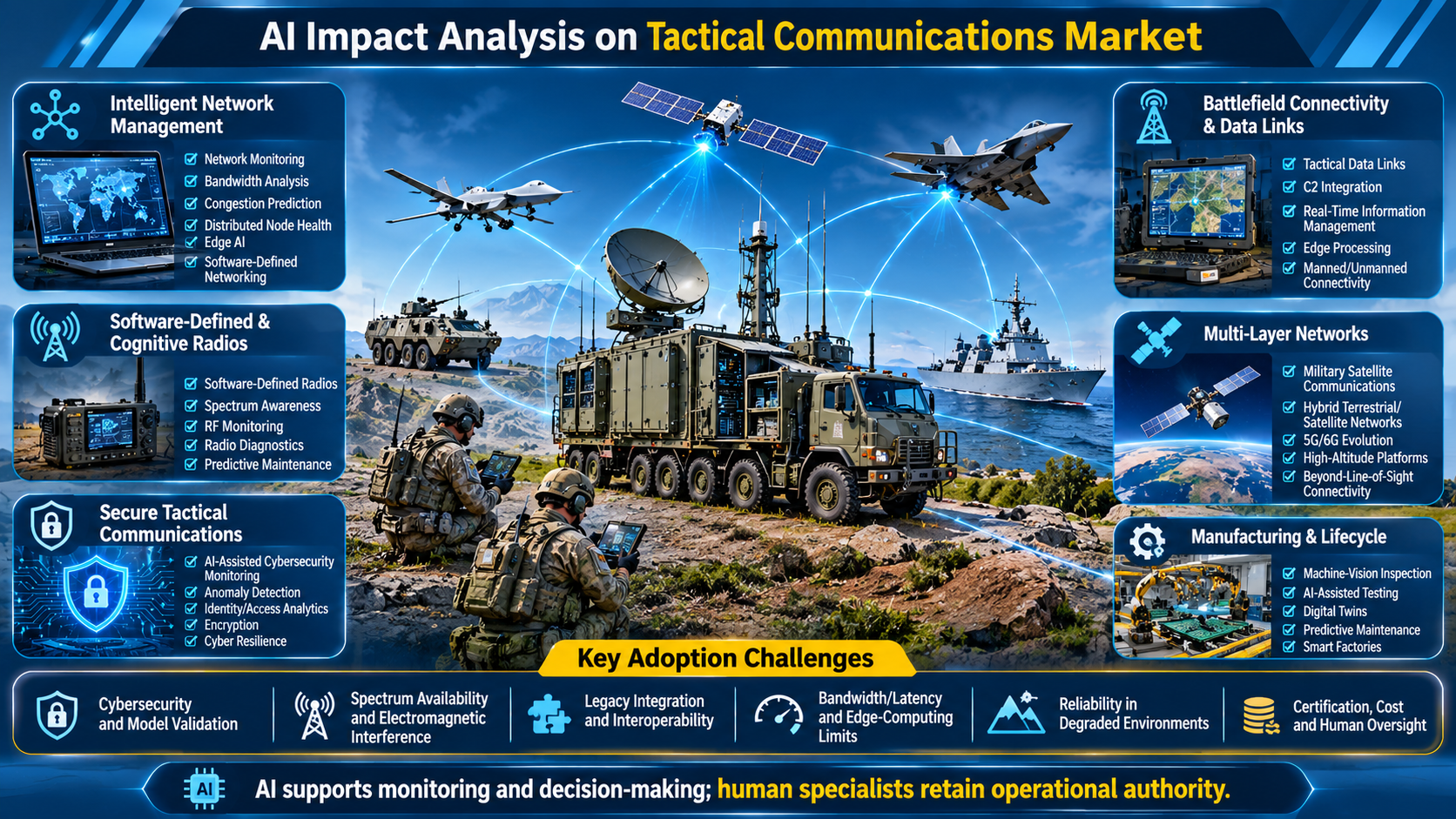
Introduction to the Tactical Communication Market
Evolution of Tactical Communication Technologies
Tactical communication systems have evolved significantly from conventional military radio equipment to sophisticated digital networks capable of supporting voice, data, video, and integrated command information. Earlier military communication architectures relied heavily on dedicated radio channels and relatively isolated communication systems. Although these technologies remain important, modern defense requirements increasingly demand connectivity between multiple platforms, units, sensors, and command centers.
The development of digital radios, software-defined radio platforms, satellite communication terminals, secure networking equipment, and tactical data links has expanded the capabilities of military communication infrastructure. Modern systems must support different communication requirements while maintaining reliability across geographically distributed environments.
Artificial intelligence is adding another dimension to this evolution. AI-enabled analytics can monitor network performance, identify unusual communication patterns, and support maintenance decisions. Instead of relying exclusively on manual monitoring, military communication organizations can use intelligent software to analyze system information and highlight conditions requiring attention.
Growing Demand for Secure Military Communication Networks
Reliable communication is essential for military coordination, situational awareness, and command continuity. Defense organizations require systems that can exchange information across land, naval, airborne, and space-based platforms while maintaining appropriate security controls.
The growing use of digital battlefield technologies is increasing the amount of information moving across tactical networks. Intelligence data, sensor observations, platform status, logistics information, and command messages all contribute to communication demand.
AI can help network administrators understand traffic patterns and identify performance constraints. Predictive analytics can support capacity planning, while automated monitoring can help identify equipment faults and unusual network activity.
Role of Tactical Communication in Modern Battlefield Operations
Tactical communication provides the information infrastructure connecting military personnel, vehicles, aircraft, naval vessels, unmanned platforms, and command centers. It supports coordination across different levels of military operations and enables information exchange between units operating in different environments.
Modern battlefield environments are increasingly data-driven. Military organizations need communication systems capable of supporting multiple applications without compromising reliability or security.
AI can support this requirement by helping manage network information, improve system diagnostics, and provide better visibility into communication infrastructure.
Adoption of Software-Defined Radios
Software-defined radios are important components of modern tactical communication architectures because they use software-based functionality to support configurable communication capabilities. This provides greater flexibility than systems that depend entirely on fixed hardware configurations.
AI can complement software-defined radio technologies through intelligent monitoring, performance analytics, and cognitive radio applications. Machine learning can help analyze radio system information and identify patterns associated with changing network conditions.
The combination of software-defined radios and AI is expected to remain an important area of technological development.
Transition Toward Network-Centric Military Architectures
Modern defense organizations are moving toward connected architectures in which information can be shared across multiple platforms and command structures. Network-centric operations depend on reliable communication links and the ability to integrate information from different systems.
AI can help manage the complexity of these interconnected networks by analyzing traffic, monitoring equipment status, and identifying communication issues.
As military platforms become increasingly connected, intelligent network management will become a significant differentiator in the Tactical Communication Market.
AI in Intelligent Network Management and Tactical Communication Optimization
AI-Based Monitoring of Military Communication Networks
Tactical communication networks consist of multiple interconnected components, including radios, antennas, terminals, gateways, networking equipment, and command infrastructure. Monitoring these systems requires continuous analysis of network availability, data traffic, signal quality, and equipment performance.
Artificial intelligence can improve network monitoring by processing information collected across these components. Machine learning models can identify patterns associated with normal network behavior and highlight unusual changes that may indicate congestion, equipment degradation, or connectivity problems.
This allows network administrators to obtain a more comprehensive view of communication infrastructure. AI-supported monitoring can also reduce the amount of manual analysis required when managing complex military networks.
Intelligent Bandwidth Allocation and Resource Management
Bandwidth availability is an important consideration in tactical communication environments. Different applications have different communication requirements, and military networks may need to support voice communications, video feeds, sensor data, and command information simultaneously.
AI can help network administrators understand bandwidth demand by analyzing historical and real-time traffic information. Predictive analytics can identify changing usage patterns and support better capacity planning.
These capabilities can improve network visibility and help organizations manage communication resources more effectively while maintaining established priorities and security policies.
AI-Assisted Network Congestion Prediction
Network congestion can affect communication availability and the timely delivery of information. It may occur when traffic demand exceeds available network capacity or when infrastructure experiences technical limitations.
Machine learning can analyze historical traffic patterns and network performance measurements to identify conditions associated with congestion. Predictive models can help administrators recognize potential capacity problems before they significantly affect communication services.
AI can also support network performance reporting, allowing technical teams to identify recurring bottlenecks and evaluate infrastructure improvements.
Intelligent Management of Distributed Network Nodes
Military communication networks often involve distributed nodes operating across different platforms and geographical locations. These nodes may have different equipment configurations, connectivity requirements, and operating conditions.
AI can help monitor the health and performance of distributed network infrastructure. Automated analytics can consolidate information from multiple nodes and provide administrators with a clearer understanding of system availability.
This capability is particularly valuable for large defense networks where manual monitoring of every component may be difficult.
Edge AI and Software-Defined Networking
Edge AI enables data processing closer to deployed communication equipment rather than relying entirely on centralized computing infrastructure. This can be useful in environments where network connectivity is limited or where local processing is important.
Software-defined networking provides a programmable approach to network management by separating network control functions from the underlying forwarding infrastructure. AI can complement this architecture through performance analytics, fault detection, and network monitoring.
Together, edge AI and software-defined networking can support more flexible tactical communication architectures, provided that their implementation meets security, reliability, and interoperability requirements.
AI in Software-Defined Radios and Cognitive Radio Technologies
AI Integration with Software-Defined Radio Platforms
Software-defined radios are central to the modernization of military communication systems. They use programmable software to support communication functions that were traditionally implemented through dedicated hardware.
This flexibility allows radio platforms to accommodate different communication requirements and support upgrades throughout their lifecycle. AI can extend these capabilities through intelligent performance monitoring and data analysis.
Machine learning can help identify changes in radio system behavior, monitor equipment health, and support engineering assessments. AI-assisted diagnostics can also help manufacturers understand how hardware and software components perform under different operating conditions.
Cognitive Radio and Intelligent Spectrum Awareness
Cognitive radio technologies are designed to assess their radio environment and support more adaptable spectrum management. These systems are particularly relevant to military communication because spectrum availability and radio frequency conditions can vary across operating environments.
AI can support cognitive radio development by analyzing spectrum observations and identifying patterns in radio frequency activity.
Machine learning can also help researchers evaluate the performance of cognitive radio systems under different network conditions. This can improve understanding of spectrum utilization and support the development of more flexible communication technologies.
AI-Based Electromagnetic Spectrum Monitoring
The electromagnetic spectrum is a critical resource for military communication, surveillance, navigation, and other defense applications. Multiple systems may operate within overlapping or adjacent frequency ranges, creating a complex environment for communication equipment.
AI can analyze spectrum monitoring information and help identify unusual activity, signal interference, and changes in frequency utilization.
These capabilities can improve spectrum awareness and provide communication engineers with more detailed information about the electromagnetic environment.
Intelligent Radio Diagnostics and Performance Monitoring
Software-defined radio systems include electronic components, processors, antennas, and software that require continuous monitoring and maintenance.
AI can analyze radio equipment measurements and maintenance records to identify patterns associated with component degradation or system faults.
Predictive maintenance can help manufacturers and defense organizations schedule inspections more effectively. It can also reduce the risk of unexpected equipment downtime.
Future Intelligent Radio Architectures
The future of tactical radio systems will increasingly involve software-defined functionality, cognitive radio technologies, edge computing, and AI-assisted diagnostics.
These technologies can support more adaptable communication infrastructure and improve the management of complex radio systems.
Manufacturers that combine reliable radio hardware with secure software and intelligent monitoring capabilities will be positioned to address the evolving requirements of military communication programs.
AI in Secure Military Communications and Cybersecurity
AI-Powered Cybersecurity Monitoring
Military communication networks carry sensitive operational information and connect platforms that may be geographically distributed. Protecting these networks against unauthorized access, malicious software, data manipulation, and service disruptions is therefore a major priority for defense organizations.
Artificial intelligence can strengthen cybersecurity monitoring by analyzing network activity and identifying unusual behavior. Machine learning models can examine patterns in authentication events, communication traffic, software activity, and system logs to identify potential security incidents.
AI-supported monitoring can also help security teams organize alerts and distinguish potentially significant events from routine network activity. This is valuable in large communication environments where conventional monitoring tools may generate substantial volumes of information.
However, AI-based security systems must be tested carefully. Incorrect alerts can create unnecessary investigation work, while missed detections can leave vulnerabilities unresolved. Human cybersecurity specialists must remain responsible for reviewing important findings and managing incident response.
Machine Learning for Anomaly Detection
Anomaly detection is one of the most relevant AI applications in tactical communication cybersecurity. Military networks often contain established patterns of device behavior, user access, data exchange, and system performance. Machine learning can analyze these patterns and identify deviations that may require investigation.
For example, unexpected changes in device activity, unusual access attempts, or abnormal communication volumes may indicate technical faults or possible security incidents. AI can help identify these patterns more quickly than manual review of extensive system logs.
The effectiveness of anomaly detection depends on data quality and the ability of models to distinguish legitimate changes from suspicious activity. Network upgrades, new equipment, and changing operational requirements can all influence normal system behavior. Models must therefore be evaluated and updated through controlled processes.
Protection of Military Communication Data
Tactical communication systems may carry operational messages, intelligence information, platform status, and other sensitive data. Protecting this information requires multiple security controls, including encryption, identity management, access restrictions, secure software, and network monitoring.
AI can complement these controls by analyzing access patterns and identifying unusual activity. It can also support security teams by organizing vulnerability information and identifying systems that require additional assessment.
AI does not replace encryption or established security architecture. Instead, it can provide an additional layer of monitoring and analytical support within a broader cybersecurity framework.
Secure Identity and Access Management
Military communication networks may involve personnel, devices, applications, and platforms with different access requirements. Managing these identities consistently is important for protecting sensitive information and maintaining accountability.
AI-assisted analytics can help identify unusual authentication patterns, unexpected access behavior, and inconsistencies in device activity. These insights can support security administrators when reviewing access policies and investigating potential incidents.
The use of AI in identity management must be carefully governed to prevent incorrect decisions from disrupting legitimate communication. Human review and established authorization procedures remain essential.
Building Cyber-Resilient Tactical Networks
Cyber resilience involves more than preventing unauthorized access. It also requires communication infrastructure to maintain essential functions and recover appropriately when disruptions occur.
AI can contribute through continuous monitoring, predictive diagnostics, and the analysis of network health information. These capabilities can help administrators identify emerging problems and prioritize maintenance activities.
Future tactical communication systems are likely to combine AI-based security monitoring with secure hardware, verified software, encryption, and resilient network architecture. This integrated approach will become increasingly important as military communication infrastructure becomes more connected.
AI in Battlefield Connectivity, Tactical Data Links, and Real-Time Information Sharing
AI-Enabled Battlefield Communication Networks
Modern military operations increasingly depend on information exchange between personnel, vehicles, aircraft, naval platforms, sensors, and command centers. Tactical communication networks provide the connectivity required to support this exchange.
The increasing use of digital platforms is creating more complex battlefield information environments. Communication systems must support different types of data while accommodating variations in network availability, bandwidth, and platform capabilities.
AI can help manage this complexity by analyzing network activity and organizing information about communication performance. It can also support the identification of equipment problems and provide administrators with a clearer view of network availability.
Intelligent Tactical Data Management
Tactical data links and related communication technologies support the exchange of information between compatible military platforms. They can contribute to shared situational awareness and coordination across defense networks.
As the volume of information increases, managing data quality, consistency, and availability becomes more challenging. AI can help analyze incoming information, identify inconsistencies, and organize data for review.
Machine learning can also support the classification of network information according to its characteristics and intended application. These capabilities may improve information management across complex communication environments.
Integration with Command and Control Systems
Command and control systems depend on reliable communication links to support the exchange of information between military units and command organizations.
AI can support these systems by helping organize incoming data and monitor the availability of communication infrastructure. It can also identify patterns associated with network interruptions or equipment degradation.
The integration of AI with tactical communication infrastructure may improve the visibility of communication conditions across command networks. This is particularly important as defense organizations adopt increasingly connected command architectures.
Edge AI for Real-Time Information Processing
Edge computing allows information to be processed closer to the devices and platforms that generate it. In tactical environments, this can reduce dependence on centralized computing resources and support applications that require timely local analysis.
AI models deployed at the edge can assist with equipment monitoring, information classification, and selected communication management tasks. They can also support local diagnostics when connectivity to centralized systems is limited.
However, edge AI introduces constraints involving computing capacity, energy consumption, software updates, and cybersecurity. Manufacturers must balance processing requirements with the limited resources available on many military platforms.
Connectivity Across Manned and Unmanned Platforms
Military organizations are increasingly integrating unmanned aerial vehicles, autonomous ground systems, maritime platforms, and connected sensors into defense operations. These technologies require communication architectures capable of supporting information exchange between different types of equipment.
AI can help monitor connectivity and organize data generated by distributed platforms. It can also support equipment health monitoring and provide information about network performance.
Interoperability remains a major consideration because different platforms may use different communication standards, hardware configurations, and security requirements. Future tactical communication systems will need to support integration while maintaining appropriate controls over information exchange.
AI in Satellite Communication, 5G, and Next-Generation Tactical Networks
AI Integration with Military Satellite Communication
Satellite communication plays an important role in military connectivity, particularly when terrestrial infrastructure is unavailable or insufficient. It can support communication between geographically separated locations, mobile platforms, and command organizations.
AI can improve satellite network management by analyzing traffic patterns, equipment performance, and service availability. Predictive analytics can help identify potential capacity constraints and maintenance requirements.
Machine learning can also support the evaluation of satellite communication performance across different operating conditions. These capabilities are particularly relevant as military organizations develop more integrated communication architectures.
Hybrid Terrestrial and Satellite Networks
Future tactical communication infrastructure is likely to combine terrestrial radio networks, satellite links, mobile networks, and other communication technologies. This hybrid approach can provide multiple connectivity options and reduce dependence on a single infrastructure type.
AI can support the monitoring of these interconnected networks by analyzing service availability, network performance, and equipment health. It can also help administrators understand where communication infrastructure may require additional capacity or maintenance.
The integration of multiple network types introduces challenges involving interoperability, security, latency, and data management. AI can assist with monitoring these issues, but successful deployment will require standardized interfaces and carefully validated system architectures.
Integration with 5G and Emerging 6G Technologies
5G technology offers capabilities such as improved data throughput, lower latency in suitable network conditions, and support for connected devices. These features have attracted interest for military communication applications, particularly in controlled environments and installations with suitable infrastructure.
AI can complement 5G networks through traffic analysis, performance monitoring, and predictive network management. It can also support the development of intelligent network services for connected defense infrastructure.
Research into 6G technologies may introduce additional capabilities involving advanced sensing, distributed computing, and more integrated communication environments. Although military adoption will depend on maturity, security, and certification, these developments could influence future tactical network architecture.
High-Altitude Platforms and Multi-Layer Connectivity
High-altitude platforms, including selected unmanned aerial systems and stratospheric communication platforms, are being explored as potential elements of future communication infrastructure.
These systems may complement satellite and terrestrial networks by supporting connectivity in areas where conventional infrastructure is limited.
AI can contribute to platform monitoring, communication equipment diagnostics, and network performance analysis. It can also help researchers evaluate how different connectivity technologies interact within a multi-layer communication architecture.
Beyond-Line-of-Sight Communication
Beyond-line-of-sight communication is important for military platforms operating outside the coverage of conventional direct communication links. Satellite communication and other extended-range technologies can help maintain connectivity across geographically separated locations.
AI can support the monitoring of these services by analyzing network availability, traffic conditions, and equipment status. Predictive analytics can help identify possible service interruptions and support maintenance planning.
As military platforms become more distributed, resilient beyond-line-of-sight communication will remain an important area of investment and technological development.
AI in Tactical Communication Manufacturing, Testing, and Predictive Maintenance
AI-Driven Manufacturing of Military Communication Equipment
Tactical communication equipment includes radios, antennas, electronic components, communication terminals, processors, networking devices, and supporting hardware. These products must meet demanding requirements for reliability, environmental performance, and operational service life.
AI can improve manufacturing through production analytics, automated inspection, and quality monitoring. Machine learning models can analyze manufacturing information and identify patterns associated with defects or process inconsistencies.
This can help manufacturers improve production quality and reduce unnecessary rework. AI-based analytics may also support better resource planning across electronics manufacturing operations.
Machine Vision for Electronic Component Inspection
Tactical communication devices contain complex electronic assemblies that require precise inspection. Manufacturing defects involving solder joints, circuit boards, connectors, and component placement can affect product reliability.
Machine vision systems can inspect electronic assemblies using imaging and automated measurement technologies. AI can help identify visual patterns associated with defects and highlight components requiring further inspection.
This approach can improve inspection consistency and help manufacturers detect quality issues earlier in the production process.
AI-Assisted Testing and Validation
Military communication equipment undergoes extensive testing to verify electrical performance, radio frequency characteristics, software functionality, environmental durability, and system interoperability.
AI can help organize testing information and identify patterns across large datasets. Automated analytics can compare results with established engineering requirements and highlight unusual measurements for further examination.
These capabilities can improve testing efficiency, but they do not remove the need for formal verification, certification, and independent engineering assessment.
Digital Twins for Tactical Communication Equipment
Digital twins provide virtual representations of physical equipment and systems. For tactical communication manufacturers, these models can represent radio assemblies, electronic components, antennas, thermal characteristics, and other product features.
AI can analyze digital twin information to help engineers evaluate design alternatives and understand how component changes may influence system performance.
Digital engineering can also reduce dependence on repeated physical prototyping during selected development stages. When combined with validated test data, digital twins can improve product development and engineering documentation.
Predictive Maintenance of Radios and Network Equipment
Tactical communication equipment may experience degradation due to environmental exposure, vibration, temperature changes, repeated operation, and component aging.
AI can analyze equipment measurements and maintenance records to identify patterns associated with developing faults. Predictive maintenance models can help estimate when radios, antennas, power supplies, and other components may require inspection.
This can improve maintenance planning and help defense organizations reduce unexpected equipment downtime.
Smart Factories and Lifecycle Management
Smart factories combine connected manufacturing equipment, automated inspection, production analytics, and digital engineering. AI can help manufacturers identify production inefficiencies and improve quality management.
After equipment is deployed, AI can continue supporting lifecycle management through maintenance analytics and performance monitoring. Information collected from different equipment generations can help manufacturers identify recurring issues and improve future product designs.
This creates opportunities for a more continuous relationship between manufacturing, deployment, maintenance, and product development across the Tactical Communication Industry.
AI Integration with Multi-Domain Military Platforms and Autonomous Systems
AI Integration with Land-Based Tactical Communication Systems
Land-based military platforms include armored vehicles, tactical trucks, command vehicles, mobile communication units, and dismounted communication equipment. These platforms require reliable connectivity to exchange information across military formations and command structures.
The growing use of digital vehicle systems and connected sensors is increasing the amount of information moving through land-based communication networks. AI can support equipment monitoring, network performance analysis, and maintenance planning across these platforms.
Machine learning can help identify unusual equipment behavior and provide insights into communication system health. AI-enabled diagnostics can also assist maintenance organizations in identifying components that may require inspection.
For manufacturers, the opportunity lies in integrating intelligent monitoring capabilities into tactical radios, vehicle communication systems, antennas, and onboard networking equipment without increasing platform complexity unnecessarily.
Intelligent Communication Architectures for Naval Platforms
Naval communication environments involve ships, submarines, maritime aircraft, shore-based facilities, and satellite communication infrastructure. These platforms require reliable information exchange across different operating environments and communication technologies.
AI can support naval tactical communication through network performance monitoring, equipment diagnostics, cybersecurity analytics, and maintenance planning. It can also help administrators understand the availability of communication infrastructure across different onboard systems.
The integration of satellite connectivity, radio communication, and digital naval command networks is creating opportunities for more intelligent communication management.
As naval platforms become increasingly connected, secure interoperability and reliable network monitoring will remain important technology priorities.
AI-Enabled Connectivity Across Military Aircraft
Military aircraft require communication systems that support coordination with ground stations, other aircraft, naval platforms, and command organizations. These systems must operate within strict requirements involving size, weight, power consumption, reliability, and information security.
AI can contribute through communication equipment monitoring, predictive maintenance, and network analytics. Machine learning can help identify patterns associated with component degradation and support the assessment of onboard communication equipment.
AI can also assist manufacturers in evaluating communication system performance through digital engineering and simulation.
Future airborne communication architectures are likely to incorporate greater software-defined functionality and improved integration with broader military networks.
Tactical Communication Integration with Unmanned Aerial Vehicles
Unmanned aerial vehicles are increasingly used for surveillance, reconnaissance, logistics, and other military applications. Their operation depends on communication systems that support the exchange of information between airborne platforms, ground control infrastructure, and other connected systems.
AI can help monitor communication equipment health and analyze the performance of connected network infrastructure. It can also support the management of information generated by distributed unmanned platforms.
Communication reliability is particularly important because UAVs may operate in environments where network availability and connectivity conditions vary. This creates demand for robust communication equipment, secure data links, and compatible network architectures.
Communication for Autonomous Ground and Maritime Systems
Autonomous ground vehicles and maritime platforms are creating new requirements for tactical communication infrastructure. These systems may rely on connected sensors, onboard computing, remote supervision, and information exchange with other platforms.
AI can support the monitoring and analysis of communication equipment used by autonomous platforms. It can also help manufacturers evaluate network availability, equipment performance, and maintenance requirements.
As autonomous systems become more common in defense applications, tactical communication networks will need to support a wider range of connected devices and operating environments.
Interoperability Across Joint and Coalition Networks
Military operations may involve different service branches, equipment suppliers, and allied defense organizations. These participants may use different communication standards, software configurations, encryption requirements, and network architectures.
AI can help analyze communication performance and identify interoperability issues across connected systems. It can also support data management and system diagnostics, helping technical teams understand where communication compatibility requires improvement.
However, interoperability depends on standardized interfaces, compatible protocols, secure information exchange, and coordinated certification. AI cannot compensate for fundamental incompatibilities in system design.
Integration with C4ISR Systems
Command, Control, Communications, Computers, Intelligence, Surveillance, and Reconnaissance systems form an important part of modern military information infrastructure. Tactical communication networks provide connectivity between these capabilities and enable information exchange across defense platforms.
AI can help organize information from connected systems and improve visibility into network performance. Machine learning can also support equipment diagnostics and cybersecurity monitoring across the communication infrastructure.
The integration of AI with C4ISR and tactical communication systems will be an important development area as defense organizations continue moving toward connected and data-driven military architectures.
Challenges, Risks, and Regulatory Considerations in AI-Enabled Tactical Communication
Technical Challenges of Integrating AI into Legacy Infrastructure
Many military communication networks include equipment developed across different generations of technology. Legacy radios, communication terminals, networking systems, and command infrastructure may use different standards and software architectures.
Integrating AI into these systems can be difficult because older equipment may have limited processing capacity, restricted data interfaces, or incomplete monitoring capabilities.
Manufacturers must develop integration approaches that preserve existing system reliability while introducing new analytical functions. In some cases, modernization may require hardware upgrades, software replacement, or the introduction of compatible gateways.
The challenge is to introduce AI without creating unnecessary complexity or reducing the availability of established communication services.
Cybersecurity Vulnerabilities in AI-Enabled Networks
AI can improve cybersecurity monitoring, but it also introduces additional security considerations. Machine learning models depend on data, software, computing infrastructure, and communication interfaces that must be protected.
Unauthorized changes to training data, manipulated inputs, compromised software updates, or attacks against connected infrastructure could affect the reliability of AI-supported monitoring.
Defense organizations must establish secure development practices, access controls, model validation procedures, and continuous monitoring. Cybersecurity should be considered throughout the AI system lifecycle.
Data Quality and Model Accuracy
AI performance depends heavily on the quality and relevance of the information used for training and evaluation. Tactical communication networks may produce incomplete, inconsistent, or differently formatted data across equipment types.
Changes in network architecture, software versions, and operating environments can also affect model performance.
Manufacturers must ensure that AI models are evaluated using representative datasets and tested under a range of conditions. Human review and clear communication of uncertainty are important, particularly when AI-generated information may influence security or maintenance decisions.
Communication Reliability in Degraded Environments
Tactical communication systems may operate in environments where infrastructure is damaged, unavailable, congested, or affected by physical and electromagnetic conditions.
AI can help monitor network performance and identify developing technical problems. However, it cannot eliminate limitations associated with available bandwidth, physical infrastructure, equipment compatibility, or propagation conditions.
Reliable communication requires resilient system design, suitable hardware, redundancy, testing, and effective maintenance. AI should complement these engineering foundations.
Spectrum Availability and Electromagnetic Interference
Military communication systems share the electromagnetic spectrum with other communication, navigation, surveillance, and electronic systems. Spectrum availability and electromagnetic compatibility are therefore important considerations.
AI can support spectrum monitoring by analyzing radio frequency information and identifying unusual patterns. It can also assist research into cognitive radio systems and more adaptable spectrum management technologies.
However, spectrum use remains subject to technical constraints, national regulations, and coordination requirements. Intelligent software must operate within authorized and verified communication frameworks.
Interoperability Across Military Standards
Different military organizations and equipment manufacturers may use different communication standards, interfaces, data formats, and security requirements.
This creates challenges when integrating systems across joint operations and allied networks.
AI can support interoperability analysis by identifying data inconsistencies and highlighting communication compatibility issues. Nevertheless, standardization and engineering integration remain necessary.
Manufacturers will need to prioritize open interfaces, secure integration, and compliance with relevant defense communication standards.
Latency, Bandwidth, and Edge Computing Constraints
AI-enabled tactical communication applications may require computing resources, data transfer, and network connectivity. These requirements can create challenges for mobile platforms and systems operating with limited bandwidth or processing capacity.
Edge AI can reduce dependence on centralized infrastructure by allowing selected information to be processed locally. However, edge devices also face constraints involving computing performance, energy consumption, memory, and software maintenance.
Developers must balance AI functionality with the practical requirements of deployed military equipment.
Regulatory and Certification Requirements
Military communication equipment must comply with relevant technical, cybersecurity, spectrum, export control, and defense certification requirements.
AI integration adds further requirements involving software validation, data protection, model reliability, and system accountability.
Defense organizations and manufacturers must establish appropriate testing and documentation processes before deploying AI-enabled communication functions.
Compliance with relevant national and international requirements will remain an important consideration throughout product development and deployment.
Human Oversight and Operational Responsibility
AI can support communication network monitoring, cybersecurity analysis, equipment diagnostics, and information management. However, important security and operational decisions should remain under appropriate human authority.
Network administrators and military communication specialists must be able to review AI-generated alerts, understand their limitations, and determine appropriate responses.
Clear responsibility for system configuration, software updates, cybersecurity, and maintenance will be essential to maintaining trust in AI-enabled tactical communication infrastructure.
High Development Costs and Deployment Complexity
Developing AI-enabled tactical communication systems requires investment in hardware, software, data infrastructure, cybersecurity, testing, and integration.
Manufacturers must also support legacy compatibility, environmental qualification, and long-term maintenance. These requirements can increase product development costs and create barriers for smaller suppliers.
However, improvements in computing hardware, AI development platforms, digital engineering, and automated testing may gradually improve development efficiency.
The long-term commercial opportunity will depend on whether manufacturers can deliver reliable AI capabilities without creating excessive cost or complexity for defense customers.
AI-Powered Tactical Communication Market to 2035
Development of Autonomous and Self-Managing Communication Networks
By 2035, tactical communication networks are expected to incorporate more advanced automation and intelligent monitoring. AI will support network performance assessment, equipment diagnostics, traffic analysis, and infrastructure maintenance.
Future communication architectures may use AI to identify developing service issues and provide administrators with recommendations for maintaining network availability.
The development of self-managing networks will depend on secure software, reliable data, standardized interfaces, and human-supervised control.
Advancements in AI-Enabled Software-Defined Radios
Software-defined radios will remain important components of future military communication infrastructure. Their programmable architecture provides flexibility for modernization and integration with different communication technologies.
AI may expand their capabilities through intelligent diagnostics, spectrum awareness, and performance monitoring.
Cognitive radio research will also contribute to more adaptable radio architectures. These developments could help defense organizations manage increasingly complex communication environments while maintaining compliance with authorized spectrum requirements.
Expansion of Cognitive Radio and Intelligent Spectrum Management
The electromagnetic spectrum will remain a critical resource for military communication and other defense applications.
AI-supported spectrum monitoring can help identify patterns in frequency utilization and improve the analysis of radio environments. Cognitive radio technologies may become increasingly sophisticated as machine learning and software-defined functionality advance.
The commercial opportunity will involve developing reliable, secure, and interoperable radio technologies that can operate within established regulatory and defense requirements.
AI-Driven Secure and Resilient Battlefield Communications
Cybersecurity and network resilience will remain major investment priorities. Future tactical communication systems are likely to incorporate intelligent monitoring, anomaly detection, secure identity management, and predictive maintenance.
AI will help cybersecurity teams analyze large volumes of network information and identify unusual activity.
However, trusted communication will continue to depend on established security controls, encryption, secure hardware, verified software, and effective network architecture.
Integration with Satellite and 5G/6G Networks
Future military communication infrastructure will increasingly combine terrestrial networks, tactical radios, satellite communication, and emerging mobile network technologies.
AI can support the management of these interconnected systems through traffic analysis, equipment monitoring, and performance assessment.
Multi-layer communication architectures may improve connectivity options for geographically distributed platforms, although security, interoperability, latency, and service availability will remain important considerations.
Growth of Edge AI and Real-Time Information Processing
Edge AI is expected to become increasingly relevant as military platforms generate larger volumes of sensor and operational data.
Processing selected information closer to deployed equipment can reduce dependence on centralized computing infrastructure and support timely local analysis.
Future tactical communication products may therefore incorporate more capable processors, efficient AI software, and integrated monitoring functions.
Manufacturers will need to balance these capabilities against the weight, size, power, and environmental requirements of military platforms.
Intelligent Multi-Domain Communication Architectures
Land, naval, airborne, space-based, and unmanned platforms are becoming more interconnected. This is increasing demand for tactical communication infrastructure capable of supporting information exchange across different operating environments.
AI can help monitor these networks and organize information from distributed communication systems.
Interoperability and cybersecurity will be central to this development. Defense organizations will require systems that can integrate with existing platforms while maintaining appropriate information security and operational control.
AI-Supported Interoperability Across Allied Defense Networks
Joint and coalition defense activities require communication systems that can exchange information across different organizations and equipment configurations.
AI may support interoperability analysis by identifying data inconsistencies, monitoring network performance, and assisting technical teams with system diagnostics.
Future market opportunities will favor manufacturers that develop adaptable communication products and support recognized defense standards.
Digital Twins and AI-Accelerated System Development
Digital twins will become increasingly valuable in tactical communication research and development. They can represent radio systems, antennas, electronic assemblies, networking equipment, and complete communication architectures.
AI can analyze simulation results and support engineering evaluation of different design configurations.
This can improve product development efficiency, reduce dependence on repeated physical prototypes in selected stages, and support more comprehensive testing.
Digital twins can also contribute to equipment lifecycle management by connecting engineering information with maintenance and performance records.
Emerging Investment Opportunities Through 2035
The Tactical Communication Market is expected to evolve alongside broader military modernization and digital defense initiatives. AI-enabled software-defined radios, intelligent network management, secure communication infrastructure, predictive maintenance, and multi-domain connectivity will create opportunities across the value chain.
Equipment manufacturers will need to combine reliable hardware with software capabilities, cybersecurity, and long-term technical support. Suppliers offering integrated communication solutions may benefit from increasing demand for connected military platforms and resilient network infrastructure.
The strongest opportunities will likely emerge where AI delivers measurable improvements in system availability, network visibility, maintenance efficiency, and security without compromising reliability.
Future Outlook
Artificial intelligence is becoming an important technology in the evolution of the Tactical Communication Market. As military organizations transition toward connected, software-defined, and data-driven defense architectures, the need for intelligent and resilient communication infrastructure is increasing. AI is influencing this transition through network management, cognitive radio technologies, cybersecurity, battlefield connectivity, predictive maintenance, and multi-domain integration.
Machine learning can improve the analysis of communication network performance, while AI-enabled cybersecurity tools can support anomaly detection and security monitoring. Software-defined radios and cognitive radio technologies are creating opportunities for more adaptable communication architectures. Edge AI, satellite connectivity, and emerging 5G and 6G technologies are also expanding the possibilities for next-generation military networks.
At the manufacturing level, AI can improve electronic component inspection, automated testing, digital engineering, and equipment lifecycle management. Predictive maintenance can help identify developing faults in tactical radios, antennas, and networking equipment, supporting better equipment availability.
However, successful adoption will depend on addressing several challenges, including cybersecurity vulnerabilities, spectrum limitations, legacy system integration, interoperability, data quality, and deployment costs. Defense organizations must also ensure that AI-enabled communication infrastructure remains secure, reliable, and subject to appropriate human oversight.
Looking toward 2035, the Tactical Communication Market is likely to move toward increasingly intelligent and interconnected military communication ecosystems. The integration of AI with software-defined radios, satellite networks, tactical data links, edge computing, and C4ISR infrastructure will influence the next generation of military connectivity.
Ultimately, AI will not replace the fundamental requirements of secure communication hardware and reliable network infrastructure. Instead, it will strengthen the analytical and management capabilities surrounding these systems. Manufacturers that successfully combine advanced communication technologies with AI, cybersecurity, and digital engineering will be well positioned to address the evolving requirements of modern defense organizations.
80% of the Forbes Global 2000 B2B companies rely on MarketsandMarkets to identify growth opportunities in emerging technologies and use cases that will have a positive revenue impact.
- Food Packaging Market Size Set for Strong Growth Through 2030 Amid Rising Demand for Convenience Foods
- Crop Protection Chemical Market Size, Share & Growth Forecast (2025–2030)
- Mulch Films Market: Driving Sustainable Agriculture Through Innovation
- Agricultural Adjuvants Market Analysis, Trends, and Growth Outlook (2026–2031)
- Japan Enterprise Asset Management Market Growth: AI and Smart Infrastructure Drive Demand


