What Challenges Could Affect the Aircraft Propulsion Components Market
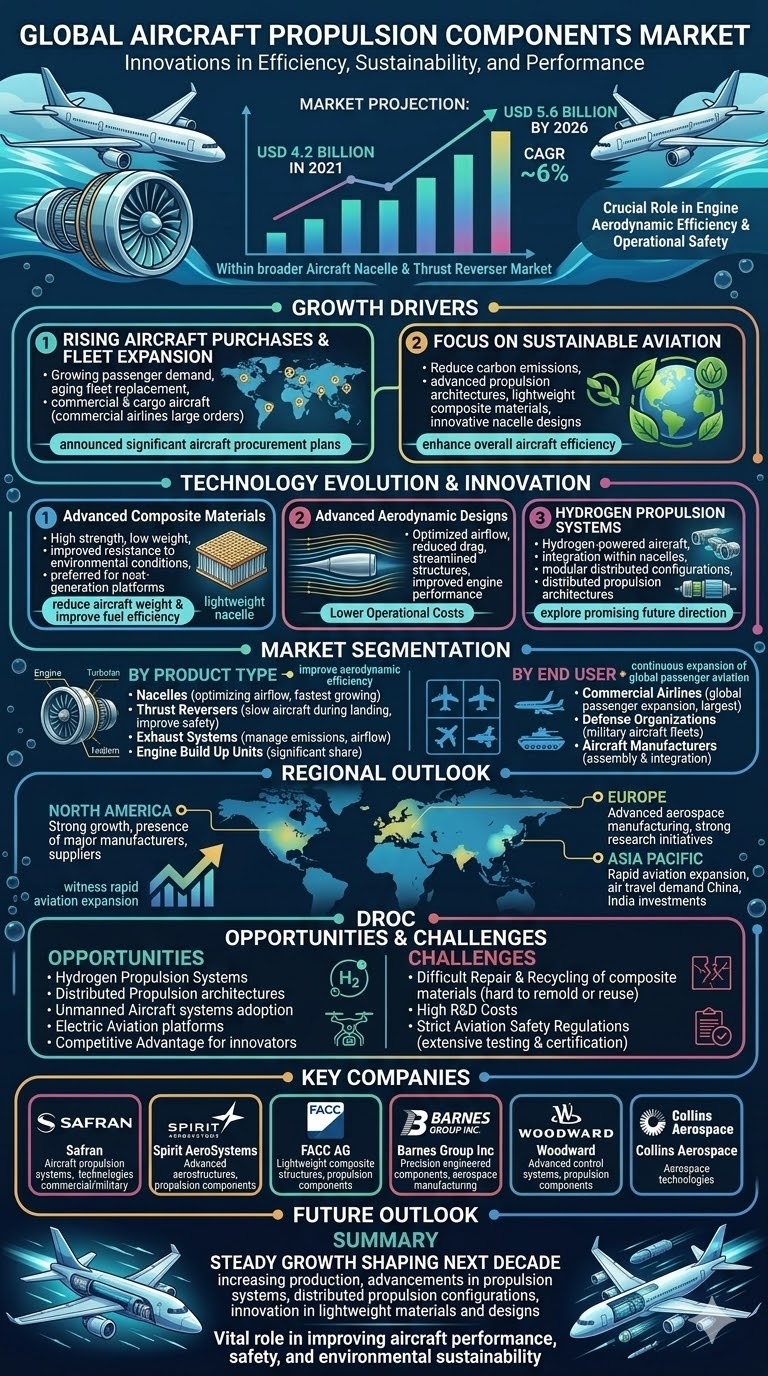
The Global Aircraft Propulsion Components Market is gaining significant attention as the aviation industry focuses on improving fuel efficiency, reducing emissions, and enhancing aircraft performance. Within the broader Aircraft Nacelle and Thrust Reverser Market, the industry was valued at approximately USD 4.2 billion in 2021 and is projected to reach around USD 5.6 billion by 2026, growing at a compound annual growth rate of about 6% during the forecast period.
Aircraft propulsion components play a crucial role in supporting engine performance, aerodynamic efficiency, and operational safety. Components such as nacelles, thrust reversers, and exhaust systems are designed to optimize airflow, reduce drag, and improve thrust management during flight operations.
To Know About the Assumptions Considered for the Study Download the Pdf Brochure
The Aircraft Propulsion Components Market is also influenced by increasing investments in sustainable aviation technologies. As governments and aviation organizations aim to reduce carbon emissions, manufacturers are developing advanced propulsion architectures, lightweight composite materials, and innovative nacelle designs that enhance overall aircraft efficiency.
Aircraft Propulsion Components Market Overview
The Aircraft Propulsion Components Market reflects the aviation industry’s continuous effort to improve aircraft performance and meet environmental standards. Aircraft propulsion systems consist of multiple integrated components designed to support engine operation and ensure optimal thrust generation.
Nacelles are streamlined structures that house aircraft engines and contribute to aerodynamic efficiency by reducing drag. Thrust reversers, on the other hand, help slow down aircraft during landing by redirecting engine thrust forward, reducing reliance on braking systems.
With modern aircraft becoming more fuel efficient and environmentally friendly, propulsion components are being redesigned to support advanced engine architectures. The increasing use of composite materials and advanced manufacturing technologies is also improving component durability and reducing overall aircraft weight.
Key Drivers of the Aircraft Propulsion Components Market
Rising Aircraft Purchases and Fleet Expansion
The expansion of global aircraft fleets is one of the major drivers of the Aircraft Propulsion Components Market. Airlines are increasingly purchasing new aircraft to meet growing passenger demand and replace aging fleets.
Large aircraft orders placed by airlines worldwide have increased the demand for propulsion system components. For example, several major airlines have announced significant aircraft procurement plans to expand their operations and improve service capacity.
The increasing demand for commercial, cargo, and business aircraft is expected to drive long term growth in the Aircraft Propulsion Components Market.
Focus on Sustainable Aviation
The aviation industry is under increasing pressure to reduce carbon emissions and improve environmental sustainability. Aircraft manufacturers are investing heavily in research and development to design propulsion systems that are more efficient and environmentally friendly.
Advanced nacelle designs, lightweight composite materials, and improved thrust reverser mechanisms help reduce fuel consumption and emissions while maintaining high performance standards.
Technological Advancements in the Aircraft Propulsion Components Market
Advanced Composite Materials
Modern aircraft propulsion components are increasingly manufactured using advanced composite materials. These materials offer high strength, low weight, and improved resistance to environmental conditions.
Composite nacelles help reduce aircraft weight and improve fuel efficiency, making them a preferred choice for next generation aircraft platforms.
Integration of Advanced Aerodynamic Designs
Aerodynamic optimization is another important factor driving innovation in the Aircraft Propulsion Components Market. Streamlined nacelle structures and advanced airflow management technologies reduce drag and improve engine performance.
These improvements enhance overall aircraft efficiency and contribute to lower operational costs for airlines.
Hydrogen Propulsion Systems
Hydrogen powered aircraft represent a promising future direction for the aviation industry. Hydrogen electric propulsion systems integrated into nacelle structures could significantly reduce carbon emissions.
Several aerospace companies are exploring hydrogen propulsion architectures where modular powertrain systems are integrated within nacelles to create distributed propulsion configurations.
Market Segmentation in the Aircraft Propulsion Components Market
By Product Type
The Aircraft Propulsion Components Market is segmented into nacelles, thrust reversers, exhaust systems, and engine build up units.
Aircraft nacelles represent the fastest growing segment due to their importance in improving aerodynamic efficiency and supporting modern engine architectures.
Thrust reversers play a vital role in aircraft landing operations by helping reduce landing distance and improving safety.
Exhaust systems represent a significant share of the market as they are essential components for managing engine airflow and emissions.
By End User
Commercial airlines represent the largest end user segment due to the continuous expansion of global passenger aviation.
Defense organizations also rely heavily on propulsion components for military aircraft fleets and specialized aviation platforms.
Aircraft manufacturers use propulsion components during aircraft assembly and integration processes.
Regional Outlook of the Aircraft Propulsion Components Market
North America is expected to experience strong growth in the Aircraft Propulsion Components Market due to the presence of major aircraft manufacturers and propulsion system suppliers.
The United States and Canada continue to invest heavily in aviation technologies to maintain competitiveness with European and Asian aerospace manufacturers.
Europe represents another important market supported by advanced aerospace manufacturing capabilities and strong aviation research initiatives.
Asia Pacific is witnessing rapid aviation expansion driven by increasing air travel demand and the development of new aircraft manufacturing programs.
Countries such as China and India are investing significantly in aviation infrastructure and aircraft production.
Opportunities in the Aircraft Propulsion Components Market
The development of hydrogen propulsion systems presents a major opportunity in the Aircraft Propulsion Components Market. Hydrogen powered nacelle systems could enable distributed propulsion architectures and significantly reduce aircraft emissions.
The increasing adoption of unmanned aircraft systems and electric aviation platforms also creates new demand for specialized propulsion components.
Manufacturers that invest in advanced materials, aerodynamic innovations, and sustainable propulsion technologies will gain a competitive advantage in this evolving market.
Challenges in the Aircraft Propulsion Components Market
Despite strong growth prospects, the Aircraft Propulsion Components Market faces several challenges. The use of composite materials, while beneficial for weight reduction and performance, presents difficulties in repair and recycling.
Composite nacelles and thrust reversers are difficult to remold or reuse, which increases maintenance costs and complicates repair processes.
High research and development costs associated with advanced propulsion technologies also present financial challenges for manufacturers.
Strict aviation safety regulations require extensive testing and certification, which increases development timelines and operational costs.
Key Companies in the Aircraft Propulsion Components Market
Several major aerospace companies play a significant role in the Aircraft Propulsion Components Market.
Safran is a leading provider of aircraft propulsion systems and nacelle technologies used in commercial and military aircraft.
Spirit AeroSystems specializes in advanced aerostructures and propulsion components designed for modern aircraft platforms.
FACC AG focuses on lightweight composite structures and advanced propulsion system components.
Barnes Group Inc provides precision engineered components used in aircraft propulsion systems and aerospace manufacturing.
Woodward develops advanced control systems and propulsion components designed to enhance aircraft engine performance.
Other important companies in the Aircraft Propulsion Components Market include Aernnova Aerospace, Magellan Aerospace, Collins Aerospace, The NORDAM Group, and GKN Aerospace, all of which contribute to technological innovation and manufacturing capabilities in the industry.
Future Outlook of the Aircraft Propulsion Components Market
The Aircraft Propulsion Components Market is expected to experience steady growth as aircraft technologies continue to evolve. Increasing aircraft production, advancements in propulsion systems, and sustainability initiatives will shape the market over the next decade.
Emerging technologies such as hydrogen propulsion, electric aviation, and distributed propulsion architectures will further influence the design and development of aircraft propulsion components.
Manufacturers that focus on innovation, lightweight materials, and sustainable technologies will be well positioned to capture future market opportunities.
The Aircraft Propulsion Components Market plays a vital role in improving aircraft performance, safety, and environmental sustainability. With market value projected to reach USD 5.6 billion by 2026, the industry reflects growing demand for advanced propulsion technologies.
Fleet expansion, technological innovation, and the transition toward sustainable aviation are key factors driving market growth. As the aviation industry continues to evolve, propulsion component manufacturers will play an essential role in shaping the future of aircraft design and performance.
80% of the Forbes Global 2000 B2B companies rely on MarketsandMarkets to identify growth opportunities in emerging technologies and use cases that will have a positive revenue impact.
- Food Packaging Market Size Set for Strong Growth Through 2030 Amid Rising Demand for Convenience Foods
- Crop Protection Chemical Market Size, Share & Growth Forecast (2025–2030)
- Mulch Films Market: Driving Sustainable Agriculture Through Innovation
- Agricultural Adjuvants Market Analysis, Trends, and Growth Outlook (2026–2031)
- Japan Enterprise Asset Management Market Growth: AI and Smart Infrastructure Drive Demand