

Aviation Fuel Technology Innovation: Key Trends, Growth Drivers, and Future Opportunities
Introduction to Aviation Fuel Technology
Aviation fuel serves as the backbone of the global aerospace industry, enabling commercial airlines, military aircraft, cargo operators, and business aviation fleets to operate efficiently across international air transportation networks. As air travel continues to expand and sustainability becomes a strategic priority, Aviation Fuel Technology is undergoing a significant transformation.
Modern aviation fuel innovation focuses on improving fuel efficiency, reducing greenhouse gas emissions, enhancing engine performance, and supporting global decarbonization goals. The development of Sustainable Aviation Fuel (SAF), synthetic fuels, advanced biofuels, hydrogen-based solutions, and next-generation refining technologies is reshaping the future of aviation energy.
As governments, airlines, aircraft manufacturers, and fuel suppliers pursue carbon reduction targets, aviation fuel technologies are expected to play a critical role in creating a more sustainable and resilient aerospace ecosystem.
History of Aviation Fuel Technology
The evolution of aviation fuel technology closely mirrors the growth of the aviation industry itself. Early aircraft relied on simple gasoline-based fuels designed for piston-engine aircraft. With the emergence of jet engines in the mid-20th century, specialized jet fuels such as Jet A and Jet A-1 became industry standards due to their higher energy density and operational reliability.
Over the decades, advancements in refining technologies, fuel additives, engine compatibility, and environmental regulations have improved fuel performance and safety. In recent years, growing concerns regarding climate change have accelerated research and investment into sustainable aviation fuels and low-carbon alternatives capable of supporting future air transportation demands.
Today, aviation fuel innovation is focused on balancing operational efficiency, energy security, and environmental sustainability.
Benefits of Aviation Fuel Technology
Modern aviation fuel technologies provide numerous benefits to airlines, operators, and the broader aerospace industry.
1. Enhanced Aircraft Performance
Advanced fuel formulations improve combustion efficiency, engine reliability, and overall aircraft performance.
2. Reduced Environmental Impact
Sustainable aviation fuels can significantly reduce lifecycle carbon emissions compared to conventional jet fuels.
3. Improved Energy Security
Diversified fuel sources reduce dependence on traditional petroleum-based supply chains.
4. Greater Operational Efficiency
Advanced fuels help optimize fuel consumption, reducing operational costs for airlines.
5. Compatibility with Existing Infrastructure
Many sustainable aviation fuels are designed as "drop-in" solutions that work with current aircraft engines and airport infrastructure.
Current Market Size and Growth Trends of the Aviation Fuel Industry
The aviation fuel market is experiencing strong growth driven by rising air passenger traffic, expanding cargo operations, fleet modernization initiatives, and increasing adoption of sustainable aviation fuels.
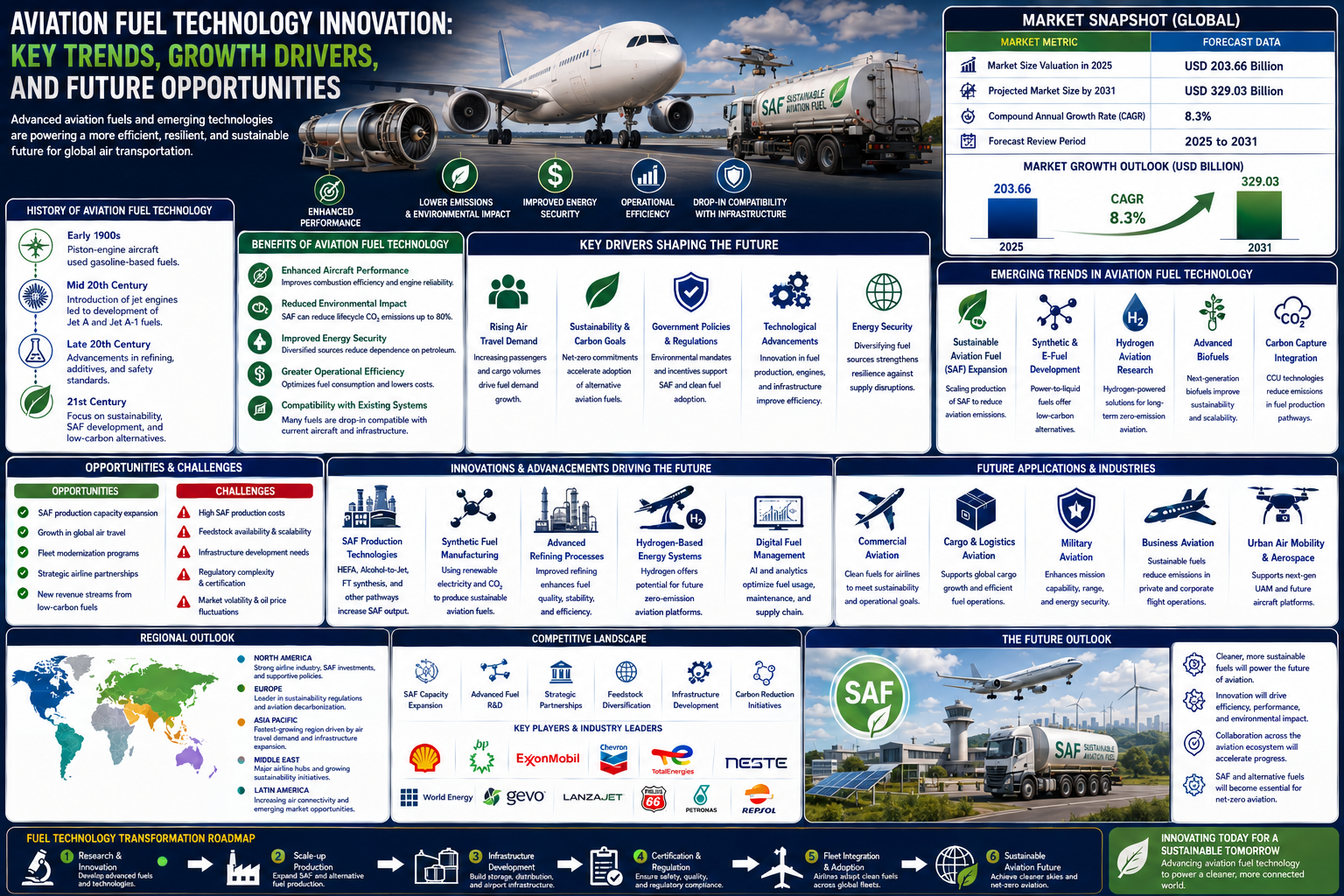
According to MarketsandMarkets, the Global Aviation Fuel Market Size was valued at USD 203.66 billion in 2025 and is projected to reach USD 329.03 billion by 2031, growing at a CAGR of 8.3% from 2025 to 2031.
Several factors are contributing to this market growth:
-
Increasing global air passenger traffic and commercial aviation activity
-
Rising investments in Sustainable Aviation Fuel (SAF) production
-
Expansion of international cargo and logistics operations
-
Growing government support for aviation decarbonization initiatives
-
Fleet modernization and fuel efficiency programs
-
Development of advanced biofuel and synthetic fuel technologies
-
Increasing airline commitments toward net-zero emissions targets
Key Drivers and Factors Influencing the Future of Aviation Fuel Technology
Several important factors are shaping the future of aviation fuel innovation.
1. Sustainability and Carbon Reduction Goals
Airlines and aviation organizations are pursuing aggressive emissions reduction targets, driving investment in alternative fuel technologies.
2. Growing Air Travel Demand
Increasing passenger traffic and global connectivity continue to support long-term fuel demand growth.
3. Government Policies and Regulations
Environmental regulations and carbon reduction mandates are accelerating SAF adoption worldwide.
4. Energy Security Concerns
Diversifying aviation fuel sources enhances resilience against supply chain disruptions and geopolitical risks.
5. Technological Advancements
Continuous innovation in fuel production, refining processes, and alternative energy systems is improving fuel efficiency and sustainability.
Emerging Trends in Aviation Fuel Technology
The future of aviation fuel is being shaped by several groundbreaking innovations.
1. Sustainable Aviation Fuel (SAF) Expansion
SAF is rapidly becoming a cornerstone of aviation decarbonization strategies due to its ability to reduce lifecycle emissions.
2. Synthetic and E-Fuel Development
Power-to-liquid and synthetic fuel technologies are emerging as promising alternatives for low-carbon aviation.
3. Hydrogen Aviation Research
Aircraft manufacturers and energy companies are exploring hydrogen-powered aviation solutions for long-term sustainability.
4. Advanced Biofuel Technologies
Second-generation and third-generation biofuels are improving fuel sustainability without competing with food production systems.
5. Carbon Capture Integration
Carbon capture and utilization technologies are increasingly being incorporated into sustainable fuel production pathways.
Opportunities and Challenges in the Aviation Fuel Market
The aviation fuel market presents significant growth opportunities while facing several challenges.
Opportunities
1. Sustainable Aviation Fuel Production Expansion
Growing airline demand is creating substantial investment opportunities in SAF production facilities.
2. Emerging Fuel Technologies
Hydrogen, synthetic fuels, and advanced biofuels offer long-term growth potential.
3. Public-Private Partnerships
Collaborations between governments, airlines, and energy companies are accelerating innovation.
4. Global Decarbonization Initiatives
Net-zero commitments are supporting widespread adoption of sustainable aviation solutions.
Challenges
1. High SAF Production Costs
Sustainable aviation fuels currently remain more expensive than conventional jet fuels.
2. Feedstock Availability
Ensuring reliable and scalable feedstock supplies is critical for SAF production growth.
3. Infrastructure Development Requirements
Expanding sustainable fuel distribution networks requires significant investments.
4. Regulatory Complexity
Global harmonization of sustainability standards and certification requirements remains challenging.
Innovations and Advancements in Aviation Fuel Technology
Several technological breakthroughs are accelerating aviation fuel innovation.
1. Sustainable Aviation Fuel Production Technologies
Advanced conversion pathways such as HEFA, Alcohol-to-Jet, and Fischer-Tropsch synthesis are expanding SAF production capabilities.
2. Synthetic Fuel Manufacturing
Renewable electricity and captured carbon dioxide are being used to produce sustainable synthetic aviation fuels.
3. Advanced Refining Processes
Next-generation refining technologies improve fuel quality, efficiency, and environmental performance.
4. Hydrogen-Based Energy Systems
Hydrogen technologies offer potential pathways toward zero-emission aviation operations.
5. Digital Fuel Management Solutions
Artificial intelligence and analytics are helping airlines optimize fuel consumption and operational efficiency.
Future Applications and Industries That Will Benefit from Aviation Fuel Technology
Aviation fuel innovations are expected to benefit numerous sectors.
1. Commercial Aviation
Airlines will increasingly rely on sustainable fuels to meet environmental commitments and regulatory requirements.
2. Cargo and Logistics Aviation
Growing e-commerce and international trade will support continued fuel demand growth.
3. Military Aviation
Defense organizations are exploring sustainable fuel solutions to enhance operational resilience and energy security.
4. Business Aviation
Corporate aviation operators are increasingly adopting SAF to reduce carbon footprints.
5. Urban Air Mobility
Emerging advanced air mobility platforms may leverage sustainable fuel technologies alongside electric propulsion systems.
6. Aerospace Manufacturing
Aircraft manufacturers are designing future platforms optimized for alternative fuel compatibility.
Regional Analysis of the Global Aviation Fuel Market
North America
North America remains a leading market due to strong airline activity, SAF investments, and supportive government policies.
Europe
Europe is at the forefront of aviation decarbonization initiatives, with aggressive sustainability regulations driving SAF adoption.
Asia Pacific
Rapid air passenger growth, fleet expansion, and infrastructure investments make Asia Pacific one of the fastest-growing aviation fuel markets.
Middle East
The Middle East benefits from major airline hubs, expanding aviation infrastructure, and growing sustainability initiatives.
Latin America
Increasing air connectivity and economic development are supporting aviation fuel demand growth across the region.
Competitive Landscape of the Aviation Fuel Market
The aviation fuel market is highly competitive, with energy companies, fuel suppliers, refiners, and technology developers investing heavily in sustainable fuel innovation.
Key competitive strategies include:
-
Sustainable aviation fuel capacity expansion
-
Strategic airline partnerships
-
Advanced refining technology investments
-
Alternative fuel development programs
-
Carbon reduction initiatives
-
Feedstock diversification strategies
-
Global supply chain expansion
Key Manufacturers and Industry Participants
Major organizations operating across the aviation fuel value chain include:
-
Shell
-
BP
-
ExxonMobil
-
Chevron
-
TotalEnergies
-
Neste
-
World Energy
-
Gevo
-
LanzaJet
-
Phillips 66
These companies are investing in SAF production, refining innovations, alternative fuel technologies, and global aviation sustainability initiatives.
Conclusion: The Promising Future of Aviation Fuel Technology
Aviation fuel technology is undergoing a transformative evolution as the aerospace industry seeks to balance growing transportation demand with ambitious sustainability goals. Innovations in sustainable aviation fuels, synthetic fuels, hydrogen energy systems, and advanced refining technologies are creating new pathways toward a lower-carbon aviation future.
As the Global Aviation Fuel Market expands from USD 203.66 billion in 2025 to USD 329.03 billion by 2031, industry stakeholders are expected to accelerate investments in fuel innovation, infrastructure development, and sustainability initiatives.
While challenges related to production costs, feedstock availability, and regulatory frameworks remain, continued technological advancement and collaboration across the aviation ecosystem will drive long-term growth and market transformation.
Organizations that invest in next-generation aviation fuel technologies today will play a critical role in shaping the future of sustainable global air transportation.
Download Sample Research Report for Aviation Fuel Market Future @ https://www.marketsandmarkets.com/pdfdownloadNew.asp?id=231148230
80% of the Forbes Global 2000 B2B companies rely on MarketsandMarkets to identify growth opportunities in emerging technologies and use cases that will have a positive revenue impact.
- Food Packaging Market Size Set for Strong Growth Through 2030 Amid Rising Demand for Convenience Foods
- Mulch Films Market: Driving Sustainable Agriculture Through Innovation
- Agricultural Adjuvants Market Analysis, Trends, and Growth Outlook (2026–2031)
- Crop Protection Chemical Market Size, Share & Growth Forecast (2025–2030)
- Japan Enterprise Asset Management Market Growth: AI and Smart Infrastructure Drive Demand


