

Counter UAS Market Strategies for Government, Airport, and Critical Infrastructure Operators
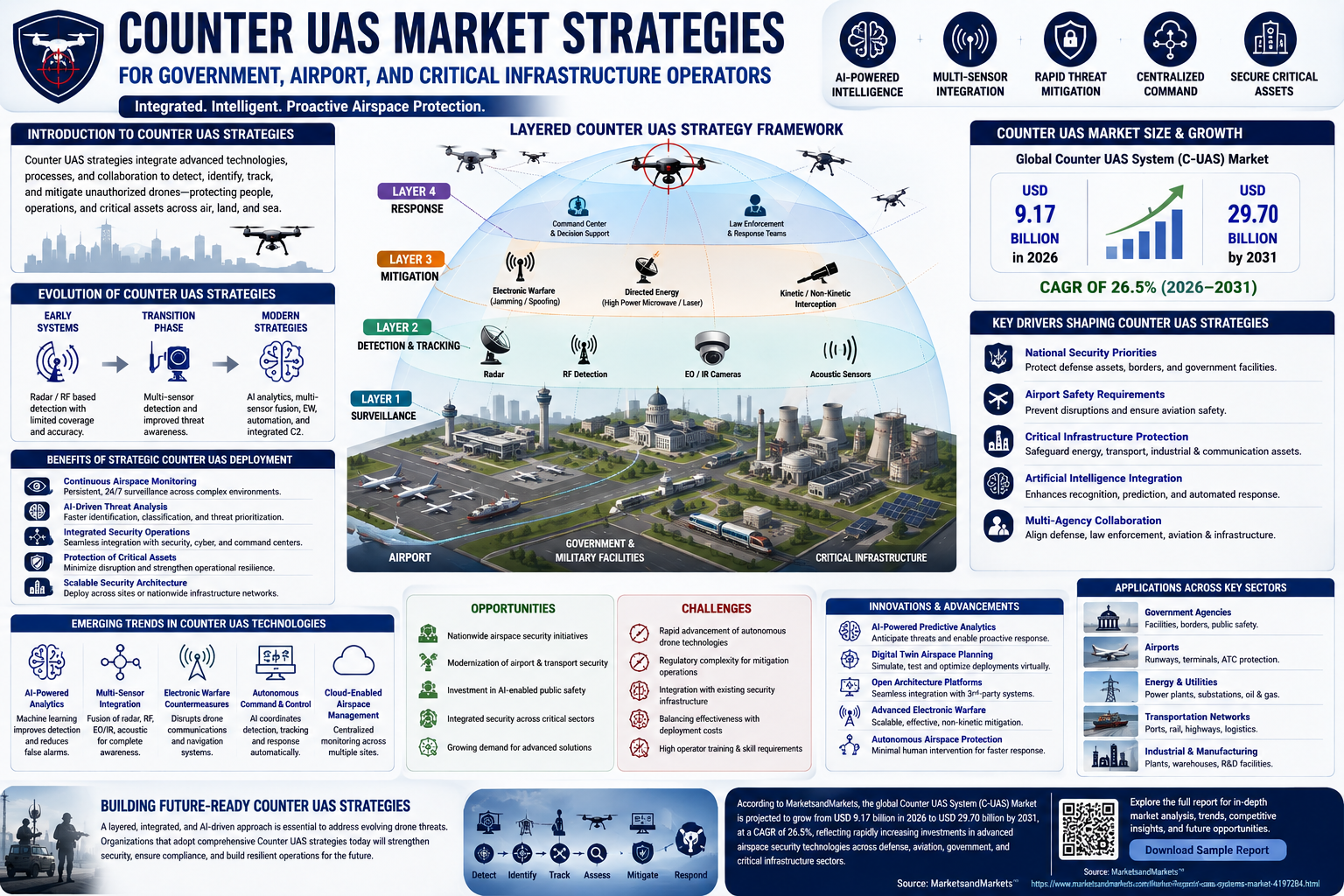
Introduction to Counter UAS Strategies
The rapid growth of commercial and military unmanned aerial systems has created unprecedented challenges for organizations responsible for protecting national security, public safety, transportation infrastructure, and strategic industrial assets. Unauthorized drones are increasingly capable of conducting surveillance, disrupting airport operations, smuggling contraband, gathering intelligence, and even delivering explosive payloads. These evolving threats have transformed Counter Unmanned Aircraft Systems (Counter UAS) from specialized military capabilities into essential components of modern security strategies.
Government agencies, airports, energy providers, transportation authorities, and operators of critical infrastructure are now implementing integrated Counter UAS ecosystems that combine artificial intelligence, radar, radio frequency monitoring, electro optical sensors, infrared imaging, electronic warfare, and centralized command platforms. Rather than relying on isolated technologies, organizations are adopting layered defense strategies that deliver continuous airspace awareness, rapid threat identification, and coordinated response capabilities.
Evolution of Counter UAS Security Strategies
Counter UAS security strategies have evolved significantly over the past decade. Initial deployments focused primarily on detecting unauthorized drones using radar or radio frequency sensors. While effective against conventional drones, these systems offered limited capability against autonomous platforms, low flying aircraft, or coordinated drone swarms.
Modern security strategies integrate multiple sensing technologies with artificial intelligence driven analytics, automated command and control systems, cyber protection, and electronic countermeasures. This layered approach provides greater detection accuracy, improved operational awareness, and faster response times while supporting large scale protection across complex environments.
Benefits of Strategic Counter UAS Deployment
Modern Counter UAS strategies deliver several important operational advantages.
- Continuous Airspace Monitoring: Multi sensor technologies provide persistent surveillance across protected airspace.
- Artificial Intelligence Driven Threat Analysis: AI enables faster identification, classification, and prioritization of drone threats.
- Integrated Security Operations: Counter UAS platforms connect with physical security, cybersecurity, and command centers for coordinated incident response.
- Protection of Critical Assets: Organizations reduce operational disruption and improve resilience against unauthorized drone activity.
- Scalable Security Architecture: Layered Counter UAS strategies support deployment across individual facilities or nationwide infrastructure networks.
Current Market Size and Growth Trends of the Counter UAS Industry
The Counter UAS industry is experiencing exceptional expansion as governments, airport authorities, and infrastructure operators increase investments in intelligent airspace security. Growing drone activity, evolving autonomous capabilities, and expanding regulatory requirements continue accelerating demand for advanced Counter UAS solutions worldwide.
According to MarketsandMarkets, the global Counter UAS System (C UAS) Market was valued at USD 9.17 billion in 2026 and is projected to reach USD 29.70 billion by 2031, growing at a remarkable CAGR of 26.5% during the forecast period.
Several major trends are driving this rapid market growth:
- Increasing government investments in national airspace security
- Growing deployment of AI powered drone detection and tracking technologies
- Rising protection requirements for airports, energy facilities, and transportation infrastructure
- Expansion of electronic warfare and autonomous counter drone capabilities
- Continuous adoption of integrated command and control platforms for secure airspace management
Key Drivers Shaping Counter UAS Strategies
Several strategic developments continue influencing Counter UAS adoption.
National Security Priorities
Governments are strengthening domestic airspace security to protect military facilities, government buildings, border operations, and strategic infrastructure.
Airport Safety Requirements
Airports require advanced Counter UAS capabilities to prevent operational disruptions, flight delays, and safety incidents caused by unauthorized drones.
Critical Infrastructure Protection
Energy facilities, ports, communication networks, transportation systems, and industrial sites increasingly require dedicated airspace protection strategies.
Artificial Intelligence Integration
Machine learning improves drone recognition, behavioral analysis, predictive threat assessment, and automated response coordination.
Multi Agency Collaboration
Counter UAS strategies increasingly integrate defense organizations, law enforcement agencies, aviation authorities, emergency services, and infrastructure operators into unified operational frameworks.
Emerging Trends in Counter UAS Technologies
Several innovations are redefining secure airspace management.
Artificial Intelligence Powered Analytics
Advanced machine learning continuously improves drone detection accuracy while reducing false alarms.
Multi Sensor Integration
Radar, radio frequency monitoring, electro optical cameras, infrared imaging, and acoustic sensors work together to create comprehensive situational awareness.
Electronic Warfare Countermeasures
Modern electronic warfare technologies disrupt drone communications and navigation systems without requiring kinetic engagement.
Autonomous Command and Control
Artificial intelligence coordinates threat detection, tracking, prioritization, and response across multiple defensive systems.
Cloud Enabled Airspace Management
Centralized cloud platforms enable organizations to monitor multiple facilities through unified security operations centers.
Opportunities and Challenges in the Counter UAS Market
The Counter UAS market offers substantial opportunities for governments and technology providers.
Opportunities
- Expansion of nationwide airspace security initiatives
- Modernization of airport and transportation security infrastructure
- Increased investment in AI enabled public safety technologies
- Growth of integrated security operations across critical infrastructure sectors
Challenges
- Rapid advancement of autonomous drone technologies
- Regulatory complexity surrounding drone mitigation operations
- Integration of Counter UAS systems with existing security infrastructure
- Balancing operational effectiveness with deployment costs
Innovations and Advancements in Counter UAS Technologies
Innovation continues strengthening secure airspace capabilities.
AI Powered Predictive Analytics
Artificial intelligence anticipates drone behavior and identifies threats before operational disruption occurs.
Digital Twin Airspace Planning
Virtual simulations optimize sensor placement and response strategies before deployment.
Open Architecture Security Platforms
Flexible software enables seamless integration with surveillance systems, cybersecurity platforms, and emergency response networks.
Advanced Electronic Warfare
Modern electronic attack capabilities provide scalable and highly effective drone mitigation.
Autonomous Airspace Protection
Future Counter UAS ecosystems will increasingly automate threat detection, assessment, and response with minimal operator intervention.
Future Applications Across Government and Critical Infrastructure
Counter UAS technologies continue expanding across multiple operational environments.
Government Agencies
Protection of government facilities, border security operations, defense installations, and public safety organizations.
Airports
Securing runways, air traffic operations, terminals, and aviation infrastructure against unauthorized drone activity.
Energy and Utilities
Protecting power generation facilities, substations, oil and gas infrastructure, and renewable energy assets.
Transportation Networks
Securing ports, rail systems, logistics hubs, highways, and communication infrastructure.
Industrial and Manufacturing Facilities
Protecting production sites, warehouses, research facilities, and high value industrial operations.
Building Future Ready Counter UAS Strategies
The future of Counter UAS security will depend on integrated strategies that combine artificial intelligence, multi sensor awareness, electronic warfare, autonomous command systems, and secure airspace management platforms. Governments, airport operators, and critical infrastructure organizations must move beyond standalone drone detection technologies toward comprehensive security ecosystems capable of addressing increasingly sophisticated aerial threats.
Organizations implementing layered Counter UAS strategies today will improve operational resilience, enhance regulatory compliance, strengthen public safety, and better protect national infrastructure against emerging drone risks.
According to MarketsandMarkets, the global Counter UAS System (C UAS) Market is projected to grow from USD 9.17 billion in 2026 to USD 29.70 billion by 2031, at a CAGR of 26.5%, reflecting rapidly increasing investments in advanced airspace security technologies across defense, aviation, government, and critical infrastructure sectors.
To explore comprehensive market forecasts, technology trends, competitive intelligence, and regional opportunities, visit:
https://www.marketsandmarkets.com/Market-Reports/counter-cuas-systems-market-4197284.html
Download the Sample Research Report to gain detailed insights into market developments, technology innovations, competitive strategies, and future opportunities shaping the global Counter UAS System Market.
80% of the Forbes Global 2000 B2B companies rely on MarketsandMarkets to identify growth opportunities in emerging technologies and use cases that will have a positive revenue impact.
- Food Packaging Market Size Set for Strong Growth Through 2030 Amid Rising Demand for Convenience Foods
- Crop Protection Chemical Market Size, Share & Growth Forecast (2025–2030)
- Mulch Films Market: Driving Sustainable Agriculture Through Innovation
- Agricultural Adjuvants Market Analysis, Trends, and Growth Outlook (2026–2031)
- Japan Enterprise Asset Management Market Growth: AI and Smart Infrastructure Drive Demand


