

Home/ Aerospace and Defense / beyond-biofuels-how-e-saf-synthetic-transforming-saf-market-growth

Beyond Biofuels: How e-SAF and Synthetic Fuels Are Transforming the Sustainable Aviation Fuel Market

MarketsandMarkets™ Research Private Ltd,, 23 Jun 2026
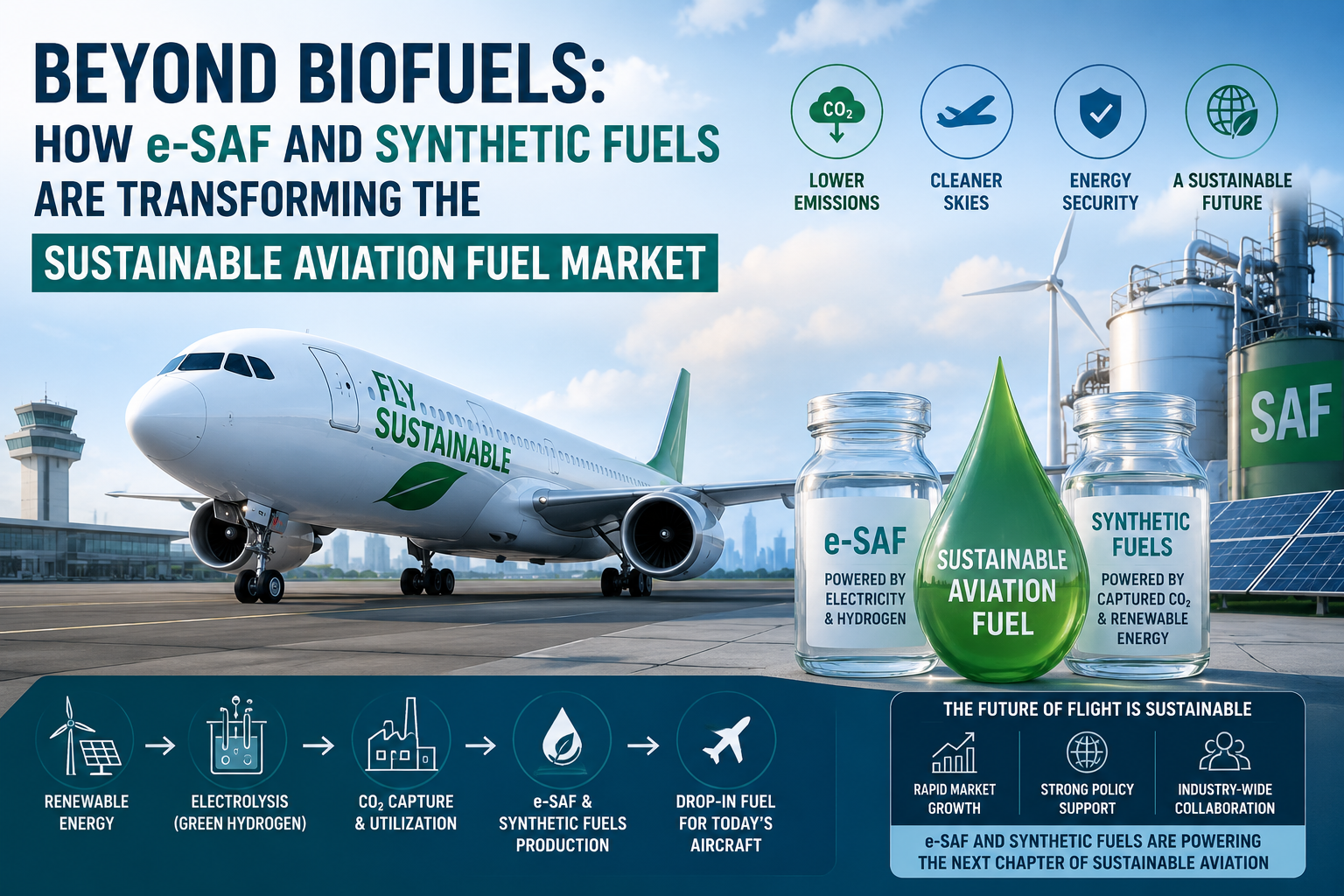
The global aviation industry is entering a new phase in its decarbonization journey as attention shifts beyond traditional bio-based Sustainable Aviation Fuels (SAF) toward next-generation solutions capable of supporting long-term net-zero emissions goals. While biofuels derived from waste oils, agricultural residues, and other renewable feedstocks have played a crucial role in launching the SAF market, concerns surrounding feedstock availability, scalability, and future demand are driving interest in alternative fuel pathways. Among the most promising innovations are electro-Sustainable Aviation Fuel (e-SAF) and synthetic aviation fuels, which are emerging as transformative technologies with the potential to reshape the future of low-carbon air transportation.

The Limitations of Conventional Bio-Based SAF

Bio-based Sustainable Aviation Fuel has become the foundation of the current SAF industry, with production primarily relying on feedstocks such as used cooking oil, animal fats, agricultural waste, and forestry residues. These fuels have demonstrated the ability to significantly reduce lifecycle greenhouse gas emissions while remaining compatible with existing aircraft engines and fueling infrastructure.

However, as airlines, governments, and industry organizations pursue increasingly ambitious decarbonization targets, questions have emerged regarding the long-term scalability of biofuel production. Feedstock availability remains limited, and competition for sustainable biomass resources is expected to intensify as demand grows across multiple sectors. These challenges are encouraging the aviation industry to explore new fuel technologies capable of supporting large-scale deployment over the coming decades.

Download Brochure Analyst-Verified Insights @ https://www.marketsandmarkets.com/pdfdownloadNew.asp?id=70301163

e-SAF Represents the Next Generation of Aviation Fuel

Electro-Sustainable Aviation Fuel, commonly known as e-SAF, is widely viewed as one of the most promising solutions for the future of aviation decarbonization. Unlike traditional biofuels, e-SAF is produced using renewable electricity, green hydrogen, and captured carbon dioxide rather than biological feedstocks.

The production process begins with the generation of green hydrogen through water electrolysis powered by renewable energy sources such as wind, solar, or hydropower. This hydrogen is then combined with carbon dioxide captured from industrial emissions or directly from the atmosphere to create synthetic hydrocarbons that can be refined into aviation fuel.

Because e-SAF relies on renewable energy and recycled carbon, it offers the potential for significantly lower lifecycle emissions while reducing dependence on limited biomass resources. This makes it an attractive long-term solution for supporting global aviation sustainability goals.

Synthetic Fuels Expanding Pathways to Decarbonization

Synthetic aviation fuels, often referred to as e-fuels or Power-to-Liquid (PtL) fuels, are attracting growing attention as the aviation sector seeks scalable alternatives to fossil-based jet fuel. These fuels are chemically similar to conventional aviation fuels but are produced through advanced industrial processes that utilize renewable energy and captured carbon.

One of the key advantages of synthetic fuels is their ability to integrate seamlessly into existing aviation infrastructure. Airlines can use these fuels within current aircraft fleets without significant modifications, enabling immediate emissions reductions while preserving operational flexibility.

As production technologies continue to mature, synthetic fuels are expected to become an increasingly important component of the global SAF portfolio.

Green Hydrogen Driving Market Transformation

Green hydrogen has emerged as a foundational element in the development of e-SAF and synthetic aviation fuels. Produced using renewable-powered electrolysis, green hydrogen provides a carbon-free energy source that enables the synthesis of sustainable hydrocarbons.

The rapid expansion of renewable energy infrastructure and growing investments in hydrogen production facilities are creating favorable conditions for large-scale synthetic fuel development. Governments and private-sector organizations worldwide are investing heavily in hydrogen ecosystems, recognizing their importance not only for aviation but also for broader industrial decarbonization efforts.

As hydrogen production costs decline and infrastructure expands, the economic viability of e-SAF is expected to improve significantly.

Carbon Capture Technologies Creating New Fuel Opportunities

Carbon capture is another critical technology enabling the growth of synthetic aviation fuels. Captured carbon dioxide serves as a key raw material for e-SAF production, creating a pathway to recycle carbon rather than extracting new fossil-based resources.

Direct Air Capture (DAC) systems and industrial carbon capture technologies are advancing rapidly, improving both efficiency and scalability. These innovations are helping establish circular carbon systems in which atmospheric or industrial carbon emissions are converted into usable aviation fuel.

By combining carbon capture with renewable hydrogen production, the aviation industry can move closer to creating closed-loop fuel cycles that substantially reduce overall carbon emissions.

Addressing Scalability Challenges in Aviation Decarbonization

One of the primary reasons e-SAF and synthetic fuels are gaining momentum is their potential to overcome the scalability limitations associated with conventional biofuels. While bio-based feedstocks are constrained by land availability, agricultural productivity, and waste resource volumes, synthetic fuel production can theoretically expand alongside renewable energy generation capacity.

This scalability advantage is particularly important as global air travel demand continues to grow. Meeting future aviation fuel requirements while achieving net-zero emissions will likely require fuel production pathways capable of operating at massive industrial scales.

Synthetic fuels offer a promising solution by leveraging abundant renewable energy resources and advanced manufacturing technologies.

Government Policies Accelerating Technology Development

Governments around the world are increasingly supporting the development of e-SAF and synthetic fuel technologies through funding programs, research initiatives, tax incentives, and regulatory frameworks. Many policymakers view synthetic fuels as essential components of long-term aviation decarbonization strategies.

Regulatory measures that promote SAF adoption are increasingly being designed to encourage investment in advanced fuel pathways, including Power-to-Liquid technologies. These policies are helping reduce financial risks for developers while accelerating commercialization efforts.

As climate commitments become more ambitious, government support is expected to play a vital role in scaling synthetic fuel production.

Investment Momentum Is Building Across the Industry

The growing importance of e-SAF and synthetic fuels is attracting substantial investment from airlines, energy companies, technology providers, infrastructure developers, and financial institutions. Strategic partnerships are emerging across the aviation value chain as stakeholders seek to secure future fuel supplies and accelerate technology deployment.

Large-scale demonstration projects and commercial production facilities are already being developed in several regions, signaling increasing confidence in the long-term potential of synthetic aviation fuels. This investment activity is expected to drive continued innovation and support market expansion over the next decade.

The Future of Sustainable Aviation Fuel

The Sustainable Aviation Fuel market is evolving from a biofuel-focused industry into a broader ecosystem that includes multiple production pathways and advanced fuel technologies. While conventional biofuels will continue to play an important role in supporting near-term emissions reductions, e-SAF and synthetic fuels are positioned to drive the next wave of industry growth.

The combination of renewable electricity, green hydrogen, carbon capture, and advanced fuel synthesis technologies offers a pathway toward scalable, low-carbon aviation fuel production capable of supporting future demand. As technological advancements continue and production costs decline, synthetic fuels are expected to become increasingly competitive and commercially significant.

Conclusion

The future of Sustainable Aviation Fuel extends far beyond traditional biofuels. e-SAF and synthetic fuels are emerging as transformative technologies that can address many of the scalability and sustainability challenges facing the aviation industry. Powered by renewable energy, green hydrogen, and carbon capture systems, these advanced fuels offer a promising pathway toward deep emissions reductions and long-term aviation decarbonization. As governments, airlines, and energy companies continue investing in next-generation fuel solutions, e-SAF and synthetic fuels are set to play a pivotal role in shaping the future of the global Sustainable Aviation Fuel market.

DMCA.com Protection Status

