

Counter Drone Market: Growth, Trends, Technology Evolution, and Global Outlook
The Counter Drone market is rapidly expanding due to increasing drone threats across military, government, and commercial sectors. Driven by AI-powered detection systems, advanced mitigation technologies, and defense modernization programs, the market is witnessing strong global growth. North America leads the Counter Drone market, while Asia Pacific is emerging as a high-growth region. Ground-based systems and AI-enabled solutions are shaping the future of airspace security.
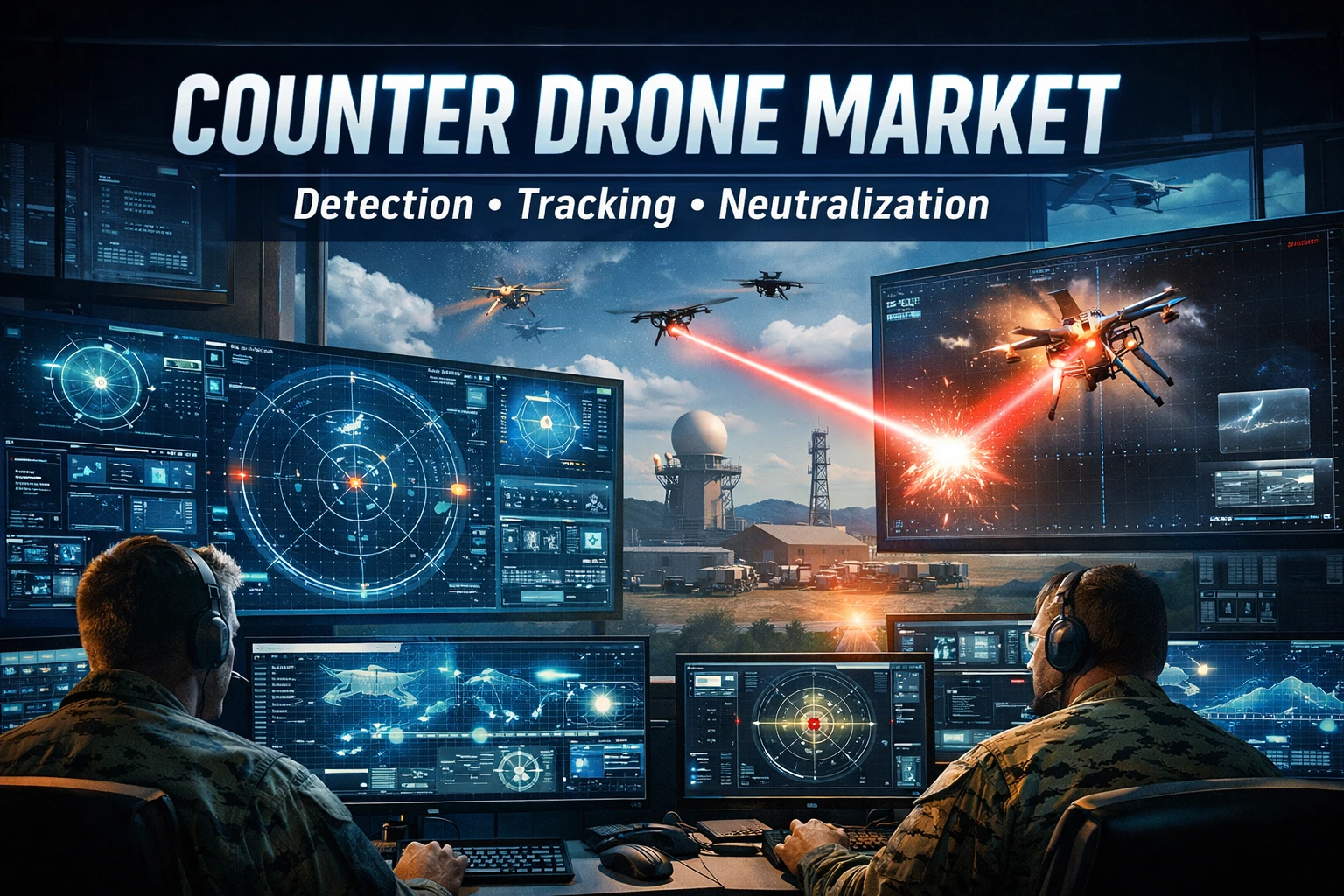
The Counter Drone market, also referred to as the Counter-UAS (Unmanned Aerial System) market, is emerging as one of the fastest-growing segments within the global defense and security industry. The rapid proliferation of commercial, recreational, and military drones has created significant security challenges, driving increased demand for advanced counter drone solutions worldwide. The Counter Drone market is expected to experience strong growth in the coming years, fueled by rising geopolitical tensions, increasing incidents of unauthorized drone activity, and expanding investments in airspace security. Governments, defense agencies, airports, and critical infrastructure operators are actively deploying counter drone technologies to detect, track, and neutralize unauthorized drones, making the Counter Drone market a strategic priority across multiple sectors.
The counter-unmanned aircraft system (C-UAS) market is projected to reach USD 20.31 billion by 2030, growing from USD 6.64 billion in 2025 at a CAGR of 25.1%. The growth of the market is driven by the rising demand for advanced detection, tracking, and interception technologies that enhance defense efficiency, interoperability, and multi-domain protection against evolving unmanned threats.
10 Key Takeaways – Counter Drone Market
• Counter Drone market is experiencing rapid global growth due to rising drone-related security threats.
• Military and defense sector dominates Counter Drone market share.
• AI-powered detection and autonomous mitigation systems are transforming the industry.
• Ground-based Counter Drone systems account for the largest deployment segment.
• Directed energy weapons and RF jamming technologies are gaining traction.
• Airports and critical infrastructure are emerging as key commercial adopters.
• North America leads the Counter Drone market in revenue and innovation.
• Asia Pacific is expected to witness the fastest growth rate.
• Integration with air defense networks enhances operational efficiency.
• Increasing drone swarm threats are pushing next-generation Counter Drone solutions.
Rising Threat Landscape Driving Counter Drone Market Growth
One of the primary factors accelerating the growth of the Counter Drone market is the rapid increase in drone usage globally. Drones are now widely used in commercial applications such as logistics, surveillance, agriculture, and infrastructure inspection. However, the same accessibility and affordability of drones have created security vulnerabilities. Unauthorized drones pose serious threats to military bases, airports, public events, borders, and critical infrastructure such as power plants and oil facilities. These threats include espionage, smuggling, terrorist attacks, and disruption of operations.
The growing frequency of drone-related incidents has forced governments and defense organizations to invest heavily in counter drone systems. The Counter Drone market is benefiting significantly from increased defense spending and modernization programs focused on strengthening airspace security. Military organizations worldwide are integrating counter drone solutions into their layered air defense systems to enhance threat detection, situational awareness, and response capabilities.
Technological Advancements Transforming the Counter Drone Market
Technological innovation is a major driver shaping the evolution of the Counter Drone market. Modern counter drone systems combine multiple detection and mitigation technologies to provide comprehensive protection. These include radar systems, radio frequency (RF) sensors, electro-optical and infrared cameras, acoustic sensors, and artificial intelligence-powered analytics platforms.
Artificial intelligence is playing a transformative role in the Counter Drone market by enabling faster and more accurate threat identification. AI-powered counter drone systems can automatically detect drone signatures, classify threats, and initiate response actions with minimal human intervention. Machine learning algorithms improve system performance over time by learning from operational data, reducing false alarms and improving detection accuracy.
Another important technological advancement in the Counter Drone market is the development of directed energy weapons, including laser systems and microwave-based countermeasures. These technologies provide precise and efficient neutralization of drones without causing collateral damage. Additionally, electronic warfare techniques such as signal jamming and GPS spoofing are widely used in the Counter Drone market to disrupt drone communications and navigation systems.
Key Components of the Counter Drone Market
The Counter Drone market consists of several key components, including detection systems, tracking systems, command and control systems, and mitigation solutions.
Detection systems play a critical role in the Counter Drone market by identifying drones in protected airspace. Radar systems are commonly used for long-range detection, while RF sensors identify drone communication signals. Electro-optical and infrared cameras provide visual confirmation and tracking capabilities.
Tracking systems are essential for monitoring drone movements and predicting their trajectories. These systems enable operators to assess potential threats and determine appropriate response strategies. Command and control systems serve as the central platform for integrating data from multiple sensors and providing operators with real-time situational awareness.
Mitigation systems are the most critical component of the Counter Drone market, as they neutralize unauthorized drones. These systems include RF jammers, kinetic interceptors, laser weapons, and spoofing technologies. Mitigation solutions are increasingly in demand as security agencies seek reliable methods to prevent drone intrusions.
Deployment Modes in the Counter Drone Market
The Counter Drone market includes various deployment modes to address different operational requirements. Ground-based counter drone systems are the most widely deployed due to their ability to provide continuous protection for fixed installations such as military bases, airports, and government facilities. These systems offer long-range detection and high reliability, making them the backbone of the Counter Drone market.
Mobile and handheld counter drone systems are also gaining popularity, particularly among law enforcement agencies and military units. These portable systems provide flexibility and rapid deployment capabilities in dynamic environments. Mobile counter drone solutions are especially useful for securing public events, urban areas, and temporary installations.
Vehicle-mounted counter drone systems represent another important segment of the Counter Drone market. These systems enable protection for moving assets such as military convoys and VIP transportation.
End-User Segmentation in the Counter Drone Market
The military and defense sector represents the largest end-user segment in the Counter Drone market. Military organizations are deploying advanced counter drone systems to protect bases, border areas, and strategic assets from hostile drone activities. The increasing use of drones in modern warfare has made counter drone capabilities essential for national security.
Government and law enforcement agencies are also major contributors to the Counter Drone market. These organizations use counter drone systems to secure public events, government buildings, and urban areas. Counter drone solutions help prevent unauthorized surveillance and ensure public safety.
The commercial sector is emerging as a fast-growing segment in the Counter Drone market. Airports, power plants, oil and gas facilities, and critical infrastructure operators are investing in counter drone technologies to protect their operations. The rising adoption of counter drone solutions in commercial applications is expanding the overall Counter Drone market.
Regional Analysis of the Counter Drone Market
North America holds the largest share of the Counter Drone market, driven by strong defense spending and technological innovation. The United States is a major contributor to the Counter Drone market, with significant investments in advanced defense technologies and homeland security systems.
Europe represents another key region in the Counter Drone market, supported by increased defense cooperation and modernization initiatives. European countries are investing in counter drone solutions to strengthen border security and protect critical infrastructure.
The Asia Pacific region is expected to witness rapid growth in the Counter Drone market due to rising security concerns and increasing defense budgets. Countries such as India, China, Japan, and South Korea are investing in counter drone technologies to enhance national security.
The Middle East is also an important market for counter drone systems, driven by ongoing regional conflicts and the need to protect critical energy infrastructure.
Competitive Landscape in the Counter Drone Market
The Counter Drone market is highly competitive, with several global defense companies and technology providers actively developing advanced counter drone solutions. Major companies are focusing on innovation, partnerships, and product development to strengthen their market position.
Leading players in the Counter Drone market are investing in research and development to improve detection accuracy, response speed, and system integration. Companies are also developing AI-powered counter drone systems to enhance operational efficiency.
Strategic collaborations between defense contractors, technology companies, and government agencies are playing a key role in advancing the Counter Drone market. These partnerships help accelerate innovation and improve system capabilities.
Future Outlook of the Counter Drone Market
The future of the Counter Drone market looks highly promising as drone threats continue to evolve. The increasing adoption of autonomous drones and swarm drone technologies is expected to create new challenges, further driving demand for advanced counter drone solutions.
Artificial intelligence will play a central role in the future of the Counter Drone market by enabling fully autonomous detection and mitigation capabilities. AI-powered counter drone systems will be able to identify and neutralize threats in real time without human intervention.
The integration of counter drone systems with broader air defense networks will enhance overall security and situational awareness. Network-centric counter drone systems will enable seamless communication between sensors, command centers, and mitigation platforms.
The commercial adoption of counter drone technologies is also expected to increase significantly. Airports, smart cities, and industrial facilities will continue investing in counter drone systems to protect critical infrastructure.
The Counter Drone market is experiencing rapid growth as governments, defense organizations, and commercial sectors recognize the importance of protecting airspace from unauthorized drones. The increasing frequency of drone-related security incidents, combined with advancements in AI and detection technologies, is driving strong demand for counter drone solutions. The Counter Drone market is expected to continue expanding as new technologies emerge and security requirements evolve. With ongoing investments in innovation, artificial intelligence, and integrated defense systems, the Counter Drone market will remain a critical component of global security infrastructure in the coming decade.
FAQ Section – Counter Drone Market
1. What is driving the growth of the Counter Drone market?
The Counter Drone market is primarily driven by rising unauthorized drone activities, growing geopolitical tensions, and increasing demand for airspace security across military, government, and commercial sectors.
2. Which technologies are used in the Counter Drone market?
The Counter Drone market uses radar systems, RF detection, AI-powered analytics, electro-optical sensors, jamming systems, spoofing technologies, and directed energy weapons.
3. Which region dominates the Counter Drone market?
North America currently holds the largest share of the Counter Drone market due to high defense spending and advanced technological adoption.
4. What role does AI play in the Counter Drone market?
AI enhances threat detection accuracy, reduces false alarms, enables autonomous response systems, and improves real-time decision-making in counter drone operations.
5. Who are the major end users in the Counter Drone market?
Major end users include military & defense organizations, government agencies, law enforcement, airports, and critical infrastructure operators.
80% of the Forbes Global 2000 B2B companies rely on MarketsandMarkets to identify growth opportunities in emerging technologies and use cases that will have a positive revenue impact.
- Food Packaging Market Size Set for Strong Growth Through 2030 Amid Rising Demand for Convenience Foods
- Crop Protection Chemical Market Size, Share & Growth Forecast (2025–2030)
- Mulch Films Market: Driving Sustainable Agriculture Through Innovation
- Agricultural Adjuvants Market Analysis, Trends, and Growth Outlook (2026–2031)
- Japan Enterprise Asset Management Market Growth: AI and Smart Infrastructure Drive Demand

