

Directed Energy Weapons Market: Investment Trends, Funding Opportunities, and Growth Outlook Through 2035
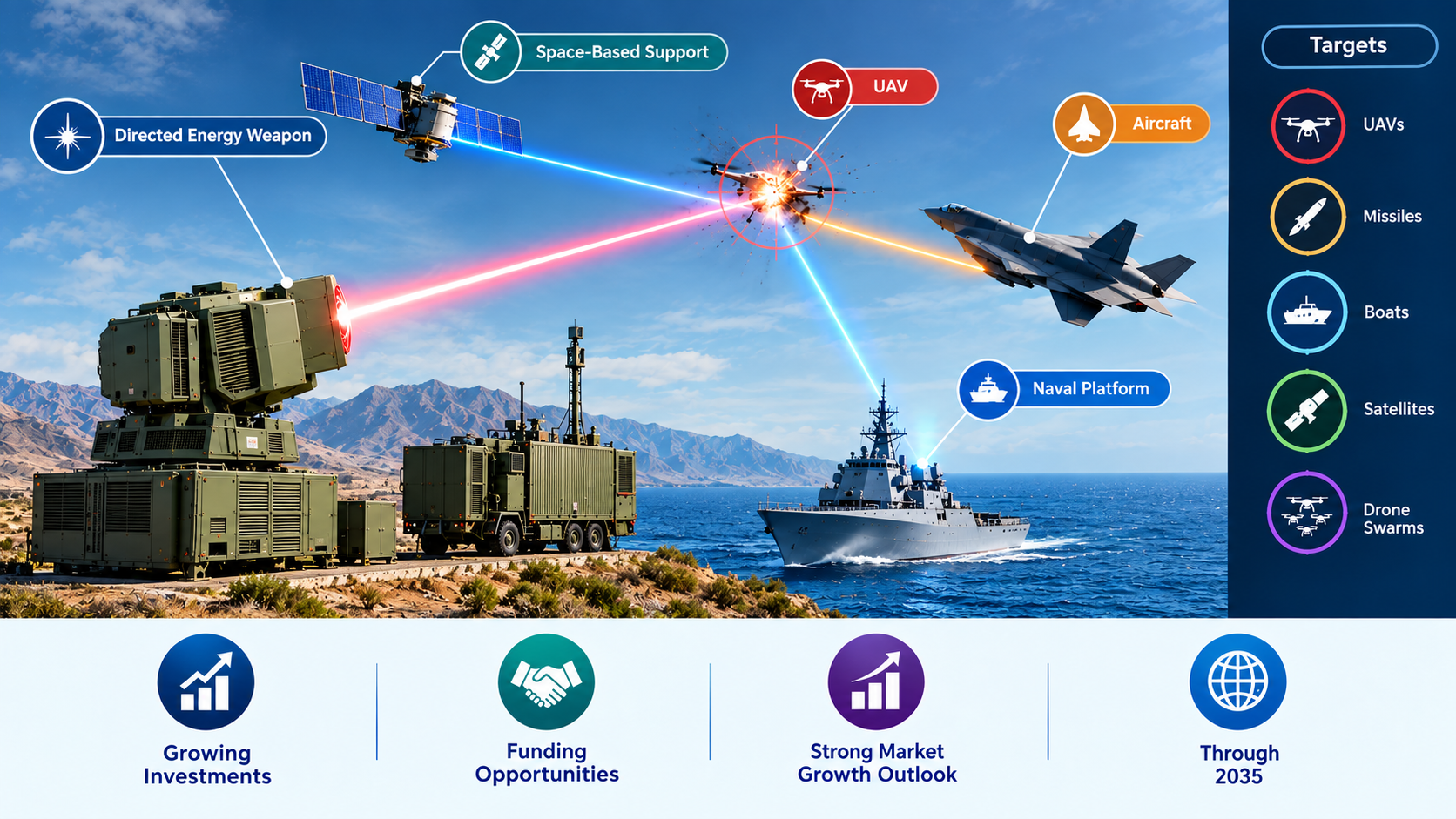
The global defense industry is entering a new phase of technological modernization as military organizations increasingly invest in advanced systems capable of addressing emerging threats. The rapid growth of unmanned aerial systems, cruise missiles, rockets, artillery, and other airborne threats is creating significant demand for new defensive technologies. Within this evolving defense environment, directed energy weapons are emerging as an important area of investment and innovation.
The Directed Energy Weapons Market is evolving beyond experimental defense programs toward increasingly practical operational applications. Military organizations are investing in high-energy laser systems, high-power microwave technologies, advanced beam-control systems, power-generation technologies, sensors, tracking systems, and integrated command-and-control architectures.
This transformation is positioning directed energy weapons as a potentially important component of future integrated air and missile defense networks. Rather than relying exclusively on conventional interceptors and kinetic weapons, armed forces are exploring technologies that can provide rapid response capabilities against a growing range of threats.
Directed Energy Weapons Market Enters an Investment-Driven Growth Phase
The defense environment is becoming increasingly complex as militaries face growing numbers of low-cost drones, rockets, artillery systems, and missile threats. Traditional air-defense systems can be highly effective, but intercepting inexpensive threats with costly missiles can create significant economic and operational challenges.
Directed energy weapons are attracting investment because they offer a different approach to threat engagement. High-energy lasers and high-power microwave systems are being developed to provide additional defensive options within layered air-defense architectures.
According to MarketsandMarkets, the Global Directed Energy Weapon Market Size was valued at USD 4.58 billion in 2026 and is projected to reach USD 12.11 billion by 2035, growing at a CAGR of 11.4% from 2026–2035. The market is growing as militaries look for effective ways to counter drones, rockets, artillery, and missiles. Governments are also increasing investments in laser and microwave technologies as part of broader defense modernization programs.
The investment environment is creating opportunities across the complete directed energy technology ecosystem, including:
-
High-energy laser systems
-
High-power microwave technologies
-
Advanced power-generation systems
-
Thermal-management technologies
-
Beam-control and optical systems
-
Radar and target-tracking sensors
-
Artificial intelligence and automation
-
Command-and-control software
-
Mobile defense platforms
-
Counter-drone systems
This expanding ecosystem is attracting interest from traditional defense contractors as well as companies specializing in photonics, advanced electronics, semiconductors, sensors, power systems, software, and artificial intelligence.
Why Counter-Drone Defense Is Driving Directed Energy Investment
One of the most important factors supporting the Directed Energy Weapons Market is the rapid growth of drone threats. Small and relatively inexpensive unmanned aerial vehicles can be used for reconnaissance, surveillance, disruption, and attacks against military facilities and critical infrastructure.
The increasing availability of drones has created a need for scalable counter-UAS capabilities. Conventional interceptors may not always represent the most economically efficient solution against large numbers of low-cost unmanned systems.
Directed energy technologies could provide an additional layer within counter-drone defense architectures. High-energy lasers are being developed to engage specific targets, while high-power microwave systems may offer capabilities against electronic components and groups of unmanned systems.
This is increasing investment in integrated systems that combine:
-
Radar detection
-
Electro-optical and infrared sensors
-
Target identification
-
Artificial intelligence
-
Tracking systems
-
Laser weapons
-
Microwave technologies
-
Command-and-control software
The future of counter-drone defense is therefore likely to involve multiple technologies operating together rather than relying on a single defensive solution.
High-Energy Lasers Are Transforming Air Defense Technology
High-energy laser technology represents one of the most visible areas of innovation within the Directed Energy Weapons Market. Laser systems use concentrated electromagnetic energy to engage targets at the speed of light.
Modern defense laser programs are focused on improving power output, beam quality, tracking accuracy, power efficiency, and thermal management. These technological improvements are helping transform laser weapons from research-oriented technologies into increasingly deployable defense systems.
A high-energy laser system typically depends on multiple advanced technologies working together. Sensors must detect and track a target, while beam-control systems must maintain precision. Power systems must provide sufficient energy, and thermal-management technologies must control the heat generated during operation.
This creates investment opportunities across multiple technology areas. The growth of the Directed Energy Weapons Market is therefore not limited to the weapon itself. Companies supplying optics, sensors, semiconductors, cooling technologies, power electronics, and software could also benefit from increasing investment.
High-Power Microwave Weapons Create New Defense Opportunities
While high-energy lasers focus energy toward a specific target, high-power microwave technologies represent another important category of directed energy systems. These systems use electromagnetic energy that can potentially affect electronic components and systems.
High-power microwave technologies are attracting interest because modern military operations increasingly depend on electronics, communications, sensors, processors, navigation systems, and autonomous platforms.
The growing use of drones and electronically controlled systems is increasing the strategic importance of technologies capable of countering electronic threats.
Future microwave weapon development could support applications involving:
-
Counter-drone operations
-
Protection against drone swarms
-
Defense of military facilities
-
Protection of critical infrastructure
-
Electronic disruption
-
Counter-electronics missions
The development of microwave technologies is also increasing demand for advanced electronics, antennas, power systems, electromagnetic engineering, and specialized testing capabilities.
Artificial Intelligence Is Enhancing Directed Energy Systems
Artificial intelligence is expected to become increasingly important within future directed energy weapon systems. Modern defense environments can involve large numbers of objects and potential threats, making rapid detection, classification, tracking, and prioritization increasingly challenging.
AI can help process information collected from radar, cameras, infrared sensors, and other surveillance systems. Automated systems may assist operators by identifying potential threats and supporting faster decision-making.
AI-enabled capabilities can potentially support:
-
Automated target detection
-
Object classification
-
Threat prioritization
-
Sensor fusion
-
Predictive tracking
-
Fire-control optimization
-
Autonomous system monitoring
-
Command-and-control support
The integration of AI is creating additional investment opportunities in defense software and advanced computing.
The future Directed Energy Weapons Market may therefore depend increasingly on the convergence of physical energy systems with intelligent software. A weapon system must not only generate energy effectively but must also detect, identify, track, and engage threats within a complex operational environment.
Advanced Sensors and Tracking Systems Become Critical
Directed energy weapons require extremely accurate tracking capabilities. A laser system, for example, must maintain precise focus on a target while accounting for movement and environmental conditions.
This creates strong demand for advanced sensing technologies.
Radar can provide long-range detection and tracking, while electro-optical and infrared sensors can provide additional information about a target. Combining information from multiple sensors can improve situational awareness.
The integration of sensor technologies is creating opportunities in:
-
Advanced radar
-
Electro-optical systems
-
Infrared sensors
-
Fire-control systems
-
Target-tracking technologies
-
Sensor fusion
-
Artificial intelligence
-
Data-processing systems
As threats become faster and more complex, the ability to rapidly detect and track objects could become just as important as the energy weapon itself.
Power Generation Is a Major Technology Challenge
One of the most important technical challenges facing the Directed Energy Weapons Market is power generation. Advanced laser and microwave systems require substantial amounts of electrical energy.
Mobile directed energy systems may need to operate from vehicles, ships, or other platforms with limited available power. This creates demand for more efficient generators, energy-storage systems, batteries, power electronics, and power-management technologies.
Future innovation could focus on improving:
-
Electrical power generation
-
Energy storage
-
Battery technologies
-
Power conversion
-
Power distribution
-
Energy efficiency
-
Mobile power systems
Companies capable of developing compact and efficient power solutions could therefore play an important role in the future directed energy ecosystem.
Thermal Management Becomes a Critical Investment Area
Generating high levels of energy also creates heat. Effective thermal management is essential for maintaining system performance and reliability.
Future directed energy systems will require advanced cooling technologies capable of operating under demanding military conditions.
Thermal-management innovation could involve:
-
Advanced cooling systems
-
Heat exchangers
-
Liquid cooling
-
Thermal materials
-
Intelligent temperature monitoring
-
Compact cooling architectures
As directed energy weapons become more powerful, thermal management is likely to remain one of the most important areas of engineering innovation.
Directed Energy Weapons Move Toward Mobile Platforms
Early directed energy programs were often associated with fixed installations and technology demonstrations. The next stage of development is increasingly focused on mobility.
Military organizations are exploring the integration of directed energy systems onto:
-
Ground vehicles
-
Naval platforms
-
Aircraft
-
Fixed defense installations
-
Mobile air-defense systems
Mobile deployment could allow directed energy technologies to support military forces operating in different environments.
Vehicle-mounted systems may provide protection for maneuvering forces, while naval systems could contribute to ship defense. Fixed installations could protect military bases and critical infrastructure.
This expansion into multiple platforms is increasing opportunities for vehicle manufacturers, naval companies, aerospace organizations, power-system suppliers, and defense integrators.
Directed Energy Weapons Could Strengthen Layered Air Defense
The future of air defense is likely to depend on multiple technologies operating together. No single defensive system can address every type of threat.
Directed energy weapons could become an additional layer within integrated defense architectures.
A future defense network could combine:
-
Long-range surveillance radar
-
Conventional missile systems
-
Short-range air-defense systems
-
Electronic warfare
-
Counter-UAS technologies
-
High-energy lasers
-
High-power microwave systems
-
AI-enabled command networks
Such an architecture could allow defense organizations to select different technologies depending on the type and scale of a threat.
The integration of directed energy systems into broader command-and-control networks is therefore becoming an important area of investment.
The Counter-Drone Market Creates Major Growth Opportunities
The growth of drone technology is fundamentally changing military defense planning. Small unmanned systems are becoming more capable, autonomous, and widely available.
This is creating strong demand for counter-UAS technologies.
Directed energy weapons could become particularly relevant in environments where military organizations need to defend against repeated drone threats. High-energy lasers and microwave systems could complement kinetic interceptors and electronic warfare systems.
The counter-drone ecosystem is expanding across:
-
Detection technologies
-
Radar systems
-
RF sensors
-
Electro-optical systems
-
Artificial intelligence
-
Electronic warfare
-
Laser weapons
-
Microwave systems
-
Command-and-control platforms
The convergence of these technologies is creating a broader defense market that extends well beyond individual directed energy weapons.
Defense Investment Is Expanding Globally
The growth of the Directed Energy Weapons Market is being supported by defense modernization programs across multiple regions.
Governments are increasing investment in advanced military technologies as they seek to address evolving threats and strengthen national defense capabilities.
North America remains an important center for directed energy research and development, supported by significant defense technology investment. European countries are also increasing their focus on air defense, counter-drone technologies, and military modernization.
Asia-Pacific represents another important area of opportunity as regional governments continue investing in advanced defense capabilities.
Global investment is supporting the development of technologies such as:
-
High-energy lasers
-
Microwave weapons
-
Counter-drone systems
-
Advanced radar
-
Artificial intelligence
-
Autonomous defense systems
-
Integrated air defense
-
Secure communications
The international expansion of defense modernization programs is creating opportunities for companies across the global directed energy supply chain.
Directed Energy Investment Is Expanding Beyond Traditional Defense Contractors
One of the most significant developments in the defense technology industry is the growing involvement of specialized technology companies.
Directed energy systems require expertise from multiple scientific and industrial sectors. As a result, the market is creating opportunities for companies specializing in photonics, semiconductors, advanced electronics, AI, software, power systems, and sensors.
Investment opportunities are emerging across the complete technology stack.
A directed energy system may require contributions from:
-
Defense contractors
-
Laser technology companies
-
Photonics specialists
-
Semiconductor manufacturers
-
Sensor developers
-
Power electronics companies
-
Software providers
-
Artificial intelligence companies
-
Thermal-management specialists
This diversification is helping create a broader innovation ecosystem around directed energy technologies.
Cybersecurity and Resilient Command Networks Become Important
As directed energy systems become increasingly connected to defense networks, cybersecurity becomes an important consideration.
Modern weapon systems depend on software, sensors, communications networks, and command systems. Protecting these systems against cyber threats is essential.
Future directed energy architectures may require:
-
Secure communications
-
Encrypted data transmission
-
Cyber-resilient software
-
Identity management
-
Intrusion detection
-
Secure command networks
-
Edge computing
-
AI-based anomaly detection
The growing importance of cybersecurity is creating another layer of opportunity within the Directed Energy Weapons Market.
Challenges Could Slow Directed Energy Weapon Adoption
Despite strong growth prospects, the development and deployment of directed energy weapons involve significant challenges.
High-energy systems require substantial research and development investment. Engineers must address challenges involving power generation, cooling, beam control, system integration, and reliability.
Environmental conditions can also affect system performance. Military systems must operate in complex environments and must meet demanding reliability requirements.
Key challenges include:
-
Power Requirements: Advanced directed energy systems require significant electrical power, particularly when deployed on mobile platforms.
-
Thermal Management: High-energy systems generate substantial heat and require effective cooling technologies.
-
System Integration: Directed energy weapons must integrate successfully with sensors, tracking systems, communications networks, and command-and-control architectures.
-
Cost and Development Time: Advanced defense technologies require extensive testing and long development cycles.
-
Operational Reliability: Military organizations require systems capable of performing under demanding environmental conditions.
Addressing these challenges will be essential for converting advanced directed energy technologies into scalable operational capabilities.
Future Outlook for the Directed Energy Weapons Market
The future of the Directed Energy Weapons Market is expected to be shaped by continued investment in lasers, microwave technologies, artificial intelligence, advanced sensors, power systems, and integrated defense networks.
According to MarketsandMarkets, the market is projected to grow from USD 4.58 billion in 2026 to USD 12.11 billion by 2035, representing a CAGR of 11.4%.
The most significant opportunity may extend beyond the development of individual weapons. Directed energy technologies are becoming part of a broader transformation in defense architecture.
Future systems could combine AI-enabled sensors, radar, laser weapons, microwave technologies, electronic warfare, and conventional interceptors within integrated command networks.
The next generation of directed energy capabilities may increasingly focus on:
-
Counter-drone defense
-
High-energy laser technology
-
High-power microwave systems
-
Artificial intelligence
-
Autonomous threat detection
-
Advanced sensor fusion
-
Mobile directed energy platforms
-
Integrated air defense
-
Improved power generation
-
Advanced thermal management
This evolution could transform directed energy weapons from specialized technologies into increasingly important components of future defense systems.
Directed Energy Weapons Are Creating a New Defense Technology Ecosystem
The Directed Energy Weapons Market is entering an important phase of growth driven by military modernization, counter-drone requirements, and increasing investment in advanced defense technologies.
The market was valued at USD 4.58 billion in 2026 and is projected to reach USD 12.11 billion by 2035, growing at a CAGR of 11.4% according to MarketsandMarkets.
However, the most important opportunity extends beyond the growth of individual laser or microwave weapons.
The convergence of photonics, artificial intelligence, advanced sensors, power electronics, thermal management, cybersecurity, and command-and-control technologies is creating an integrated directed energy ecosystem.
For defense organizations, directed energy technologies could provide additional options for countering drones, rockets, artillery, and missiles while strengthening layered defense architectures.
For technology companies and investors, opportunities are emerging across the entire value chain—from laser systems and microwave technologies to sensors, software, AI, power management, and advanced electronics.
As defense modernization continues, directed energy weapons are likely to become increasingly important within future military technology strategies. The next stage of development will not be defined solely by the power of a laser or microwave system, but by how effectively advanced energy technologies can be integrated with sensors, artificial intelligence, secure networks, and modern command-and-control systems.
Download Sample Research Report for Directed Energy Weapons Market Future @
https://www.marketsandmarkets.com/Market-Reports/directed-energy-weapon-market-19132295.html
80% of the Forbes Global 2000 B2B companies rely on MarketsandMarkets to identify growth opportunities in emerging technologies and use cases that will have a positive revenue impact.
- Food Packaging Market Size Set for Strong Growth Through 2030 Amid Rising Demand for Convenience Foods
- Crop Protection Chemical Market Size, Share & Growth Forecast (2025–2030)
- Mulch Films Market: Driving Sustainable Agriculture Through Innovation
- Agricultural Adjuvants Market Analysis, Trends, and Growth Outlook (2026–2031)
- Japan Enterprise Asset Management Market Growth: AI and Smart Infrastructure Drive Demand


