

Unmanned Aerial Vehicle Market: Investment Trends, Funding Opportunities, and Growth Outlook Through 2030
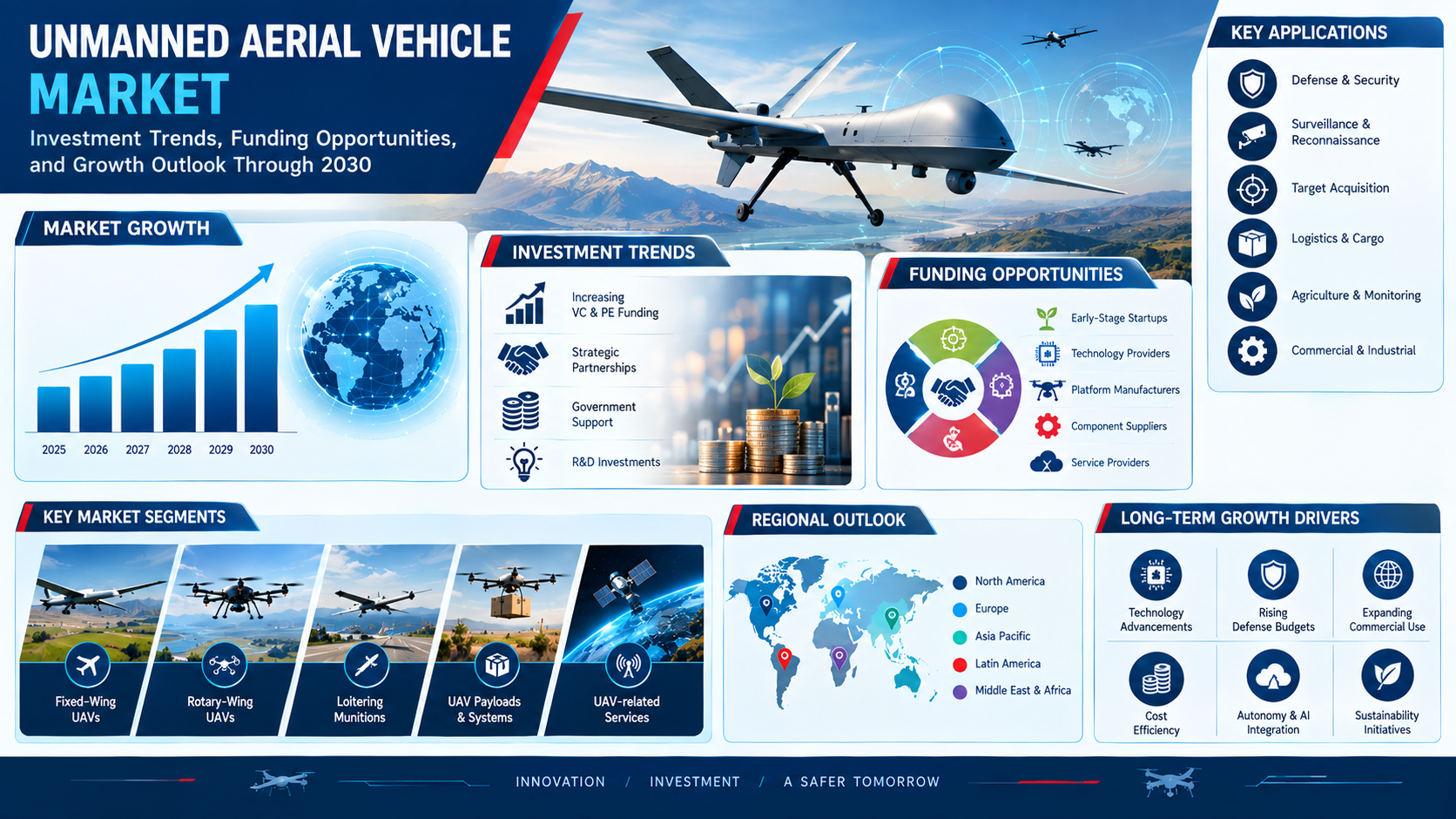
The global aerospace and defense industry is entering a new era of unmanned and autonomous operations as governments, defense organizations, commercial enterprises, and technology companies increasingly invest in advanced drone technologies. Artificial intelligence, autonomous navigation, advanced sensors, high-performance communications, efficient power systems, edge computing, and data analytics are expanding the capabilities of unmanned aerial vehicles and transforming the way they are deployed across multiple industries.
The Unmanned Aerial Vehicle Market is evolving far beyond traditional remotely piloted aircraft. Modern UAVs are increasingly capable of operating with higher levels of autonomy, processing information onboard, collaborating with other platforms, and performing increasingly sophisticated missions. From military intelligence, surveillance, and reconnaissance to infrastructure inspection, agriculture, logistics, public safety, mapping, and environmental monitoring, drones are becoming an important component of the global technology ecosystem.
As investment accelerates and new applications emerge, the UAV industry is creating significant opportunities for manufacturers, software companies, sensor developers, communications providers, AI specialists, and investors. The market's future growth through 2030 is expected to be shaped by the convergence of autonomy, artificial intelligence, advanced sensing, and next-generation aerial mobility technologies.
Unmanned Aerial Vehicle Market Enters a New Growth Phase
The UAV industry has experienced significant technological development over the past decade. Earlier generations of drones were primarily associated with military surveillance and specialized commercial applications. Today, UAV technology has expanded into a broad ecosystem supporting government, defense, industrial, and commercial operations.
According to MarketsandMarkets, the Global Unmanned Aerial Vehicle Market Size is projected to grow from USD 26.12 billion in 2025 to USD 40.56 billion by 2030, growing at a CAGR of 9.2% from 2025 to 2030. The drone market volume at the OEM level is projected to increase from 596.94 thousand units in 2025 to 869.76 thousand units by 2030.
This growth reflects the expanding role of UAVs across multiple applications and industries. Technological advancements, including improved autonomy, efficient power systems, and advanced sensing technologies, are expanding the capabilities of drones and enabling their use in increasingly complex operational environments.
The growing UAV market can be attributed to several important factors:
-
Increasing investment in autonomous and unmanned technologies
-
Growing demand for military intelligence, surveillance, and reconnaissance missions
-
Rapid advancements in artificial intelligence and autonomous navigation
-
Rising adoption of drones for commercial and industrial applications
-
Improvements in sensors, cameras, radar, and payload technologies
-
Development of more efficient propulsion and power systems
-
Growing demand for aerial data collection and analytics
-
Expansion of drone applications in agriculture, logistics, infrastructure, and public safety
These trends are transforming UAVs from specialized aviation platforms into increasingly versatile technology systems.
The Evolution of the Unmanned Aerial Vehicle Industry
The history of unmanned aerial vehicles extends back several decades, particularly within military aviation. Early UAV systems were generally developed for surveillance, reconnaissance, target acquisition, and training purposes. These platforms often depended heavily on ground-based operators and communications systems.
Technological progress has dramatically changed the capabilities of UAVs. Improvements in computing power, miniaturized electronics, GPS, sensors, communications, batteries, and software have enabled the development of smaller, more capable, and increasingly autonomous drones.
Modern UAV systems can integrate multiple technologies, including electro-optical and infrared cameras, radar, LiDAR, communications equipment, navigation systems, and artificial intelligence software. These technologies allow drones to collect, process, and transmit information while operating across increasingly complex environments.
The industry is now moving toward a new phase characterized by intelligent autonomy. Instead of simply flying under continuous manual control, future UAVs are expected to perform more navigation, sensing, and mission-management functions autonomously while remaining under appropriate human supervision.
AI Is Transforming the Future of UAV Technology
Artificial intelligence is becoming one of the most important technologies shaping the future of the Unmanned Aerial Vehicle Market. Traditional drones depend significantly on operators for navigation, mission planning, and data interpretation. AI-enabled UAVs can increasingly automate many of these processes.
Machine learning and computer vision can help drones analyze images and sensor data more efficiently. Autonomous navigation technologies can support flight planning and obstacle avoidance. Sensor fusion can combine information from cameras, radar, LiDAR, GPS, and other systems to improve situational awareness.
AI-enabled UAV capabilities can include:
-
Autonomous navigation and flight control
-
Computer vision and image analysis
-
Object detection and classification
-
Sensor fusion
-
Obstacle detection and avoidance
-
Automated mission planning
-
Real-time data processing
-
Predictive maintenance
-
Autonomous fleet management
-
Collaborative and swarm operations
The integration of AI is particularly important because the volume of data generated by UAVs continues to increase. Advanced software can help process this information closer to where it is collected, reducing dependence on remote systems and improving operational responsiveness.
This creates significant investment opportunities for companies developing autonomy software, AI algorithms, edge computing technologies, machine vision systems, and intelligent mission-management platforms.
Advanced Sensors Are Expanding UAV Capabilities
The performance of a UAV increasingly depends on the quality of its sensors and payload systems. Advances in imaging technology, radar, LiDAR, thermal sensors, hyperspectral systems, and other sensing technologies are enabling drones to perform a wider range of missions.
Advanced sensors allow UAVs to collect detailed information about physical environments, infrastructure, agricultural land, industrial facilities, and areas of strategic interest. The combination of multiple sensors can provide a more complete understanding of operational conditions.
For example, a UAV equipped with high-resolution cameras can support visual inspection, while thermal sensors can identify temperature variations. LiDAR can create highly detailed three-dimensional maps, and radar can support sensing in challenging environmental conditions.
The growing demand for advanced UAV sensing technologies is creating opportunities across the broader drone supply chain. Sensor manufacturers, semiconductor companies, imaging specialists, software developers, and data analytics providers are becoming increasingly important participants in the UAV ecosystem.
Military Applications Continue to Drive UAV Investment
Defense remains one of the most important markets for advanced unmanned aerial vehicles. Military organizations increasingly rely on UAVs to support intelligence, surveillance, reconnaissance, communications, targeting support, border monitoring, and other missions.
The growing importance of unmanned systems reflects broader changes in military modernization. Defense organizations are seeking technologies that can improve situational awareness, extend operational reach, and reduce the exposure of personnel to dangerous environments.
Military UAVs range from small tactical drones to larger strategic platforms capable of operating over extended distances. Smaller drones can provide units with localized intelligence, while larger systems can support broader surveillance and reconnaissance missions.
The future of military UAV investment is expected to focus increasingly on autonomy, artificial intelligence, secure communications, resilient navigation, advanced sensors, and collaborative operations. Defense organizations are also exploring the potential of large numbers of lower-cost unmanned systems that can operate as connected networks.
This shift is expanding opportunities not only for traditional aerospace and defense manufacturers but also for technology companies specializing in software, AI, communications, electronics, and autonomous systems.
Commercial UAV Applications Are Expanding Rapidly
While defense remains an important driver of UAV development, commercial applications are expanding the industry's addressable market. Companies across multiple sectors are adopting drones because they can collect aerial information more efficiently than many traditional methods.
Infrastructure inspection represents an important application area. UAVs can inspect bridges, power lines, pipelines, buildings, and industrial facilities while reducing the need for personnel to access difficult or potentially hazardous locations.
Agriculture is another major opportunity. Drones can support crop monitoring, precision agriculture, land analysis, and other data-driven farming activities. Advanced sensors can provide information that helps agricultural organizations monitor crop conditions and improve operational decision-making.
Other important commercial applications include:
-
Infrastructure inspection
-
Precision agriculture
-
Construction monitoring
-
Land surveying and mapping
-
Environmental monitoring
-
Public safety operations
-
Disaster assessment
-
Industrial inspection
-
Logistics and delivery
-
Media and aerial imaging
As regulations, technology, and operational capabilities continue to evolve, commercial UAV applications could become an increasingly important contributor to market growth.
Efficient Power Systems Are Extending UAV Operations
Power and propulsion technology remain critical factors influencing UAV performance. Flight endurance, payload capacity, range, and operational flexibility depend heavily on the efficiency of the drone's power system.
Technological advancements are helping manufacturers develop more efficient UAV propulsion systems and improve energy management. Different UAV applications require different power solutions depending on mission requirements, aircraft size, and operating conditions.
Longer endurance can significantly expand the potential applications of drones. A UAV capable of remaining airborne for extended periods can support persistent surveillance, environmental monitoring, infrastructure inspection, and other missions that require continuous operations.
Investment opportunities are therefore emerging in batteries, energy storage, electric propulsion, hybrid power systems, fuel technologies, and intelligent energy-management software.
As UAV fleets become larger and more autonomous, efficient power systems could become an increasingly important competitive advantage for drone manufacturers.
Autonomous Navigation Is Creating New Market Opportunities
Navigation is one of the most important components of UAV technology. Traditional drones often depend on GPS and continuous operator input. However, future autonomous UAV systems will require more sophisticated navigation capabilities.
Autonomous navigation can involve a combination of GPS, inertial navigation systems, cameras, radar, LiDAR, and AI-powered perception technologies. These systems can help UAVs understand their surroundings and navigate complex environments.
The ability to operate with reduced dependence on continuous communications could become particularly important for both military and commercial applications. UAVs may need to continue operating when communications are limited or when satellite navigation is unavailable.
This is increasing investment in technologies such as:
-
AI-powered navigation
-
Vision-based navigation
-
Sensor fusion
-
GPS-denied navigation
-
Obstacle avoidance
-
Autonomous flight planning
-
Edge computing
-
Resilient positioning systems
Companies capable of developing reliable autonomous navigation systems could play an important role in the next phase of UAV industry growth.
UAV Swarms Could Transform the Drone Industry
One of the most important future developments in the UAV Market could be the growth of collaborative drone operations. Instead of deploying individual UAVs independently, organizations are increasingly exploring systems where multiple drones can share information and coordinate activities.
Swarm technology can potentially allow groups of UAVs to provide distributed sensing and broader coverage. Rather than depending on a single aircraft, organizations could deploy multiple interconnected systems.
The development of UAV swarms requires significant technological capabilities. Artificial intelligence, communications, edge computing, autonomous coordination, and mission-management software all play important roles.
Swarm operations could create new opportunities for technology providers working on:
-
Autonomous coordination software
-
Multi-UAV communications
-
AI-based mission management
-
Distributed computing
-
Fleet management systems
-
Sensor networks
-
Human-machine interfaces
The long-term potential of collaborative UAV operations is helping attract investment into the broader autonomy and unmanned systems ecosystem.
Investment Is Moving Beyond UAV Hardware
One of the most important changes in the Unmanned Aerial Vehicle Market is the growing importance of software and digital technologies. The physical aircraft provides mobility and payload capacity, but software increasingly determines how intelligently and efficiently the system can operate.
This is changing the investment landscape. Investors and technology companies are increasingly looking beyond airframes and propulsion systems toward higher-value digital capabilities.
The software ecosystem surrounding UAVs includes artificial intelligence, mission planning, fleet management, cybersecurity, data analytics, simulation, digital twins, and autonomous navigation.
This creates opportunities for companies that may not manufacture drones directly. A technology company could develop AI software that operates across multiple UAV platforms. A data analytics company could process information collected by drone fleets. A cybersecurity provider could help protect communications and onboard systems.
The UAV industry is therefore evolving into a broader technology ecosystem involving aerospace, software, electronics, telecommunications, and data services.
Edge Computing Will Become Increasingly Important
As UAVs collect larger volumes of data, transmitting all information to a remote location for processing may become inefficient or impractical. Edge computing allows drones to process important information closer to where the data is generated.
An AI-enabled UAV could analyze sensor information onboard and identify relevant patterns before transmitting selected information to operators. This could reduce communications requirements and improve response times.
Edge computing is particularly important for autonomous systems because drones need to make rapid decisions based on changing environmental conditions.
Investment opportunities in edge computing include:
-
High-performance onboard processors
-
AI accelerators
-
Low-power computing systems
-
Real-time data analytics
-
Sensor-processing software
-
Autonomous decision-support systems
The convergence of UAVs and edge computing could support the development of increasingly intelligent and independent aerial systems.
Cybersecurity Is Becoming a Critical UAV Requirement
As drones become more connected, cybersecurity is becoming an increasingly important consideration. UAVs depend on software, communications links, navigation systems, sensors, and data networks.
Protecting these systems is essential for maintaining operational reliability. Cybersecurity requirements are becoming particularly important as organizations deploy larger fleets of connected UAVs.
Future UAV systems may increasingly incorporate secure communications, encrypted data transmission, authentication technologies, anomaly detection, and resilient software architectures.
Cybersecurity will also be important for protecting data collected by commercial drones. Organizations using UAVs for infrastructure inspection, industrial operations, or other sensitive applications will need to ensure that collected information is properly secured.
This creates additional market opportunities for cybersecurity companies and technology providers serving the UAV ecosystem.
Investment and Funding Opportunities Across the UAV Value Chain
The projected growth in UAV market value and OEM unit volumes is creating opportunities across the entire industry value chain. Investment is not limited to drone manufacturers.
Important investment areas include:
-
UAV airframes and platforms
-
Artificial intelligence and autonomy software
-
Advanced sensors and payloads
-
Cameras and imaging systems
-
Radar and LiDAR technologies
-
Propulsion and power systems
-
Batteries and energy storage
-
Secure communications
-
Edge computing
-
Navigation technologies
-
Cybersecurity
-
Drone fleet-management platforms
-
Data analytics
-
Simulation and training systems
The expansion of these opportunities is attracting startups, established aerospace companies, software developers, and technology investors.
The most successful companies may increasingly be those capable of integrating multiple technologies into complete solutions rather than focusing exclusively on individual components.
Challenges Facing the Unmanned Aerial Vehicle Market
Despite strong growth opportunities, the UAV industry faces several challenges. Regulatory requirements remain one of the most important considerations, particularly for commercial operations involving flights beyond the visual line of sight.
Safety and reliability are also critical. UAVs operating near populated areas or critical infrastructure must demonstrate reliable performance and appropriate operational controls.
Other challenges include:
-
Regulatory Complexity: Different countries and regions have different rules governing UAV operations, which can complicate international expansion.
-
Cybersecurity Risks: Increasing connectivity creates additional requirements for protecting UAV software, communications, and data.
-
Airspace Integration: The growing number of drones will require effective systems for integrating UAVs safely into broader airspace.
-
Technology Costs: Advanced sensors, AI systems, and autonomous capabilities can increase development costs.
-
Battery and Endurance Limitations: Flight duration remains a challenge for many smaller UAV platforms.
-
Interoperability: Different drones and systems need to communicate effectively with command, communications, and data networks.
Addressing these challenges will be essential for enabling the next stage of UAV adoption.
The Future of the UAV Market Through 2030
The future of the Unmanned Aerial Vehicle Market is expected to be increasingly defined by autonomy, artificial intelligence, advanced sensing, efficient power systems, and connected operations.
The projected increase in OEM drone volume from 596.94 thousand units in 2025 to 869.76 thousand units by 2030 demonstrates the expanding scale of the industry. At the same time, the growth in market value from USD 26.12 billion to USD 40.56 billion reflects continued investment in increasingly capable and technologically advanced UAV systems.
Future UAVs are expected to become more autonomous and intelligent. Instead of functioning primarily as remotely controlled aircraft, drones could increasingly operate as connected components within larger digital ecosystems.
A future operation could involve multiple UAVs collecting information, processing data using onboard AI, sharing relevant intelligence through secure networks, and coordinating with ground systems and human operators.
This transformation will increase the importance of software, communications, cybersecurity, and data processing alongside traditional aerospace engineering.
UAVs Are Becoming a Core Technology of the Autonomous Economy
The Unmanned Aerial Vehicle Market is entering an important period of technological and commercial expansion. According to MarketsandMarkets, the market is projected to grow from USD 26.12 billion in 2025 to USD 40.56 billion by 2030, at a CAGR of 9.2%. Meanwhile, OEM drone volume is projected to increase from 596.94 thousand units to 869.76 thousand units during the same period.
The growth of the industry is being supported by technological advancements in autonomy, efficient power systems, and advanced sensing technology. Artificial intelligence, computer vision, sensor fusion, edge computing, secure communications, and autonomous navigation are expanding what UAVs can accomplish.
For investors and technology companies, the opportunity extends across the complete UAV ecosystem. Drone manufacturers represent only one part of the market. Significant opportunities are also emerging in AI software, sensors, propulsion, batteries, communications, cybersecurity, navigation, fleet management, and data analytics.
For governments, defense organizations, and commercial enterprises, UAV technology offers opportunities to improve operational efficiency, collect valuable information, and perform missions that may otherwise require greater time, cost, or personnel resources.
As the industry moves toward 2030, the most significant transformation may not simply be the increasing number of drones in operation. The real change will be the evolution of UAVs into intelligent, autonomous, and connected systems capable of operating as part of broader digital and technology ecosystems.
The next generation of the Unmanned Aerial Vehicle Market will therefore be shaped not only by how far or how fast drones can fly, but by how effectively artificial intelligence, autonomous systems, advanced sensors, communications networks, and human operators can work together to create new capabilities across defense, industry, and commercial applications.
Discover detailed insights into market trends, growth opportunities, technology developments, and the future outlook for the global Unmanned Aerial Vehicle industry by exploring the latest research from MarketsandMarkets.
Download Sample Research Report for the Unmanned Aerial Vehicle Market Future @ https://www.marketsandmarkets.com/Market-Reports/unmanned-aerial-vehicles-uav-market-662.html
80% of the Forbes Global 2000 B2B companies rely on MarketsandMarkets to identify growth opportunities in emerging technologies and use cases that will have a positive revenue impact.
- Food Packaging Market Size Set for Strong Growth Through 2030 Amid Rising Demand for Convenience Foods
- Crop Protection Chemical Market Size, Share & Growth Forecast (2025–2030)
- Mulch Films Market: Driving Sustainable Agriculture Through Innovation
- Agricultural Adjuvants Market Analysis, Trends, and Growth Outlook (2026–2031)
- Japan Enterprise Asset Management Market Growth: AI and Smart Infrastructure Drive Demand


