

Directed Energy Weapon Technology Innovation: Key Trends, Growth Drivers, and Future Opportunities
Introduction to Directed Energy Weapon Technology
Directed Energy Weapons (DEWs) represent one of the most transformative innovations in modern defense technology. Unlike conventional kinetic weapons that rely on projectiles, directed energy weapons use concentrated energy in the form of high-energy lasers, high-power microwaves, particle beams, or electromagnetic energy to disable, damage, or destroy targets with exceptional precision.
As military forces worldwide seek advanced solutions to counter emerging threats such as unmanned aerial systems, hypersonic weapons, missiles, and electronic warfare attacks, Directed Energy Technologies are rapidly becoming a strategic priority. These systems offer faster response times, reduced operational costs per engagement, high accuracy, and scalable effects across various combat scenarios.
The growing focus on multi-domain operations, integrated air and missile defense, and autonomous battlefield systems is accelerating investment in next-generation directed energy weapon technologies.
History of Directed Energy Weapon Technology
The concept of using energy as a weapon has existed for decades, with significant research beginning during the Cold War era. Early efforts focused on developing laser and particle beam systems for missile defense and strategic military applications.
Advancements in solid-state lasers, fiber laser technologies, power generation systems, thermal management solutions, and artificial intelligence have significantly improved the feasibility of operational DEW systems. In recent years, military organizations across North America, Europe, Asia-Pacific, and the Middle East have accelerated testing and deployment programs for directed energy platforms across land, air, sea, and space domains.
Today, directed energy weapons are transitioning from experimental concepts to operational defense capabilities capable of addressing evolving security challenges.
Benefits of Directed Energy Weapon Technology
Directed energy weapons offer numerous advantages over traditional kinetic weapon systems.
1. Precision Target Engagement
DEWs can engage threats with exceptional accuracy while minimizing collateral damage.
2. Speed-of-Light Response
Laser and microwave weapons engage targets almost instantaneously, improving reaction times against fast-moving threats.
3. Low Cost Per Shot
Once deployed, directed energy systems can provide significantly lower engagement costs compared to traditional missile interceptors.
4. Scalable Effects
Operators can adjust power levels based on mission requirements, ranging from temporary disruption to complete target destruction.
5. Deep Magazine Capability
Unlike conventional weapons limited by ammunition supplies, DEWs can continue operating as long as power is available.
Current Market Size and Growth Trends of the Directed Energy Weapon Industry
The directed energy weapon market has experienced significant growth due to rising geopolitical tensions, modernization initiatives, and increasing demand for advanced defense capabilities.
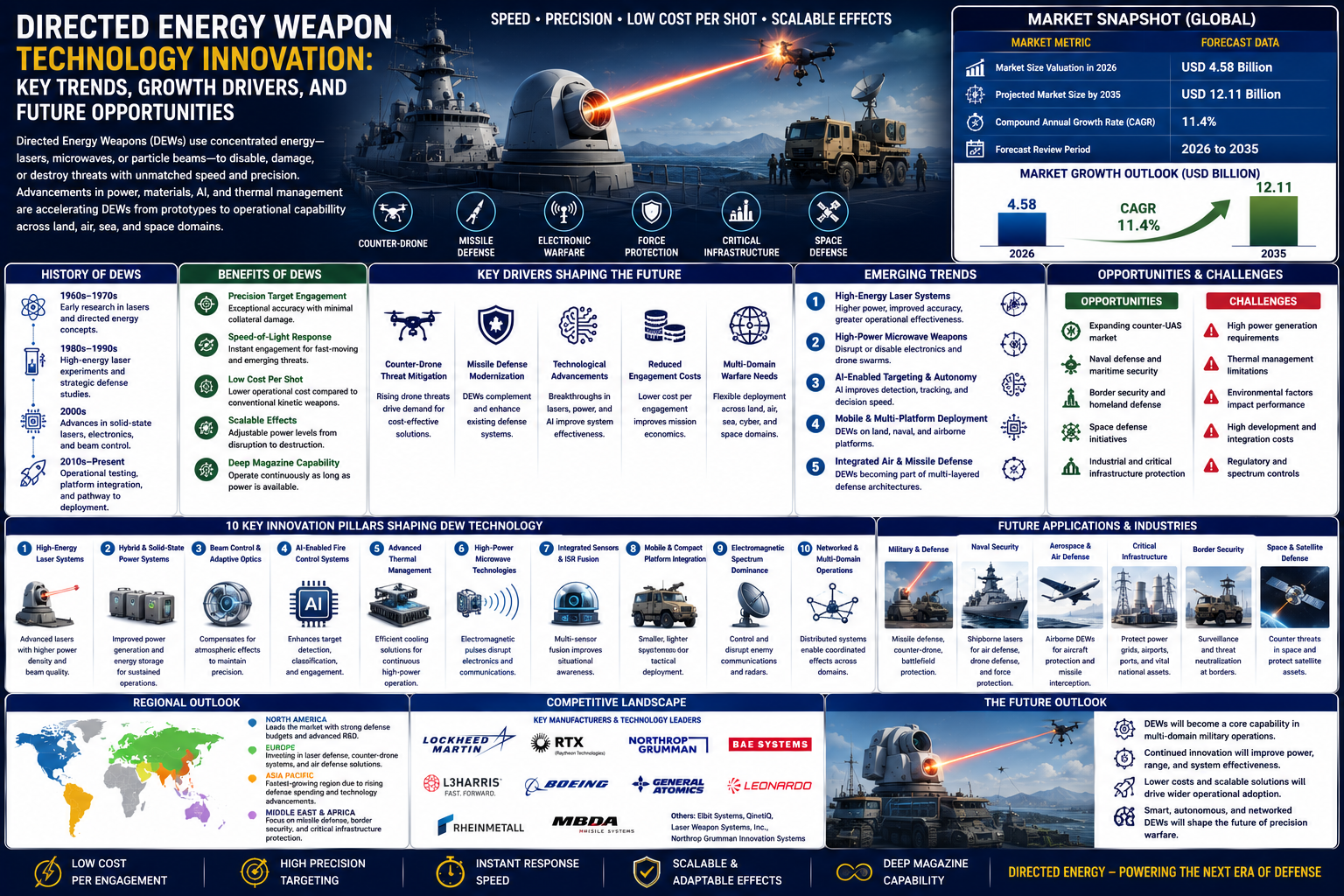
According to MarketsandMarkets, the Global Directed Energy Weapon Market Size was valued at USD 4.58 billion in 2026 and is projected to reach USD 12.11 billion by 2035, growing at a CAGR of 11.4% from 2026 to 2035.
Several factors are contributing to this market expansion:
-
Rising investments in next-generation military modernization programs
-
Growing demand for counter-drone and counter-UAS systems
-
Increasing deployment of integrated air and missile defense solutions
-
Advancements in laser, microwave, and power generation technologies
-
Expansion of naval and airborne directed energy programs
-
Growing focus on electronic warfare and electromagnetic spectrum operations
-
Increased defense spending across major military powers
Key Drivers and Factors Influencing the Future of Directed Energy Weapon Technology
Several strategic drivers are shaping the future of the directed energy weapon market.
1. Counter-Drone Threat Mitigation
The rapid proliferation of unmanned aerial systems is increasing demand for cost-effective counter-UAS technologies.
2. Missile Defense Modernization
Military organizations are investing in DEWs to complement existing missile defense architectures.
3. Technological Advancements
Continuous improvements in beam control, energy storage, power generation, and thermal management are enhancing system effectiveness.
4. Reduced Engagement Costs
Directed energy systems offer significantly lower operational costs compared to traditional interceptor-based solutions.
5. Multi-Domain Warfare Requirements
Modern military strategies increasingly require flexible capabilities across land, air, sea, cyber, and space domains.
Emerging Trends in Directed Energy Weapon Technology
Several innovations are shaping the future of directed energy weapons.
1. High-Energy Laser Systems
Advanced laser weapons are achieving higher power levels, improved accuracy, and greater operational effectiveness.
2. High-Power Microwave Weapons
Microwave-based systems are emerging as effective tools for disabling electronic systems and drone swarms.
3. Artificial Intelligence Integration
AI-powered targeting and threat identification systems are improving engagement speed and accuracy.
4. Mobile Directed Energy Platforms
Military organizations are deploying DEW systems on tactical vehicles, ships, and aircraft.
5. Multi-Layered Air Defense Integration
Directed energy weapons are increasingly being incorporated into integrated air and missile defense architectures.
Opportunities and Challenges in the Directed Energy Weapon Market
The directed energy weapon market presents significant growth opportunities while also facing several technical and operational challenges.
Opportunities
1. Counter-UAS Market Expansion
The increasing threat posed by drones creates substantial demand for directed energy countermeasures.
2. Naval Defense Applications
Warships can benefit from directed energy systems for missile defense, drone interception, and force protection.
3. Border Security and Homeland Defense
Government agencies are exploring DEW technologies for critical infrastructure protection and border surveillance.
4. Space Defense Initiatives
Future space-based defense architectures may incorporate directed energy technologies for threat mitigation.
Challenges
1. Power Generation Requirements
High-energy systems require substantial power generation and storage capabilities.
2. Thermal Management Limitations
Managing heat generated during sustained operations remains a critical engineering challenge.
3. Environmental Factors
Atmospheric conditions such as fog, rain, dust, and turbulence can impact laser performance.
4. Development and Integration Costs
Research, testing, and deployment of advanced DEW systems require significant investments.
Innovations and Advancements in Directed Energy Weapon Technology
Breakthrough technologies are accelerating the operational readiness of directed energy systems.
1. Fiber Laser Technology
Modern fiber lasers provide higher efficiency, reliability, and scalability compared to earlier laser architectures.
2. Beam Control and Adaptive Optics
Advanced beam control systems improve accuracy and effectiveness in challenging operational environments.
3. Compact Energy Storage Systems
Next-generation batteries and power systems support mobile deployment of DEWs.
4. AI-Enabled Fire Control Systems
Artificial intelligence enhances target acquisition, tracking, and engagement processes.
5. Electromagnetic Spectrum Dominance Technologies
Emerging microwave systems provide new capabilities for electronic warfare and infrastructure protection.
Future Applications and Industries That Will Benefit from Directed Energy Weapon Technology
Directed energy technology is expected to support numerous defense and security applications.
1. Military and Defense
DEWs will play a critical role in missile defense, counter-drone operations, and battlefield protection.
2. Naval Security
Warships can utilize laser systems to counter aerial threats and enhance maritime defense capabilities.
3. Aerospace and Air Defense
Airborne laser systems may provide future capabilities for aircraft protection and missile interception.
4. Critical Infrastructure Protection
Governments and security agencies can deploy DEWs to protect strategic facilities and national assets.
5. Border Security Operations
Directed energy systems offer enhanced surveillance and threat neutralization capabilities for border protection.
6. Space and Satellite Defense
Future space security architectures may leverage directed energy technologies to address emerging orbital threats.
Regional Analysis of the Global Directed Energy Weapon Market
North America
North America dominates the directed energy weapon market due to extensive defense investments, advanced research programs, and strong military modernization initiatives.
Europe
European nations are increasing investments in laser defense systems, counter-drone capabilities, and integrated air defense solutions.
Asia Pacific
Asia Pacific is witnessing rapid growth driven by rising defense expenditures, geopolitical tensions, and indigenous military technology development.
Middle East
The region is increasingly adopting directed energy solutions to address missile, drone, and border security threats.
Latin America
Growing investments in defense modernization and homeland security programs are creating emerging opportunities for directed energy technologies.
Competitive Landscape of the Directed Energy Weapon Market
The directed energy weapon industry is highly competitive, with defense contractors and technology companies investing heavily in research and development.
Key competitive strategies include:
-
High-energy laser system development
-
Advanced microwave weapon technologies
-
Strategic defense partnerships
-
AI-enabled targeting systems
-
Integrated missile defense solutions
-
Platform modernization programs
-
Multi-domain operational capabilities
Key Manufacturers and Industry Leaders
Several organizations are leading innovation in the directed energy weapon ecosystem.
-
Lockheed Martin
-
RTX Corporation
-
Northrop Grumman
-
BAE Systems
-
L3Harris Technologies
-
Boeing
-
General Atomics
-
Leonardo
-
Rheinmetall
-
MBDA
These organizations continue investing in high-energy laser systems, microwave weapons, beam control technologies, advanced sensors, and integrated defense architectures.
Conclusion: The Promising Future of Directed Energy Weapon Technology
Directed energy weapon technology is reshaping the future of defense by providing highly precise, scalable, and cost-effective capabilities for modern military operations. Advances in laser systems, microwave technologies, artificial intelligence, power generation, and thermal management are enabling the transition of DEWs from research programs to operational deployment.
As the Global Directed Energy Weapon Market grows from USD 4.58 billion in 2026 to USD 12.11 billion by 2035, governments and defense organizations worldwide are expected to accelerate investments in these transformative technologies.
While technical challenges related to power requirements, thermal management, and environmental performance remain, continued innovation and strategic collaboration are expected to unlock substantial opportunities across military, aerospace, homeland security, and critical infrastructure sectors.
Organizations that embrace directed energy innovation today will be well-positioned to lead the next generation of defense capabilities and shape the future of precision warfare.
Download Sample Research Report for Directed Energy Weapon Market Future @ https://www.marketsandmarkets.com/pdfdownloadNew.asp?id=19132295
80% of the Forbes Global 2000 B2B companies rely on MarketsandMarkets to identify growth opportunities in emerging technologies and use cases that will have a positive revenue impact.
- Food Packaging Market Size Set for Strong Growth Through 2030 Amid Rising Demand for Convenience Foods
- Crop Protection Chemical Market Size, Share & Growth Forecast (2025–2030)
- Mulch Films Market: Driving Sustainable Agriculture Through Innovation
- Agricultural Adjuvants Market Analysis, Trends, and Growth Outlook (2026–2031)
- Japan Enterprise Asset Management Market Growth: AI and Smart Infrastructure Drive Demand

