

Why the US Air Forces Argus XL Deployment Signals the Next Growth Phase for the Counter-UAS System (C-UAS) Market
The rapid proliferation of unmanned aerial systems has fundamentally changed the global security landscape. Once primarily used for intelligence gathering, drones are now employed for surveillance, electronic warfare, precision attacks, logistics, and coordinated swarm operations. As these threats become increasingly sophisticated, military organizations are accelerating investments in advanced counter-unmanned aircraft system (C-UAS) technologies capable of detecting, identifying, tracking, and neutralizing hostile drones before they reach critical assets.
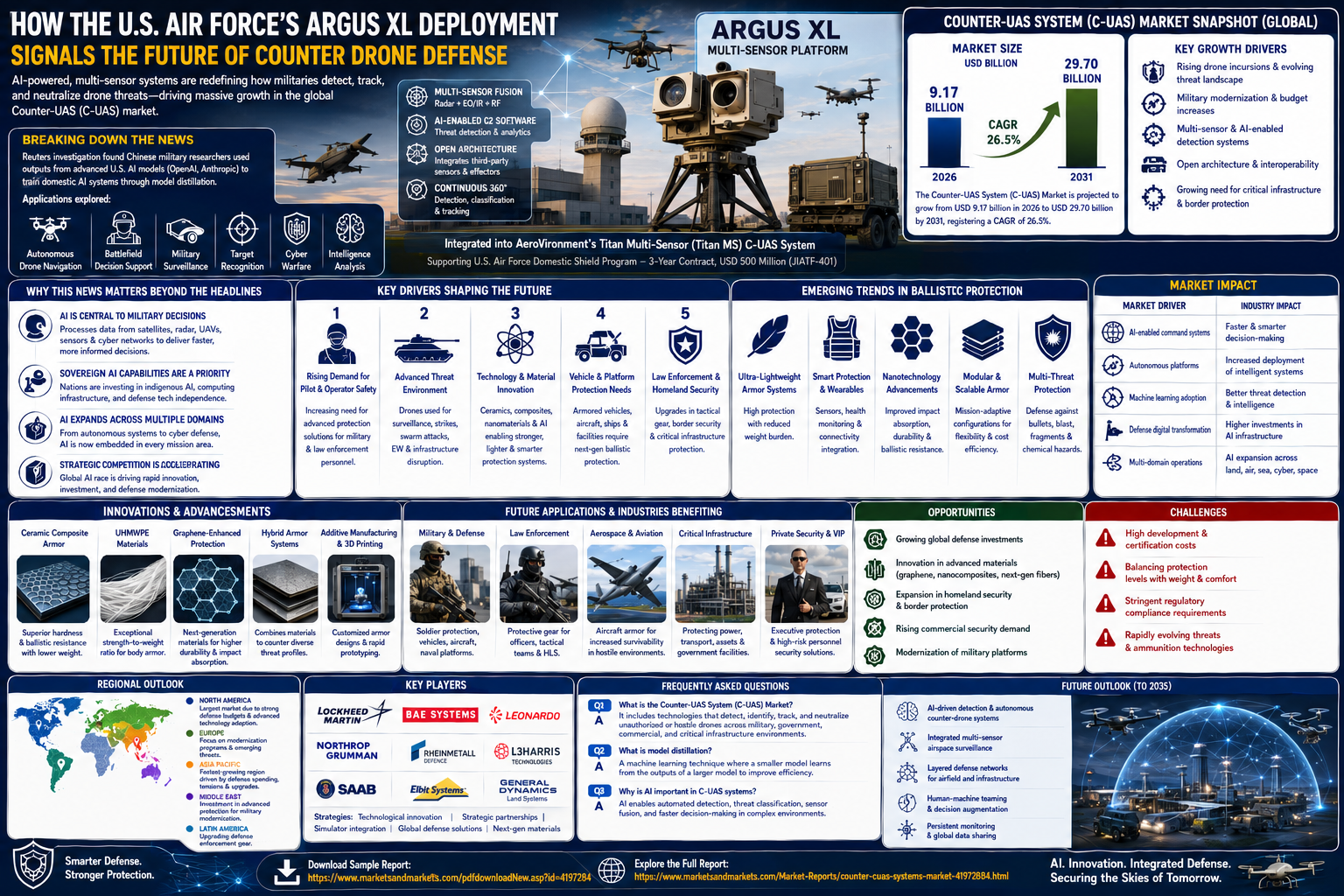
A recent development by the U.S. Air Force illustrates this shift toward more integrated and intelligent counter-drone capabilities. The service is strengthening its domestic air defense posture by deploying Teledyne FLIR Defense's Argus XL multi-sensor platform as part of AeroVironment's Titan Multi-Sensor (Titan MS) Counter-UAS system. The deployment falls under the three-year, USD 500 million Domestic Shield Program supporting Joint Interagency Task Force 401 (JIATF-401), reflecting the growing strategic importance of layered drone defense for military installations and critical infrastructure.
Argus XL combines radar, electro-optical and infrared (EO/IR) imaging, artificial intelligence-enabled command-and-control software, and an open architecture capable of integrating third-party RF sensors and countermeasure technologies. Together, these capabilities provide continuous detection, classification, and tracking of multiple aerial threats, including small and micro drones operating in increasingly complex environments.
For defense organizations, homeland security agencies, technology providers, and investors, this deployment reinforces the long-term momentum behind the Counter-UAS System (C-UAS) Market, where multi-sensor architectures, AI-enabled threat analysis, and layered defense networks are becoming the new operational standard.
Breaking Down the News
The U.S. Air Force has expanded its counter-drone capabilities by integrating the Argus XL multi-sensor platform into AeroVironment's Titan Multi-Sensor Counter-UAS solution.
The deployment supports the Domestic Shield Program, a three-year contract valued at USD 500 million that strengthens protection for military installations and other strategic assets against evolving drone threats.
Argus XL integrates multiple technologies into a unified detection and command platform, including:
- Advanced radar systems
- Electro-optical cameras
- Infrared imaging sensors
- AI-enabled command-and-control software
- Open architecture interfaces
- Third-party RF sensor integration
The platform enables continuous surveillance while simultaneously detecting, classifying, and tracking multiple aerial targets ranging from commercial quadcopters to more advanced unmanned systems.
The announcement demonstrates how military organizations are moving away from single-sensor drone detection toward fully integrated multi-layered air defense ecosystems capable of adapting to rapidly evolving aerial threats.
Why This News Matters Beyond the Headlines
The Argus XL deployment represents more than a single procurement program.
It reflects several broader trends reshaping modern air defense strategies worldwide.
Drone Threats Continue to Increase
Military conflicts have demonstrated that drones can conduct:
- Intelligence collection
- Precision strikes
- Electronic warfare
- Swarm attacks
- Infrastructure disruption
- Battlefield surveillance
As drone technology becomes more affordable and widely available, protecting military bases, airports, government facilities, and critical infrastructure has become an increasingly urgent priority.
Multi-Sensor Detection Is Becoming Essential
No individual sensor can reliably detect every type of drone across all operating environments.
Modern C-UAS platforms therefore combine multiple sensing technologies including:
- Radar
- EO/IR cameras
- RF detection
- Artificial intelligence
- Command-and-control software
This layered approach significantly improves detection accuracy while reducing false alarms.
Open Architecture Is Reshaping Defense Procurement
Defense organizations increasingly prefer systems that support integration with existing sensors and future technologies.
Open architecture platforms offer:
- Greater interoperability
- Easier technology upgrades
- Vendor flexibility
- Faster capability expansion
- Lower lifecycle costs
The Argus XL architecture reflects this broader procurement trend.
What This Means for the Counter-UAS System (C-UAS) Market
The technologies showcased through the Argus XL deployment closely align with long-term trends shaping the Counter-UAS System (C-UAS) Market.
According to MarketsandMarkets, the Counter-UAS System (C-UAS) Market is projected to grow from USD 9.17 billion in 2026 to USD 29.70 billion by 2031, registering a CAGR of 26.5%.
This rapid expansion reflects increasing demand for integrated drone defense capabilities across military, homeland security, and critical infrastructure applications.
| Market Driver | Industry Impact |
|---|---|
| Rising drone incursions | Increased deployment of advanced C-UAS platforms |
| Multi-sensor architectures | Higher demand for integrated surveillance systems |
| AI-powered command and control | Faster threat detection and response |
| Open architecture solutions | Greater interoperability across defense networks |
| Layered drone defense | Expansion of comprehensive airspace protection capabilities |
The U.S. Air Force deployment reinforces each of these trends, particularly the growing emphasis on intelligent sensor fusion and scalable counter-drone ecosystems.
Organizations seeking deeper insights into future procurement priorities can explore broader developments within the Counter-UAS System (C-UAS) Market and understand how integrated defense technologies are reshaping modern airspace security.
Related Resource: Read about the Counter-UAS System (C-UAS) Market: https://www.marketsandmarkets.com/Market-Reports/counter-cuas-systems-market-4197284.html
Key Industry Trends Accelerating Market Growth
Multi-Sensor Architectures Are Becoming the Industry Standard
Modern counter-drone operations increasingly rely on sensor fusion rather than individual detection technologies.
Integrated platforms combine:
- Radar
- EO/IR imaging
- RF detection
- Acoustic sensors
- Artificial intelligence
These capabilities provide comprehensive situational awareness across diverse operating environments.
AI Is Improving Threat Classification
Artificial intelligence enables C-UAS platforms to:
- Identify drone types
- Classify potential threats
- Prioritize targets
- Reduce false positives
- Support rapid operator decisions
AI-driven automation significantly improves operational effectiveness during complex engagements involving multiple simultaneous aerial threats.
Layered Defense Networks Continue to Expand
Military organizations increasingly deploy multiple defensive layers including:
- Early warning sensors
- AI-enabled tracking
- Electronic warfare systems
- Kinetic interceptors
- Directed-energy weapons
Layered architectures improve resilience while increasing interception success rates.
Protection of Critical Infrastructure Is Driving Adoption
Counter-drone technologies are expanding beyond military applications.
Increasing deployments are occurring at:
- Airports
- Energy facilities
- Border regions
- Government buildings
- Strategic industrial sites
- Public event venues
Critical infrastructure protection has become one of the fastest-growing segments of the Counter Drone Market.
Small Drone Detection Is Becoming a Strategic Priority
Commercially available micro drones present unique detection challenges due to their size, speed, and low radar signatures.
Advanced sensor fusion platforms such as Argus XL improve the ability to:
- Detect low-observable drones
- Maintain persistent surveillance
- Track multiple small aerial targets
- Support continuous 24/7 monitoring
These capabilities are becoming increasingly important across both military and civilian security operations.
Market Implications for Stakeholders
For Defense Organizations
Military forces are prioritizing integrated C-UAS ecosystems capable of protecting fixed installations and deployed forces.
Future procurement is expected to emphasize:
- Multi-sensor surveillance platforms
- AI-enabled command systems
- Layered air defense
- Mobile C-UAS systems
- Open architecture solutions
These investments support greater operational flexibility and improved readiness.
For Investors
The Counter-UAS Market continues to present attractive long-term growth opportunities.
High-growth investment areas include:
- AI-powered detection software
- Radar technologies
- EO/IR imaging systems
- Electronic warfare platforms
- Counter-drone command-and-control solutions
Rising geopolitical tensions continue supporting sustained demand.
For Technology Providers
Manufacturers increasingly compete by delivering interoperable and scalable counter-drone ecosystems.
Competitive differentiation depends upon:
- Detection accuracy
- Sensor integration
- Artificial intelligence capabilities
- Platform flexibility
- Operational reliability
Innovation remains central to long-term market leadership.
For Governments and Homeland Security Agencies
Governments continue expanding investments in domestic drone defense capabilities.
Priority objectives include:
- Airspace security
- Border protection
- Critical infrastructure resilience
- Public safety
- National security preparedness
Counter-drone technologies are becoming integral components of broader homeland security strategies.
Frequently Asked Questions
What is the Counter-UAS System (C-UAS) Market?
The Counter-UAS System (C-UAS) Market includes technologies designed to detect, identify, track, classify, and mitigate unauthorized or hostile drones across military, government, commercial, and critical infrastructure environments.
What is the Argus XL platform?
Argus XL is a multi-sensor counter-drone platform developed by Teledyne FLIR Defense that integrates radar, EO/IR cameras, AI-enabled command-and-control software, and open architecture interfaces for comprehensive drone detection and tracking.
Why are multi-sensor platforms becoming important?
Multi-sensor systems combine multiple detection technologies to improve accuracy, reduce false alarms, and provide continuous situational awareness against diverse drone threats.
What role does artificial intelligence play in C-UAS systems?
AI supports automated drone detection, threat classification, target prioritization, sensor fusion, and operational decision-making, enabling faster and more effective responses.
Why is open architecture important for counter-drone systems?
Open architecture allows defense organizations to integrate third-party sensors, countermeasures, and future technologies without replacing entire systems, improving flexibility and reducing lifecycle costs.
Which sectors are adopting counter-UAS technologies?
Military organizations, homeland security agencies, airports, border security authorities, energy operators, government facilities, and critical infrastructure operators are increasingly deploying C-UAS solutions.
What technologies complement counter-drone detection systems?
Electronic warfare, RF jamming, kinetic interceptors, directed-energy weapons, and AI-enabled command platforms work together to create layered counter-drone defense architectures.
Where can organizations find deeper insights into C-UAS market trends?
Industry stakeholders often rely on specialized market intelligence to evaluate technology developments, procurement strategies, competitive dynamics, and future market opportunities.
Looking Beyond Today's Headlines
The U.S. Air Force's deployment of Argus XL reflects the continued evolution of counter-drone defense from isolated detection systems toward fully integrated airspace security ecosystems.
Future counter-UAS operations will increasingly rely on artificial intelligence, sensor fusion, automation, and open architecture platforms capable of adapting to rapidly changing threat environments.
Several trends are expected to define the next decade:
- AI-powered drone detection
- Multi-sensor surveillance platforms
- Open architecture C-UAS ecosystems
- Layered air defense networks
- Autonomous counter-drone technologies
- Persistent airspace monitoring
As drone threats continue to evolve in both scale and sophistication, integrated counter-drone systems will become an essential component of military modernization and homeland security strategies worldwide.
Future Outlook
The U.S. Air Force's integration of the Argus XL multi-sensor platform into its Titan Multi-Sensor Counter-UAS system demonstrates how rapidly defense organizations are strengthening layered airspace protection against increasingly sophisticated drone threats. By combining radar, EO/IR imaging, AI-enabled command-and-control, and open architecture integration, the deployment reflects the direction of next-generation counter-drone operations.
These developments align closely with broader trends shaping the Counter-UAS System (C-UAS) Market, where rising drone incursions, AI-enabled detection, multi-sensor surveillance, and scalable defense architectures continue to drive significant market expansion.
For defense organizations, investors, technology providers, and policymakers, understanding these trends will be essential as unmanned aerial threats continue to evolve. The increasing adoption of intelligent, interoperable, and layered counter-drone systems suggests that C-UAS technologies will remain among the fastest-growing segments of the global defense industry.
For readers seeking deeper insights into market forecasts, technology developments, competitive dynamics, and growth opportunities, MarketsandMarkets provides comprehensive research on the Counter-UAS System (C-UAS) Market and the forces driving its continued evolution.
Download Sample Report: https://www.marketsandmarkets.com/pdfdownloadNew.asp?id=4197284
Explore the Counter-UAS System (C-UAS) Market: https://www.marketsandmarkets.com/Market-Reports/counter-cuas-systems-market-4197284.html
80% of the Forbes Global 2000 B2B companies rely on MarketsandMarkets to identify growth opportunities in emerging technologies and use cases that will have a positive revenue impact.
- Food Packaging Market Size Set for Strong Growth Through 2030 Amid Rising Demand for Convenience Foods
- Mulch Films Market: Driving Sustainable Agriculture Through Innovation
- Agricultural Adjuvants Market Analysis, Trends, and Growth Outlook (2026–2031)
- Crop Protection Chemical Market Size, Share & Growth Forecast (2025–2030)
- Japan Enterprise Asset Management Market Growth: AI and Smart Infrastructure Drive Demand


