

Unmanned Aerial Vehicle Market: Companies, Mergers, Acquisitions, and Competitive Landscape
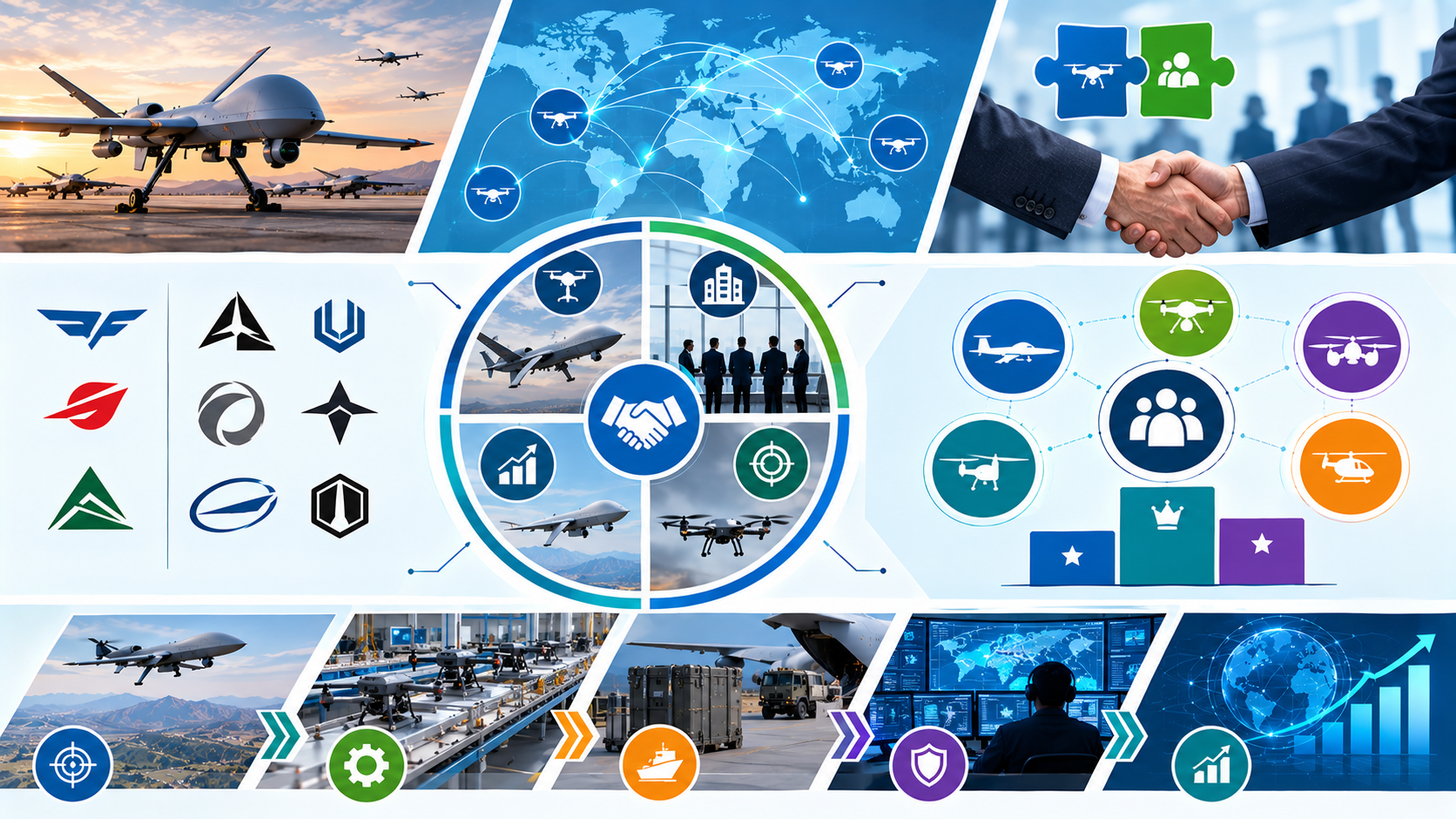
The global aerospace and defense industry is entering a new phase of technological transformation as governments, military organizations, commercial enterprises, and technology companies increasingly invest in artificial intelligence, autonomous navigation, advanced sensors, robotics, secure communications, and network-centric systems. This transformation is accelerating the adoption of unmanned aircraft across defense, security, industrial, logistics, and commercial applications, positioning the Unmanned Aerial Vehicle Market as one of the most dynamic segments of the global aerospace ecosystem.
The Unmanned Aerial Vehicle Market is also evolving beyond traditional remotely piloted drones designed primarily for surveillance and reconnaissance. Companies across the industry are increasingly developing autonomous fixed-wing UAVs, multirotor drones, vertical takeoff and landing platforms, tactical drones, long-endurance systems, cargo UAVs, loitering platforms, and interconnected unmanned aircraft ecosystems. The result is a shift from individual aircraft platforms toward intelligent, connected, software-defined, and increasingly autonomous aerial systems.
This technological transformation is also changing the competitive landscape. The UAV industry now includes major aerospace and defense contractors, specialized drone manufacturers, artificial intelligence companies, robotics startups, sensor developers, semiconductor companies, communications providers, software companies, and advanced propulsion specialists. Competition is increasingly centered not only on aircraft performance but also on autonomy, software, sensors, data processing, cybersecurity, manufacturing capacity, and the ability to integrate UAVs into larger operational networks.
According to MarketsandMarkets, the Global Unmanned Aerial Vehicle Market is projected to grow from USD 26.12 billion in 2025 to USD 40.56 billion by 2030, growing at a CAGR of 9.2% during the forecast period. The drone market volume for OEM platforms is projected to increase from 596.94 thousand units in 2025 to reach 869.76 thousand units by 2030. Technological advancements, including improved autonomy, efficient power systems, and advanced sensing technologies, are expanding the capabilities of UAVs and supporting continued market growth.
Unmanned Aerial Vehicle Market Enters an Investment and Consolidation Phase
The rapid expansion of UAV applications is creating a highly competitive investment environment. Governments are increasing procurement of unmanned systems, commercial companies are exploring drone-enabled operations, and technology investors are supporting companies developing autonomous aircraft and related technologies.
The market opportunity extends across the complete UAV technology stack. Aircraft manufacturers are developing new platforms, while technology companies are supplying artificial intelligence software, cameras, radar systems, navigation technologies, communications equipment, processors, batteries, and mission-management platforms.
This broad ecosystem is encouraging partnerships, strategic investments, mergers, acquisitions, and technology collaborations.
Large aerospace and defense companies often have strong relationships with government customers, established manufacturing capabilities, and experience integrating complex systems. However, smaller technology companies can sometimes move more quickly in areas such as artificial intelligence, autonomous software, robotics, and commercial drone development.
As a result, the competitive landscape increasingly combines established aerospace companies with specialized technology innovators.
Companies are using partnerships and acquisitions to gain access to important technologies rather than developing every capability internally. An aerospace manufacturer may seek autonomy software expertise, while a defense technology company may invest in advanced sensors or secure communications.
This is contributing to the emergence of a more integrated UAV industry.
Competition Is Moving Beyond the Aircraft Platform
Earlier competition in the UAV industry was often focused primarily on aircraft design, flight performance, endurance, payload capacity, and range. While these factors remain important, the competitive landscape is becoming increasingly software-driven.
A modern UAV is not simply an aircraft. It is also a flying sensor platform, computing system, communications node, and increasingly autonomous machine.
Companies that can combine aerospace engineering with artificial intelligence, advanced sensors, edge computing, and digital connectivity are gaining opportunities to differentiate their platforms.
For example, two aircraft may have similar physical capabilities, but the platform with more advanced autonomy software may require fewer operators. A UAV with better onboard processing capabilities may analyze sensor information faster. A drone connected to a larger command network may provide greater operational value than an isolated platform.
The competitive advantage is therefore increasingly shifting toward integrated capabilities.
Companies are competing across areas such as autonomous navigation, computer vision, sensor fusion, artificial intelligence, secure communications, flight-control software, cybersecurity, and mission-management systems.
This is changing how aerospace companies evaluate potential partnerships and acquisition opportunities.
Major Aerospace and Defense Companies Remain Important Competitors
Large aerospace and defense companies continue to play an important role in the Unmanned Aerial Vehicle Market. These organizations typically have extensive engineering capabilities, established government relationships, advanced manufacturing infrastructure, and experience managing complex aerospace programs.
Their competitive strength often comes from the ability to develop and integrate complete systems.
A major aerospace company may combine an aircraft platform with sensors, communications systems, ground-control stations, mission software, and support infrastructure.
This integrated approach can be particularly important for defense customers that require complete operational capabilities rather than individual aircraft.
However, established companies are increasingly facing competition from specialized UAV manufacturers and technology-focused startups.
The growing importance of commercial technologies is also changing the competitive environment. Artificial intelligence, advanced processors, commercial sensors, cloud computing, and robotics technologies are becoming increasingly relevant to unmanned aviation.
This creates opportunities for companies outside the traditional aerospace industry to enter the market.
The result is a more diverse competitive landscape involving defense contractors, aerospace manufacturers, technology companies, and specialized drone developers.
Specialized UAV Manufacturers Are Expanding Their Market Position
Specialized UAV companies are becoming increasingly important competitors because they can focus exclusively on unmanned aviation technologies.
These companies often develop expertise in particular market segments, including tactical UAVs, commercial drones, long-endurance systems, vertical takeoff and landing platforms, autonomous aircraft, and drone services.
Specialization can provide advantages in rapidly evolving technology markets.
A company focused entirely on autonomous UAV development may be able to introduce new technologies more quickly than a larger organization managing multiple aerospace product lines.
Smaller manufacturers can also focus on specific customer requirements and develop highly specialized platforms.
The growing demand for different categories of UAVs is creating opportunities for companies with specialized capabilities.
Some manufacturers focus on small tactical systems, while others develop larger platforms for long-endurance operations. Commercial companies may specialize in inspection, mapping, agriculture, logistics, or industrial applications.
This diversification is increasing competition throughout the market.
Artificial Intelligence Companies Are Becoming Strategic Partners
Artificial intelligence is becoming one of the most important technologies shaping competition within the Unmanned Aerial Vehicle Market.
Modern UAVs increasingly depend on software to process sensor information, navigate complex environments, identify objects, manage missions, and support autonomous operations.
This is creating opportunities for AI companies to become strategic partners for aerospace and defense manufacturers.
Instead of developing every artificial intelligence capability internally, UAV manufacturers may collaborate with specialized technology companies.
Potential areas of cooperation include computer vision, machine learning, sensor fusion, autonomous navigation, route planning, edge computing, and mission analytics.
The growing importance of AI is also increasing the strategic value of software companies.
Acquiring or partnering with a company that has advanced autonomy technology could provide a UAV manufacturer with capabilities that would otherwise require years of internal research and development.
This is one reason why mergers, acquisitions, and strategic partnerships are expected to remain important within the broader UAV ecosystem.
Mergers and Acquisitions Are Reshaping the Competitive Landscape
Mergers and acquisitions can play an important role in the development of the UAV industry because the market requires expertise across multiple technology areas.
Building a competitive unmanned system requires more than designing an aircraft.
Companies may need expertise in propulsion, aerodynamics, sensors, artificial intelligence, software, navigation, communications, cybersecurity, and manufacturing.
Acquiring specialized companies can help larger organizations gain access to these capabilities more quickly.
A defense company may seek to acquire an autonomous systems developer. An aerospace manufacturer may invest in a sensor company. A technology organization may acquire a drone manufacturer to gain access to aircraft platforms.
These transactions can create integrated technology portfolios.
The strategic objective is often to combine complementary capabilities.
For example, a UAV manufacturer may have strong aircraft engineering capabilities but limited artificial intelligence expertise. A software company may have advanced autonomy technology but lack aerospace manufacturing infrastructure.
Combining these capabilities through partnerships or acquisitions can create stronger competitive positions.
The UAV industry is therefore increasingly becoming an ecosystem where technology ownership and integration capabilities are important strategic assets.
Strategic Partnerships Are Often as Important as Acquisitions
Not every company needs to acquire technology providers.
Strategic partnerships are becoming an important alternative to mergers and acquisitions.
Partnerships can allow companies to combine technologies while maintaining independent organizations.
A UAV manufacturer may partner with a communications provider to improve connectivity. A sensor company may collaborate with an aircraft manufacturer to integrate new payloads. An artificial intelligence company may work with a defense contractor to develop autonomous mission-management systems.
These partnerships can reduce development time and help companies access new markets.
Collaborative ecosystems are particularly important because UAV technology is advancing rapidly.
No single organization necessarily possesses leading capabilities across every technology area.
The most successful companies may therefore be those that can build effective networks of technology partners.
This creates a competitive environment where collaboration and competition often exist simultaneously.
Companies may compete in one market segment while partnering in another technology area.
Autonomy Is Becoming a Major Competitive Differentiator
The ability of UAVs to operate with increasing levels of autonomy is becoming an important competitive factor.
Traditional drones often require continuous operator involvement. As UAV fleets become larger, this operating model becomes increasingly difficult to scale.
Companies are therefore investing in autonomous flight-control systems capable of supporting navigation, route planning, obstacle avoidance, sensor management, and mission execution.
Advanced autonomy can potentially reduce operator workload and increase the number of aircraft that a single operator can supervise.
This capability can create significant operational advantages.
Companies with strong autonomy technologies may therefore become attractive acquisition targets or strategic partners.
Autonomous software can also potentially be applied across multiple aircraft platforms.
This creates opportunities for companies developing scalable software architectures rather than individual hardware products.
The growing importance of autonomy is contributing to the convergence of aerospace, robotics, and artificial intelligence industries.
Advanced Sensors Are Driving Technology Competition
Sensor technology represents another important area of competition.
UAVs can carry electro-optical cameras, infrared systems, radar, LiDAR, hyperspectral sensors, multispectral cameras, and other payload technologies.
The ability to integrate advanced sensors can significantly expand the missions that a UAV can perform.
Defense organizations require sensors for intelligence, surveillance, reconnaissance, and situational awareness.
Commercial organizations require sensors for mapping, agriculture, infrastructure inspection, environmental monitoring, and industrial analysis.
Companies developing smaller, lighter, and more capable sensors are therefore becoming increasingly important participants in the UAV ecosystem.
Sensor manufacturers can also become attractive acquisition targets because advanced payload technology can provide UAV companies with important competitive advantages.
The future competitive landscape will increasingly involve companies competing not only to build better aircraft but also to provide more valuable information.
Efficient Power Systems Are Creating New Competitive Opportunities
Flight endurance remains one of the most important factors influencing UAV performance.
Companies are therefore investing in improved batteries, electric propulsion systems, hybrid power technologies, fuel cells, and energy-management systems.
Efficient power systems can increase flight duration, payload capacity, and operational flexibility.
This is particularly important for commercial applications such as inspection, delivery, and mapping.
Longer flight endurance can reduce the number of aircraft required to complete missions.
The development of advanced power systems is creating opportunities for companies outside the traditional aerospace sector.
Battery manufacturers, electric motor companies, energy storage specialists, and propulsion technology developers are becoming increasingly important partners.
Companies that can develop or access efficient power technologies may gain important competitive advantages.
As a result, power-system innovation is likely to remain a significant area of investment and partnership activity.
Vertical Takeoff and Landing Technology Is Expanding Competition
Vertical takeoff and landing technology is creating another important area of competition.
Conventional fixed-wing UAVs can offer greater range and endurance but may require runways or launch infrastructure.
Multirotor drones can operate from confined locations but may have more limited endurance.
Hybrid VTOL platforms attempt to combine the advantages of both approaches.
These systems can take off vertically while transitioning to efficient forward flight.
The technology is creating opportunities across defense, logistics, maritime operations, inspection, and remote-area applications.
Companies specializing in VTOL technology are becoming increasingly important competitors.
The complexity of hybrid aircraft also creates opportunities for partnerships involving propulsion systems, flight-control software, autonomous navigation, and advanced aerodynamics.
As the market expands, companies with strong VTOL capabilities may become strategically important within the broader competitive landscape.
Software Is Becoming a Strategic Asset
One of the most significant changes in the UAV competitive landscape is the increasing value of software.
The physical aircraft provides mobility and payload capacity, but software increasingly determines how intelligently and efficiently the platform can operate.
AI-enabled UAV software can support autonomous navigation, computer vision, sensor fusion, mission planning, fleet coordination, predictive maintenance, object classification, route optimization, and decision support.
This means competition is increasingly extending beyond aircraft manufacturing.
Software can potentially be deployed across multiple platforms.
A successful autonomy system may be integrated into different UAV designs, creating opportunities for scalability.
Companies developing advanced software may therefore have strategic value that extends beyond their physical assets.
The growing importance of software is encouraging aerospace companies to invest in digital capabilities.
Some organizations are building internal software teams, while others are partnering with or acquiring specialized technology companies.
The convergence of aviation hardware and software is therefore becoming one of the defining characteristics of the modern UAV industry.
Swarm Technology Is Creating a New Competitive Frontier
The development of coordinated UAV operations could create another important transformation within the market.
Swarm technology involves multiple unmanned platforms operating together to achieve common objectives.
Managing large numbers of aircraft requires advanced software, secure communications, artificial intelligence, and autonomous coordination.
Companies developing swarm technologies are therefore working across multiple areas of innovation.
The competitive opportunity extends beyond the individual aircraft.
A company may develop the software required to coordinate multiple drones, manage distributed sensor networks, and allocate mission tasks across a fleet.
This creates opportunities for artificial intelligence companies, communications providers, and software developers.
As swarm technology becomes increasingly important, partnerships and acquisitions involving autonomous coordination technologies could become more strategically significant.
Human-Machine Teaming Is Influencing Product Development
The future of UAV operations is unlikely to depend entirely on fully independent autonomous systems.
Human-machine teaming is emerging as an increasingly important operating model.
Under this approach, UAVs can perform routine navigation, monitoring, and data-processing functions while human operators provide mission oversight and strategic direction.
This model is influencing product development.
Companies are investing in better ground-control interfaces, AI-enabled decision support, mission-management software, and operator training technologies.
The objective is to allow operators to manage increasingly complex UAV fleets efficiently.
Human-machine teaming can also influence competitive differentiation.
A company that develops a more intuitive mission-control system may provide customers with operational advantages.
The market opportunity therefore extends beyond the aircraft itself to the digital interfaces connecting humans with autonomous systems.
Communications Companies Are Becoming Important Participants
Secure and reliable communications are essential for UAV operations.
Drones may need to communicate with ground-control stations, other aircraft, satellites, and command networks.
As UAV operations become increasingly connected, communications technology is becoming a more important part of the competitive landscape.
Satellite communications can support UAVs operating over large geographical areas.
Terrestrial networks can provide connectivity for commercial operations.
Advanced networking technologies can also support coordinated fleets and real-time data transmission.
This is creating opportunities for telecommunications companies, satellite communications providers, and secure networking specialists.
Partnerships between UAV manufacturers and communications companies are becoming increasingly important because connectivity can expand the operational range and capabilities of unmanned systems.
Cybersecurity Is Becoming a Competitive Requirement
Cybersecurity is increasingly becoming a fundamental requirement for UAV manufacturers and operators.
Modern drones depend on software, communications networks, sensors, navigation technologies, and digital interfaces.
Protecting these systems is essential for maintaining operational reliability.
Companies are therefore investing in encrypted communications, secure software architectures, authentication systems, identity management, intrusion detection, and cyber-resilient operations.
Cybersecurity capabilities can become an important competitive advantage, particularly in defense and critical infrastructure applications.
Technology companies specializing in cybersecurity may also become important strategic partners or acquisition targets.
As UAVs become more autonomous and connected, protecting the digital ecosystem will become increasingly important.
The future competitive landscape will therefore include companies competing on their ability to provide secure and resilient unmanned systems.
Manufacturing Scale Is Becoming Increasingly Important
The projected increase in UAV market volume is making manufacturing capacity an important competitive consideration.
According to MarketsandMarkets, OEM drone volume is projected to increase from 596.94 thousand units in 2025 to 869.76 thousand units by 2030.
As demand increases, companies will need the ability to manufacture aircraft efficiently and consistently.
Manufacturing scale can become particularly important for defense customers requiring large numbers of systems and commercial operators deploying extensive drone fleets.
Companies are therefore investing in automation, digital manufacturing, supply-chain management, and scalable production processes.
The ability to rapidly increase production can become an important competitive advantage.
This may also influence mergers and acquisitions.
A technology company with advanced UAV designs but limited manufacturing infrastructure may seek partnerships with larger industrial organizations.
Conversely, established manufacturers may seek to acquire innovative companies to gain access to new technologies.
The combination of innovation and production capacity will therefore be important in determining future market leadership.
Startups Are Increasing Innovation Across the UAV Ecosystem
Technology startups are becoming increasingly important participants in the UAV market.
Smaller companies often focus on emerging technologies such as artificial intelligence, autonomous flight, advanced sensors, swarm coordination, electric propulsion, and digital aviation platforms.
Startups can provide innovation that complements the capabilities of larger aerospace companies.
This is creating opportunities for investment, partnerships, and acquisitions.
Large companies may invest in startups to gain early access to emerging technologies.
Governments and defense organizations may also support specialized technology companies developing new unmanned capabilities.
The growing presence of startups is increasing competition but also expanding the overall innovation ecosystem.
The future UAV industry is therefore likely to include a combination of large aerospace companies with global manufacturing capabilities and specialized technology companies focused on high-growth innovation areas.
Commercial and Defense Markets Are Increasingly Connected
Historically, defense and commercial UAV markets often developed separately.
However, the increasing availability of commercial technologies is creating greater interaction between the two sectors.
Artificial intelligence, sensors, processors, batteries, communications technologies, and autonomous software can potentially support applications across both markets.
This convergence is changing competitive strategies.
Companies that previously focused exclusively on commercial drones may find opportunities in government and security markets.
Defense companies may adopt technologies originally developed for commercial applications.
The result is a broader technology ecosystem where innovation can move between different market segments.
This convergence is also increasing the importance of intellectual property, partnerships, and technology acquisition strategies.
Companies that control important technologies may have opportunities across multiple UAV applications.
Investment Activity Is Supporting Competitive Expansion
The projected growth of the Unmanned Aerial Vehicle Market is attracting investment from aerospace companies, defense organizations, technology investors, and venture capital firms.
Investment is supporting the development of new platforms and enabling technologies.
Companies are investing in artificial intelligence, autonomous navigation, sensors, propulsion, communications, cybersecurity, and digital infrastructure.
Strategic investors may focus on companies that can provide technologies applicable across multiple UAV platforms.
Financial investment can help startups scale manufacturing and accelerate product development.
Corporate investment can help established companies gain access to emerging technologies.
This combination of strategic and financial investment is likely to continue shaping the competitive landscape through 2030.
Challenges Could Influence Market Competition
Despite strong growth opportunities, companies operating in the UAV market face several challenges.
Developing advanced aircraft requires significant research and development investment.
UAV systems must meet demanding requirements related to safety, reliability, endurance, and performance.
Regulatory requirements can also affect commercial deployment.
Beyond visual line of sight operations, autonomous flights, and large-scale drone operations require appropriate regulatory frameworks.
Supply-chain challenges can affect the availability of electronic components, sensors, batteries, and other critical technologies.
Cybersecurity and communications reliability also remain important concerns.
Companies must therefore balance innovation with operational reliability.
The organizations that can successfully combine advanced technology with scalable manufacturing, regulatory compliance, cybersecurity, and customer support are likely to strengthen their competitive positions.
Future Outlook for the Unmanned Aerial Vehicle Competitive Landscape
The future of the Unmanned Aerial Vehicle Market is expected to be shaped by continued technological innovation, increasing investment, strategic partnerships, and industry consolidation.
According to MarketsandMarkets, the Global UAV Market is projected to grow from USD 26.12 billion in 2025 to USD 40.56 billion by 2030, representing a CAGR of 9.2%. OEM drone volume is projected to increase from 596.94 thousand units in 2025 to 869.76 thousand units by 2030.
However, competition will increasingly extend beyond aircraft manufacturing.
The future UAV industry will involve competition across artificial intelligence, autonomy, sensors, power systems, software, communications, cybersecurity, and manufacturing.
Mergers and acquisitions are likely to remain strategically important because companies increasingly need access to multiple specialized technologies.
Strategic partnerships will also continue to play an important role.
The industry is moving toward connected technology ecosystems rather than isolated aircraft platforms.
A future UAV manufacturer may combine internally developed aircraft with externally sourced artificial intelligence, satellite connectivity, advanced sensors, cybersecurity software, and cloud-based mission management.
This model could create opportunities for companies across the complete technology stack.
The Unmanned Aerial Vehicle Market is therefore entering a new competitive phase defined by consolidation, collaboration, technological specialization, and digital transformation.
For major aerospace and defense companies, the opportunity lies in integrating new technologies into scalable and reliable UAV platforms.
For specialized drone manufacturers, opportunities exist in rapidly growing segments such as autonomous systems, tactical UAVs, VTOL platforms, and commercial applications.
For technology companies, the market offers opportunities across artificial intelligence, software, sensors, communications, cybersecurity, and edge computing.
For investors, the UAV ecosystem provides exposure to the convergence of aerospace, robotics, artificial intelligence, and digital infrastructure.
As the global UAV market continues expanding toward 2030, the most successful companies may not necessarily be those that simply manufacture the largest number of aircraft.
Market leadership will increasingly depend on the ability to combine advanced hardware with intelligent software, autonomous operations, secure connectivity, scalable manufacturing, and strong technology partnerships.
The next stage of competition in the Unmanned Aerial Vehicle Market will therefore be defined by how effectively aerospace companies, technology innovators, and strategic partners can build integrated unmanned aviation ecosystems capable of supporting the increasingly complex requirements of defense and commercial customers.
80% of the Forbes Global 2000 B2B companies rely on MarketsandMarkets to identify growth opportunities in emerging technologies and use cases that will have a positive revenue impact.
- Food Packaging Market Size Set for Strong Growth Through 2030 Amid Rising Demand for Convenience Foods
- Crop Protection Chemical Market Size, Share & Growth Forecast (2025–2030)
- Mulch Films Market: Driving Sustainable Agriculture Through Innovation
- Agricultural Adjuvants Market Analysis, Trends, and Growth Outlook (2026–2031)
- Japan Enterprise Asset Management Market Growth: AI and Smart Infrastructure Drive Demand


