

AI and Onboard Processing Transform Next-Generation Satellite Systems
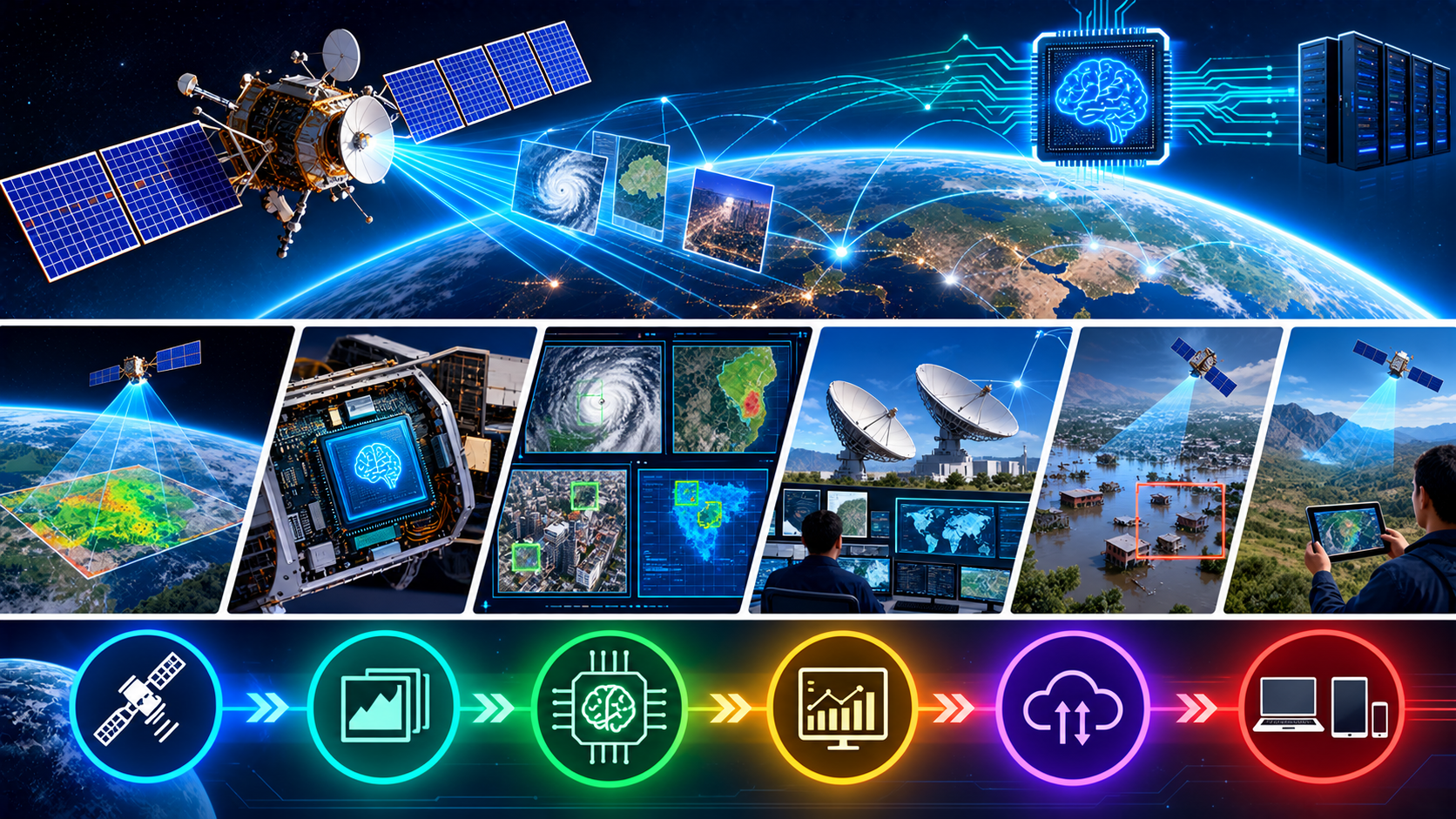
The global satellite industry is entering a new phase of digital transformation as satellite operators, manufacturers, commercial organizations, governments, and defense agencies increasingly integrate artificial intelligence, onboard processing, advanced sensors, digital payloads, high performance computing, automation, and intelligent data management into space systems. This transformation is accelerating the development of next generation satellites capable of processing, analyzing, and managing information closer to the point where it is collected.
The satellite industry is evolving beyond conventional spacecraft that primarily collect data and transmit it to ground stations for processing. Modern satellite systems increasingly combine onboard computing, artificial intelligence, advanced communication payloads, high resolution sensors, digital signal processing, autonomous operations, cloud connectivity, and sophisticated ground infrastructure. The result is a shift from traditional data collection satellites toward intelligent space platforms capable of performing increasingly complex processing and decision support functions.
According to MarketsandMarkets, the Global Satellites Market Size was valued at USD 23.28 billion in 2026 and is projected to reach USD 58.37 billion by 2032, growing at a CAGR of 16.6% from 2026 to 2032. In terms of volume, the market is expected to reach 7,748 units by 2032 from 4,383 units in 2026. Market growth is driven by expanding satellite networks, increasing demand for communication and Earth observation services, rising commercial involvement, and ongoing government and defense investments in space infrastructure.
Satellite Market Enters an Investment Driven Growth Phase
Next generation satellite systems are increasingly attracting investment because organizations require greater processing capabilities, faster data handling, improved communication performance, and more autonomous space operations. Traditional satellite architectures often relied heavily on ground infrastructure for data processing and analysis. The growing availability of onboard computing and artificial intelligence is changing this model by allowing satellites to perform more processing tasks in space.
The growing adoption of advanced satellite technologies is creating opportunities across the complete space technology ecosystem. Satellite manufacturers, processor developers, sensor companies, artificial intelligence providers, communication payload manufacturers, software developers, ground infrastructure companies, cloud providers, and data analytics organizations are increasingly becoming part of the satellite ecosystem.
The underlying opportunity is not limited to the satellite platform itself. A complete next generation satellite solution can include the spacecraft bus, power systems, propulsion, sensors, communication payloads, onboard processors, artificial intelligence software, data storage, navigation systems, ground stations, cloud infrastructure, analytics platforms, and network management capabilities.
The projected expansion of the global satellite market provides a strong foundation for this transformation. The market is expected to increase from USD 23.28 billion in 2026 to USD 58.37 billion by 2032, while satellite volume is projected to increase from 4,383 units to 7,748 units during the same period.
AI Is Transforming Satellite Operations
Artificial intelligence is becoming an important technology shaping the evolution of satellite systems. Earlier satellite workflows generally depended heavily on ground based processing, predefined operating procedures, and manual analysis. Modern systems increasingly incorporate AI for data processing, anomaly detection, image analysis, operational optimization, autonomous decision support, and network management.
AI can help satellites process information collected from onboard sensors and communication systems. Instead of transmitting all raw information to Earth, intelligent processing can help identify relevant information and support more efficient use of communication resources.
For Earth observation satellites, AI can support the analysis and classification of imagery and sensor information. Satellite systems can identify objects, monitor environmental changes, analyze terrain, and detect specific patterns within collected datasets.
For communication satellites, AI can support network optimization, capacity management, traffic analysis, and system monitoring.
For satellite operators, this transition can move satellites from data collection platforms toward intelligent information processing systems.
The convergence of satellite technology, artificial intelligence, onboard computing, advanced sensors, and data analytics is therefore creating new opportunities throughout the global satellite ecosystem.
Onboard Processing Is Expanding Satellite Capabilities
Onboard processing represents one of the most important areas of innovation in next generation satellite systems. Traditional satellite architectures often transmitted large quantities of raw data to ground stations before processing and analysis. As satellite sensors become more capable, this approach can generate significant communication and processing requirements.
Onboard processing can allow satellites to perform selected computational tasks before transmitting information to Earth.
This can support more efficient data management by reducing the amount of unnecessary information transmitted through communication links.
Advanced onboard processors can support image processing, signal processing, data filtering, object identification, compression, and other computational functions depending on satellite requirements.
The increasing availability of high performance processors is expanding the capabilities of satellites and creating opportunities for semiconductor companies, processor manufacturers, software developers, and satellite system integrators.
The integration of onboard computing with AI can further increase satellite intelligence by enabling systems to analyze information closer to the source.
Advanced Sensors Are Expanding Satellite Intelligence
Sensor technology represents an important area of innovation within next generation satellite systems. Different satellite applications require different forms of information, and modern platforms can integrate increasingly sophisticated sensors according to mission requirements.
High resolution optical sensors remain important for Earth observation applications. Other sensing technologies can support different requirements related to environmental monitoring, weather observation, mapping, scientific research, and defense applications.
The increasing availability of advanced sensors is expanding the amount and complexity of information collected by satellites.
This creates a need for more capable onboard processing systems.
Rather than transmitting every piece of collected information to ground stations, satellites equipped with intelligent processing capabilities can analyze selected data before transmission.
This combination of advanced sensors and onboard intelligence can improve the efficiency of satellite data workflows.
The modular integration of sensors, processors, communication systems, and software is creating opportunities for satellite manufacturers and specialized technology providers.
Autonomous Satellite Operations Are Changing Space Workflows
Autonomy is becoming an important development shaping the future of satellite systems. Traditional satellite operations required substantial interaction between spacecraft and ground control infrastructure. Modern satellites increasingly incorporate automated systems for monitoring, navigation, resource management, and operational decision making.
Autonomous satellite operations can allow spacecraft to respond to certain conditions without requiring continuous human intervention.
AI based systems can analyze spacecraft information and identify operational conditions that require attention.
Automated systems can also support mission planning, resource management, payload scheduling, and other operational activities.
This capability becomes increasingly valuable as satellite constellations expand and the number of spacecraft operating in orbit increases.
As satellite networks become larger and more complex, autonomous technologies can support more efficient management of space assets.
The growing sophistication of autonomous satellite systems is therefore helping transform spacecraft from remotely controlled platforms into increasingly intelligent space systems.
Satellite Data Processing Is Increasing the Value of Space Assets
Satellite data represents an important source of value within the space ecosystem. Satellites can collect large quantities of imagery, sensor information, communication data, and operational information.
The value of satellite technology therefore extends beyond the spacecraft itself.
Organizations can use processed satellite information for communication, Earth observation, environmental monitoring, mapping, defense, scientific research, infrastructure monitoring, and other applications.
Onboard processing can increase the efficiency of this workflow by allowing satellites to perform selected computational tasks before data reaches ground infrastructure.
Artificial intelligence can further support the identification and classification of information within satellite datasets.
The increasing integration of satellite platforms with advanced processing technologies is contributing to the growing importance of software within the satellite ecosystem.
Satellite hardware provides the platform for collecting and transmitting information, while software and processing technologies increasingly determine how efficiently that information can be converted into useful insights.
Edge Computing Is Creating New Satellite Opportunities
The movement of computing capabilities closer to the source of data is creating new opportunities for satellite systems.
Space based edge computing can allow satellites to process information before transmitting it to Earth. This can be particularly relevant when satellites collect large quantities of data or operate in environments where communication capacity is limited.
Onboard processing can support data filtering and prioritization.
Instead of transmitting all collected information, satellite systems can identify data that is considered more relevant for downstream processing.
This can improve communication efficiency while potentially reducing the amount of ground processing required.
The integration of edge computing, AI, and satellite sensors is therefore creating a new generation of intelligent spacecraft architectures.
This development can create opportunities for processor manufacturers, software developers, satellite manufacturers, and companies specializing in space based computing technologies.
Earth Observation Is Becoming More Intelligent
Earth observation represents an important application area for advanced satellite systems. Modern Earth observation satellites can collect high volumes of imagery and sensor information across large geographic areas.
The increasing resolution and frequency of satellite observations are generating growing data volumes.
AI and onboard processing can help manage this information by identifying relevant features and supporting automated analysis.
Satellite systems can process collected information to support applications such as environmental monitoring, land observation, infrastructure assessment, agriculture, disaster monitoring, and other activities.
The combination of advanced sensors and intelligent processing can transform Earth observation from a primarily image collection activity into a more automated information generation workflow.
This is increasing the strategic value of onboard computing within the Earth observation satellite ecosystem.
Communication Satellites Are Becoming More Intelligent
Communication satellites are another major application area for next generation satellite technologies. Communication networks are experiencing increasing demand for bandwidth, flexibility, and efficient resource management.
Advanced communication payloads can support high capacity connectivity, while digital processing technologies can increase flexibility in managing communication resources.
AI can support communication network optimization by analyzing traffic patterns and network conditions.
Onboard processing can also contribute to more flexible communication architectures by enabling digital signal processing closer to the source.
The integration of intelligent processing and advanced communication payloads can help satellite operators manage increasingly complex communication networks.
As satellite connectivity becomes more integrated with terrestrial communication infrastructure, the importance of intelligent satellite systems is expected to increase.
Digital Payloads Are Expanding Satellite Flexibility
Digital payload technologies are becoming increasingly important in next generation satellite architectures. Traditional satellite payloads were often designed around relatively fixed configurations. Digital systems can provide greater flexibility in how communication resources and payload functions are managed.
Digital signal processing can support dynamic management of communication capacity and payload resources.
This can help satellite operators respond to changing communication requirements.
Digital payloads can also create closer integration between satellite hardware and software.
This shift is changing the competitive landscape within the satellite industry. Satellite manufacturers increasingly need capabilities across physical spacecraft engineering, digital processing, software, networking, and data management.
The result is an increasingly software driven satellite ecosystem in which digital capabilities become a major differentiating factor.
Commercial Applications Are Expanding Satellite Demand
Commercial involvement is becoming an important factor supporting satellite market expansion. Private organizations are increasingly participating in satellite manufacturing, communication services, Earth observation, data analytics, launch services, ground infrastructure, and space based applications.
The increasing participation of commercial companies is creating demand for more capable and flexible satellite systems.
Commercial satellite operators are seeking technologies that can improve data processing, reduce operational complexity, optimize communication capacity, and provide faster access to useful information.
AI and onboard processing can support these objectives by improving satellite intelligence and reducing dependence on ground based processing for certain tasks.
The broader commercial ecosystem is therefore creating opportunities for companies developing processors, sensors, software, AI systems, communication payloads, and satellite platforms.
Cloud Platforms Are Transforming Satellite Data Management
Satellite systems can generate large quantities of data that require storage, processing, visualization, and distribution.
Cloud platforms can provide infrastructure for managing satellite datasets and enabling authorized users to access processed information from different locations.
The combination of satellites, onboard processing, cloud computing, and analytics is creating an integrated digital workflow.
Satellite systems can perform selected processing functions in space while cloud infrastructure can support more extensive processing, storage, visualization, and analysis on Earth.
This creates a distributed processing environment connecting spacecraft and terrestrial computing infrastructure.
The growing integration of satellite systems with cloud platforms is also creating opportunities for subscription based satellite data services and digital applications.
Software Is Becoming a Major Competitive Factor
One of the most significant changes in the satellite industry is the growing importance of software.
The physical satellite provides the platform for collecting, processing, and transmitting information, but software increasingly determines how efficiently these functions are managed.
Modern satellite software capabilities can support autonomous operations, onboard data processing, AI based analytics, image analysis, signal processing, network management, anomaly detection, resource allocation, data compression, and satellite health monitoring.
These capabilities are expanding competition beyond traditional satellite manufacturers.
Companies that can combine reliable spacecraft hardware with advanced processors, AI software, analytics, and digital infrastructure can provide more complete solutions rather than individual satellite components.
The increasing importance of software is also creating opportunities for technology companies that may not have traditionally operated within the satellite manufacturing industry.
Improved Processing Systems Are Supporting More Efficient Missions
Processing capabilities remain an important area of satellite innovation.
Higher processing performance can allow satellites to handle larger datasets and execute increasingly sophisticated algorithms.
This can be particularly valuable for Earth observation satellites collecting high resolution imagery and other sensor information.
Improved processing efficiency can also support communication applications where satellite systems need to manage large quantities of digital information.
Efficient processors can contribute to mission productivity by enabling satellites to perform more computational tasks without requiring equivalent increases in ground infrastructure.
As processor technologies continue to improve, the operational capabilities of next generation satellites are expected to expand.
Connectivity Is Enabling More Integrated Satellite Operations
Modern satellite systems increasingly depend on connectivity between spacecraft, ground stations, network operations centers, cloud infrastructure, and end users.
Reliable communication links support mission monitoring, data transmission, satellite control, and information distribution.
Connectivity also enables satellites to become part of broader digital ecosystems.
Satellite platforms can increasingly interact with cloud systems, terrestrial networks, analytics platforms, communication infrastructure, and other space assets.
The result is a shift from isolated satellite operations toward integrated space and terrestrial data ecosystems.
This trend is creating opportunities for communication technology providers, cloud companies, software developers, satellite manufacturers, and network infrastructure providers.
Challenges Could Slow Adoption of Intelligent Satellite Systems
Despite strong growth prospects, several challenges remain within the global satellite ecosystem.
Advanced satellite systems can require significant investment in spacecraft development, processors, sensors, software, testing, launch, and ground infrastructure.
Onboard AI and processing technologies also introduce technical requirements related to computing performance, power consumption, thermal management, reliability, and radiation tolerance.
Space based computing systems must operate under demanding environmental conditions while maintaining high levels of reliability.
Data management can also become a challenge as satellite sensors generate increasingly large quantities of information.
Cybersecurity represents another important consideration as satellites become increasingly connected to ground networks, cloud infrastructure, and other digital systems.
Addressing these challenges will be important for converting technological advances into scalable next generation satellite architectures.
Investment and Innovation Are Expanding Across the Satellite Ecosystem
The growth of the global satellite market is encouraging investment across multiple technology areas. According to MarketsandMarkets, the Global Satellites Market is projected to increase from USD 23.28 billion in 2026 to USD 58.37 billion by 2032, representing a CAGR of 16.6%. The corresponding satellite market volume is projected to increase from 4,383 units in 2026 to 7,748 units by 2032.
This growth reflects expanding satellite networks, increasing demand for communication and Earth observation services, rising commercial involvement, and ongoing government and defense investments in space infrastructure.
For next generation satellite systems, these developments create opportunities across satellite platforms, processors, sensors, communication payloads, artificial intelligence, onboard computing, software, cloud infrastructure, cybersecurity, and analytics.
The competitive environment is consequently becoming broader and more technology driven.
Future Outlook for Next Generation Satellite Systems
The future of satellite systems is expected to move toward increasingly autonomous, intelligent, processing capable, and digitally integrated platforms.
The next generation of satellites is likely to combine advanced sensors, onboard computing, artificial intelligence, digital payloads, high performance processors, autonomous operations, cloud connectivity, and real time analytics.
Rather than operating as standalone spacecraft, satellites are increasingly becoming components of broader digital information ecosystems.
Communication satellites can use intelligent processing to improve network performance. Earth observation satellites can analyze information closer to the source. Government and defense organizations can use autonomous satellite capabilities to support mission requirements. Commercial operators can use AI and onboard processing to develop more efficient satellite services.
The broader satellite market provides an important foundation for this transformation. MarketsandMarkets projects the global satellite market to reach USD 58.37 billion by 2032, while satellite volume is projected to reach 7,748 units during the same period.
Next Generation Satellites Are Becoming Intelligent Data Platforms
The Global Satellite Industry is moving into a new phase defined by artificial intelligence, onboard processing, advanced sensing, digital payloads, autonomous operations, cloud computing, and integrated data workflows.
The growth of the broader satellite industry is creating a strong technology foundation for this transformation. Expanding satellite networks, increasing demand for communication and Earth observation services, commercial participation, and government and defense investments are supporting continued development across the space infrastructure ecosystem.
The most important opportunity may extend beyond the growth of individual spacecraft. The convergence of satellite hardware with AI, onboard processors, advanced sensors, digital payloads, cloud platforms, and analytics is creating an integrated intelligent satellite ecosystem.
For satellite operators, these technologies can provide more efficient and scalable approaches to processing information and managing space assets.
For communication and Earth observation organizations, onboard intelligence can improve the way satellite data is collected, processed, and delivered.
For technology companies, opportunities exist across satellite platforms, processors, sensors, communication payloads, autonomous software, AI systems, data analytics, cloud infrastructure, and cybersecurity.
As satellite technology continues to advance, next generation spacecraft are likely to evolve from traditional remotely managed platforms into intelligent space based data systems capable of processing information, optimizing operations, and supporting increasingly sophisticated communication and observation missions.
80% of the Forbes Global 2000 B2B companies rely on MarketsandMarkets to identify growth opportunities in emerging technologies and use cases that will have a positive revenue impact.
- Food Packaging Market Size Set for Strong Growth Through 2030 Amid Rising Demand for Convenience Foods
- Crop Protection Chemical Market Size, Share & Growth Forecast (2025–2030)
- Mulch Films Market: Driving Sustainable Agriculture Through Innovation
- Agricultural Adjuvants Market Analysis, Trends, and Growth Outlook (2026–2031)
- Japan Enterprise Asset Management Market Growth: AI and Smart Infrastructure Drive Demand


