

Inertial Navigation Systems Market: Investment Trends, Funding Opportunities, and Growth Outlook Through 2030
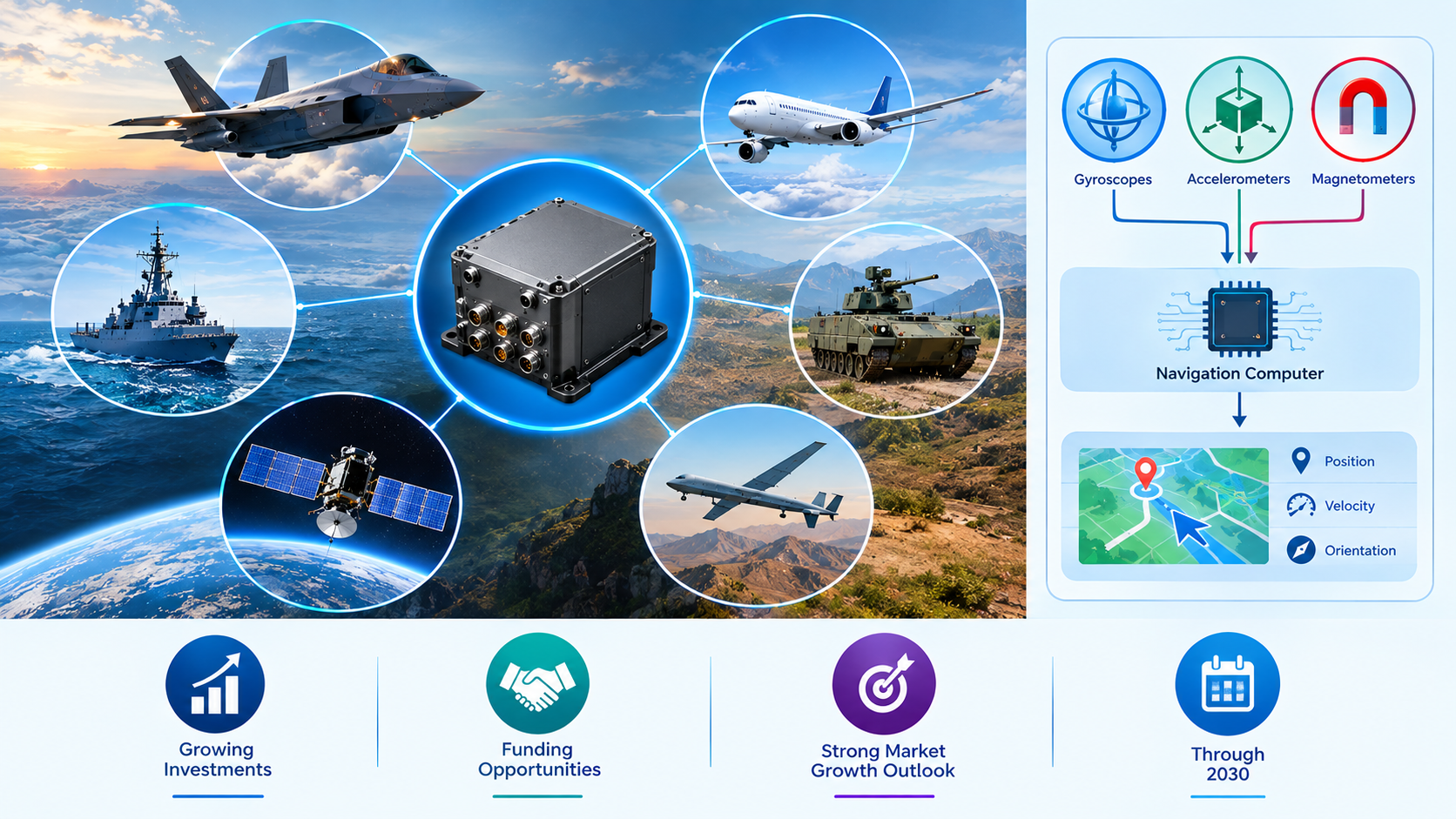
The global defense, aerospace, maritime, automotive, and industrial sectors are entering a new phase of navigation modernization as platforms increasingly require accurate positioning, orientation, and motion information in environments where conventional navigation signals may be unavailable or unreliable. This transformation is accelerating demand for inertial navigation systems (INS), inertial measurement units (IMUs), gyroscopes, accelerometers, and integrated navigation technologies across aircraft, unmanned systems, missiles, ships, vehicles, spacecraft, and industrial platforms. As positioning requirements become more demanding, the Inertial Navigation Systems Market is emerging as an increasingly important component of modern navigation and autonomous operations.
The Inertial Navigation Systems Market is also evolving beyond traditional navigation applications. Defense organizations and commercial operators are increasingly deploying inertial technologies alongside satellite navigation, radar, optical sensors, GNSS, LiDAR, and other positioning technologies. This is creating hybrid navigation architectures capable of maintaining accurate positioning when GPS or other satellite-based navigation signals are degraded, disrupted, or unavailable. The result is a shift toward resilient, multi-sensor navigation systems that combine inertial data with external references to deliver reliable positioning across increasingly complex operating environments.
Inertial Navigation Systems Market Enters an Investment-Driven Growth Phase
Navigation accuracy is becoming increasingly important as military and commercial platforms become more autonomous, connected, and digitally integrated. Aircraft, ships, ground vehicles, UAVs, spacecraft, and precision systems require continuous information about their position, velocity, orientation, and movement. Inertial navigation systems provide this information by measuring acceleration and angular motion, allowing platforms to estimate their movement without depending exclusively on external navigation signals.
This capability is particularly valuable for defense platforms operating in contested electromagnetic environments. Electronic warfare and GNSS interference can reduce the reliability of satellite-based positioning, increasing demand for navigation systems capable of maintaining performance independently for periods of time. Commercial users are also seeking resilient navigation for aircraft, autonomous vehicles, maritime platforms, industrial equipment, and other applications where uninterrupted positioning is important.
According to MarketsandMarkets, the Global Inertial Navigation System Market Size was valued at USD 9.42 billion in 2026 and is projected to reach USD 11.92 billion by 2030, growing at a CAGR of 6.1% from 2025–2030. Market growth is being supported by rising demand for accurate navigation across defense and commercial platforms and the increasing requirement for reliable navigation in GPS-denied environments.
This growth is creating opportunities across the broader inertial technology ecosystem, including:
-
Inertial navigation systems
-
Inertial measurement units
-
Gyroscopes and accelerometers
-
Fiber optic gyroscopes
-
Ring laser gyroscopes
-
MEMS-based inertial sensors
-
Navigation computers
-
Sensor-fusion software
-
GNSS/INS integrated systems
GPS-Denied Navigation Is Transforming the INS Investment Landscape
One of the strongest factors supporting investment in inertial navigation technology is the growing need for positioning when GPS or GNSS signals cannot be relied upon. Modern defense operations increasingly occur in environments where satellite navigation signals may be intentionally disrupted through jamming or interference. Even outside military environments, signal obstruction can occur inside buildings, underground facilities, urban environments, tunnels, and other locations where satellite signals are weak.
Inertial navigation provides an important alternative because it does not require continuous communication with external navigation infrastructure. An INS can calculate changes in position and orientation using measurements from onboard inertial sensors. Although accumulated errors can cause drift over time, integrating inertial navigation with other sensors can significantly improve long-duration accuracy.
This is encouraging investment in navigation architectures that combine INS with complementary technologies such as GNSS, radar, cameras, LiDAR, celestial navigation, terrain-reference systems, and other external positioning sources.
The market opportunity therefore extends beyond standalone inertial systems toward resilient navigation architectures capable of switching between multiple navigation references depending on operating conditions.
Advanced Inertial Sensors Are Driving Technology Innovation
The performance of an inertial navigation system depends heavily on the quality of its underlying sensors. Accelerometers measure linear acceleration while gyroscopes measure angular velocity. Improvements in these components directly influence navigation accuracy, stability, size, weight, power consumption, and cost.
Traditional high-performance navigation systems have relied on technologies such as ring laser gyroscopes and fiber optic gyroscopes for demanding defense and aerospace applications. At the same time, MEMS technology is expanding the addressable market by enabling smaller and more cost-effective inertial sensors.
The evolution of MEMS-based inertial technology is particularly important for UAVs, autonomous vehicles, robotics, industrial equipment, and other platforms where size, weight, power, and cost are critical considerations.
As sensor manufacturers improve bias stability, scale-factor accuracy, vibration resistance, temperature compensation, and calibration, inertial systems are becoming suitable for an increasingly broad range of applications. This creates investment opportunities for companies developing next-generation gyroscopes, accelerometers, IMUs, and sensor-processing technologies.
Defense Applications Remain a Major Growth Opportunity
Defense is one of the most important application areas for inertial navigation systems because military platforms require reliable navigation under challenging operating conditions. Aircraft, missiles, ships, armored vehicles, UAVs, artillery systems, submarines, and other defense platforms can use inertial navigation to maintain positioning and orientation.
For military aircraft, INS technology supports navigation, flight control, stabilization, and mission systems. For missiles and precision systems, inertial sensors can provide critical motion and orientation data during flight. For naval platforms, inertial navigation can support operations where GPS availability may be limited, including underwater environments.
The increasing focus on electronic warfare is further strengthening the strategic importance of resilient navigation. When satellite navigation signals are disrupted, platforms need alternative sources of positioning information. Inertial navigation therefore becomes an important component of navigation resilience.
Defense modernization programs are consequently creating opportunities for companies that can deliver high-performance navigation systems capable of operating in demanding environments while meeting stringent size, weight, power, reliability, and security requirements.
Aviation Is Expanding Demand for High-Accuracy Navigation
The aviation industry represents another important opportunity for the Inertial Navigation Systems Market. Commercial aircraft, military aircraft, helicopters, UAVs, and advanced air mobility platforms depend on navigation systems for flight management, stabilization, guidance, and situational awareness.
Modern aircraft increasingly use integrated navigation architectures that combine inertial sensors with GNSS and other navigation references. This approach improves accuracy while providing additional resilience when one navigation source becomes unavailable.
The emergence of autonomous aircraft and advanced UAVs is creating additional demand. Unmanned aircraft require reliable navigation for autonomous flight, route following, obstacle avoidance, landing, and mission execution. As UAVs become capable of operating with reduced human intervention, the reliability of onboard navigation becomes increasingly important.
The expansion of autonomous aviation therefore creates opportunities for compact, lightweight, low-power inertial navigation technologies capable of delivering high accuracy without adding excessive weight or complexity.
Autonomous Vehicles Are Creating New Commercial Opportunities
The growth of autonomous and connected vehicles is expanding the role of inertial navigation beyond traditional aerospace and defense applications. Autonomous vehicles require continuous information about movement, orientation, and position to safely navigate their surroundings.
Inertial sensors can complement GNSS, cameras, LiDAR, radar, and other technologies. For example, when satellite positioning becomes temporarily unavailable, an inertial system can help maintain vehicle-state estimates while other sensors provide additional environmental references.
This makes INS technology relevant to autonomous cars, industrial vehicles, mining equipment, agricultural machinery, construction equipment, and mobile robots. The ability to integrate inertial measurements with perception and positioning technologies can improve navigation reliability across challenging operating environments.
As autonomous systems move from controlled demonstrations toward broader commercial deployment, navigation reliability is becoming an increasingly important purchasing criterion. This creates opportunities for companies providing integrated inertial and sensor-fusion solutions rather than standalone sensors alone.
Maritime and Underwater Navigation Creates a Major Opportunity
Maritime platforms have unique navigation requirements because satellite signals are unavailable or unreliable when vessels operate underwater. Submarines and autonomous underwater vehicles (AUVs) therefore rely heavily on inertial navigation and complementary technologies.
Inertial navigation systems can provide continuous information about an underwater platform's movement while additional technologies such as acoustic positioning, Doppler velocity logs, and other sensors can help reduce accumulated navigation errors.
The expansion of autonomous maritime operations is creating additional opportunities. Unmanned surface vessels and underwater systems are increasingly being developed for surveillance, inspection, oceanographic research, infrastructure monitoring, mine detection, and other applications.
As autonomous maritime platforms operate for longer periods without direct human control, reliable navigation becomes increasingly important. This is expected to support continued demand for high-performance inertial systems capable of operating in environments where conventional positioning infrastructure is unavailable.
Sensor Fusion Is Changing the Investment Outlook
The future of inertial navigation is increasingly connected to sensor fusion. Rather than relying on a single navigation source, modern platforms can combine data from multiple sensors to create a more accurate and resilient navigation solution.
An integrated navigation architecture may combine:
-
Inertial measurement units
-
GNSS/GPS
-
Radar
-
LiDAR
-
Cameras
-
Magnetometers
-
Doppler sensors
-
Celestial navigation
-
Terrain-reference systems
-
Barometric sensors
Sensor-fusion algorithms can compare measurements from different sources and compensate for the limitations of individual technologies. This can improve positioning accuracy and reduce the effects of inertial drift.
The development of sophisticated sensor-fusion software is therefore becoming an important investment opportunity. Companies that combine advanced inertial hardware with navigation algorithms, AI-enabled processing, and real-time sensor fusion can potentially create more differentiated solutions than providers focused exclusively on individual sensors.
AI and Software Are Reshaping Inertial Navigation
Artificial intelligence is increasingly being integrated into navigation systems to improve sensor interpretation, error correction, positioning, and autonomous decision-making. Traditional navigation algorithms rely heavily on mathematical models and predefined sensor characteristics. Modern systems can increasingly use machine learning techniques to identify patterns in sensor data and compensate for complex errors.
AI-enabled navigation could help address challenges associated with sensor drift, environmental changes, vibration, temperature variation, and unpredictable operating conditions.
The software opportunity is particularly important because navigation systems are becoming more computationally sophisticated. High-performance processors can process large quantities of sensor information in real time, allowing navigation systems to integrate multiple data sources and continuously estimate platform position and orientation.
This shift is creating investment opportunities in navigation software, AI algorithms, embedded computing, digital signal processing, and sensor-fusion platforms.
Inertial Navigation Investment Is Increasingly Focused on Miniaturization
Miniaturization is another major trend shaping the Inertial Navigation Systems Market. Smaller platforms require navigation technologies that occupy less space and consume less power while maintaining sufficient accuracy.
MEMS-based inertial sensors are particularly relevant to this trend. Their compact size and scalability make them attractive for UAVs, robotics, autonomous vehicles, wearable systems, industrial equipment, and other applications.
As autonomous systems become smaller, the demand for miniature navigation systems is expected to increase. This creates opportunities for manufacturers capable of delivering compact IMUs and navigation systems without compromising performance.
The combination of miniaturization, low power consumption, advanced calibration, and improved sensor accuracy could significantly expand the number of platforms capable of incorporating inertial navigation.
Cybersecurity and Navigation Resilience Become Critical Requirements
As navigation systems become increasingly connected to broader digital architectures, cybersecurity is becoming an important consideration. Modern platforms may exchange navigation information across communication networks and integrate data from external systems.
For defense users, navigation data can be mission-critical. Manipulation or disruption of positioning information could affect platform operations. This makes secure system architecture, trusted software, protected communications, and resilient navigation important components of future INS development.
The increasing threat of GNSS interference also highlights the importance of navigation resilience. Platforms cannot always assume that satellite navigation signals will remain continuously available.
Consequently, investment is increasingly moving toward navigation architectures capable of maintaining acceptable performance during signal degradation or loss. INS technology can serve as a foundational layer within these resilient architectures.
Investment and Innovation Are Expanding Across Multiple Industries
The Inertial Navigation Systems Market is benefiting from demand across both defense and commercial sectors. Defense remains a critical application because of the need for reliable navigation in contested and GPS-denied environments. At the same time, aviation, maritime, automotive, industrial, and autonomous-system applications are expanding the commercial opportunity.
The convergence of inertial sensors with GNSS, AI, robotics, autonomous systems, and advanced computing is creating a broader navigation technology ecosystem. Companies that can serve multiple industries may benefit from diversified demand while specialized suppliers can focus on high-performance defense and aerospace applications.
The investment opportunity is therefore distributed across the value chain, including sensor manufacturers, navigation-system developers, semiconductor companies, software providers, autonomous-platform manufacturers, and system integrators.
Challenges Could Slow Inertial Navigation Market Adoption
Despite strong growth prospects, several challenges remain. One of the fundamental limitations of inertial navigation is accumulated error. Because an INS calculates movement from onboard measurements, even small sensor errors can accumulate over time and create position drift.
This makes calibration, sensor quality, algorithm development, and integration with external navigation references extremely important. High-performance inertial sensors can also be expensive, particularly when they require stringent accuracy and reliability for defense and aerospace applications.
Another challenge is balancing performance with size, weight, power consumption, and cost. Commercial platforms often require affordable and compact systems, while military and aerospace customers may prioritize accuracy and reliability.
Integration complexity can also increase when INS solutions need to operate with GNSS, radar, LiDAR, cameras, or other sensors. Addressing these challenges will be essential for expanding adoption across emerging autonomous and navigation-dependent applications.
Future Outlook for the Inertial Navigation Systems Market
The future of the Inertial Navigation Systems Market is expected to move toward increasingly accurate, compact, resilient, and software-defined navigation technologies. According to MarketsandMarkets, the market is projected to grow from USD 9.42 billion in 2026 to USD 11.92 billion by 2030, registering a CAGR of 6.1% from 2025–2030.
The market's future growth will be shaped by the increasing requirement for reliable positioning across defense and commercial platforms. GPS-denied and GPS-degraded environments will remain an important driver, particularly as electronic warfare capabilities and signal-interference risks increase.
At the same time, the expansion of autonomous vehicles, UAVs, robotics, advanced aircraft, maritime platforms, and industrial automation will create new demand for compact and cost-effective inertial navigation technologies.
The next generation of INS solutions is likely to combine advanced sensors, AI-enabled processing, GNSS integration, sensor fusion, and resilient navigation algorithms. Rather than functioning as isolated navigation equipment, inertial systems will increasingly become components of integrated positioning and autonomy architectures.
The Inertial Navigation Systems Market Is Moving Toward Resilient, Multi-Sensor Navigation
The Inertial Navigation Systems Market is entering an important phase of development driven by the convergence of navigation resilience, autonomy, advanced sensors, and digital processing. The market is projected to reach USD 11.92 billion by 2030 from USD 9.42 billion in 2026, reflecting a 6.1% CAGR from 2025–2030, according to MarketsandMarkets.
However, the most important opportunity may extend beyond the growth of traditional inertial navigation equipment. The increasing requirement for reliable positioning in GPS-denied environments is encouraging the development of integrated navigation architectures that combine inertial sensors with GNSS, radar, LiDAR, cameras, acoustic systems, and other positioning technologies.
For defense organizations, these technologies can provide critical navigation resilience for aircraft, missiles, ships, UAVs, ground vehicles, and other military platforms.
For commercial technology companies and investors, opportunities are expanding across aviation, autonomous vehicles, maritime systems, robotics, industrial automation, and advanced mobility.
The convergence of MEMS sensors, fiber optic gyroscopes, advanced accelerometers, AI, sensor fusion, edge computing, and resilient navigation algorithms is expected to reshape the competitive landscape.
As autonomous and connected platforms become increasingly dependent on accurate positioning, inertial navigation is likely to evolve from a specialized navigation technology into a foundational component of resilient autonomous systems. The next stage of market development will therefore not be defined simply by improvements in individual gyroscopes or accelerometers, but by how effectively inertial technologies can be integrated with multiple sensors, intelligent software, and autonomous platforms to deliver reliable navigation under increasingly challenging conditions.
Market source: MarketsandMarkets – Inertial Navigation System Market: https://www.marketsandmarkets.com/Market-Reports/inertial-navigation-system-market-154810661.html
80% of the Forbes Global 2000 B2B companies rely on MarketsandMarkets to identify growth opportunities in emerging technologies and use cases that will have a positive revenue impact.
- Food Packaging Market Size Set for Strong Growth Through 2030 Amid Rising Demand for Convenience Foods
- Crop Protection Chemical Market Size, Share & Growth Forecast (2025–2030)
- Mulch Films Market: Driving Sustainable Agriculture Through Innovation
- Agricultural Adjuvants Market Analysis, Trends, and Growth Outlook (2026–2031)
- Japan Enterprise Asset Management Market Growth: AI and Smart Infrastructure Drive Demand


