

Ka, K, and Ku Band Small Satellite Technology Innovation: Key Trends, Growth Drivers and Opportunities
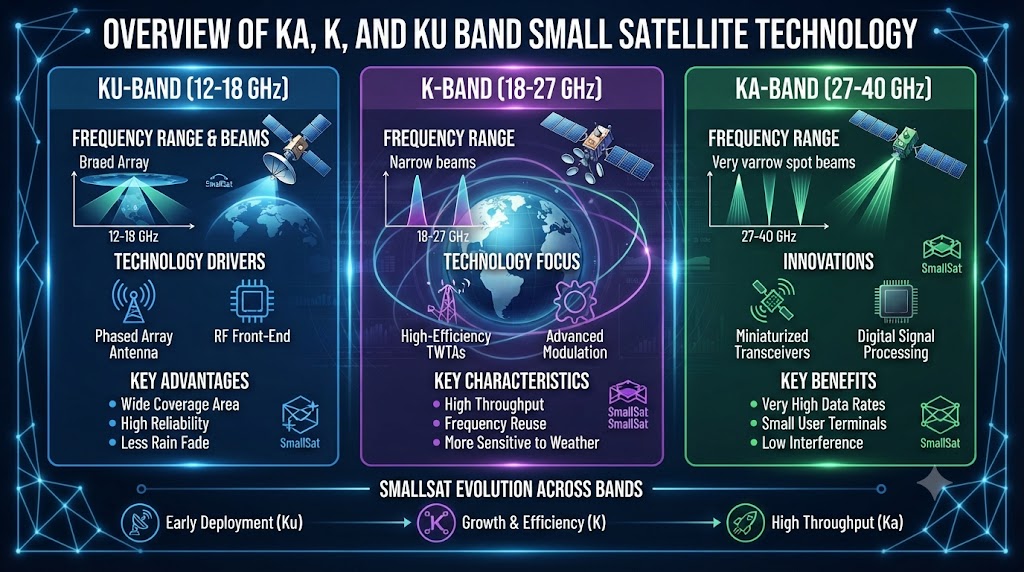
Introduction to Ka, K, and Ku Band Small Satellite Technology
In the rapidly evolving space technology landscape, Ka, K, and Ku Band Small Satellites have emerged as a transformative innovation, revolutionizing satellite communications, broadband connectivity, Earth observation, and data transmission capabilities. These small satellite systems leverage advanced radio frequency bands to provide high-speed communication services, support growing data requirements, and enable efficient connectivity across commercial, government, defense, and scientific applications.
Unlike traditional large satellite platforms, small satellites offer advantages such as reduced development costs, shorter manufacturing cycles, flexible deployment options, and the ability to operate as part of large satellite constellations. The increasing demand for high-throughput satellite communications, broadband internet connectivity, and real-time data services is driving investments in Ka, K, and Ku Band technologies. As satellite manufacturers and operators continue to develop advanced antennas, high-frequency payloads, electronically steered antennas, and sophisticated communication systems, Ka, K, and Ku Band Small Satellites are becoming increasingly important in the next generation of space-based connectivity. As we explore the future of this technology, we uncover a realm of exciting possibilities and transformative advancements that promise to reshape satellite communications and global connectivity.
History of Ka, K, and Ku Band Small Satellite Technology
The development of satellite communication technologies has evolved significantly since the beginning of the space age. Early communication satellites primarily operated using lower-frequency bands that provided reliable connectivity but offered limited bandwidth and data transmission capacity. As demand for satellite communications increased, the use of higher-frequency bands, including Ku-band and later Ka-band, expanded significantly. These frequency bands provided greater bandwidth and enabled satellite operators to deliver higher-capacity communication services.
The emergence of small satellite technologies has further transformed the industry. Advances in miniaturized electronics, lightweight components, high-performance processors, and compact satellite payloads have made it possible to integrate sophisticated communication capabilities into smaller spacecraft. Today, Ka, K, and Ku Band Small Satellites are being deployed as individual spacecraft and as part of large satellite constellations. These systems are supporting broadband internet, mobile connectivity, Earth observation, defense communications, and other data-intensive applications.
Benefits of Ka, K, and Ku Band Small Satellite Technology
Ka, K, and Ku Band Small Satellite technology offers numerous advantages over traditional satellite communication systems:
-
High Data Transmission Capacity: Higher-frequency bands provide greater bandwidth, enabling faster transmission of large volumes of data for broadband and communication applications.
-
Compact and Cost-Effective Platforms: Small satellites can be developed and launched at lower costs compared with traditional large satellite platforms, making space-based connectivity more accessible.
-
Flexible Deployment: Small satellites can be launched individually or in constellations, providing operators with flexible options for expanding network coverage.
-
Global Connectivity: Ka, K, and Ku Band satellite systems can provide communication services across remote and underserved regions where terrestrial infrastructure is limited or unavailable.
Current Market Size and Growth Trends of Ka, K, and Ku Band Small Satellite Industry
The Ka, K, and Ku Band Small Satellite market has witnessed significant growth as demand for high-speed satellite communications and broadband connectivity continues to increase. The expansion of satellite constellations, growing data consumption, and increasing investments in commercial and government space programs are supporting the development of advanced small satellite communication technologies.
According to MarketsandMarkets, the global Ka, K, and Ku Band Small Satellite Market size was valued at USD 4.24 Billion in 2025 and is projected to reach USD 13.59 Billion by 2030, growing at a CAGR of 26.2% from 2026 to 2030.
This rapid growth can be attributed to several factors, including:
-
Increasing demand for high-speed broadband and satellite internet connectivity
-
Growing deployment of small satellite constellations for communication applications
-
Rising investments in commercial and government space programs
-
Increasing adoption of high-throughput satellite communication technologies
-
Advancements in miniaturized satellite payloads and high-frequency communication systems
As global demand for reliable and high-capacity connectivity continues to increase, Ka, K, and Ku Band Small Satellites are expected to play an increasingly important role in expanding communication networks and supporting next-generation space-based services.
Key Drivers and Factors Influencing the Future of Ka, K, and Ku Band Small Satellite Technology
Several key drivers and factors are shaping the future of Ka, K, and Ku Band Small Satellite technology:
-
Growing Demand for High-Speed Connectivity: Increasing global demand for broadband internet, video streaming, cloud services, and data-intensive applications is driving the need for high-capacity satellite communication networks.
-
Expansion of Small Satellite Constellations: The deployment of large satellite constellations is increasing the demand for compact spacecraft capable of providing continuous and low-latency communication services.
-
Advancements in Satellite Technology: Innovations in antennas, digital payloads, onboard processors, and communication systems are improving the capabilities of small satellites.
-
Increasing Demand for Remote Connectivity: Satellite networks are becoming increasingly important for connecting rural, remote, maritime, and underserved regions where terrestrial communication infrastructure is difficult to deploy.
-
Growing Government and Defense Applications: Governments and defense organizations are investing in resilient satellite communication systems for secure communications, surveillance, intelligence, and mission-critical connectivity.
Emerging Trends in Ka, K, and Ku Band Small Satellite Technology
The future of Ka, K, and Ku Band Small Satellite technology is shaped by several exciting trends and innovations:
-
High-Throughput Small Satellites: Advanced small satellites are increasingly being designed to support high-throughput communication services, enabling faster and more efficient data transmission.
-
Large Satellite Constellations: Operators are developing large constellations of small satellites to improve network coverage, reduce communication latency, and increase system redundancy.
-
Electronically Steered Antennas: Advanced phased-array and electronically steered antenna technologies are enabling satellites to dynamically manage communication beams and improve connectivity.
-
Onboard Digital Processing: The integration of advanced digital processors enables satellites to dynamically process and route data, improving network efficiency and flexibility.
-
Multi-Band Satellite Systems: Future satellite platforms are increasingly incorporating multiple frequency bands to provide flexible communication services across diverse applications and geographic regions.
Opportunities and Challenges in the Ka, K, and Ku Band Small Satellite Market
As the Ka, K, and Ku Band Small Satellite market continues to evolve, it presents numerous opportunities for businesses, satellite operators, and technology providers alike:
-
Market Expansion: The growing demand for satellite broadband, telecommunications, Earth observation, and government connectivity services offers significant growth opportunities for companies operating in this market.
-
Innovation and Product Differentiation: Companies investing in advanced satellite payloads, miniaturized communication systems, high-performance antennas, and digital technologies can gain a competitive advantage.
-
Satellite Constellation Development: The increasing deployment of small satellite constellations creates opportunities across satellite manufacturing, launch services, ground infrastructure, communication systems, and satellite operations.
However, the Ka, K, and Ku Band Small Satellite market also faces several challenges that need to be addressed:
-
Signal Interference and Atmospheric Effects: Higher-frequency satellite signals can be more susceptible to atmospheric attenuation and weather-related disruptions, requiring advanced system design and signal management technologies.
-
Spectrum Management Challenges: Increasing satellite deployments are creating greater demand for limited radio frequency spectrum, making spectrum coordination and regulatory compliance increasingly important.
-
Space Debris and Orbital Congestion: The rapid growth of small satellite constellations raises concerns about orbital congestion and space debris, requiring responsible satellite deployment and end-of-life management.
-
High Competition and Infrastructure Requirements: The development of satellite networks requires significant investment in spacecraft, launch services, ground stations, and network infrastructure, creating financial and operational challenges for new market entrants.
Innovations and Advancements in Ka, K, and Ku Band Small Satellite Technology
The future of Ka, K, and Ku Band Small Satellite technology is being shaped by a multitude of innovative technologies and advancements:
-
Advanced Phased-Array Antennas: Electronically steered phased-array antennas enable flexible beam management and support dynamic communication links without requiring traditional mechanical antenna movement.
-
Software-Defined Payloads: Software-defined satellite payloads allow operators to reconfigure communication capabilities in orbit, providing greater flexibility to respond to changing network requirements.
-
Digital Beamforming Technology: Advanced digital beamforming enables satellite operators to optimize coverage areas and dynamically allocate capacity based on changing user demand.
-
AI-Enabled Satellite Network Management: Artificial intelligence and machine learning can optimize satellite network performance, predict equipment issues, manage bandwidth, and improve resource allocation.
-
Integration with 5G and Next-Generation Networks: Ka, K, and Ku Band Small Satellites are increasingly being integrated with terrestrial communication networks, creating hybrid connectivity solutions capable of supporting seamless communication across different environments.
Future Applications and Industries That Will Benefit from Ka, K, and Ku Band Small Satellite Technology
The future of Ka, K, and Ku Band Small Satellite technology holds immense potential across a wide range of applications and industries:
-
Telecommunications and Broadband: Small satellite networks will continue supporting high-speed broadband services, particularly in remote and underserved regions.
-
Earth Observation: High-capacity satellite communication systems can support the transmission of large volumes of Earth observation data from remote sensing and imaging satellites to ground stations.
-
Defense and Government: Government and defense organizations can benefit from secure and resilient satellite communications for military operations, intelligence, surveillance, and mission-critical applications.
-
Maritime and Aviation: Ships, aircraft, and other mobile platforms can use satellite communication networks to maintain reliable connectivity across oceans and remote regions.
-
Disaster Management and Emergency Communications: Satellite networks can provide critical communication services when terrestrial infrastructure is damaged or unavailable following natural disasters and emergencies.
-
Internet of Things (IoT) and Connected Devices: Small satellite constellations can support large-scale IoT connectivity for applications such as asset tracking, environmental monitoring, logistics, and industrial operations.
Conclusion: The Promising Future of Ka, K, and Ku Band Small Satellite Technology
The future of Ka, K, and Ku Band Small Satellite technology is brimming with exciting possibilities and transformative advancements. As global demand for high-speed connectivity and data-intensive services continues to grow, small satellites operating across advanced communication frequency bands will play an increasingly important role in expanding the reach and capacity of satellite networks. From high-throughput satellite communications and large-scale constellations to electronically steered antennas, software-defined payloads, AI-enabled network management, and integration with 5G networks, the future of Ka, K, and Ku Band Small Satellites promises to revolutionize the way communication services are delivered from space. However, realizing the full potential of this technology will require continued research and development, addressing challenges related to spectrum availability, signal interference, space debris, orbital congestion, cybersecurity, and infrastructure costs. Collaboration among satellite manufacturers, communication providers, launch companies, regulators, governments, and technology developers will be crucial in driving innovation and enabling the widespread adoption of next-generation satellite communication systems.
As we look ahead, one thing is certain: the future of Ka, K, and Ku Band Small Satellite technology is bright, and its impact will be felt across virtually every aspect of global connectivity, ushering in a new era of high-capacity, flexible, resilient, and accessible space-based communication solutions. Discover the latest advancements and solutions in Ka, K, and Ku Band Small Satellite technology by exploring comprehensive market research and industry analysis. Stay ahead of emerging satellite communication trends and explore how advanced small satellite platforms, high-throughput payloads, and next-generation connectivity technologies are shaping the future of the global space industry.
Download Sample Research Report for Ka, K, and Ku Band Small Satellite Market Future:
https://www.marketsandmarkets.com/Market-Reports/ka-k-ku-band-small-satellite-market-91938491.html
80% of the Forbes Global 2000 B2B companies rely on MarketsandMarkets to identify growth opportunities in emerging technologies and use cases that will have a positive revenue impact.
- Food Packaging Market Size Set for Strong Growth Through 2030 Amid Rising Demand for Convenience Foods
- Crop Protection Chemical Market Size, Share & Growth Forecast (2025–2030)
- Mulch Films Market: Driving Sustainable Agriculture Through Innovation
- Agricultural Adjuvants Market Analysis, Trends, and Growth Outlook (2026–2031)
- Japan Enterprise Asset Management Market Growth: AI and Smart Infrastructure Drive Demand


