

Delivery Drones Technology Innovation: Key Trends, Growth Drivers, and Future Opportunities
Introduction to Delivery Drones Technology
Delivery drones are transforming the future of logistics by enabling autonomous, rapid, and cost-efficient transportation of goods. These unmanned aerial vehicles (UAVs) are designed to transport packages, medical supplies, food products, retail goods, and critical shipments directly to consumers or businesses with minimal human intervention.
Driven by advances in artificial intelligence, autonomous navigation, battery technologies, computer vision, and communication systems, delivery drones are becoming a key component of next-generation logistics networks. Organizations across e-commerce, healthcare, retail, and transportation sectors are increasingly exploring drone delivery solutions to improve efficiency, reduce delivery times, and enhance customer satisfaction.
As demand for faster and more sustainable delivery services continues to rise, Delivery Drone Technology is emerging as one of the most disruptive innovations in the logistics and transportation industry.
History of Delivery Drone Technology
The concept of unmanned aerial vehicles has existed for decades, primarily within military applications. The commercialization of drone technology accelerated during the early 21st century with advancements in lightweight materials, GPS systems, battery performance, and autonomous flight controls.
Initially used for aerial photography, surveillance, and inspection, drones quickly gained attention as potential delivery platforms. Major technology companies, logistics providers, and retailers began investing in drone delivery programs aimed at reducing delivery times and overcoming last-mile logistics challenges.
Today, delivery drones are being tested and deployed worldwide for commercial package delivery, healthcare logistics, emergency response, and remote-area transportation.
Benefits of Delivery Drones Technology
Delivery drones offer numerous advantages over traditional delivery methods.
1. Faster Delivery Times
Autonomous drones can significantly reduce delivery times by bypassing road congestion and traveling directly to destinations.
2. Reduced Operational Costs
Drone-based delivery systems can lower transportation and labor costs associated with traditional logistics operations.
3. Enhanced Accessibility
Delivery drones can reach remote, rural, and geographically challenging locations where conventional transportation may be limited.
4. Environmental Sustainability
Electric-powered drones produce lower emissions compared to many conventional delivery vehicles.
5. Improved Emergency Response
Drones can rapidly transport medical supplies, vaccines, blood products, and emergency equipment during critical situations.
Current Market Size and Growth Trends of the Delivery Drones Industry
The delivery drones market has witnessed remarkable growth due to increasing e-commerce activity, advancements in autonomous technologies, and growing demand for rapid delivery services.
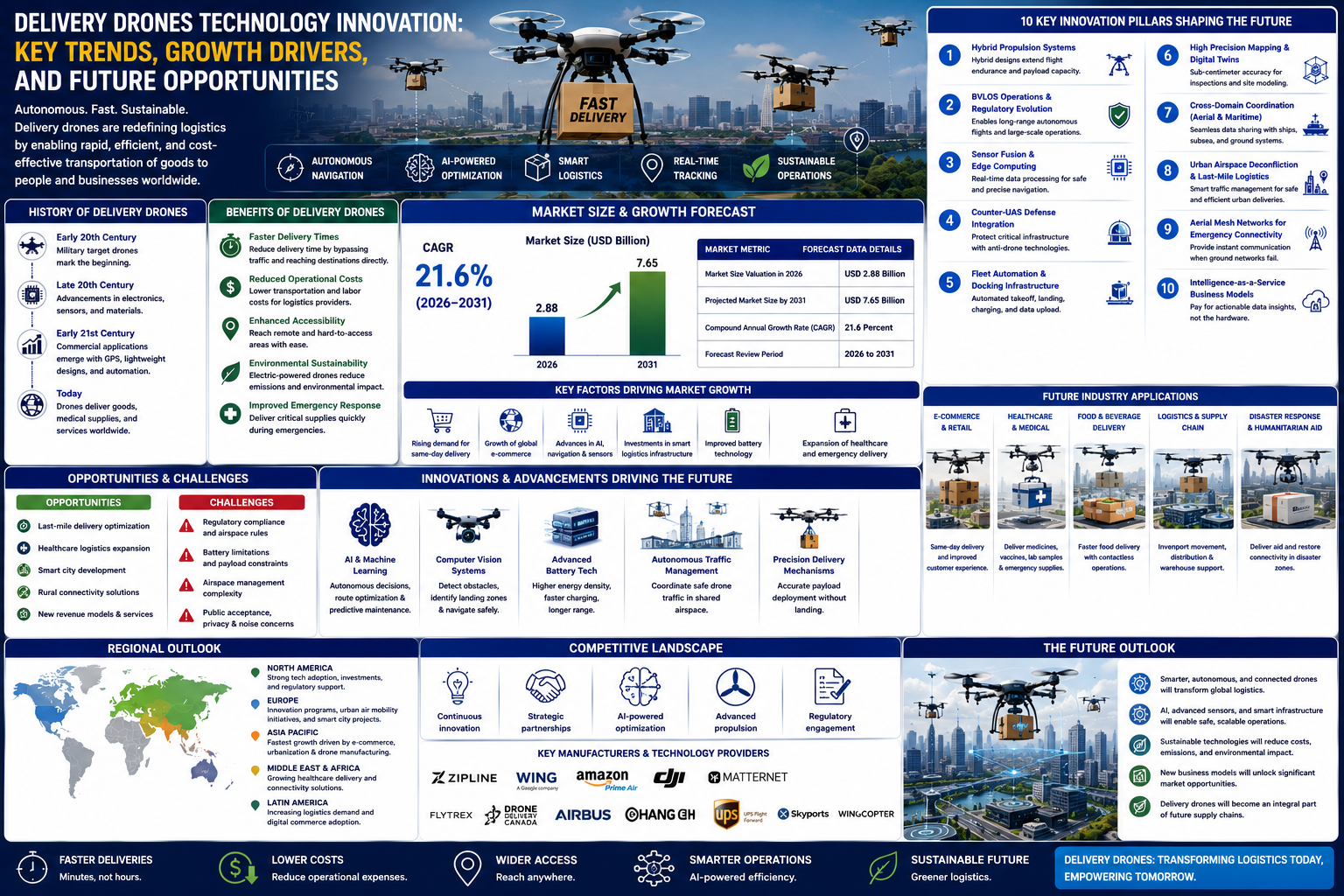
According to MarketsandMarkets, the Global Delivery Drones Market Size was valued at USD 2.88 billion in 2026 and is projected to reach USD 7.65 billion by 2031, growing at a CAGR of 21.6% from 2026 to 2031.
This rapid market expansion can be attributed to several factors:
-
Rising demand for same-day and instant delivery services
-
Growth of global e-commerce platforms
-
Advancements in autonomous navigation and AI technologies
-
Increasing investments in smart logistics infrastructure
-
Growing adoption of drone delivery in healthcare applications
-
Expansion of urban air mobility ecosystems
-
Improved battery technologies and flight capabilities
Key Drivers and Factors Influencing the Future of Delivery Drones Technology
Several factors are accelerating innovation within the delivery drones market.
1. E-Commerce Growth
The rapid expansion of online retail is creating demand for faster, more efficient last-mile delivery solutions.
2. Artificial Intelligence Advancements
AI-powered flight control systems enable autonomous navigation, obstacle avoidance, route optimization, and operational efficiency.
3. Labor Shortages in Logistics
Many logistics providers are exploring drone technologies to address workforce shortages and improve operational scalability.
4. Urban Congestion Challenges
Drone delivery offers an alternative to congested urban transportation networks.
5. Regulatory Progress
Evolving aviation regulations are enabling broader commercial deployment of drone delivery services.
Emerging Trends in Delivery Drones Technology
The future of delivery drones is being shaped by several exciting innovations.
1. Beyond Visual Line of Sight (BVLOS) Operations
BVLOS capabilities are expanding operational range and enabling large-scale drone delivery networks.
2. AI-Powered Autonomous Navigation
Advanced machine learning algorithms are improving flight safety, route planning, and delivery precision.
3. Swarm Drone Technologies
Multiple drones operating collaboratively can enhance delivery efficiency and logistics scalability.
4. Hybrid Propulsion Systems
Manufacturers are developing hybrid-electric systems to increase flight endurance and payload capacity.
5. Smart Logistics Integration
Delivery drones are increasingly being integrated into digital supply chain management platforms and smart city ecosystems.
Opportunities and Challenges in the Delivery Drones Market
The delivery drones market presents substantial opportunities while facing important challenges.
Opportunities
1. Last-Mile Delivery Optimization
Drone technology can dramatically improve the efficiency of last-mile logistics operations.
2. Healthcare Logistics Expansion
Medical delivery applications represent one of the fastest-growing opportunities for drone deployment.
3. Smart City Development
Future urban infrastructure may increasingly incorporate drone delivery corridors and automated logistics hubs.
4. Rural Connectivity Solutions
Drones can provide reliable delivery services in underserved and remote regions.
Challenges
1. Regulatory Compliance
Drone operators must comply with evolving aviation regulations and airspace management requirements.
2. Battery Limitations
Current battery technologies continue to constrain flight duration and payload capacity.
3. Airspace Management Complexity
The safe integration of drones into existing airspace systems remains a significant challenge.
4. Public Acceptance and Privacy Concerns
Addressing concerns related to safety, privacy, and noise pollution is critical for widespread adoption.
Innovations and Advancements in Delivery Drones Technology
Several breakthrough technologies are shaping the future of autonomous drone delivery.
1. Artificial Intelligence and Machine Learning
AI enables autonomous decision-making, route optimization, predictive maintenance, and operational efficiency.
2. Computer Vision Systems
Advanced cameras and sensors allow drones to detect obstacles, identify landing zones, and navigate complex environments.
3. Advanced Battery Technologies
New battery innovations are improving flight endurance, charging speed, and operational range.
4. Autonomous Traffic Management Systems
Drone traffic management platforms help coordinate safe operations within increasingly crowded airspace.
5. Precision Delivery Mechanisms
Innovative payload deployment systems enable accurate package delivery without requiring drones to land.
Future Applications and Industries That Will Benefit from Delivery Drone Technology
The future of delivery drones extends across multiple industries.
1. E-Commerce and Retail
Retailers will increasingly utilize drones for same-day and rapid package delivery services.
2. Healthcare and Medical Logistics
Hospitals and healthcare providers can leverage drones for transporting medications, vaccines, laboratory samples, and emergency supplies.
3. Food and Beverage Delivery
Restaurants and food delivery platforms are exploring drone-based delivery models to improve customer service.
4. Logistics and Supply Chain Management
Drones will support inventory movement, warehouse operations, and distribution network optimization.
5. Disaster Response and Humanitarian Aid
Emergency organizations can deploy drones to deliver critical supplies during natural disasters and humanitarian crises.
6. Industrial Operations
Mining, energy, and infrastructure companies can use delivery drones to transport tools, spare parts, and critical equipment to remote worksites.
Regional Analysis of the Global Delivery Drones Market
North America
North America leads the delivery drones market due to strong technology adoption, supportive regulatory initiatives, and significant investments from major logistics and technology companies.
Europe
European countries are actively investing in drone innovation programs, smart city infrastructure, and advanced air mobility initiatives.
Asia Pacific
Asia Pacific is expected to experience the fastest growth due to expanding e-commerce ecosystems, urbanization, and increasing drone manufacturing capabilities.
Middle East & Africa
The region is witnessing growing interest in drone logistics solutions for healthcare delivery, smart city projects, and remote-area connectivity.
Latin America
Rising demand for efficient logistics solutions and growing digital commerce adoption are supporting market growth across Latin America.
Competitive Landscape of the Delivery Drones Market
The delivery drones market is highly competitive, characterized by continuous innovation, technology partnerships, and investments in autonomous logistics ecosystems.
Key competitive strategies include:
-
Development of autonomous navigation technologies
-
Expansion of drone delivery networks
-
AI-powered logistics optimization
-
Advanced battery and propulsion innovations
-
Strategic partnerships with retailers and logistics providers
-
Regulatory engagement and compliance initiatives
Key Manufacturers and Technology Providers in the Delivery Drones Industry
Several companies are leading innovation within the delivery drone ecosystem.
-
Zipline
-
Wing
-
Amazon Prime Air
-
DJI
-
Matternet
-
Flytrex
-
Drone Delivery Canada
-
Airbus
-
EHang Holdings Limited
-
UPS Flight Forward
-
Skyports
-
Wingcopter
These organizations continue investing in autonomous flight systems, advanced logistics platforms, AI-driven navigation technologies, and scalable drone delivery infrastructure.
Conclusion: The Promising Future of Delivery Drones Technology
Delivery drone technology is revolutionizing logistics by enabling faster, smarter, and more sustainable delivery operations. Advances in artificial intelligence, autonomous navigation, battery performance, computer vision, and airspace management are rapidly transforming drone delivery from pilot projects into commercially viable logistics solutions.
As the global Delivery Drones Market grows from USD 2.88 billion in 2026 to USD 7.65 billion by 2031, organizations across retail, healthcare, logistics, and transportation sectors will continue investing in drone technologies to enhance efficiency and customer satisfaction.
While challenges related to regulation, airspace integration, battery limitations, and public acceptance remain, continued innovation is expected to unlock significant growth opportunities. The future of delivery drones promises highly connected, autonomous logistics networks capable of transforming how goods move across cities, rural communities, and global supply chains.
Discover the latest advancements and opportunities shaping the future of delivery drone technology and explore how autonomous aerial logistics is redefining modern delivery services.
Download Sample Research Report for Delivery Drones Market Future @ https://www.marketsandmarkets.com/pdfdownloadNew.asp?id=10580366
80% of the Forbes Global 2000 B2B companies rely on MarketsandMarkets to identify growth opportunities in emerging technologies and use cases that will have a positive revenue impact.
- Food Packaging Market Size Set for Strong Growth Through 2030 Amid Rising Demand for Convenience Foods
- Mulch Films Market: Driving Sustainable Agriculture Through Innovation
- Agricultural Adjuvants Market Analysis, Trends, and Growth Outlook (2026–2031)
- Crop Protection Chemical Market Size, Share & Growth Forecast (2025–2030)
- Japan Enterprise Asset Management Market Growth: AI and Smart Infrastructure Drive Demand

