

The Global Military Drone Investment Boom: From Tactical UAVs to Autonomous Fleets
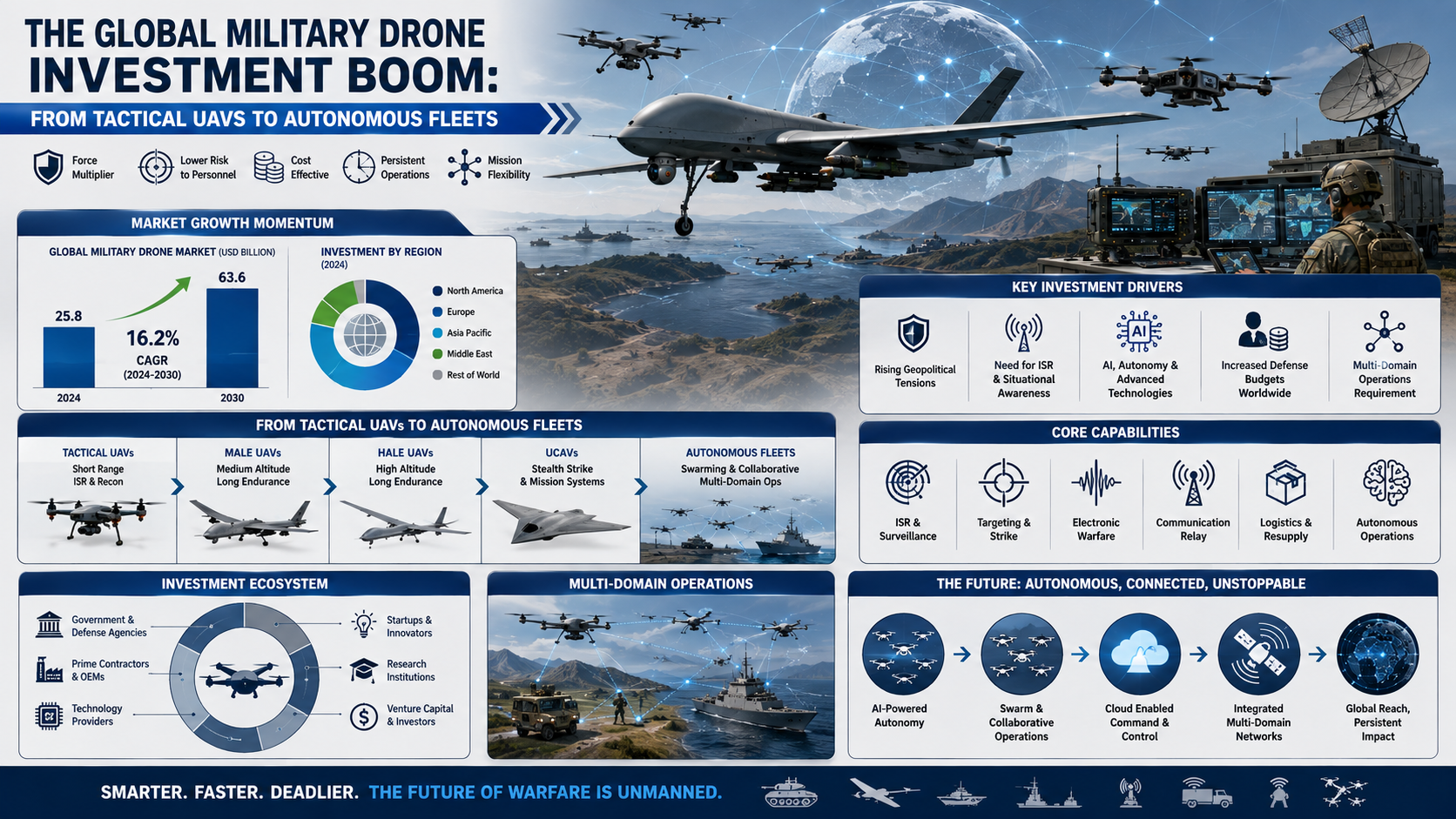
In the rapidly changing defense landscape, military drones have evolved from specialized surveillance platforms into essential components of modern military operations. Unmanned aerial vehicles (UAVs) are increasingly being deployed for intelligence, surveillance, and reconnaissance (ISR), target acquisition, communications, logistics, electronic warfare, and other mission requirements. At the same time, advances in artificial intelligence, autonomy, sensors, propulsion, communications, and onboard computing are enabling the development of increasingly sophisticated unmanned platforms.
The growing availability of advanced military drones is also changing how defense forces approach procurement and force modernization. Rather than relying exclusively on a small number of expensive manned platforms, militaries are increasingly evaluating combinations of crewed aircraft, tactical UAVs, larger unmanned aircraft, loitering systems, and autonomous platforms.
This transformation is contributing to a global military drone investment boom. Governments are increasing procurement programs, developing indigenous UAV capabilities, and investing in technologies that can support increasingly networked and autonomous military operations. The shift is particularly important as defense organizations seek persistent surveillance, greater operational reach, and scalable unmanned capabilities.
Evolution of Military Drones
The development of military drones began with relatively simple remotely controlled aircraft used primarily for observation and training. Over time, advances in electronics, communications, satellite navigation, sensors, and flight-control systems enabled UAVs to perform increasingly complex missions.
Early military UAVs were primarily focused on reconnaissance. Modern systems, however, can perform a much wider range of missions. Tactical UAVs can provide battlefield intelligence, while larger systems can support long-endurance surveillance and persistent ISR. Other unmanned platforms are being developed for communications relay, electronic warfare, logistics, maritime surveillance, and autonomous operations.
The evolution of military drones can be broadly characterized by several major developments:
• Transition from remotely controlled systems toward increasingly autonomous platforms
• Integration of high-resolution electro-optical, infrared, radar, and multispectral sensors
• Development of longer-endurance and longer-range UAV platforms
• Integration of artificial intelligence and onboard data processing
• Increasing use of secure satellite and tactical communications
• Development of networked unmanned fleets capable of sharing information
The result is a military drone ecosystem that extends well beyond the traditional concept of a remotely piloted aircraft.
Benefits of Military Drones
Military drones offer numerous advantages over conventional manned platforms and can complement existing defense capabilities:
-
Persistent Surveillance: Long-endurance UAVs can remain airborne for extended periods, providing continuous intelligence and surveillance over areas of interest.
-
Reduced Risk to Personnel: Unmanned platforms can perform certain missions without placing a human pilot directly inside the aircraft.
-
Operational Flexibility: Military drones can be configured for different missions, including ISR, communications, surveillance, electronic warfare, and logistics.
-
Cost Scalability: Smaller tactical UAVs can provide capabilities at a potentially lower acquisition and operating cost than some traditional manned platforms.
-
Rapid Deployment: Compact UAVs can be transported and deployed relatively quickly, supporting tactical units and expeditionary operations.
-
Advanced Situational Awareness: Modern sensors can provide commanders with near-real-time information for planning and decision-making.
-
Autonomous Operations: Advances in autonomy allow UAVs to perform navigation, sensing, and mission functions with decreasing dependence on continuous human control.
Current Market Size and Growth Trends of the Military Drones Industry
The global Military Drones Market is experiencing strong growth as defense organizations increase investments in unmanned capabilities and incorporate UAVs into broader military modernization programs.
According to MarketsandMarkets, the Global Military Drones Market Size was valued at USD 34.85 billion in 2026 and is projected to reach USD 109.22 billion by 2031, growing at a CAGR of 25.7% from 2026 to 2031. The procurement volume of military drones is projected to grow from 16,157 units in 2026 to 26,544 units by 2031. The market is growing because of rising defense spending in major countries.
This rapid expansion reflects the increasing strategic importance of unmanned systems in defense planning. Governments are investing in new UAV fleets while also upgrading existing platforms with improved sensors, communications, autonomy, and mission systems.
Several factors are supporting this growth, including:
• Increasing defense spending by major military powers
• Growing procurement of tactical and strategic UAVs
• Increasing demand for persistent ISR capabilities
• Development of autonomous and semi-autonomous military platforms
• Increasing integration of AI into unmanned systems
• Growing requirements for battlefield situational awareness
• Expansion of military communications and network-centric warfare
• Increasing investment in domestic and indigenous UAV production
Key Drivers and Factors Influencing the Future of Military Drones
Several major drivers are shaping the continued expansion of military drone investments.
Rising Defense Spending
Increasing defense budgets are one of the most important factors supporting military UAV procurement.
Governments are allocating additional resources to surveillance, intelligence, autonomous systems, precision capabilities, and battlefield networking. Military drones can contribute to these requirements across multiple mission categories.
As defense organizations modernize their forces, UAVs are increasingly being considered alongside manned aircraft, ground systems, satellites, and other intelligence assets.
Growing Demand for ISR
Intelligence, surveillance, and reconnaissance remain among the most important applications for military drones.
UAVs can provide persistent aerial observation while carrying electro-optical, infrared, radar, and other sensing payloads. This can provide commanders with information needed to understand changing battlefield conditions.
The demand for persistent ISR is therefore expected to remain a fundamental driver of military drone procurement.
Increasing Need for Autonomous Systems
Autonomy is becoming a major focus of defense research and procurement.
Future military UAVs are expected to perform more functions independently, including navigation, obstacle avoidance, sensor management, target detection, and coordination with other unmanned systems.
This trend is creating opportunities for companies developing AI-enabled flight-control systems, autonomous mission software, and intelligent sensing technologies.
Network-Centric Warfare
Modern military operations increasingly depend on connected platforms sharing information.
Military drones can serve as airborne sensors and communications nodes within larger networks. Their ability to collect and transmit information can support distributed operations involving aircraft, ground vehicles, naval platforms, satellites, and command centers.
This is making communications and networking technologies increasingly important to the military drone ecosystem.
Indigenous UAV Development
Many countries are also seeking to develop domestic UAV capabilities.
Indigenous production can provide governments with greater control over supply chains, technology development, maintenance, upgrades, and future mission configurations.
This is contributing to investment in local manufacturing capabilities, UAV research, propulsion systems, sensors, communications, and autonomous technologies.
Emerging Trends in Military Drone Technology
The future of military drones is being shaped by several technological trends.
1. AI-Powered Military Drones
Artificial intelligence is expected to become increasingly important in military UAV operations.
AI can assist with object detection, image analysis, navigation, route planning, sensor management, and other functions.
By processing information closer to the point of collection, AI-enabled UAVs can potentially provide faster situational awareness and reduce the volume of information that human operators must manually analyze.
2. Autonomous Drone Fleets
The industry is moving from individual UAV platforms toward networked fleets.
Multiple UAVs can potentially operate as coordinated groups, sharing information and distributing mission tasks.
This concept is creating new requirements for fleet management, secure communications, autonomous coordination, and collaborative decision-making.
3. Swarming Technologies
Swarm concepts represent an important area of military drone research.
A swarm can involve multiple unmanned platforms coordinating their activities to achieve a common mission objective. Advances in AI, communications, distributed computing, and autonomy are helping make increasingly sophisticated collaborative UAV operations possible.
4. Advanced ISR Sensors
Military drones are increasingly equipped with sophisticated sensing systems.
These include electro-optical and infrared cameras, synthetic aperture radar, multispectral sensors, electronic intelligence payloads, and other mission-specific technologies.
The combination of multiple sensors can provide more comprehensive battlefield awareness.
5. Edge Computing
Onboard computing is becoming increasingly important.
Rather than transmitting every piece of raw sensor data to a remote command center, UAVs can increasingly process information onboard and transmit relevant intelligence.
Edge computing can support faster decision-making while reducing communications bandwidth requirements.
Opportunities and Challenges in the Military Drones Market
The rapid expansion of military drone procurement creates significant opportunities for aerospace companies, defense contractors, electronics manufacturers, software developers, sensor providers, and communications companies.
Opportunities
-
Tactical UAVs: Increasing demand for small and medium-sized systems creates opportunities for manufacturers developing portable and rapidly deployable platforms.
-
Autonomous Fleets: The transition toward autonomous operations creates opportunities in AI, robotics, fleet management, and collaborative UAV technologies.
-
ISR Payloads: Growing surveillance requirements are driving demand for advanced electro-optical, infrared, radar, and multispectral payloads.
-
Military Communications: Networked UAVs require secure communications, data links, satellite connectivity, and tactical networking systems.
-
AI and Edge Computing: Processing sensor information onboard UAVs creates opportunities for specialized processors and AI software.
-
UAV Modernization: Existing military drone fleets require upgrades to sensors, avionics, communications, propulsion, and mission systems.
-
Indigenous Manufacturing: Government initiatives to strengthen domestic defense production are creating opportunities for local UAV manufacturers and technology suppliers.
However, the military drone market also faces several challenges.
The increasing sophistication of UAVs requires significant investment in research, development, testing, and cybersecurity. Military drones must operate reliably in demanding environments while maintaining secure communications and resistance to electronic interference.
Another challenge is the rapid evolution of counter-UAS technologies. As military forces deploy more drones, adversaries are simultaneously developing detection, tracking, electronic warfare, and other counter-drone capabilities.
This creates a continuous technology cycle in which UAV manufacturers must improve survivability, communications, autonomy, sensing, and mission flexibility.
Innovations and Advancements in Military Drone Technology
The future of military drones will be driven by advancements across aircraft design, sensors, communications, artificial intelligence, propulsion, and autonomy.
AI-Enabled Mission Systems
AI is increasingly being incorporated into UAV mission systems to support automated analysis and decision assistance.
Future platforms could use AI to analyze sensor information, identify objects, recognize patterns, and prioritize information for operators.
This will make AI an increasingly important differentiator in military drone development.
Autonomous Navigation
Autonomous navigation technologies allow UAVs to operate with greater independence.
Advanced flight-control systems can combine navigation sensors, onboard computing, terrain information, and obstacle detection to support increasingly sophisticated autonomous missions.
Advanced Communications
Secure and resilient communications are fundamental to networked military drone operations.
Future UAVs are expected to incorporate advanced tactical data links, satellite communications, broadband connectivity, and other technologies to maintain connectivity across distributed battlefields.
High-Endurance Platforms
Advances in propulsion, aerodynamics, lightweight materials, and energy management are enabling longer-endurance UAVs.
Greater endurance can provide persistent surveillance and allow UAVs to operate over larger areas without frequent recovery and replacement.
Manned-Unmanned Teaming
Military planners are increasingly exploring coordinated operations between manned and unmanned platforms.
UAVs can potentially act as additional sensors, communications nodes, or mission-support platforms operating alongside crewed aircraft and other military systems.
This concept could become increasingly important as militaries transition toward more distributed and connected force structures.
Future Applications and Industries That Will Benefit From Military Drones
1. Intelligence, Surveillance, and Reconnaissance
ISR will remain the largest and most important application area for military UAVs.
Long-endurance UAVs can provide persistent surveillance and support commanders with information about areas of interest.
2. Battlefield Operations
Tactical UAVs can provide battlefield units with aerial intelligence and situational awareness.
Small UAVs can be deployed by individual units, while larger systems can support broader operational missions.
3. Maritime and Naval Operations
Military drones are increasingly being evaluated for maritime surveillance and naval missions.
UAVs can support monitoring of maritime areas, reconnaissance, communications, and other naval requirements.
4. Border and Perimeter Surveillance
Military and security organizations can use long-endurance UAVs to monitor borders and large geographic areas.
The ability to remain airborne for extended periods can support persistent surveillance requirements.
5. Communications Relay
UAVs can function as airborne communications nodes.
By operating above the ground environment, they can help extend communications coverage between geographically separated forces and platforms.
6. Logistics and Resupply
Unmanned aircraft are also being developed for military logistics.
Cargo UAVs can potentially support the delivery of supplies to remote or difficult-to-access locations while reducing the need to expose conventional transportation assets to certain operational risks.
7. Autonomous Military Operations
Future applications will increasingly involve autonomous systems working as part of larger military networks.
This could include coordinated UAV fleets, autonomous sensing, networked ISR, and manned-unmanned teaming.
The Global Military Drone Investment Boom
The military drone industry is undergoing a fundamental transformation from individual UAV procurement toward increasingly integrated unmanned ecosystems.
Defense organizations are no longer evaluating drones solely on their airframe specifications. Increasingly, the overall value of a military UAV depends on its sensors, communications, autonomy, software, data processing, networking, and ability to operate as part of a broader force structure.
This is creating a new investment cycle across the defense technology industry.
The strongest investment areas include:
• Tactical UAVs: Small and medium-sized systems for battlefield ISR and situational awareness.
• Long-Endurance UAVs: Platforms designed to provide persistent surveillance over extended periods.
• Autonomous Fleets: Networked groups of UAVs capable of coordinating activities.
• AI Systems: Algorithms for sensing, navigation, classification, and mission management.
• Advanced Sensors: Radar, EO/IR, multispectral, and other mission payloads.
• Secure Communications: Resilient data links, SATCOM, and tactical networking.
• Edge Computing: Onboard processing for faster intelligence generation.
• Manned-Unmanned Teaming: Integration between crewed and unmanned military platforms.
The convergence of these capabilities is transforming military drones from standalone aircraft into connected nodes within modern defense architectures.
Future Outlook for the Military Drones Market
The future of the military drone industry is expected to be defined by increasing autonomy, networking, artificial intelligence, sensor fusion, and fleet-level operations.
According to MarketsandMarkets, the Global Military Drones Market is projected to grow from USD 34.85 billion in 2026 to USD 109.22 billion by 2031 at a CAGR of 25.7%. Procurement volume is also projected to increase from 16,157 units in 2026 to 26,544 units by 2031.
Future military drone programs are likely to emphasize platforms that can operate as part of connected systems rather than isolated aircraft.
AI-enabled autonomy could allow UAVs to process sensor information and perform increasingly complex mission functions. Advanced communications will connect drones with other aircraft, ground forces, naval platforms, satellites, and command centers.
At the same time, military organizations are expected to invest in a combination of UAV types rather than relying on one platform category. Small tactical UAVs can support frontline units, while larger systems can provide long-endurance ISR and specialized missions.
This multi-tier approach is likely to accelerate the development of distributed and autonomous military drone fleets.
The Future of Military Drone Investment
The global military drone market is entering a new phase of growth as governments increase defense spending and recognize the strategic value of unmanned systems.
According to MarketsandMarkets, the Global Military Drones Market Size was valued at USD 34.85 billion in 2026 and is projected to reach USD 109.22 billion by 2031, growing at a CAGR of 25.7% from 2026 to 2031.
The increase in procurement volume from 16,157 units in 2026 to 26,544 units by 2031 further demonstrates the growing emphasis on unmanned capabilities.
However, the future of military drones will not be defined simply by the number of aircraft purchased. The industry is moving toward intelligent, connected, autonomous, and increasingly distributed systems.
AI, advanced sensors, edge computing, secure communications, autonomous navigation, fleet coordination, and manned-unmanned teaming will increasingly determine the effectiveness of next-generation UAV capabilities.
As defense organizations seek greater situational awareness, persistent surveillance, operational flexibility, and scalable force structures, military drones are likely to become increasingly integrated into air, land, maritime, space, and networked operations.
The global military drone investment boom therefore represents more than an increase in UAV procurement. It signals a broader transformation toward software-enabled, autonomous, connected, and data-driven military operations.
As this transformation continues, the organizations that combine advanced aircraft platforms with AI, sensors, communications, autonomy, and resilient networking will be positioned to shape the next generation of military aviation.
Discover the latest military drone market insights, growth trends, technologies, and opportunities through MarketsandMarkets.
80% of the Forbes Global 2000 B2B companies rely on MarketsandMarkets to identify growth opportunities in emerging technologies and use cases that will have a positive revenue impact.
- Food Packaging Market Size Set for Strong Growth Through 2030 Amid Rising Demand for Convenience Foods
- Crop Protection Chemical Market Size, Share & Growth Forecast (2025–2030)
- Mulch Films Market: Driving Sustainable Agriculture Through Innovation
- Agricultural Adjuvants Market Analysis, Trends, and Growth Outlook (2026–2031)
- Japan Enterprise Asset Management Market Growth: AI and Smart Infrastructure Drive Demand


