

Satellite Communication Equipment Technology Innovation: Global Market Forecast
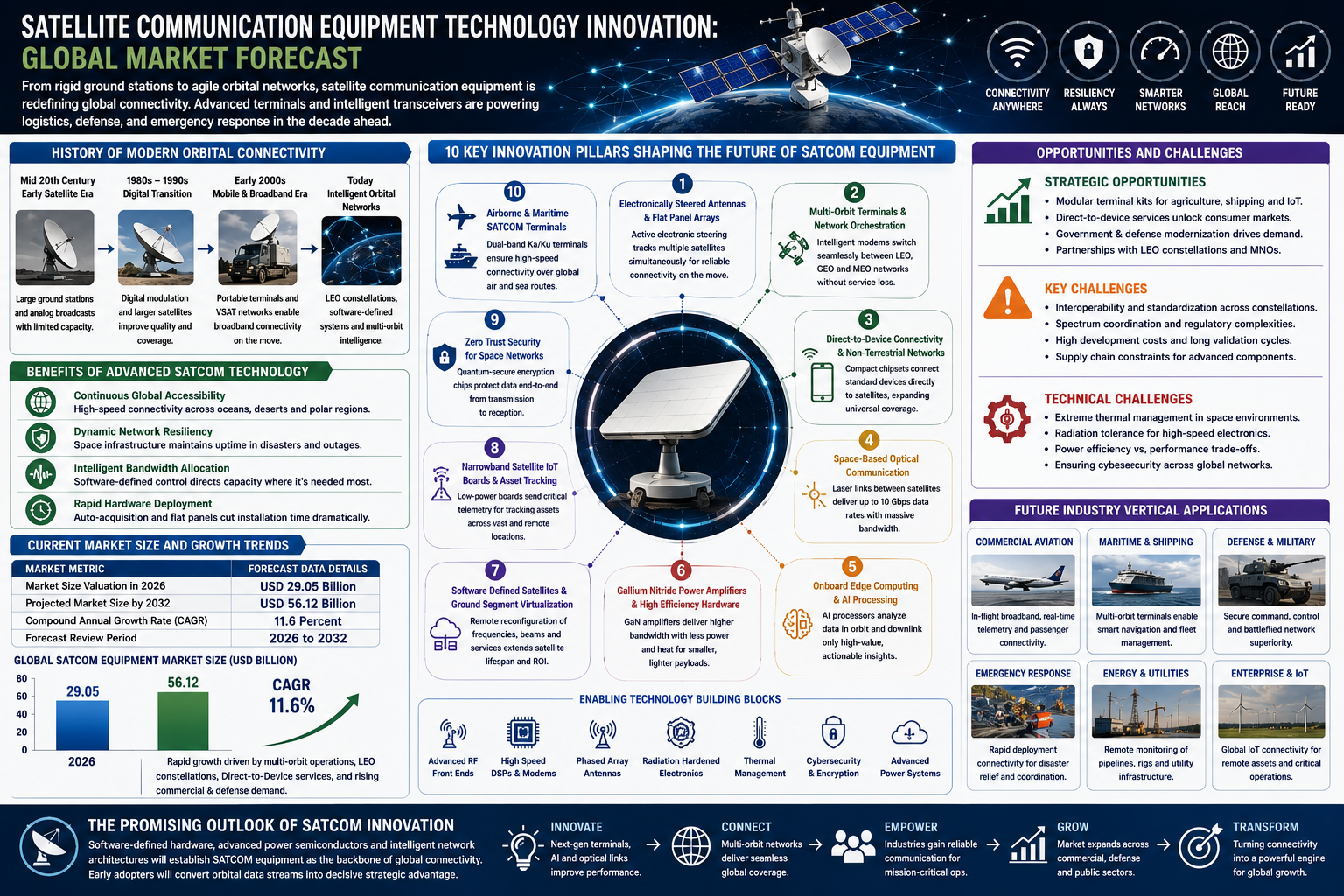
Introduction to Satellite Communication (SATCOM) Equipment Technology
Satellite Communication (SATCOM) equipment serves as the backbone of modern global communications, enabling reliable connectivity across oceans, remote regions, disaster zones, and areas where terrestrial networks are limited or unavailable. SATCOM technology encompasses a broad range of equipment, including satellite terminals, antennas, modems, transceivers, gateways, network management systems, and user terminals that facilitate data, voice, video, and broadband communication through space-based infrastructure.
Over the past decade, rapid advancements in satellite technology, digital communications, software-defined networking, and high-throughput satellites have revolutionized the SATCOM ecosystem. Today, satellite communication equipment plays a critical role in commercial telecommunications, military operations, aviation, maritime connectivity, emergency response, broadcasting, and Internet access services worldwide.
As demand for seamless global connectivity continues to grow, SATCOM Equipment Technology innovation is emerging as a key enabler of next-generation communication networks.
History of Satellite Communication Equipment Technology
The history of satellite communication dates back to the launch of the world's first communication satellites during the mid-20th century. Early satellite systems primarily supported television broadcasting and long-distance telecommunications.
The launch of geostationary communication satellites revolutionized global communications by enabling continuous coverage over large geographical regions. Over time, advancements in antenna technologies, satellite payloads, digital modulation techniques, and network management systems dramatically improved communication efficiency and reliability.
The emergence of Low Earth Orbit (LEO), Medium Earth Orbit (MEO), and High Throughput Satellite (HTS) constellations has further transformed the SATCOM landscape, enabling higher bandwidth, lower latency, and broader connectivity than ever before.
Benefits of Satellite Communication Equipment Technology
Satellite communication equipment offers several significant advantages:
1. Global Coverage
SATCOM systems provide communication services across virtually any location on Earth, including remote and underserved regions.
2. Network Reliability
Satellite networks remain operational during natural disasters, infrastructure failures, and emergency situations when terrestrial networks may be disrupted.
3. Scalability
Modern SATCOM equipment supports scalable communication architectures for enterprise, government, military, and consumer applications.
4. Enhanced Mobility
Satellite communication enables seamless connectivity for aircraft, ships, military vehicles, and mobile users operating beyond terrestrial network coverage.
5. Rapid Deployment
Satellite communication systems can be quickly deployed to support disaster recovery, emergency response, and temporary communication requirements.
Current Market Size and Growth Trends of the SATCOM Equipment Industry
The Satellite Communication Equipment market has experienced strong growth due to increasing demand for broadband connectivity, defense communications, satellite-enabled mobility services, and expanding satellite constellations.
According to MarketsandMarkets, the Global Satellite Communication (SATCOM) Equipment Market Size was valued at USD 29.05 billion in 2026 and is projected to reach USD 56.12 billion by 2032, growing at a CAGR of 11.6% from 2026 to 2032.
This remarkable market growth can be attributed to several key factors:
-
Growing deployment of Low Earth Orbit (LEO) satellite constellations
-
Increasing demand for high-speed satellite broadband services
-
Rising investments in military and defense communication networks
-
Expansion of connected aviation and maritime communication systems
-
Growth of remote enterprise connectivity solutions
-
Advancements in high-throughput satellite (HTS) technologies
-
Increasing need for resilient communication infrastructure during emergencies
Key Drivers and Factors Influencing the Future of SATCOM Equipment Technology
Several major factors are shaping the future of satellite communication equipment technology:
1. Rising Global Connectivity Demand
As digital transformation accelerates worldwide, the need for reliable connectivity in remote and underserved areas continues to drive SATCOM adoption.
2. Expansion of LEO Satellite Constellations
Large-scale satellite constellations are significantly increasing global broadband coverage while reducing communication latency.
3. Defense and Security Requirements
Military organizations increasingly rely on secure SATCOM networks for command-and-control, intelligence, surveillance, and tactical communications.
4. Growth of Mobility Applications
The aviation, maritime, transportation, and logistics sectors are driving demand for uninterrupted satellite-based connectivity.
5. Integration with 5G and Future Networks
Satellite communication systems are increasingly being integrated with terrestrial 5G and future 6G infrastructures to support hybrid connectivity models.
Emerging Trends in Satellite Communication Equipment Technology
The future of SATCOM technology is being shaped by several transformative trends:
1. Software-Defined SATCOM Networks
Software-defined technologies enable flexible network management, dynamic resource allocation, and improved operational efficiency.
2. Electronically Steered Antennas (ESAs)
Advanced flat-panel electronically steered antennas are replacing traditional mechanical systems, offering faster tracking and enhanced mobility.
3. Multi-Orbit Connectivity
Modern communication systems increasingly leverage GEO, MEO, and LEO satellite networks simultaneously to optimize performance and reliability.
4. Artificial Intelligence and Automation
AI-powered network management systems are improving bandwidth allocation, fault detection, and communication optimization.
5. High Throughput Satellite (HTS) Expansion
HTS technology is delivering significantly higher bandwidth capacities and lower cost-per-bit communication services.
Opportunities and Challenges in the SATCOM Equipment Market
The rapidly evolving SATCOM industry presents significant opportunities and challenges.
Opportunities
1. Broadband Expansion in Underserved Regions
Satellite communication can bridge the digital divide by delivering internet connectivity to remote communities.
2. Growth of Connected Mobility
Airlines, shipping companies, and transportation providers increasingly require high-speed satellite connectivity.
3. Defense Modernization Programs
Governments worldwide continue investing in secure, resilient satellite communication infrastructure.
4. Disaster Recovery Communications
Emergency response agencies rely heavily on satellite communications during infrastructure disruptions.
Challenges
1. High Infrastructure Costs
Developing and deploying advanced satellite communication systems requires substantial capital investment.
2. Spectrum Management
Increasing demand for satellite services creates challenges related to spectrum allocation and interference mitigation.
3. Cybersecurity Risks
Protecting satellite communication networks against cyber threats remains a critical priority.
4. Regulatory Complexity
Global satellite operations must comply with evolving international regulations and licensing requirements.
Innovations and Advancements in SATCOM Equipment Technology
The future of SATCOM equipment is being shaped by several groundbreaking innovations:
1. Electronically Steered Antenna Systems
Flat-panel antennas enable seamless connectivity for mobile platforms while reducing size, weight, and maintenance requirements.
2. Optical Satellite Communications
Laser-based communication technologies offer significantly higher data transmission rates compared to traditional radio-frequency systems.
3. AI-Enabled Network Optimization
Artificial intelligence improves network efficiency, resource allocation, predictive maintenance, and service quality.
4. Advanced Ground Station Infrastructure
Next-generation gateways and ground stations support higher throughput, improved resilience, and multi-orbit operations.
5. Software-Defined Payloads
Flexible satellite payload architectures allow operators to dynamically adapt network capabilities based on changing user requirements.
Future Applications and Industries That Will Benefit from SATCOM Technology
The future of satellite communication equipment extends across numerous industries and applications:
1. Telecommunications
Satellite networks will expand broadband access and complement terrestrial communication infrastructure.
2. Aviation
Commercial airlines will increasingly offer high-speed in-flight connectivity and operational communications.
3. Maritime Industry
Ships and offshore platforms will benefit from enhanced communication, navigation, and monitoring capabilities.
4. Defense and Security
Military organizations will continue leveraging SATCOM for secure communications, ISR operations, and mission-critical connectivity.
5. Disaster Management
Emergency responders will depend on satellite communications for resilient and rapid-response connectivity.
6. Energy and Mining
Remote industrial operations will utilize SATCOM networks to support automation, monitoring, and workforce communications.
7. Internet of Things (IoT)
Satellite-enabled IoT networks will connect millions of sensors and devices operating in remote environments worldwide.
Regional Analysis of the Global SATCOM Equipment Market
North America
North America dominates the SATCOM equipment market due to strong investments in commercial space programs, defense modernization, satellite broadband initiatives, and advanced communication technologies.
Europe
Europe continues to invest heavily in satellite communications to support defense, aviation, maritime operations, and digital infrastructure development.
Asia Pacific
Asia Pacific is expected to witness the fastest growth due to increasing satellite launches, expanding telecommunications infrastructure, and growing government investments in space programs.
Middle East & Africa
Growing demand for broadband connectivity, defense communications, and remote infrastructure monitoring is driving market expansion across the region.
Latin America
Satellite communication solutions are increasingly being deployed to improve connectivity across rural and geographically challenging regions.
Competitive Landscape of the SATCOM Equipment Market
The SATCOM equipment market is highly competitive, characterized by continuous innovation, strategic partnerships, satellite constellation deployments, and technological advancements.
Key competitive strategies include:
-
Development of advanced antenna technologies
-
Expansion of satellite broadband services
-
Multi-orbit communication capabilities
-
AI-enabled network management solutions
-
Strategic mergers and acquisitions
-
Integration of satellite and terrestrial networks
Key Manufacturers in the SATCOM Equipment Industry
Major companies shaping the SATCOM equipment market include:
-
Viasat, Inc.
-
Hughes Network Systems
-
Gilat Satellite Networks
-
L3Harris Technologies
-
Honeywell International Inc.
-
Thales Group
-
Cobham Satcom
-
Intellian Technologies
-
SES S.A.
-
EchoStar Corporation
-
ST Engineering iDirect
-
Airbus Defence and Space
-
Kratos Defense & Security Solutions
These companies continue investing in next-generation communication technologies, advanced antenna systems, software-defined networking, and integrated satellite communication solutions.
Conclusion: The Promising Future of SATCOM Equipment Technology
Satellite Communication (SATCOM) equipment technology is transforming the future of global communications by enabling reliable, secure, and high-speed connectivity across diverse environments and industries. Advances in high-throughput satellites, LEO constellations, software-defined networking, AI-powered optimization, and multi-orbit architectures are revolutionizing how data is transmitted around the world.
As the market grows from USD 29.05 billion in 2026 to USD 56.12 billion by 2032, organizations across telecommunications, defense, aviation, maritime, and industrial sectors will increasingly rely on advanced SATCOM solutions to meet evolving connectivity demands.
While challenges related to infrastructure costs, cybersecurity, and regulatory compliance remain, continued innovation and investment are expected to unlock substantial growth opportunities. The future of SATCOM equipment is bright, positioning satellite communications as a foundational component of next-generation global connectivity ecosystems.
Discover the latest advancements and solutions in Satellite Communication Equipment technology by exploring industry-leading innovations and emerging opportunities in space-based communications.
Download Sample Research Report for Satellite Communication (SATCOM) Equipment Market Future @ https://www.marketsandmarkets.com/pdfdownloadNew.asp?id=159285646
80% of the Forbes Global 2000 B2B companies rely on MarketsandMarkets to identify growth opportunities in emerging technologies and use cases that will have a positive revenue impact.
- Food Packaging Market Size Set for Strong Growth Through 2030 Amid Rising Demand for Convenience Foods
- Crop Protection Chemical Market Size, Share & Growth Forecast (2025–2030)
- Mulch Films Market: Driving Sustainable Agriculture Through Innovation
- Agricultural Adjuvants Market Analysis, Trends, and Growth Outlook (2026–2031)
- Japan Enterprise Asset Management Market Growth: AI and Smart Infrastructure Drive Demand


