

Top Satellites Market Trends Shaping the Global Satellite Industry in 2026
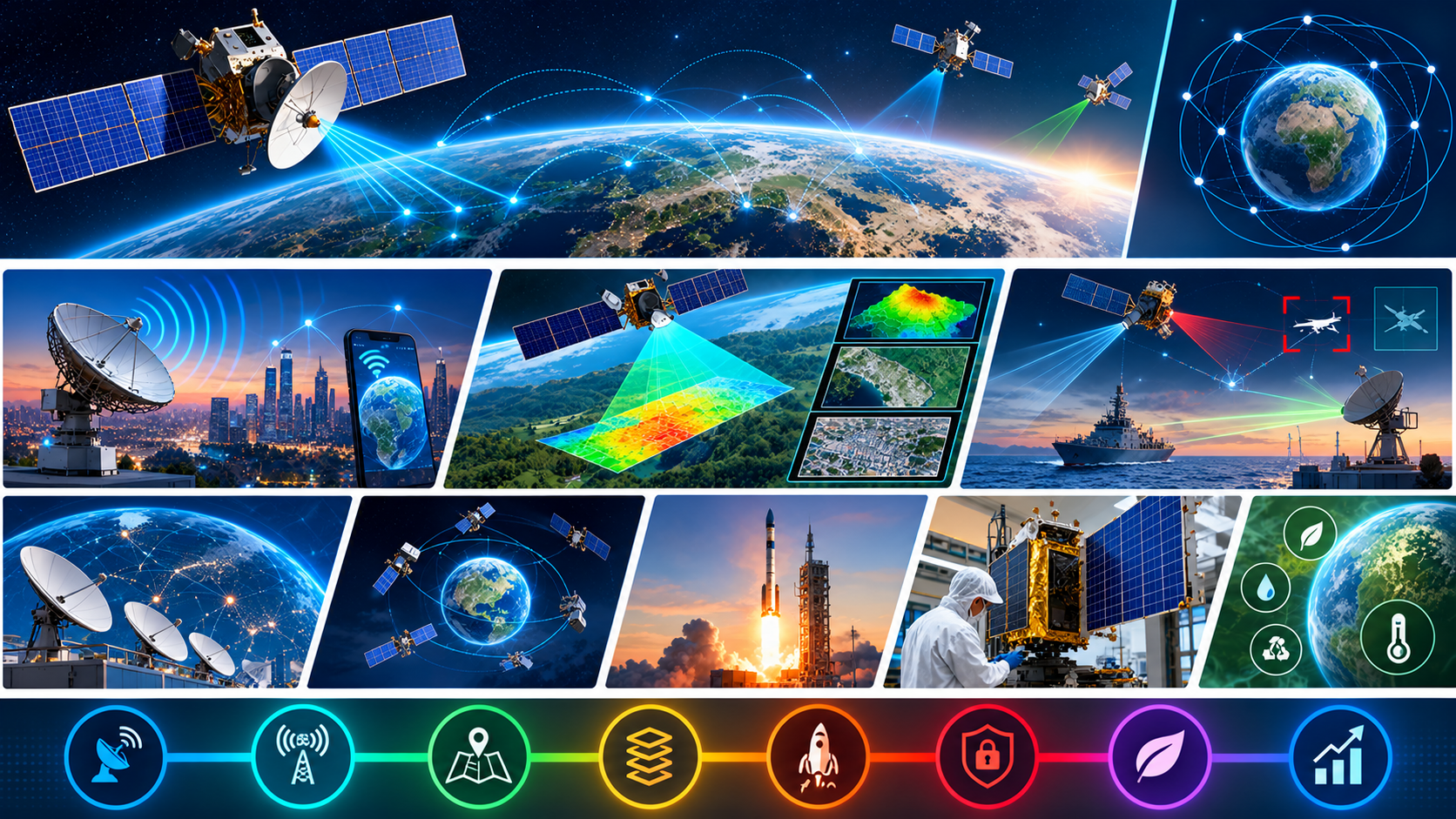
The Global Satellite Industry is entering a new phase of transformation as governments, commercial organizations, defense agencies, telecommunications providers, and technology companies increasingly invest in advanced satellite infrastructure. The convergence of satellite communications, Earth observation, navigation, remote sensing, broadband connectivity, and data services is expanding the role of satellites across both established and emerging applications. This transformation is creating new opportunities throughout the Satellites Market as satellite networks become more scalable, digitally integrated, commercially accessible, and capable of supporting a wider range of users.
The Satellites Market is also evolving beyond traditional large government owned spacecraft. The industry is increasingly characterized by commercial satellite networks, high volume satellite deployment, advanced payloads, improved onboard processing, sophisticated communications technologies, and integrated space based services. Smaller satellites and expanding constellations are changing how satellite capacity is developed and deployed, while continued investment in communication, Earth observation, navigation, and defense capabilities is supporting broader market expansion.
Satellites Market Enters an Investment Driven Growth Phase
Satellite infrastructure is increasingly attracting investment because organizations across multiple industries require reliable connectivity, positioning, observation, monitoring, and data services that terrestrial infrastructure alone cannot provide. Satellites can support communications across geographically dispersed regions, deliver Earth observation data over large areas, enable navigation and positioning, and provide critical infrastructure for government and defense applications.
According to MarketsandMarkets, the Global Satellites Market Size was valued at USD 23.28 billion in 2026 and is projected to reach USD 58.37 billion by 2032, growing at a CAGR of 16.6% from 2026 to 2032. In terms of volume, the market is expected to reach 7,748 units by 2032 from 4,383 units in 2026. Market growth is being driven by expanding satellite networks, increasing demand for communication and Earth observation services, rising commercial involvement, and ongoing government and defense investments in space infrastructure.
This growth indicates that the satellite industry is moving toward a higher volume and more diversified deployment model. Increasing satellite production and launch activity can create opportunities across spacecraft manufacturing, payload development, satellite components, ground systems, launch integration, network management, data processing, and satellite enabled services.
The investment environment is also becoming more diverse. Traditional government space programs remain important, but commercial satellite operators, telecommunications companies, Earth observation providers, technology companies, and specialized space startups are increasingly contributing to industry development.
Commercial Satellite Networks Are Reshaping the Industry
One of the most important Satellites Market trends in 2026 is the increasing commercial participation in satellite infrastructure. Historically, satellite development was heavily associated with national space agencies and government programs. The commercial space ecosystem has expanded the number of organizations involved in satellite design, manufacturing, launch, operation, data processing, and service delivery.
Commercial satellite networks are supporting applications ranging from broadband communications and enterprise connectivity to Earth observation, maritime monitoring, aviation connectivity, and remote infrastructure management.
This transition is creating a more dynamic satellite ecosystem in which spacecraft are increasingly developed around specific commercial applications and service requirements. Satellite operators can deploy networks designed for particular connectivity, imaging, monitoring, or data requirements instead of relying exclusively on traditional large spacecraft architectures.
Commercial involvement is also encouraging innovation in satellite manufacturing and deployment. Standardized spacecraft platforms, modular payload architectures, software based satellite systems, and more flexible mission designs can help organizations develop and deploy satellites according to changing market requirements.
As commercial participation continues to expand, the Satellites Market is becoming increasingly connected to the broader digital economy.
Satellite Constellations Are Becoming a Major Growth Driver
Satellite constellations are another important trend shaping the global satellite industry in 2026. Instead of depending on a single spacecraft, constellation architectures use multiple satellites operating together to provide broader coverage, increased capacity, or improved service continuity.
The growth of constellation based architectures is particularly relevant to communication and Earth observation applications. Multiple satellites can support wider geographic coverage and allow operators to develop networks that can serve users across different regions.
The increasing number of satellites being deployed is also contributing to the rise in market volume. The supplied MarketsandMarkets outlook indicates that the market is expected to reach 7,748 satellite units by 2032 compared with 4,383 units in 2026, highlighting the expansion of satellite deployment activity.
Constellation growth can create opportunities throughout the satellite value chain. Manufacturers need scalable production capabilities, component suppliers need to support higher spacecraft volumes, operators require advanced network management systems, and ground infrastructure needs to handle increasing amounts of satellite data.
The result is a shift toward satellite networks that operate as integrated systems rather than isolated spacecraft.
AI Is Transforming Satellite Operations
Artificial intelligence is becoming an increasingly important technology across satellite design, operations, data processing, and network management. Satellites generate large quantities of information through communication payloads, imaging systems, sensors, telemetry, and other onboard systems. AI can help organizations process this information more efficiently.
AI enabled satellite systems can support automated image analysis, anomaly detection, satellite health monitoring, mission planning, network optimization, and data prioritization. These capabilities can reduce the amount of manual analysis required while allowing operators to respond more quickly to changing conditions.
For Earth observation applications, AI can help analyze satellite imagery and identify patterns across large geographic areas. For satellite operators, AI can support predictive approaches to spacecraft monitoring by analyzing telemetry and identifying unusual behavior.
AI can also become important in satellite communications. Intelligent network management can help optimize available capacity, manage traffic, and support dynamic allocation of communication resources.
The growing integration of AI with satellite systems is therefore creating opportunities not only for spacecraft manufacturers but also for software companies, analytics providers, semiconductor developers, data processing companies, and network management technology providers.
Advanced Satellite Payloads Are Increasing Market Value
Satellite payloads are among the most important elements determining what a spacecraft can accomplish. As satellite applications become more sophisticated, demand is increasing for advanced communication, imaging, sensing, navigation, and data processing capabilities.
Communication satellites require sophisticated payloads capable of supporting high capacity connectivity. Earth observation satellites depend on optical, radar, multispectral, hyperspectral, or other sensing capabilities depending on the mission. Navigation satellites require technologies capable of supporting accurate positioning and timing services.
The increasing importance of payload technology is encouraging innovation across satellite electronics, antennas, sensors, onboard processing systems, communication equipment, and power management technologies.
The shift toward more capable payloads can also improve the commercial value of individual satellite missions. A satellite is increasingly becoming a data and connectivity platform rather than simply an object placed in orbit.
This is helping drive investment toward payload miniaturization, higher processing capabilities, improved sensing performance, and flexible architectures.
Earth Observation Is Expanding Satellite Applications
Earth observation is becoming an increasingly important application area within the Satellites Market. Governments, commercial organizations, infrastructure operators, agricultural companies, environmental organizations, and defense users require information about activities and conditions across large geographic areas.
Satellite based Earth observation can support monitoring of land, infrastructure, agriculture, environmental conditions, maritime activity, and other areas of interest. The ability to repeatedly observe large regions provides value for organizations that require continuous or periodic information.
The increasing demand for Earth observation services is also contributing to the expansion of commercial satellite activity. Companies can develop satellite networks designed around specific imaging requirements and sell processed information or data services to customers.
The value chain is consequently expanding beyond spacecraft manufacturing. Data analytics, image processing, cloud platforms, artificial intelligence, and specialized applications are becoming important components of the satellite economy.
As the amount of Earth observation data increases, the ability to process and interpret information efficiently will become increasingly important.
Satellite Communications Remain a Core Industry Opportunity
Communication is one of the fundamental applications supporting the Satellites Market. Satellite communication infrastructure can provide connectivity across locations where terrestrial networks are limited, unavailable, or difficult to deploy.
Demand for satellite based connectivity is supported by aviation, maritime operations, defense, government communications, remote communities, enterprise users, and other applications requiring reliable connectivity over large geographic areas.
The expansion of satellite networks is also creating opportunities for higher capacity communications. Modern satellite systems can support broadband services, data transmission, enterprise connectivity, and other applications requiring significant communication capacity.
The relationship between satellites and terrestrial communication infrastructure is also changing. Satellites are increasingly becoming complementary components of broader connectivity networks rather than isolated alternatives to terrestrial systems.
This creates opportunities for integrated networks that combine satellite connectivity with terrestrial communication infrastructure to provide wider coverage and greater service flexibility.
Defense and Government Investments Continue to Support Growth
Government and defense investments remain important contributors to satellite industry expansion. Satellites support a wide range of strategic capabilities, including communications, navigation, Earth observation, intelligence collection, situational awareness, and other space based services.
Defense organizations increasingly depend on resilient space infrastructure because satellite capabilities can support operations across geographically dispersed environments.
Government investments can also influence the wider commercial satellite ecosystem. Public sector programs can create demand for spacecraft, launch services, payloads, ground systems, communication infrastructure, and space based data services.
The supplied market information identifies ongoing government and defense investment in space infrastructure as one of the factors supporting Satellites Market growth.
This creates a market environment in which commercial and government requirements increasingly overlap. Technologies developed for commercial applications can potentially support government missions, while government programs can stimulate innovation that later becomes relevant to commercial users.
Smaller Satellites Are Changing Deployment Economics
Another major Satellites Market trend is the increasing importance of smaller satellite architectures. Smaller spacecraft can support specific missions while potentially allowing organizations to deploy larger numbers of satellites.
The growth of smaller satellite systems is closely associated with constellation development, commercial space activity, Earth observation, communications, technology demonstrations, and other applications.
Smaller spacecraft can also support more frequent technology refresh cycles. Instead of relying on a single large spacecraft for a long operating period, operators can potentially use multiple spacecraft and introduce newer technologies through subsequent deployments.
This can create opportunities for standardized satellite platforms and modular manufacturing. Component suppliers can develop products designed for repeatable spacecraft production, while satellite manufacturers can optimize production processes around higher volumes.
The increasing deployment of smaller satellites therefore has implications well beyond spacecraft size. It can influence manufacturing, procurement, launch planning, network architecture, maintenance, and technology development.
Onboard Processing Is Becoming More Important
Satellite systems are increasingly expected to process information closer to where it is generated. Onboard computing can reduce the amount of raw data that must be transmitted to ground infrastructure and can support faster responses to mission requirements.
For Earth observation satellites, onboard processing can help identify relevant imagery or events before transmitting information to the ground. In communications applications, onboard processing can support flexible routing and management of communication resources.
This trend is increasing demand for more capable processors, memory, software architectures, and data handling systems designed for the space environment.
The growing importance of onboard processing is also strengthening the connection between the satellite industry and semiconductor technology. More sophisticated spacecraft require increasingly capable computing systems while maintaining requirements related to power consumption, reliability, radiation tolerance, and thermal management.
Satellite Connectivity Is Becoming More Integrated
The satellite industry is increasingly moving toward integrated connectivity architectures. Satellites can work alongside terrestrial networks, mobile networks, fiber infrastructure, and other communication technologies.
This integration is particularly important for users operating across large geographic areas or in environments where terrestrial connectivity is inconsistent.
Satellite networks can provide coverage in remote locations and support connectivity during situations where terrestrial infrastructure is unavailable or disrupted. This makes satellite infrastructure relevant to emergency communications, remote operations, maritime connectivity, aviation, defense, and enterprise applications.
The development of integrated satellite and terrestrial networks can also increase the importance of interoperability. Satellite operators and communication technology companies increasingly need systems that can operate across different network environments.
Satellite Data Is Becoming a Strategic Asset
The value of the satellite industry is increasingly extending beyond spacecraft and connectivity toward data. Earth observation satellites generate information that can support commercial, environmental, infrastructure, government, and defense applications.
Communication satellites also generate network information that can support service management and optimization.
As satellite data volumes increase, organizations require advanced platforms for storing, processing, analyzing, and distributing information. This is creating opportunities for cloud infrastructure, AI analytics, data platforms, geospatial intelligence, and specialized software.
The growing importance of satellite data is also changing how the industry defines value. The spacecraft itself remains a critical asset, but the data and services produced by that spacecraft can represent an increasingly important part of the overall commercial ecosystem.
Ground Infrastructure Is Evolving Alongside Satellites
The expansion of satellite networks requires corresponding development in ground infrastructure. Satellites cannot operate independently of ground stations, antennas, control systems, communication equipment, data processing infrastructure, and network management platforms.
As satellite constellations become larger and more dynamic, ground systems must be capable of managing more spacecraft and greater volumes of information.
Automated ground station operations can become increasingly important in this environment. Operators need systems capable of scheduling communication sessions, monitoring satellite health, processing data, and managing network resources.
This means Satellites Market growth creates opportunities across both space based and ground based infrastructure.
The satellite industry should therefore be viewed as a complete ecosystem consisting of spacecraft, payloads, launch systems, ground infrastructure, software, data platforms, network services, and end user applications.
Satellite Cybersecurity Becomes Increasingly Important
As satellites become more connected to digital networks, cybersecurity is becoming an increasingly important consideration. Satellite systems include spacecraft computers, communication links, ground stations, operational networks, and data platforms.
A security weakness in any part of this ecosystem can potentially affect system reliability or data integrity.
Satellite operators therefore require security measures across the complete lifecycle of a mission. Secure communications, access management, network monitoring, software protection, authentication, anomaly detection, and resilient system architectures are becoming important areas of technology development.
The growth of commercial satellite networks makes cybersecurity particularly important because a larger number of organizations and users are becoming connected to space based infrastructure.
Future satellite architectures are likely to place greater emphasis on secure software, protected communication links, automated threat detection, and resilient network design.
Satellite Manufacturing Is Becoming More Scalable
The increasing number of satellite deployments is encouraging manufacturers to develop more scalable production models. Traditional satellite manufacturing often involved highly customized spacecraft designed for individual missions.
The growth of commercial networks and constellations is encouraging greater standardization and repeatability.
Manufacturers can increasingly use common spacecraft platforms, modular components, standardized interfaces, and automated production processes. These approaches can support higher production volumes and potentially reduce manufacturing complexity.
Scalable satellite production is especially relevant as the market moves toward the higher deployment volumes reflected in the forecast from 4,383 units in 2026 to 7,748 units by 2032.
This shift can create opportunities for suppliers capable of producing reliable components at higher volumes while maintaining the performance requirements of space applications.
Satellite Lifecycle Management Is Gaining Importance
As satellite fleets become larger, operators must manage increasingly complex asset portfolios. Lifecycle management covers spacecraft monitoring, software updates, component management, anomaly response, network optimization, and end of mission planning.
For constellation operators, lifecycle management can be especially complex because multiple spacecraft may operate simultaneously while entering service at different times.
Automation can help operators manage these fleets more efficiently. AI based monitoring can identify anomalies, software systems can automate routine operational tasks, and advanced network management can help coordinate spacecraft resources.
Lifecycle management is therefore becoming an important technology layer within the Satellites Market.
Investment Opportunities Are Expanding Across the Satellite Ecosystem
The growth of the global satellite industry is creating investment opportunities across multiple technology layers. Investment is no longer limited to spacecraft manufacturing.
Opportunities are emerging in satellite payloads, communication technologies, Earth observation sensors, onboard computing, satellite components, ground infrastructure, network management software, cybersecurity, data analytics, artificial intelligence, and satellite enabled services.
Commercial involvement is further expanding the addressable technology ecosystem. Startups and specialized companies can focus on individual components or software capabilities rather than developing complete spacecraft.
This specialization can accelerate innovation by allowing companies to concentrate on high value technology areas.
For investors and technology companies, the expanding satellite ecosystem creates opportunities across both hardware and software. For satellite operators, it provides access to a broader technology base that can support more flexible and capable space systems.
Challenges Could Slow Satellite Market Expansion
Despite strong growth prospects, the Satellites Market continues to face technical, financial, regulatory, and operational challenges.
Satellite development requires substantial investment, while spacecraft must meet demanding reliability requirements. Space missions can also involve complex testing, launch coordination, regulatory approvals, orbital management, and long operational lifecycles.
The increasing number of satellites introduces additional challenges related to space traffic management and orbital sustainability. Operators must also consider communication interference, coordination requirements, debris mitigation, and responsible use of orbital environments.
Cybersecurity is another important challenge as satellite systems become more connected.
The industry must also manage the complexity associated with increasingly large constellations. Operating hundreds or thousands of spacecraft requires advanced automation, network management, ground infrastructure, and data processing capabilities.
Addressing these challenges will be essential for converting strong demand into sustainable long term market expansion.
Future Outlook for the Satellites Market
The future of the Satellites Market is expected to be shaped by commercial satellite networks, constellation expansion, advanced payloads, artificial intelligence, Earth observation, satellite communications, onboard processing, integrated connectivity, and increasing government and defense investment.
MarketsandMarkets projects the global Satellites Market to grow from USD 23.28 billion in 2026 to USD 58.37 billion by 2032 at a CAGR of 16.6%. The market is also projected to expand from 4,383 satellite units in 2026 to 7,748 units by 2032.
These figures highlight the scale of the transformation taking place across the global satellite industry.
The next stage of satellite development is likely to focus increasingly on integrated systems rather than individual spacecraft. Satellites will operate as interconnected components of broader communication, observation, navigation, defense, and data ecosystems.
Commercial operators will continue to influence market development, while government and defense organizations will remain important sources of demand. At the same time, AI, advanced computing, cybersecurity, automation, and cloud based data platforms will increasingly influence how satellite infrastructure is operated and monetized.
The Satellites Market is therefore moving toward an industry model in which spacecraft, ground infrastructure, software, data, and services become increasingly interconnected.
For satellite manufacturers and component suppliers, this transformation creates opportunities to develop scalable and flexible spacecraft technologies.
For technology companies, opportunities are expanding across AI, analytics, cybersecurity, communications, onboard processing, and satellite network management.
For commercial satellite operators, the expanding market provides opportunities to develop new connectivity, Earth observation, and data services.
For governments and defense organizations, expanding satellite infrastructure can support communications, observation, navigation, and broader space based capabilities.
The global satellite industry is consequently entering a period defined not only by more satellites in orbit, but by more capable, connected, commercially integrated, and data driven satellite networks. The growth from 4,383 units in 2026 toward 7,748 units by 2032 illustrates the increasing scale of deployment, while the projected market value growth to USD 58.37 billion demonstrates the expanding economic importance of satellite infrastructure.
The future of the Satellites Market will ultimately depend on how effectively the industry combines spacecraft innovation with communications, AI, advanced sensing, computing, cybersecurity, ground infrastructure, and data services. As these technologies converge, satellites are expected to become increasingly integrated into the digital, commercial, governmental, and defense infrastructure supporting the global economy.
80% of the Forbes Global 2000 B2B companies rely on MarketsandMarkets to identify growth opportunities in emerging technologies and use cases that will have a positive revenue impact.
- Food Packaging Market Size Set for Strong Growth Through 2030 Amid Rising Demand for Convenience Foods
- Crop Protection Chemical Market Size, Share & Growth Forecast (2025–2030)
- Mulch Films Market: Driving Sustainable Agriculture Through Innovation
- Agricultural Adjuvants Market Analysis, Trends, and Growth Outlook (2026–2031)
- Japan Enterprise Asset Management Market Growth: AI and Smart Infrastructure Drive Demand


