The Sustainable Aviation Fuel (SAF) market is entering a critical growth phase in 2026 as airlines, fuel producers, governments, and technology developers accelerate efforts to decarbonize the aviation sector. With global air travel demand continuing to rise and regulatory pressure intensifying, SAF has emerged as the most practical near-term solution for reducing aviation emissions while utilizing existing aircraft fleets and airport infrastructure.
Driven by expanding airline procurement commitments, government blending mandates, advances in feedstock technologies, and significant investments in production capacity, the SAF Market is evolving from an emerging industry into a strategic pillar of the global aviation ecosystem. As stakeholders work toward ambitious net-zero targets, 2026 is expected to mark a pivotal year for commercial-scale deployment and long-term market expansion.
Airline Sustainability Commitments Accelerating SAF Adoption
Airlines worldwide are increasingly integrating SAF into their long-term decarbonization strategies.
Major aviation companies are pursuing:
-
Net-zero emissions targets
-
Long-term SAF offtake agreements
-
Strategic fuel partnerships
-
Carbon reduction programs
-
Sustainable fleet operations
-
ESG-driven sustainability initiatives
Many carriers have committed billions of dollars through multi-year fuel supply agreements to secure future SAF availability and reduce exposure to regulatory risks.
As environmental performance becomes a competitive differentiator, SAF adoption is increasingly viewed as both a sustainability and business imperative.
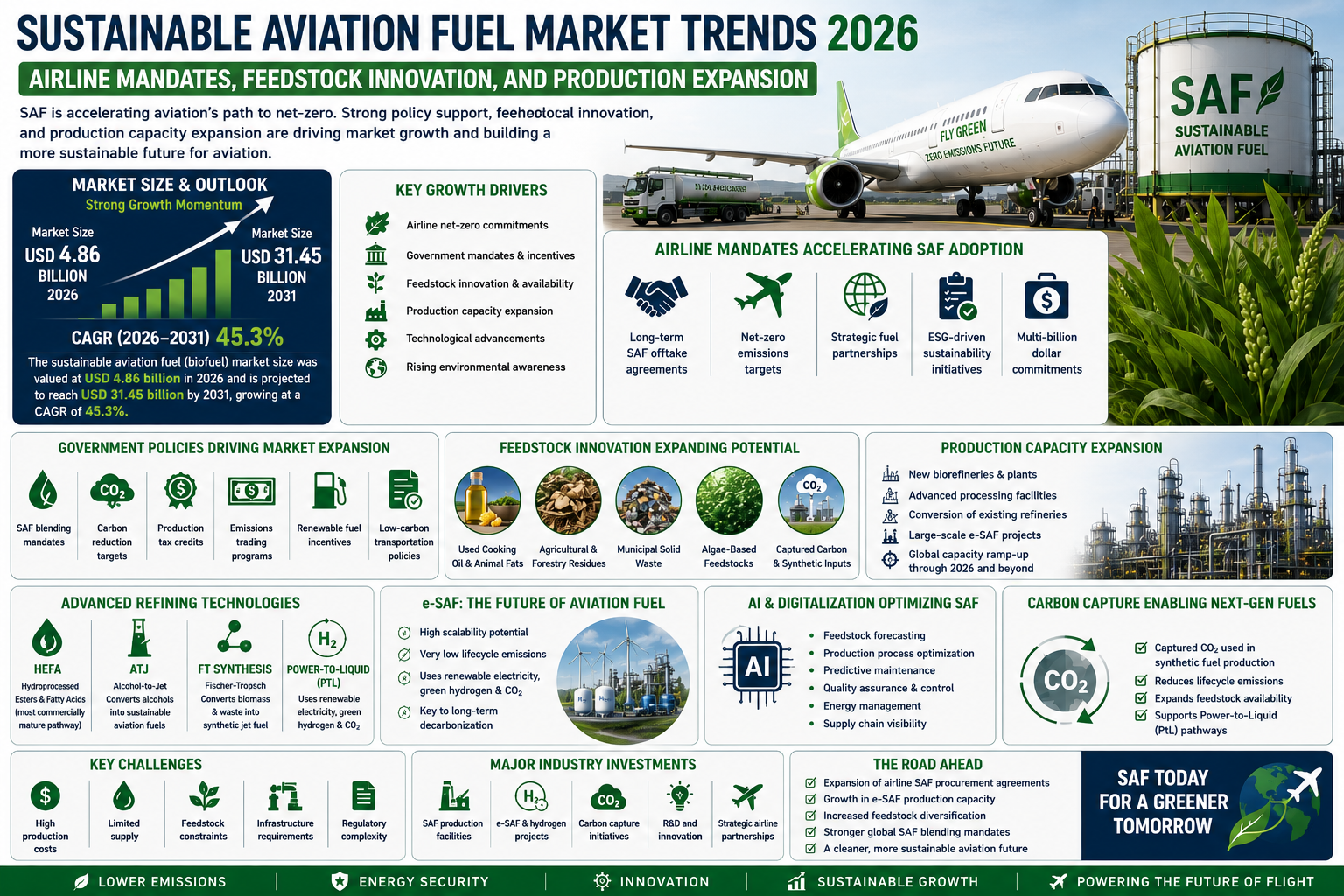
Government Mandates Driving Market Expansion
One of the strongest drivers of SAF market growth in 2026 is the implementation of government policies designed to accelerate aviation decarbonization.
Key regulatory initiatives include:
-
SAF blending mandates
-
Carbon reduction targets
-
Renewable fuel incentives
-
Production tax credits
-
Emissions trading programs
-
Low-carbon transportation policies
Governments across North America, Europe, and Asia-Pacific are establishing frameworks that encourage fuel producers and airlines to increase SAF utilization.
These policies provide long-term market certainty, helping stimulate investment throughout the SAF value chain.
Feedstock Innovation Expanding Production Potential
Feedstock availability remains a critical factor influencing SAF scalability.
Traditional SAF production relies heavily on:
-
Used cooking oil
-
Animal fats
-
Agricultural residues
-
Forestry byproducts
-
Municipal solid waste
However, growing demand is driving innovation in alternative feedstock sources.
Emerging solutions include:
-
Algae-based feedstocks
-
Industrial waste streams
-
Carbon capture-derived inputs
-
Renewable biomass resources
-
Synthetic carbon feedstocks
These innovations are helping diversify supply chains while reducing dependence on limited waste-based resources.
Feedstock diversification is expected to play a major role in supporting long-term SAF production growth.
Production Capacity Expansion Becoming a Strategic Priority
The global SAF industry is experiencing significant investment in production infrastructure.
Fuel producers are expanding capacity through:
-
New biorefineries
-
Advanced processing facilities
-
Renewable fuel conversion plants
-
Synthetic fuel manufacturing projects
-
Integrated carbon utilization facilities
Large-scale production expansion is essential to meet growing airline demand and support future regulatory requirements.
Many energy companies are transforming existing refining assets to accommodate SAF production, creating additional opportunities for rapid capacity growth.
Advanced Refining Technologies Improving Efficiency
Technological innovation is helping improve SAF production economics and scalability.
Key production pathways include:
Hydroprocessed Esters and Fatty Acids (HEFA)
The most commercially mature SAF production technology, converting waste oils and fats into aviation fuel.
Alcohol-to-Jet (ATJ)
Converts ethanol and other alcohols into sustainable aviation fuels.
Fischer-Tropsch Synthesis
Transforms biomass and waste-derived feedstocks into synthetic jet fuel.
Power-to-Liquid (PtL)
Uses renewable electricity, green hydrogen, and captured carbon dioxide to produce synthetic aviation fuels.
These technologies are improving fuel yields, reducing operational costs, and expanding production flexibility.
e-SAF Emerging as a High-Growth Opportunity
Electro-Sustainable Aviation Fuel (e-SAF) is gaining momentum as a long-term solution for aviation decarbonization.
e-SAF production combines:
-
Renewable electricity
-
Green hydrogen
-
Captured carbon dioxide
-
Synthetic fuel synthesis technologies
Unlike traditional bio-based fuels, e-SAF offers significant scalability potential without relying heavily on biological feedstocks.
As renewable energy deployment increases and production technologies mature, e-SAF is expected to become an increasingly important segment of the sustainable aviation fuel market.
Artificial Intelligence Optimizing SAF Operations
Artificial intelligence is becoming a valuable tool across the SAF value chain.
AI applications include:
-
Feedstock forecasting
-
Production optimization
-
Supply chain management
-
Predictive maintenance
-
Quality control
-
Energy efficiency improvements
Machine learning algorithms help producers identify operational efficiencies, reduce waste, and improve overall production performance.
As SAF facilities become increasingly digitalized, AI-driven optimization is expected to enhance competitiveness and support industry growth.
Carbon Capture Supporting Next-Generation Fuel Production
Carbon capture technologies are opening new opportunities for sustainable fuel production.
Captured carbon dioxide can be used as a feedstock for synthetic aviation fuels through advanced Power-to-Liquid pathways.
Benefits include:
-
Lower lifecycle emissions
-
Expanded feedstock availability
-
Improved production scalability
-
Reduced reliance on biomass resources
Carbon capture integration is expected to become an increasingly important component of future SAF production strategies.
Airline Investments Supporting Commercial Scale-Up
Airlines are playing a direct role in accelerating SAF market development through strategic investments.
Key areas of investment include:
-
Fuel production facilities
-
SAF research programs
-
e-SAF projects
-
Green hydrogen infrastructure
-
Carbon capture initiatives
These commitments provide producers with demand certainty, helping secure financing for large-scale production projects.
Growing collaboration between airlines, fuel suppliers, and technology providers is creating a more robust and integrated SAF ecosystem.
Challenges Facing the SAF Market
Despite strong momentum, several obstacles remain.
High Production Costs
SAF remains more expensive than conventional jet fuel.
Limited Supply
Production volumes still represent a small fraction of total aviation fuel demand.
Feedstock Constraints
Certain production pathways face long-term resource limitations.
Infrastructure Requirements
Scaling production and distribution networks requires significant investment.
Regulatory Complexity
Global policy frameworks remain fragmented across different regions.
Addressing these challenges will be critical for achieving large-scale SAF adoption.
Future Outlook
The Sustainable Aviation Fuel market is expected to experience significant growth throughout 2026 and beyond as regulatory support strengthens, production capacity expands, and technological innovation improves commercial viability. Airlines, governments, and energy companies are increasingly aligned in their efforts to accelerate aviation decarbonization, creating favorable conditions for long-term market development.
Several trends are expected to shape the future of the SAF market:
-
Expansion of airline SAF procurement agreements
-
Growth in e-SAF production capacity
-
Increased feedstock diversification
-
AI-driven production optimization
-
Carbon capture integration
-
Advanced refining technology deployment
-
Rising global SAF blending mandates
As the aviation industry advances toward net-zero emissions goals, Sustainable Aviation Fuel will remain at the center of decarbonization strategies. The combination of policy support, feedstock innovation, production expansion, and technological advancement is creating a strong foundation for sustained market growth through 2026 and well into the next decade.