

UAV (Drone) Jammers Technology Innovation: Key Trends, Growth Drivers and Opportunities
Introduction to UAV (Drone) Jammers Technology
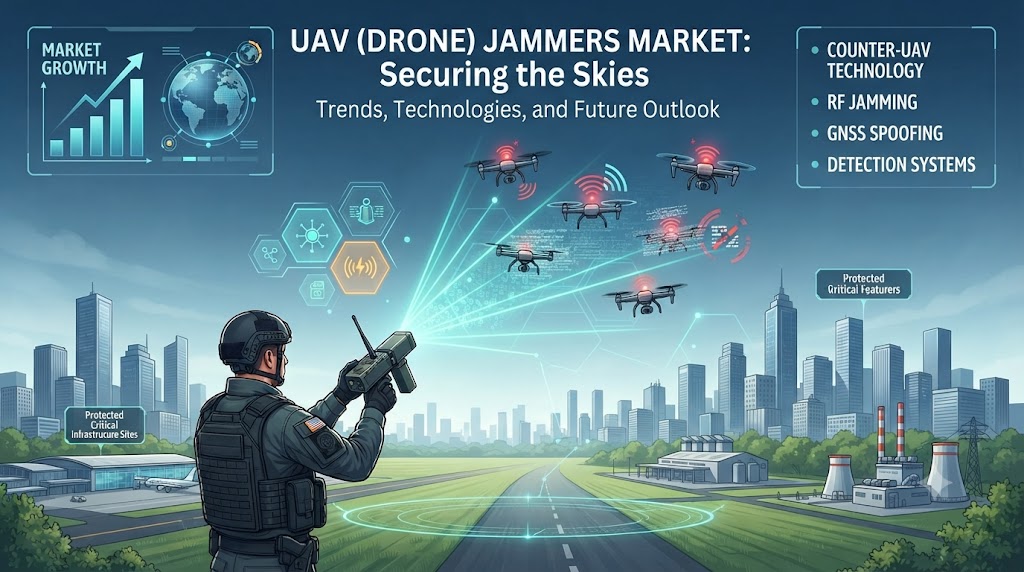
In the rapidly evolving world of unmanned aerial systems, UAV (Drone) Jammers have emerged as a critical counter-drone technology, transforming the way governments, military organizations, airports, critical infrastructure operators, and security agencies protect sensitive locations from unauthorized or potentially hostile drones. These advanced electronic countermeasure systems are designed to disrupt the communication links, navigation signals, or control channels used by drones, preventing them from operating as intended.
The rapid proliferation of commercially available drones has created new opportunities across industries while simultaneously increasing security concerns. Unauthorized drones can potentially be used for surveillance, smuggling, intelligence gathering, or other malicious activities. As a result, the demand for sophisticated Counter-UAS (C-UAS) technologies continues to increase. UAV (Drone) Jammers use radio frequency (RF) interference and other electronic countermeasure techniques to disrupt the connection between a drone and its operator or interfere with satellite navigation signals. As we explore the future of UAV (Drone) Jammers technology, we uncover a rapidly developing field of innovation that promises to strengthen airspace security and provide organizations with more effective tools for addressing emerging drone-related threats.
History of UAV (Drone) Jammers Technology
The development of UAV (Drone) Jammers is closely connected to the rapid growth of unmanned aerial vehicle technology. Early drone systems were primarily used for military reconnaissance and surveillance applications, with relatively limited availability to civilian users. As drone technology became more affordable and accessible, commercial and consumer drones rapidly expanded across the global market. The increasing availability of small and commercially available drones created new security challenges for airports, military installations, government facilities, prisons, stadiums, and other sensitive locations. This led to the development of specialized Counter-UAS technologies designed to detect, identify, track, and mitigate unauthorized drones.
Early drone jamming systems were relatively large and focused primarily on disrupting radio communications between drones and their operators. However, technological advancements have resulted in more compact, mobile, directional, and intelligent systems capable of responding to increasingly sophisticated drone threats. Today, UAV (Drone) Jammers are being integrated into comprehensive Counter-UAS architectures that combine RF detection, radar, electro-optical and infrared sensors, artificial intelligence, and electronic warfare capabilities.
Benefits of UAV (Drone) Jammers Technology
UAV (Drone) Jammers technology offers numerous advantages for organizations seeking to protect sensitive airspace and critical assets:
-
Enhanced Airspace Security: UAV jammers can help prevent unauthorized drones from entering restricted or protected airspace by disrupting their communication or navigation signals.
-
Rapid Threat Response: Modern jamming systems can provide security personnel with a rapid mitigation option when an unauthorized drone is detected.
-
Protection of Critical Infrastructure: UAV jammers can support the protection of airports, military bases, power plants, government facilities, and other strategically important locations.
-
Flexible Deployment: Portable, vehicle-mounted, fixed-site, and handheld jamming systems provide organizations with flexible options for protecting different operational environments.
Current Market Size and Growth Trends of UAV (Drone) Jammers Industry
The UAV (Drone) Jammers market has witnessed significant growth as the proliferation of drones creates increasing demand for counter-drone and airspace security solutions. Governments, defense organizations, law enforcement agencies, and critical infrastructure operators are investing in advanced technologies to address unauthorized and potentially hostile UAV activities.
According to MarketsandMarkets, the global UAV (Drone) Jammers market size was valued at USD 1.77 Billion in 2026 and is projected to reach USD 5.90 Billion by 2031, growing at a CAGR of 27.2% from 2023 to 2028.
This rapid market growth can be attributed to several factors, including:
-
Increasing incidents involving unauthorized and potentially hostile drones
-
Growing adoption of Counter-UAS systems by military and defense organizations
-
Rising security concerns surrounding airports, government facilities, and critical infrastructure
-
Increasing demand for advanced electronic warfare and RF-based counter-drone technologies
-
Technological advancements in portable, directional, and intelligent UAV jamming systems
As drone technology continues to evolve, the need for effective countermeasures is expected to increase, creating significant opportunities for manufacturers and technology providers operating in the UAV (Drone) Jammers market.
Key Drivers and Factors Influencing the Future of UAV (Drone) Jammers Technology
Several key drivers and factors are shaping the future of UAV (Drone) Jammers technology:
-
Increasing Drone Proliferation: The widespread availability of commercial and consumer drones is increasing the number of UAVs operating in civilian and restricted airspace, creating greater demand for counter-drone solutions.
-
Growing Security Threats: Unauthorized drone operations near airports, military bases, government facilities, and public events are encouraging organizations to deploy advanced UAV detection and mitigation technologies.
-
Defense Modernization: Military organizations are increasingly incorporating Counter-UAS technologies into broader air defense and electronic warfare architectures.
-
Technological Advancements: Innovations in RF signal processing, software-defined radios, artificial intelligence, and automated threat classification are improving the effectiveness of UAV jamming systems.
-
Increasing Critical Infrastructure Protection: The growing need to protect power plants, energy facilities, transportation hubs, communication infrastructure, and other critical assets is driving demand for advanced counter-drone systems.
Emerging Trends in UAV (Drone) Jammers Technology
The future of UAV (Drone) Jammers technology is shaped by several exciting trends and innovations:
-
AI-Enabled Drone Threat Identification: Artificial intelligence and machine learning are increasingly being used to analyze RF signals and sensor data, enabling faster identification and classification of potential drone threats.
-
Directional Jamming Systems: Advanced directional jammers are being developed to focus electronic interference toward specific targets, improving operational precision while reducing unintended interference with nearby communications.
-
Portable and Man-Portable Systems: Compact UAV jammers are becoming increasingly important for security personnel and military forces operating in dynamic environments where mobility is essential.
-
Integration with Multi-Sensor Counter-UAS Systems: UAV jammers are increasingly being integrated with radar, RF detection, electro-optical, and infrared sensors to create comprehensive drone detection and mitigation architectures.
-
Networked Counter-Drone Operations: Future systems are expected to connect multiple detection and mitigation platforms through centralized command-and-control networks, enabling coordinated responses to multiple UAV threats.
Opportunities and Challenges in the UAV (Drone) Jammers Market
As the UAV (Drone) Jammers market continues to evolve, it presents numerous opportunities for businesses, defense organizations, and security agencies alike:
-
Market Expansion: The increasing demand for Counter-UAS solutions across military, homeland security, airports, critical infrastructure, and law enforcement sectors offers significant growth opportunities for companies operating in this market.
-
Innovation and Product Differentiation: Companies investing in advanced RF technologies, AI-based signal processing, miniaturization, and intelligent electronic warfare capabilities can gain a competitive advantage.
-
Integration with Counter-UAS Ecosystems: The development of integrated solutions combining detection, tracking, identification, and mitigation capabilities presents opportunities for technology providers to deliver complete counter-drone solutions.
However, the UAV (Drone) Jammers market also faces several challenges that need to be addressed:
-
Regulatory and Legal Restrictions: The use of RF jamming technologies is subject to regulatory requirements in many countries, creating challenges for widespread deployment and civilian applications.
-
Risk of Unintended Interference: Jamming systems may potentially interfere with authorized communications, navigation systems, and other electronic equipment if not carefully designed and deployed.
-
Rapid Evolution of Drone Technology: The continuous development of autonomous drones, frequency-hopping communications, and alternative navigation technologies creates an ongoing need for more advanced countermeasures.
-
Cost and Deployment Challenges: Advanced Counter-UAS systems can require significant investments in equipment, infrastructure, training, and maintenance, particularly for large-scale deployments.
Innovations and Advancements in UAV (Drone) Jammers Technology
The future of UAV (Drone) Jammers is being shaped by a multitude of innovative technologies and advancements:
-
AI-Powered RF Signal Analysis: Artificial intelligence can analyze large volumes of RF data to identify unusual communication patterns and improve the speed of threat classification.
-
Software-Defined Jamming Systems: Software-defined architectures provide greater flexibility by allowing systems to adapt to changing RF environments and emerging drone communication protocols.
-
Cognitive Electronic Warfare: Cognitive systems can dynamically analyze the electromagnetic environment and adapt countermeasures to changing conditions.
-
Drone Swarm Countermeasures: As drone swarms become more sophisticated, next-generation jamming technologies are being developed to address multiple UAV threats simultaneously.
-
Integrated Counter-UAS Platforms: Manufacturers are combining UAV jammers with radar, RF sensors, electro-optical systems, command-and-control software, and other mitigation technologies to create comprehensive airspace protection solutions.
Future Applications and Industries That Will Benefit from UAV (Drone) Jammers
The future of UAV (Drone) Jammers technology holds immense potential across a wide range of applications and industries:
-
Military and Defense: Armed forces will continue deploying UAV jammers to protect military bases, forward operating locations, strategic assets, and personnel from unauthorized or hostile drones.
-
Airport Security: Airports can use Counter-UAS technologies to detect and mitigate unauthorized drone activity that could disrupt aircraft operations and passenger safety.
-
Critical Infrastructure: Power plants, energy facilities, communication networks, and other critical infrastructure operators can deploy UAV jammers as part of comprehensive security systems.
-
Government and Public Security: Government buildings and sensitive facilities can use counter-drone technologies to protect restricted airspace and reduce unauthorized UAV activity.
-
Law Enforcement: Police and security agencies can utilize portable and vehicle-mounted Counter-UAS technologies for specific security operations and protection of sensitive locations.
-
Large Public Events: Stadiums, concerts, political events, and other high-profile gatherings can benefit from integrated drone detection and mitigation systems to improve airspace security.
Conclusion: The Promising Future of UAV (Drone) Jammers Technology
The future of UAV (Drone) Jammers technology is filled with exciting possibilities and transformative advancements. As drones become more widespread, autonomous, and technologically sophisticated, the need for reliable Counter-UAS technologies will continue to increase. From AI-enabled RF signal analysis and directional jamming to integrated multi-sensor Counter-UAS platforms and advanced electronic warfare technologies, the future of UAV (Drone) Jammers promises to strengthen airspace security across military, government, commercial, and critical infrastructure environments.
However, realizing the full potential of UAV (Drone) Jammers will require continued research and development, addressing challenges related to regulatory compliance, electromagnetic interference, evolving drone technologies, and operational costs. Collaboration among defense organizations, technology developers, regulatory authorities, and security stakeholders will be crucial in developing effective and responsible counter-drone solutions.As we look ahead, one thing is certain: the future of UAV (Drone) Jammers technology is rapidly evolving, and its impact will be felt across the global security landscape, ushering in a new era of intelligent, adaptive, and integrated counter-drone capabilities.
Discover the latest advancements and solutions in UAV (Drone) Jammers technology by exploring the comprehensive research and analysis available from MarketsandMarkets. Stay ahead of emerging Counter-UAS trends and explore how advanced drone mitigation technologies are transforming the future of airspace security.
Download Sample Research Report for UAV (Drone) Jammers Market Future:
https://www.marketsandmarkets.com/Market-Reports/uav-drone-jammers-market-17767697.html
80% of the Forbes Global 2000 B2B companies rely on MarketsandMarkets to identify growth opportunities in emerging technologies and use cases that will have a positive revenue impact.
- Food Packaging Market Size Set for Strong Growth Through 2030 Amid Rising Demand for Convenience Foods
- Mulch Films Market: Driving Sustainable Agriculture Through Innovation
- Agricultural Adjuvants Market Analysis, Trends, and Growth Outlook (2026–2031)
- Crop Protection Chemical Market Size, Share & Growth Forecast (2025–2030)
- Japan Enterprise Asset Management Market Growth: AI and Smart Infrastructure Drive Demand


