

UAV Radar Technology: Innovations Transforming Drone Operations
In the rapidly evolving aerospace and defense environment, radar technology has become an increasingly important component of unmanned aerial vehicles (UAVs). As drones transition from remotely operated platforms to highly autonomous systems, onboard sensing technologies are becoming essential for navigation, surveillance, target detection, collision avoidance, and mission execution.
UAV radar enables drones to detect and track objects, terrain, aircraft, vessels, and other potential threats, even in environmental conditions where optical sensors may experience limitations. Radar can provide information about range, direction, movement, and relative velocity, allowing UAV operators and autonomous systems to develop a more comprehensive understanding of their surroundings.
The technology is being adopted across military, homeland security, maritime surveillance, commercial, and industrial applications. Defense organizations are also increasing investments in counter-UAS capabilities, creating additional demand for radar systems capable of detecting and tracking unauthorized drones.
As radar components become smaller, lighter, more power-efficient, and increasingly software-defined, advanced radar payloads are becoming more practical for UAV platforms. These developments are creating new opportunities for manufacturers to integrate sophisticated sensing capabilities without significantly compromising payload capacity or endurance.
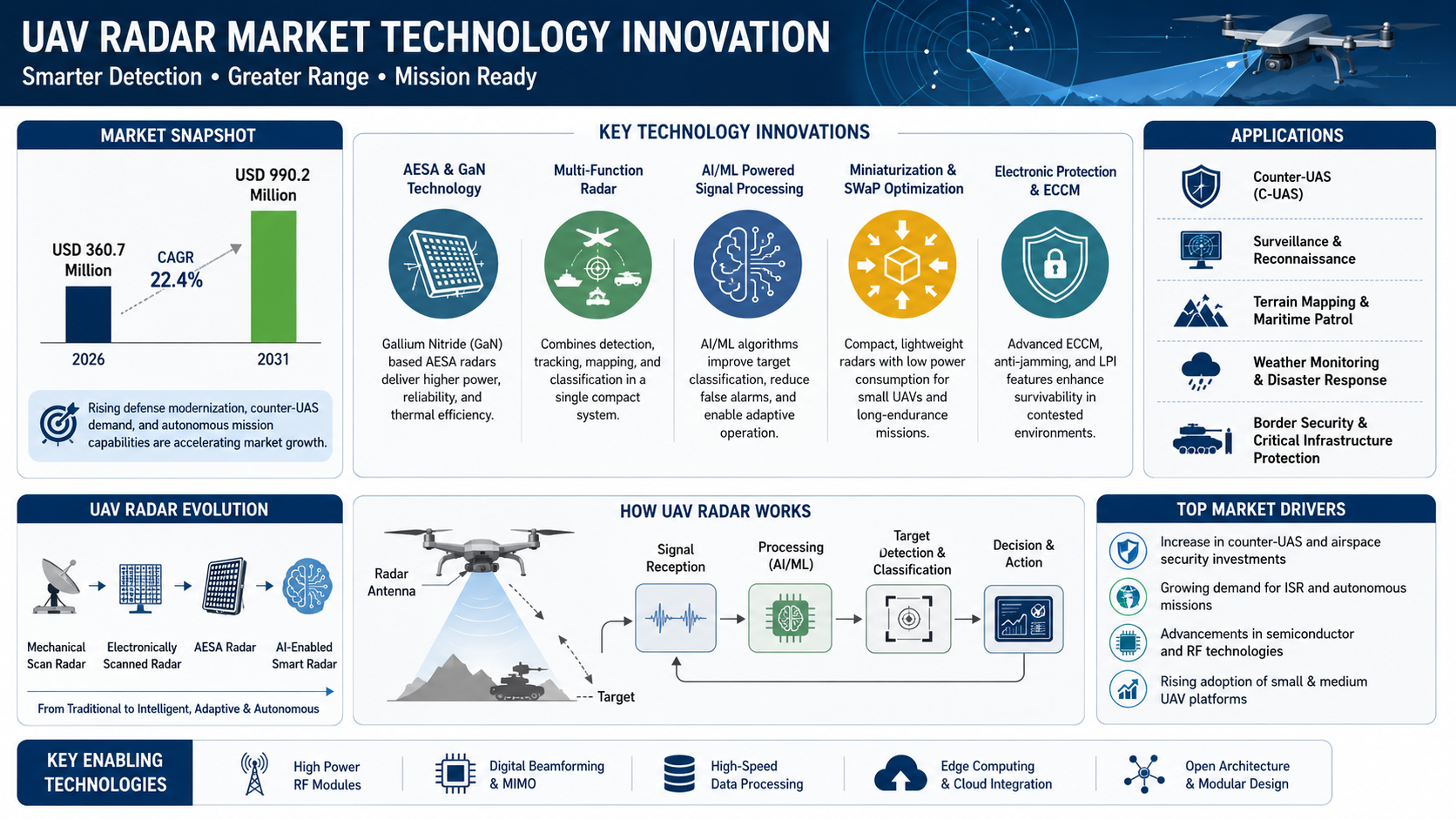
Evolution of UAV Radar Systems
Early UAVs relied heavily on electro-optical and infrared sensors for surveillance and reconnaissance. While these systems remain important, their performance can be affected by darkness, fog, rain, smoke, dust, and other environmental conditions.
Radar provides a complementary sensing capability because it uses radio-frequency signals rather than relying on visible or infrared light. This makes radar particularly useful for operations that require detection over longer ranges or under challenging weather and visibility conditions.
The evolution of electronics, semiconductor technology, signal processing, and antenna design has enabled radar systems to become increasingly compact. Modern UAV radar solutions can perform functions that previously required substantially larger airborne platforms.
Technology innovation is now focused on combining radar with other sensors and onboard processing systems. This creates multi-sensor architectures in which radar, electro-optical/infrared cameras, electronic support systems, navigation sensors, and artificial intelligence work together to improve situational awareness.
Benefits of UAV Radar Technology
UAV radar technology offers several advantages for unmanned platforms:
-
All-Weather Sensing: Radar can support detection and surveillance in conditions where optical sensors may be degraded by darkness, fog, rain, dust, or smoke.
-
Long-Range Detection: Radar can provide detection and tracking capabilities over significant distances, depending on system architecture, frequency, antenna, target characteristics, and operating conditions.
-
Situational Awareness: Radar provides information about objects and their movement, helping UAVs and operators understand the surrounding environment.
-
Detect-and-Avoid: Radar can help autonomous and remotely operated aircraft detect potential obstacles or other aircraft and support collision avoidance.
-
Maritime Surveillance: UAV radar can detect and track vessels, making it valuable for maritime security, coastal surveillance, and search-and-rescue missions.
-
ISR Capabilities: Radar payloads can support intelligence, surveillance, and reconnaissance by providing persistent sensing over areas of interest.
-
Autonomous Operations: Radar data can be integrated with onboard processing and autonomous flight systems to support increasingly sophisticated unmanned missions.
Current Market Size and Growth Trends of the UAV Radar Industry
The global UAV Radar Market is entering a period of rapid expansion as military organizations, security agencies, and UAV manufacturers increasingly adopt radar-based sensing technologies.
According to MarketsandMarkets, the Global UAV Radar Market Size was valued at USD 360.7 million in 2026 and is projected to reach USD 990.2 million by 2031, growing at a CAGR of 22.4% from 2026 to 2031.
The market is gaining momentum as defense forces and security agencies increase procurement of counter-UAS systems while UAV manufacturers expand the integration of radar payloads for ISR, maritime surveillance, detect-and-avoid, and autonomous operations.
This growth can be attributed to several important factors:
- Increasing demand for radar-equipped UAVs for intelligence, surveillance, and reconnaissance
- Growing procurement of counter-UAS systems capable of detecting and tracking drones
- Increasing adoption of UAVs for maritime and border surveillance
- Growing demand for detect-and-avoid technologies for autonomous flight
- Miniaturization of radar electronics and antennas
- Development of lightweight and low-power radar payloads
- Increasing use of AI and advanced signal processing for radar data analysis
- Rising deployment of UAVs in complex and contested environments
Key Drivers and Factors Influencing the Future of UAV Radar
Several factors are expected to shape the future development of UAV radar technology.
Increasing Demand for UAV-Based ISR
Intelligence, surveillance, and reconnaissance remain some of the most important applications for UAVs.
Radar-equipped UAVs can provide persistent surveillance over large areas while complementing electro-optical and infrared sensors.
Military forces can use these capabilities for monitoring borders, detecting potential threats, supporting battlefield awareness, and collecting information over areas that may be difficult or dangerous to monitor using manned aircraft.
Growth of Counter-UAS Systems
The proliferation of commercial and military drones has increased the requirement for technologies capable of detecting unauthorized UAV activity.
Radar is an important component of many counter-UAS architectures because it can provide initial detection and tracking information.
The growth of counter-UAS procurement is therefore creating an additional demand pathway for radar technology.
Autonomous UAV Operations
The UAV industry is moving toward greater autonomy.
Future UAVs are expected to perform more operations with limited human intervention. This requires onboard sensors capable of detecting obstacles, aircraft, terrain, and other objects.
Radar can provide an important sensing layer for autonomous navigation and detect-and-avoid functions.
Maritime Surveillance
Maritime environments represent another significant opportunity.
UAVs equipped with radar can monitor coastlines, detect vessels, support maritime security operations, and contribute to search-and-rescue missions.
The combination of long endurance UAV platforms and radar sensing can provide persistent monitoring over large maritime areas.
Radar Miniaturization
Miniaturization is one of the most important technology trends supporting UAV radar adoption.
Smaller radar components reduce the payload and power burden placed on UAV platforms. This makes advanced radar technology increasingly accessible to small and medium-sized unmanned aircraft.
Emerging Trends in UAV Radar Technology
The future of UAV radar is being shaped by several technological trends.
1. Active Electronically Scanned Array Radar
Active Electronically Scanned Array (AESA) technology is becoming increasingly relevant to airborne sensing.
AESA systems can electronically steer radar beams without requiring mechanical antenna movement. This can enable rapid beam steering and multifunction sensing.
For UAVs, the technology can support flexible surveillance and tracking while potentially reducing mechanical complexity.
2. Artificial Intelligence and Machine Learning
AI and machine learning are expected to transform how radar data is processed.
Modern radar systems can generate large quantities of information. AI algorithms can help classify detected objects, identify patterns, reduce false alarms, and prioritize potential threats.
AI-enabled radar could eventually allow UAVs to make faster decisions about what objects require additional attention.
3. Synthetic Aperture Radar
Synthetic Aperture Radar (SAR) is another important technology for UAV applications.
SAR can generate high-resolution imagery and support surveillance regardless of daylight conditions. UAV-mounted SAR systems can provide valuable information for terrain mapping, infrastructure monitoring, border surveillance, disaster assessment, and military reconnaissance.
4. Detect-and-Avoid Radar
As UAV operations expand into increasingly congested airspace, detect-and-avoid technology will become increasingly important.
Radar can help UAVs identify nearby aircraft and obstacles, supporting safer autonomous and beyond-visual-line-of-sight operations.
This technology will be particularly important for future commercial drone delivery, inspection, logistics, and other autonomous applications.
5. Compact Multimode Radar
Future UAV radar systems are expected to perform multiple functions using common hardware.
A single radar payload could potentially support surveillance, tracking, navigation, weather detection, maritime monitoring, and detect-and-avoid applications depending on its architecture and software.
This multifunction capability can improve the utilization of limited UAV payload capacity.
Opportunities and Challenges in the UAV Radar Market
The rapid development of UAV radar technology creates significant opportunities for radar manufacturers, UAV companies, defense organizations, and system integrators.
Opportunities
- Defense ISR: Growing demand for persistent intelligence, surveillance, and reconnaissance creates opportunities for radar payload manufacturers.
- Counter-UAS: Increasing drone proliferation is creating demand for radar-based drone detection and tracking.
- Maritime Security: Radar-equipped UAVs can support vessel detection and coastal surveillance.
- Autonomous Flight: Increasing UAV autonomy creates demand for radar-based detect-and-avoid and navigation systems.
- Border Surveillance: UAV radar can support persistent monitoring of large border areas.
- Commercial UAVs: Infrastructure inspection, logistics, mapping, and industrial applications could expand demand for compact radar payloads.
- AI Integration: Combining AI with radar signal processing can create new opportunities for automated detection and classification.
However, UAV radar developers also face challenges. Radar payloads must balance detection performance with size, weight, power consumption, thermal requirements, and cost.
Integration can be particularly challenging for smaller UAVs because available payload capacity and onboard power are limited. Manufacturers therefore need to develop increasingly compact and energy-efficient radar architectures.
Another challenge is the complexity of processing radar data. Advanced radar systems generate substantial amounts of information, requiring sophisticated processors and algorithms to transform raw signals into useful operational intelligence.
Regulatory requirements and spectrum management can also influence deployment, particularly as UAV operations expand into commercial and civilian airspace.
Innovations and Advancements in UAV Radar Technology
The future of UAV radar technology will depend on advances across hardware, software, signal processing, antennas, and artificial intelligence.
AI-Powered Radar Processing
AI can transform raw radar information into actionable insights.
Machine learning algorithms can potentially classify detected objects, distinguish drones from birds or other objects, identify movement patterns, and improve target tracking.
This is particularly important for counter-UAS applications where systems need to detect small and slow-moving targets in complex environments.
Advanced Signal Processing
Improvements in digital signal processing can enable radar systems to extract more information from weak or complex signals.
Advanced algorithms can improve detection, tracking, filtering, and classification performance.
As processing hardware becomes more capable, more signal processing functions can be performed directly onboard UAVs.
Electronic Beam Steering
Electronically scanned antennas can provide rapid beam steering and flexible radar coverage.
This is particularly valuable for UAVs because a radar system may need to monitor different areas rapidly while the aircraft is simultaneously navigating through changing environments.
Software-Defined Radar
Software-defined architectures can provide flexibility similar to the software-defined radio concept.
Radar parameters, processing modes, and mission functions can increasingly be controlled through software, allowing one hardware platform to perform different tasks.
This can reduce the need for separate specialized radar systems.
Sensor Fusion
Radar will increasingly operate as part of a multi-sensor architecture.
Radar information can be combined with EO/IR imagery, navigation data, electronic intelligence, and other sensor inputs.
Sensor fusion can provide a more complete picture of the operational environment and improve object identification and tracking.
Future Applications and Industries That Will Benefit From UAV Radar
1. Defense and Military
Defense will remain a major application area for UAV radar.
Military UAVs can use radar for ISR, battlefield surveillance, target tracking, maritime monitoring, border security, and situational awareness.
Radar can also support operations where visual sensors alone may not provide sufficient information.
2. Counter-UAS
Counter-UAS systems represent a major growth opportunity.
Radar can serve as a detection and tracking layer within integrated counter-drone architectures.
These systems can be deployed around military installations, airports, critical infrastructure, and other protected locations.
3. Maritime Surveillance
Radar-equipped UAVs can monitor vessels and maritime activity across large areas.
Potential applications include coastal security, illegal fishing detection, search and rescue, port security, and naval surveillance.
4. Border Security
Long-endurance UAVs equipped with radar can support persistent surveillance along borders.
Radar can complement optical systems and provide additional detection capabilities during nighttime or poor visibility conditions.
5. Commercial Drone Operations
As commercial drone operations expand, radar could become increasingly important for safe autonomous operations.
Potential applications include infrastructure inspection, energy asset monitoring, logistics, agriculture, mapping, and industrial surveillance.
6. Search and Rescue
Radar-equipped UAVs can support search-and-rescue teams by providing aerial situational awareness over large areas.
Integration with EO/IR sensors can improve the ability to locate objects and people in challenging environments.
7. Autonomous Systems
The development of autonomous UAVs will create additional demand for compact radar systems.
Autonomous platforms require reliable environmental sensing to navigate safely and respond to obstacles and changing airspace conditions.
Competitive and Technology Landscape
The UAV Radar Market includes radar manufacturers, aerospace and defense companies, UAV manufacturers, sensor technology providers, and system integrators.
Competition is increasingly focused on improving radar detection capabilities while reducing size, weight, power consumption, and cost.
Technology differentiation is emerging through:
- AESA and electronically scanned architectures
- Compact radar payloads
- AI-based signal processing
- Advanced target classification
- SAR capabilities
- Multimode radar
- Detect-and-avoid technologies
- Counter-UAS radar
- Sensor fusion
- Software-defined radar architectures
Companies that successfully combine radar hardware, advanced signal processing, AI, and UAV platform integration are likely to be well positioned to capture emerging opportunities.
The Promising Future of UAV Radar Technology
The future of the UAV Radar Market is closely connected to the transformation of unmanned aircraft from remotely operated platforms into highly autonomous, connected, and sensor-rich systems.
According to MarketsandMarkets, the Global UAV Radar Market Size was valued at USD 360.7 million in 2026 and is projected to reach USD 990.2 million by 2031, growing at a CAGR of 22.4% from 2026 to 2031.
The market is gaining momentum from several converging trends, including increasing defense procurement, growing counter-UAS requirements, greater adoption of UAVs for ISR and maritime surveillance, and the increasing need for detect-and-avoid capabilities.
Technology innovation will remain central to market development. AESA, AI-powered signal processing, SAR, electronically scanned antennas, software-defined architectures, sensor fusion, and compact radar designs are expected to expand the capabilities of UAV platforms.
The growing integration of radar with autonomous flight systems is particularly significant. Future UAVs will need to perceive their environments, identify potential hazards, track objects, and make increasingly sophisticated navigation decisions. Radar can provide an important sensing layer for these capabilities.
At the same time, counter-UAS applications are creating another major growth pathway. As unauthorized and potentially hostile drones become a growing security concern, radar-based detection and tracking will remain an important element of layered counter-drone systems.
The convergence of radar, artificial intelligence, autonomous navigation, advanced communications, and multi-sensor fusion is therefore expected to redefine UAV capabilities over the coming years.
As UAVs become more autonomous and operate across increasingly complex environments, advanced radar technology will move beyond conventional detection and surveillance to become a core component of situational awareness, autonomous decision-making, detect-and-avoid, ISR, maritime security, and counter-UAS operations.
80% of the Forbes Global 2000 B2B companies rely on MarketsandMarkets to identify growth opportunities in emerging technologies and use cases that will have a positive revenue impact.
- Food Packaging Market Size Set for Strong Growth Through 2030 Amid Rising Demand for Convenience Foods
- Crop Protection Chemical Market Size, Share & Growth Forecast (2025–2030)
- Mulch Films Market: Driving Sustainable Agriculture Through Innovation
- Agricultural Adjuvants Market Analysis, Trends, and Growth Outlook (2026–2031)
- Japan Enterprise Asset Management Market Growth: AI and Smart Infrastructure Drive Demand


