

Unmanned Aerial Vehicle Technology Innovation: Global Trends and Market Forecast
Introduction to Unmanned Aerial Vehicle Technology
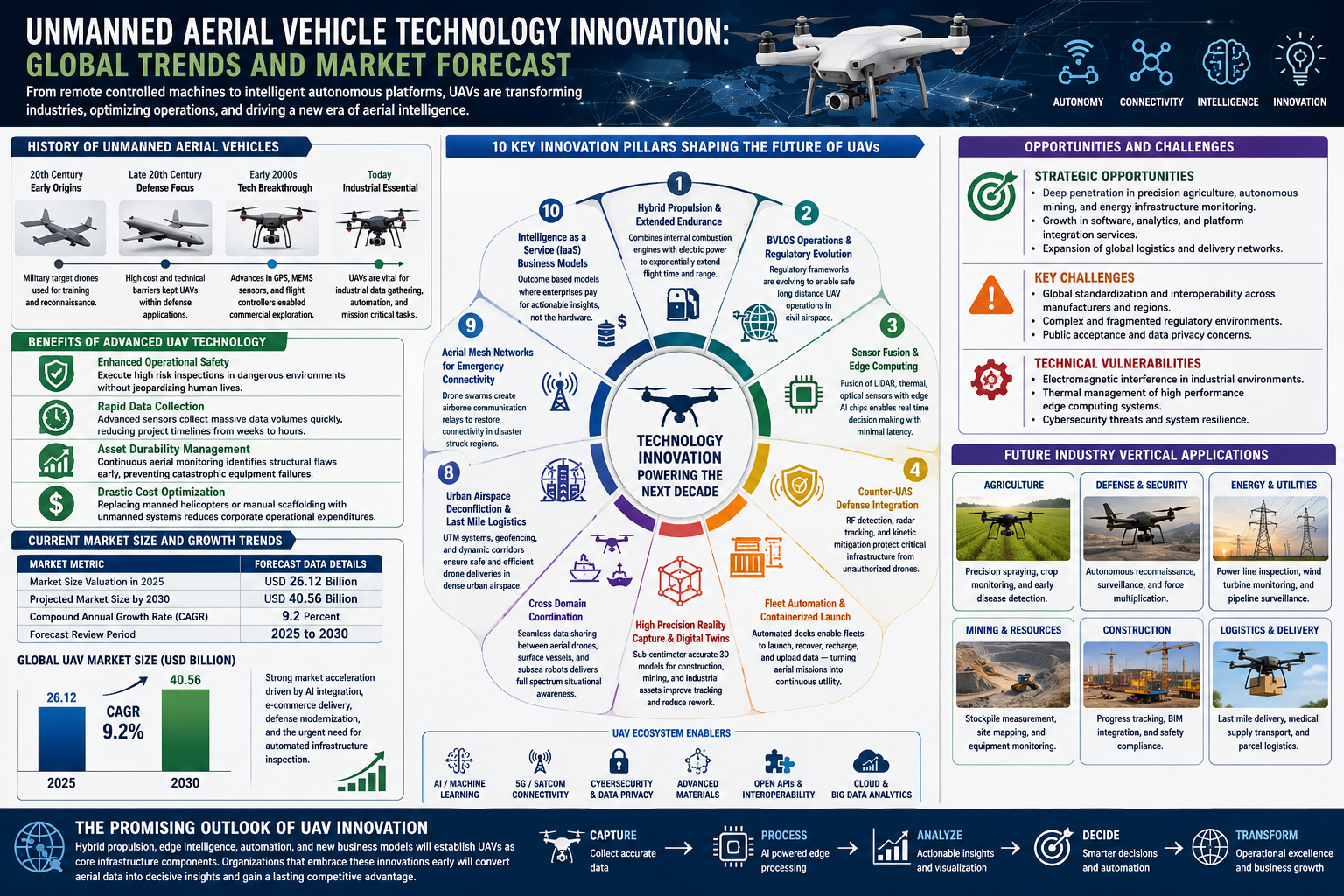
Unmanned Aerial Vehicles (UAVs), commonly known as drones, have evolved from simple remotely piloted aircraft into highly sophisticated autonomous aerial platforms capable of performing complex missions with minimal human intervention. Rapid advancements in artificial intelligence (AI), machine learning, sensor technologies, communications systems, and autonomous navigation are transforming UAV capabilities across defense, commercial, industrial, and public safety sectors.
Today, UAV technology innovation is enabling organizations to improve operational efficiency, reduce costs, enhance situational awareness, and access previously unreachable environments. From military reconnaissance and border surveillance to precision agriculture and infrastructure inspection, UAVs are becoming indispensable tools in modern operations.
History of Unmanned Aerial Vehicle Technology
The origins of UAV technology can be traced back to the early 20th century when remotely controlled aircraft were first developed for military training and target practice. During the Cold War era, UAVs were increasingly utilized for intelligence gathering and surveillance missions.
The technology witnessed significant advancement during the 1990s and early 2000s with the introduction of sophisticated military drones capable of long-endurance flights and real-time intelligence collection. Over the last decade, improvements in battery systems, GPS navigation, miniaturized sensors, and AI-powered flight control systems have accelerated the adoption of UAVs across commercial industries worldwide.
Today, UAVs range from small consumer drones weighing a few hundred grams to large unmanned combat aerial vehicles (UCAVs) capable of carrying advanced payloads and operating in contested environments.
Benefits of Unmanned Aerial Vehicle Technology
UAV technology offers numerous advantages across various industries:
-
Enhanced Operational Efficiency: UAVs can perform tasks faster and more efficiently than traditional manned systems in many applications.
-
Cost Reduction: Organizations can significantly reduce labor, fuel, and operational expenses by deploying UAV solutions.
-
Improved Safety: UAVs eliminate the need to place personnel in hazardous environments such as disaster zones, combat areas, and high-risk industrial sites.
-
Real-Time Data Collection: Advanced sensors and communication systems provide instant access to critical intelligence and operational information.
-
Greater Accessibility: UAVs can reach remote, difficult-to-access, or dangerous locations that may be challenging for conventional vehicles or personnel.
Current Market Size and Growth Trends of the UAV Industry
The global UAV industry has experienced substantial growth due to increasing investments in defense modernization, commercial drone adoption, and advancements in autonomous technologies.
According to MarketsandMarkets, the global Unmanned Aerial Vehicle Market size was valued at USD 26.12 billion in 2025 and is projected to reach USD 40.56 billion by 2030, growing at a CAGR of 9.2% from 2025 to 2030.
This impressive market expansion is being driven by several important factors:
-
Growing demand for military surveillance, intelligence, reconnaissance, and combat missions
-
Increasing use of UAVs in agriculture, mining, energy, and infrastructure inspection
-
Rapid integration of AI, computer vision, and autonomous navigation systems
-
Rising investments in drone delivery and logistics solutions
-
Expansion of urban air mobility (UAM) and advanced aerial transportation concepts
-
Adoption of swarm drone technologies for military and commercial applications
-
Development of beyond-visual-line-of-sight (BVLOS) operations and supporting regulatory frameworks
Key Drivers and Factors Influencing the Future of UAV Technology
Several powerful factors are accelerating UAV technology innovation globally:
1. Defense Modernization Programs
Governments worldwide are investing heavily in advanced UAV platforms to strengthen intelligence, surveillance, reconnaissance (ISR), electronic warfare, and precision strike capabilities.
2. Artificial Intelligence and Autonomy
AI-powered UAVs can process vast amounts of data, identify targets, avoid obstacles, and execute missions autonomously, significantly improving operational effectiveness.
3. Advanced Sensor Technologies
The integration of LiDAR, hyperspectral imaging, thermal cameras, synthetic aperture radar (SAR), and multispectral sensors is expanding UAV applications across numerous sectors.
4. Growth of Commercial Applications
Industries increasingly rely on UAVs for aerial mapping, asset monitoring, precision agriculture, environmental monitoring, and emergency response operations.
5. Improved Connectivity and Communications
The deployment of 5G networks, satellite communications, and edge computing technologies is enabling real-time UAV control and data transmission capabilities.
Emerging Trends in Unmanned Aerial Vehicle Technology
The UAV industry is witnessing several transformative trends that are shaping future growth:
1. Autonomous and AI-Driven UAV Operations
Modern UAVs are increasingly capable of autonomous navigation, mission planning, obstacle avoidance, and decision-making using AI algorithms.
2. Swarm Drone Technology
Multiple UAVs can operate collaboratively as coordinated swarms to conduct surveillance, reconnaissance, search-and-rescue, and military operations.
3. Hybrid and Long-Endurance Platforms
Manufacturers are developing hybrid-electric and solar-powered UAVs capable of extended flight durations and greater operational range.
4. UAV Traffic Management Systems
As drone deployment increases, advanced air traffic management systems are being developed to safely integrate UAVs into national airspace.
5. Edge Computing and Real-Time Analytics
Onboard processing capabilities allow UAVs to analyze data in real time, reducing latency and improving mission responsiveness.
Opportunities and Challenges in the UAV Market
The rapidly expanding UAV ecosystem presents significant opportunities and challenges.
Opportunities
1. Expanding Commercial Drone Services
Industries are increasingly adopting UAVs for inspection, surveying, monitoring, and logistics operations.
2. Defense Procurement Programs
Rising geopolitical tensions continue to drive demand for advanced military UAV platforms and counter-UAV systems.
3. Smart City Development
UAVs can support traffic monitoring, infrastructure management, public safety, and environmental assessment initiatives.
4. Drone Delivery Services
E-commerce companies and logistics providers are exploring UAV-based delivery networks to improve efficiency and reduce transportation costs.
Challenges
1. Regulatory Complexity
Governments continue to develop evolving regulations related to UAV operations, certification, and airspace integration.
2. Cybersecurity Risks
UAV systems remain vulnerable to cyberattacks, signal interference, and electronic warfare threats.
3. Battery Limitations
Energy storage constraints continue to affect flight endurance and payload capacity for many UAV platforms.
4. Airspace Management
Managing increasing UAV traffic while maintaining aviation safety remains a critical industry challenge.
Innovations and Advancements in UAV Technology
Continuous research and development efforts are driving remarkable advancements across the UAV ecosystem:
1. AI-Powered Mission Autonomy
Advanced algorithms enable UAVs to independently execute missions with minimal human oversight.
2. Next-Generation Propulsion Systems
Electric, hydrogen fuel cell, and hybrid propulsion technologies are extending flight endurance while reducing environmental impact.
3. Advanced Payload Integration
Modern UAVs can carry sophisticated surveillance, communications, electronic warfare, and scientific research payloads.
4. Counter-UAV Technologies
Governments and security organizations are developing systems capable of detecting, tracking, and neutralizing hostile drones.
5. Digital Twin and Simulation Technologies
Virtual testing environments are accelerating UAV development cycles and improving operational readiness.
Future Applications and Industries That Will Benefit from UAV Technology
The future of UAV innovation extends far beyond current applications.
1. Defense and National Security
UAVs will continue to support intelligence gathering, border surveillance, electronic warfare, and autonomous combat operations.
2. Agriculture
Precision farming applications will improve crop monitoring, pesticide application, irrigation management, and yield optimization.
3. Energy and Utilities
UAVs will facilitate infrastructure inspections for power grids, pipelines, offshore platforms, and renewable energy installations.
4. Logistics and Transportation
Drone delivery networks and urban air mobility platforms are expected to transform transportation ecosystems.
5. Disaster Management and Emergency Response
UAVs will provide rapid situational awareness during natural disasters, search-and-rescue operations, and humanitarian missions.
6. Environmental Monitoring
Researchers will increasingly use UAVs to monitor wildlife, forests, climate conditions, and environmental changes.
Conclusion: The Promising Future of Unmanned Aerial Vehicle Technology
Unmanned Aerial Vehicle technology innovation is redefining how governments, businesses, and industries approach surveillance, logistics, infrastructure management, public safety, and defense operations. The convergence of artificial intelligence, autonomous navigation, advanced sensing technologies, and next-generation communications systems is unlocking unprecedented capabilities for UAV platforms.
As the market grows from USD 26.12 billion in 2025 to USD 40.56 billion by 2030, UAVs are expected to become increasingly integrated into both military and commercial ecosystems. Organizations that invest in advanced UAV technologies today will be better positioned to capitalize on emerging opportunities in automation, data intelligence, and aerial mobility.
Despite challenges related to regulations, cybersecurity, and airspace integration, ongoing innovation and investment are expected to accelerate adoption and create new avenues for growth. The future of UAV technology remains highly promising, with drones poised to become a foundational component of the next generation of intelligent, connected, and autonomous systems.
Download Sample Research Report for Unmanned Aerial Vehicle Market Future @ https://www.marketsandmarkets.com/pdfdownloadNew.asp?id=662
80% of the Forbes Global 2000 B2B companies rely on MarketsandMarkets to identify growth opportunities in emerging technologies and use cases that will have a positive revenue impact.
- Food Packaging Market Size Set for Strong Growth Through 2030 Amid Rising Demand for Convenience Foods
- Crop Protection Chemical Market Size, Share & Growth Forecast (2025–2030)
- Mulch Films Market: Driving Sustainable Agriculture Through Innovation
- Agricultural Adjuvants Market Analysis, Trends, and Growth Outlook (2026–2031)
- Japan Enterprise Asset Management Market Growth: AI and Smart Infrastructure Drive Demand

